Why do people buy luxury cars? Honestly, they rarely purchase them because they really like the car or because it does something that much better than "lesser" models, lesser models that many of them, not all but many, are based on. Well, to over-state the obvious, luxury cars are are most often bought because, plain and simple...
they're status symbols. And,
this just in, people like to show off. Back in the 1970's, if you wanted to show off how well you were doing, or wanted to be perceived as doing, you didn't drive a Cadillac, jack. No, sir. You drove a
Lincoln Continental Mark. They were big, showy, unforgiving, made no sense and took no prisoners. They were the perfect type of car for people who were seriously into archery too. Today let's take a couple of minutes and look at all of Lincoln's fabulous Continental Mark's from Edsel Ford's European inspired beauty that,
although never referred to as a Mark, technically started the whole Mark thing not to mention creating the whole personal-luxury car niche. We'll also take a look at his son's Mark II, Lee Iacocca's division saving "III" and...
beyond. C'mon
, rosin up that bow and let's go for a ride.
The First Lincoln Continental: Edsel Ford's Dream
In 1922 Edsel Ford's father, Henry Ford, took control of a luxury car company named after President Abraham Lincoln originally founded by former GM executive Henry Leland. Mr. Ford put Edsel, not even thirty-years old at the time, in charge of it. Blessed with artistic intuition and instincts, Edsel began to turn the struggling brand around over seeing production of stylish and luxuriously equipped automobiles that appealed to a more well-heeled clientele than those that sought the far plebeian if somber styling of his father's namesake company. Enamored of the cars he saw on his various trips aboard, in 1938, Edsel commissioned Bob Gregorie, then head of Ford design, to design a car evocative of the ones he'd seen. One with a long hood, short trunk, no running boards and, yes, a spare tire mounted just aft of the trunk lid.

Built on an existing Lincoln Zephyr chassis, what was referred to as a "Lincoln Zephyr Continental" was so well received that Edsel Ford ordered the car into production starting in 1939. This 1940 model of Edsel's is on display in the Henry Ford Museum in Dearborn, Michigan. We're not generally fans of pre-war designs but this is a rare exception. And an exceptional one at that.
Although World War II truncated it's production, the Lincoln Continental returned in 1946 albeit considerably modified and, dare we say, less attractive and distinctive than pre-war models. Frankly, we find it hard to believe that Edsel would have approved this clumsy design; he passed away at age forty-nine in 1943. While never a strong seller, Hollywood celebrities and the like were enamored with the Lincoln Continental, especially the pre-war models, and it became a "halo" car for Lincoln. However, due to Ford's precarious post-war fiscal footing, the Continental model was discontinued after model year 1948.
Continental Mark II: William Clay's Ode to his Father
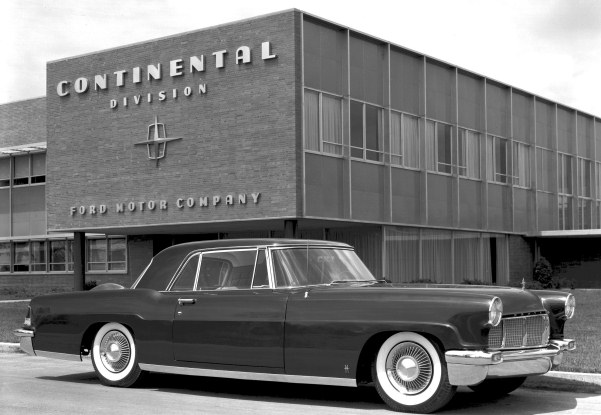
While there was no "Lincoln Continental" between 1949 and 1955, starting in 1956, Ford Motor Company created an entire Continental
division. Part of an attempt at the pricing ladder General Motors had offering an automobile for every wallet, Ford put the Continental Division at the top of a pecking order that also included, from most affordable to expensive - Ford, Mercury,
a planned Edsel division, Lincoln and, again, Continental.
The only models the Continental Division produced where these striking two-door sedans positioned and priced to compete not with Cadillac but with the world's finest and most expensive "motor-cars" like Rolls-Royce and Bentley. They were designated
"Mark II" with the mindset that Edsel Ford's Continental was the "Mark I", although, to review, they were never called that when in production. The Mark II's were extravagantly styled with "classic" touches evoking not only the "Great Gatsby" era of auto design but the Continental "Mark I"'s long hood, short deck proportions. They also included this "trunk hump" emulating the Mark I's outboard rear spare tire case. The spare tire actually sits behind the trunk lid making, wed'd have to believe, access to the trunk compartment rather challenging. Sidebar - i
sn't it fascinating that something so innately practical could come to denote class and design sophistication? While mechanically rudimentary, the II's were, in our opinion, very memorable designs. Again, these cars are "Continental's not
"Lincoln Continental's".
Not surprisingly given these were priced at more than ten-thousand dollars each, less than three-thousand Mark II's were sold in 1956 and 1957. Losing some one thousand dollars on every one sold, perhaps hastily, Ford dropped the Continental division after 1957. Interestingly, rather than moving the Mark II "down" to Lincoln, it was dropped altogether for 1958 with Ford moving the Continental nameplate to a range-topping Lincoln.
Similar to Chrysler's "letter-car" series where each year of the model's run the car's got a different letter, 1958-1960 Lincoln Continentals were denoted as Mark III, IV and subsequently V. Somewhat mercifully given these '58-'60 Continental's lacked (yeah, yeah, subjective) the graceful lines of the Mark II and are garish compared to even post-war "Mark I's", the "Mark" designation was dropped come 1961 when the Elwood Engel designed Continental debuted.
While these Continental's with their with their famed "suicide-doors" and available convertible top would become the best selling Lincoln model to date at the time, and are arguably as famous as the Continental Mark's to come, they were outsold by Cadillac some years by six to one. That was because, and this is coming from people who were around when these cars were still sort-of-kind-of-new, while certainly different, they lacked Cadillac's curbside firepower. We also thought, yeah, we know, subjective, that they were...
weird. Cool? Maybe...sort of...but they were still different in a not-so-cool kinda way. In any event, Ford's Lincoln division was bleeding cash and needed a hit and a hit fast in order to stay afloat. Literally and figuratively.
Lincoln Continental Mark III: Lee Iaccoca Makes his Mark
If any
one person can get credit for at least the idea of what would become the 1969 Lincoln Continental Mark III, which, technically should have been "Mark VI", it would be Lee Iaccoca. Riding high off being given almost sole credit for the success of the Ford Mustang, allegedly, it was Iaccoca who first suggested that Lincoln have a personal luxury car based off what would be the 1967 Ford Thunderbird. Mr. Iacocca is on the left behind this 1964 1/2 Mustang. The gentleman to his left is Ford product developer Don Frey. whom many give credit for actually developing the idea of small, sporty, four passenger car. "417" refers to the date the Mustang was launched, April 17, 1964.

Hard to imagine that back in the '60's Lincoln didn't have a coupe but they didn't from 1961 to 1965 and these Continental coupes that debuted in 1966 looked like what they were - two-door versions of the four-door Continental; there was no convertible coupe. What's more, these two-door Continentals, while blissfully eschewing the bizarre-ness of the four door models, lacked the distinctive styling that most "look-at-me" luxury car buyers want. Although sharing nothing externally, you really see a familial resemblance to the Ford Galaxie here;
that was not a good thing.

When initial design models of the what would become the Continental Mark III lacked the elan Iaccoca was looking for, it was he, again, allegedly, who suggested not only a waterfall grill reminiscent of the ones found on a Roll-Royce, but the distinctive "trunk-hump" that was found on the 1956-1957 Continental Mark II. Many within Ford bristled at the design but Henry Ford II, aka, "Hank The Deuce", loved it and ordered it put into production immediately. HFII, incidentally, was Edsel Ford's oldest son and at the time president of the Ford Motor Company.

Introduced in April 1968 as an early '69, while certainly not for everyone, somehow and someway, the disparate design elements of the Thunderbird based Mark III worked;
well, worked that is, if you like the design. Auto critics hated it
(the hell do they know anyway) but Lincoln finally had a Cadillac fighter that while certainly not as advanced engineering wise as Cadillac's front-wheel-drive Eldorado, it was deemed far more luxurious. More importantly, the Mark III appealed to buyers willing to spend extra for an automobile that
looked prestigious. While being nothing more than a Thunderbird with a fancy body and plusher interior, Ford reportedly made $2,000 on every one sold. The table was then set, good, bad and indifferent, for decades of future Mark's.
Lincoln Continental Mark IV: Bunkie Gets Fired

The more research we do about automobile development the more we're fascinated by the dysfunctional corporate culture prevalent at car companies. We have no reason to doubt that same ego-maniacal madness exists today but back in the late 1960's, the soap opera was far more front, center and out in front of the proverbial curtain. At Ford, the central characters of the Dearborn Soap Opera where "Hank The Deuce", Iacocca and former GM executive Bunkie Knudsen. The clash of Iacocca, a long time Ford executive and Knudsen, whom "The Deuce" brought on from GM as company president in 1968 purportedly to squash Iacocca, the stuff of automotive legend. Apparently, it was Knudsen whom insisted on retooling what was "The Deuce's" favorite car without consulting with him. That sort of thing a prime example of an executive either having too much autonomy or sheer arrogance. By the time Ford fired Knudsen just eighteen months into his tenure, it was too late to stop the production of what was to become (above) the 1972 Lincoln Continental Mark IV.

With smoother lines and larger fender openings, the Mark IV, which was even larger than the Mark III, sold significantly better than the III did. While Lincoln sold on average twenty-five thousand III's a year between 1969 and 1971, they sold more than fifty-thousand "IV's" in 1972 and seventy-thousand in 1973. Even during the height of the first gas crisis in 1973-1974 and through 1976, Lincoln averaged more than fifty-thousand sold each year. While certainly a drop in the bucket compared to top selling makes and models, the IV's, like the III's, were profitable and accounted for more than fifty-percent of Lincoln sales. Above is a 1973 "IV" with its distinctive 1973 only front "safety bumper".

Aside from the addition of the government mandated five-mile per hour safety bumpers Lincoln did little to update the styling of the IV during its five year production run. However, for 1976, the last year of the IV, Lincoln offered color coordinated designer editions with some of the world's most famous fashion designers lending their, we suppose, talent and more importantly their names to the cars.
Like watching reruns today of semi-iconic TV shows like "Fantasy Island", "Love Boat" and others, Lincoln Continental Mark's, in general, are all but impossible to explain to those who weren't around when they came out. Even more so these designer editions; you just had to be there. By the way, I'll take a "Pucci" and the wife will take a "Givenchy".
Lincoln Continental Mark V: Size Matters

Lincoln didn't tout any engineering virtues of its "new" for 1977 Mark V; Ford not having the financial where-with-all in the mid-seventies to justify an all new, and sorely needed, chassis for the Mark V. The styling revisions, which Lincoln believed significant enough to update the nomenclature, didn't break any new ground either. The most significant styling update of the V was a near aircraft carrier straight "character" line from the top of the front fenders that stretched to the back edge of the rear quarter panels, allegedly functional louvers on the front fenders behind the wheel openings and a return to upright rear tail lamps.

While the straight character line, in our opinion, made the overall design less distinctive than the III or IV and did nothing if not accentuate the sheer bulk of the V, the return to the same taillight design as the III was a welcome addition as it made the rear of the car less a "Thunderbird with a trunk hump". Can't say we dislike the louvers although it's obvious they were added to breakup the sheer flat expanse of the sheet metal. Must say, even with the oh-my-god-shoot-me-now fake convertible top, this Bill Blass '79 is a
fine looking automobile. Again, you had to be there.
Speaking of the Ford Thunderbird, V's were built on the same chassis that underpinned all Mark's up to that time but with Ford switching Thunderbird to their mid-size chassis for 1977, for the first time, a Lincoln Continental Mark and T-Bird weren't just, more or less, trim variations of the same car.
Lincoln also and perhaps wisely so, swiped at General Motors newly downsized full-size models with advertising vernacular for the V like,
"Boldly contemporary...yet reassuringly compatible with traditions evolving from the first Continental, the only American luxury car honored for design excellence at the New York Museum of Art." While there was little in common between the design of "Edsel's Continental" and a Mark V, Lincoln had knew exactly what buyers wanted what with Mark V sales going through the proverbial moon roof with more than two-hundred and twenty-five thousand V's sold in just three years. No doubt many of those sales came from disenfranchised GM buyers or buyers that knew that sooner or later Lincoln was going to be downsizing as well. How right
those buyers were.
Lincoln Continental Mark VI: Mini-Me
How the heck did Lincoln go from doing something so well to doing something so badly? Did they just get lucky with previous Mark's or did they just get unlucky with the VI? The truth, as with most things, probably lies somewhere in between. Granted, in 1980, Ford had a lot to contend when they rolled out their first truly "all-new" Continental Mark since Iacocca's division saving home run back in the spring of 1968. First, with the relative and almost inexplicable run-a-way sales success of the V, anything following it, especially one having to be in compliance with ever stricter federal emissions and fuel-economy guidelines, would have a tough act to follow. Secondly, and unbeknownst to Ford at the time of course, the country was about to dip (again) into a nasty recession, one with another hike in fuel pries that helped crater new car sales to a nineteen-year low. Charging twenty percent more for a VI than a V didn't do sales any favors either.

However, let's be real. Blame the recession, the second energy crisis and price gouging all you want; the reason Mark VI sales dropped an incredible seventy-three percent year over year was because it a stubby, awkward looking automobile. Year-to-year, Mark VI sales were never half of what V sales were through it's 1980-83 production run. Mark IV sales weren't affected nearly at all by the 1973-74 gas shortage and recession so...
it had to have been the actual car, no? In fact, for 1981 and 1982 Mark VI sales were worse than 1980. A slight uptick for 1983 brought the grand total of Mark VI's sold to a piddling 63,662; roughly fifteen thousand less Mark V's than Lincoln sold in 1979 alone.
Seeing the success of that Cadillac had with their down-sized 1979 Eldorado, not to mention their 1975 Seville, downsizing a luxury automobile successfully was possible. While Lincoln marketed the engineering marvel that the VI purportedly was, what was most important to their faithful buyers, its styling, simply,
and, yes, pun intended, missed its mark. Which is interesting since you have to imagine that many of the designers whom helped pen the, again, inexplicably successful Mark V, had a hand in the VI. Then again, that was probably part of the problem. For certain, with literally everything to lose, designers no-doubt had their hands tied by anxious Ford executives whom didn't want any chances taken. Design by committee rarely if ever works and the "mini me-Mark V" Mark VI was a prime example of too many cooks in th kitchen. Oh, and for cryin'-out-loud, who thought making a four-door Mark VI was a good idea?

Funny, in a vacuum and through the lens of a spectacle now forty-years older now, the VI is not the worst looking car ever made. Well, from certain angles. Yes, it shamefully apes the design cues of the V and other Marks, the Mark IV and V beholden of the Mark III, but it looks exactly like what it is - a shrunken V. That, in theory, not a bad thing but something got woefully lost in translation. Shrinking what they had was certainly not the recipe Cadillac used for their 1979 Eldorado yet it was every bit the Cadillac the elephantine model it replaced was. Lincoln flunked the down-sizing exam., big time. And at exactly the wrong time too.

Despite being approximately eleven inches shorter and nearly two inches less wide than a V, the VI was still a very big car and a big car with more genuinely usable interior and trunk space too. However, while size mattered to a certain degree with buyers of domestic luxury cars years ago, what they really sought, just like today, were status symbols and the VI looked a whole lot less like a status-symbol like than the V did. If you don't see that now, well, like we've said already, you just had to be there.

In fairness, what was Lincoln to do? It was all but impossible for them to comply with new regulations with a car that weighed five-thousand pounds, had the aerodynamics of a barn and was powered by an engine that used gas like a bon-fire. If today's technology was around in the late '70's would the Big Two and Half simply updated their engines rather than change everything? That's a good question but cars had gotten too big anyways and what with the inevitable onslaught, regardless of the gas shortages and price hikes, of the European and Japanese super cars to come in the '80's, something had to be done. However, in closing the chapter on the VI, we'd like to think that Lincoln could have done a better job than they did with it. If anything, their loyal customers deserved better.
Lincoln Continental Mark VII: A Party No One Wanted to Go To
Those responsible for the Continental Mark had an even bigger conundrum replacing the Mark VI than they had with replacing the V. What with the VI flaming out as it did, they now had the galvanizing and humbling experience of white-hot, ribald, merciless failure as a motivator. One that clearly was due to design rather than circumstance. Remarkably,
refreshingly even, Lincoln did what now appears the obvious thing to do when they downsized the Mark further still for 1984 with the Continental Mark VII.
On paper, seeing how even more god-awful the Fox-body 1980 Ford Thunderbird was than the Mark VI,
the VI, incidentally rode on Ford's new-for-1979 "Panther" chassis, the notion of Ford switching the Mark over to the same chassis the Thunderbird was on was a terrible idea. In the flesh, though, while obviously a Lincoln in 1983 aero Thunderbird\Mercury Cougar clothing, the Mark VII, was, to us, a delightful looking design that bespoke of a forward thinking Lincoln to come as the day-glo mid-1980's melted into the late eighties and beyond. Wouldn't you know it? It wasn't meant to be and the VII, despite a nine year run where, for all intents and purposes it went unchanged, never found the audience that Lincoln had wistfully hoped for. So, what went wrong?
Well, the VII certainly had its work cut out for it. Being a radical departure from every Mark that came before it was one thing but it had to contend with what had become a fast evolving luxury car market. One with ferocious foreign competition Lee Iaccocca, Bunkie Knudsen and Henry Ford II didn't have to deal with.
In the eighties, "Young-Urban-Professionals" wouldn't be caught dead in a Lincoln (or Cadillac) and even their older, "core-target" buyers, were fragmented - many didn't know what to make of the the Mark VII. Thus, sales of the Mark VII during, again, an unusually long production run, added up to approximately two-hundred fifty thousand sold. Remember, Lincoln pushed out that many Mark V's in just three years. VII sales, year-to-year, roughly, on average, in line with VI sales and a third of what V sales were each year. Well, at least the Mark VII was actually a pretty good car. A tasty dish at a party that no one wanted to attend anymore.
Lincoln Continental Mark VIII: A Far off Time and Place
By the early 1990's, personal luxury car sales had slowed due to shifting customer tastes and wants,
we surmise at least when sales first began to plummet, from product development at the apex of the popularity of a sacrificing requiring, niche market fad out of step with buyer expectations.
For more on this subject please review our section on the Mark VI. There was foreign competition as well and, what's more, young, style conscious buyers whom in the past may have aspired to a personal-luxury car,
if they stayed with a domestic make at all, had the additional choice then of
sport utility vehicles. They cost about the same as a personal luxury car and had an aire of "rugged sophistication" that was different, we won't say "better", but it was definitely different than what a luxurious coupe offered image conscious buyers.
Why compromise when you can have it all? It didn't help matters that Lincoln's public perception in the market could not have have been older and less hip either. Under this harsh, retrospective glare it's amazing to us Ford even bothered with the Lincoln Continental Mark VIII.
Save for unique styling that was perhaps the boldest of all personal luxury cars available at the time, the Ford MN12 based Mark VIII didn't exactly evolve the market segment to places it had never been before either Then again, where could it have gone? Bold styling? Offered elsewhere. Powerful engine? Sporty ride and handling? Also offered elsewhere - even at other Ford divisions. Speaking of which, it differed from the the 1989 vintage Ford Thunderbird and Mercury Cougar it shared the MN12 with only in that it was modified somewhat to accommodate Ford's very wide DOHC V-8 engine. Everything else that was different was pure gingerbread. What were buyers actually getting then when they ponied the extra coin for an VIII?

Lincoln once again peddling an automobile priced with steep stipend that really wasn't all that different from other models it was based on. In a market niche that wasn't just splintered but shattered by the early 1990's, there were few takers each model year for an expensive automobile that offered little cache above unique styling inside and out. Sure, there were buyers who could care less about the logo on the trunk lid and bought the VIII because they simply liked the design of it but those buyers were few and far between.
Who knows what Lincoln's expectations for the Mark VIII were. Again, knowing the market dynamics at the time and how poorly the VII sold, it's a head scratcher they made the effort at all. We're glad they did, mind you, but then again, we're the folks at a wedding who only dance when 1970's disco and
some 1980's music is playing. Cars like the Mark VIII, and while we're at it all personal luxury cars from say, 1980 on, we feel are half-hearted attempts to ape a different time and place. Which is ironic given that at the height of their success, personal luxury cars were nostalgia based as they emulated cars from the past. When Ford pulled the plug on the the Mark VIII after 1998, few cared or noticed. In spirit, allegedly, Lincoln replaced the Mark VIII with the LS, which was a four-door sedan. In reality though, seeing the way the market had shifted, the Mark VIII was replaced by the Lincoln Navigator.
Lincoln Continental Marks - Weren't They Great?
Today's cross-overs do it all, don't they? They perform better than sports cars of just twenty years ago, are as comfortable as a favorite easy chair, they're as practical as giant luggage and, well, some of them, actually look pretty good too. By and large, though, and, yeah-yeah, subjective, most if not all of them lack the mojo, the elan if you will that all of the Lincoln Continental Mark's had, yes, to some degree even the Mark VI. You look at these Marks of the 1970's now and you wonder what in the world where they thinking. Weren't they great?