Sunday, January 24, 2021

1970 Chevrolet Corvette - Well Worn

I never saw many third-generation Chevrolet Corvette's when I was a kid and when I did it was like seeing a rock star and all that entails. Much like many a rock star, charismatic people as well, if anything these cars were best at garnering attention rather than doing anything other than that particularly well. Ok. Some were actually pretty powerful but for the record, most that were sold were relatively tame powered base models like this well worn but still star struck worthy example from model year 1970. 

I believe their apparent scarcity on the part of New York's Long Island I grew up on was due to it being a working class area; a working class area that rubbed elbows with the type of wealth that dreams are made of. So, while traveling with my family in our bone-stripped '68 Ford Ranch Wagon and seeing a car like this was monumental, it was not out of the ordinary. 

If that makes any sense you're probably from the Island or similar communities around the country where us riff-raff and the riche literally sit across from one another. 

That's one of the many crazy things about Long Island - wherever you are you're never far from folks who are really wealthy. Extremely poor for that matter too. My family slotting in between the two universes albeit, frankly, way, way closer to the have not's. 

The weather sucks a good six to nine months out of the year on Long Island too so many of these, not so sure about this one, tucked away in garages and under wraps. They've never been "bad-weather cars".  

My parents knew their plot and position in the world and, I guess, as they got older wanted to "live a little". That's why in the late '70's they ditched the station wagon for a 1970 Buick Electra which was subsequently replaced with a 1972 Cadillac. They bought them very used and on the cheap too but oh, how the neighbors were impressed. Young me, of course, appalled at how pretentious the purchases were and worse yet how the neighbors seemingly bought it into it. Maybe they were just being nice. 

Purchasing a used Corvette as a frivolous toy in addition to the Buick and Cadillac? I can't even fathom how I would have felt about that had they done that; in fairness, if for no other reason than my father wasn't a "car-person". The old luxury cars were purchased for all the wrong reasons as they salved my mother's desire to appear better off than we actually were.  

That notion as off putting to me as it gets. Buy something because you like it and not for what it says about you. Trust me, do so and you run this risk of being sorely disappointed. 

This old rock star has seen better days but it's not like it couldn't be restored to its former glory. That would be expensive, though. I guesstimate you'd need thirty-grand to get this it into proper shape. That on top of the fifteen-grand that's the price of admission. 

I don't understand why someone would spend that kind of money on something like this but bless their hearts, some people do. As they say, it's better to buy something already restored than buy something and have it restored. Often times that's less expensive too. Forty-give grand or so would also buy a late model Corvette as well which does everything at a world-class level of performance that this 1970 struggled so mightily to do. 

Struggled at everything except looking like a rock star. 

Friday, January 22, 2021

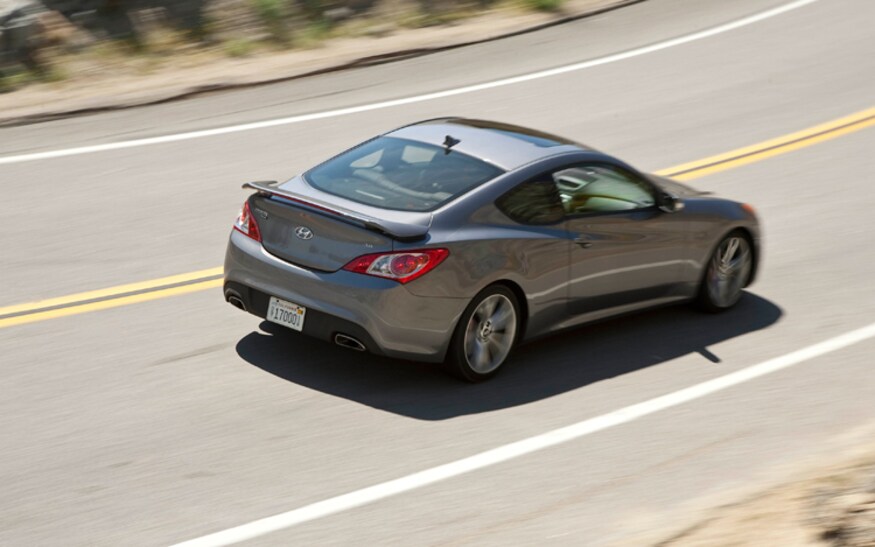
Hyundai Genesis Coupe - Imagine That

Sometimes first impression are everything. Back about 1992 or so a woman I worked with asked me if I could look at her car, a first-generation Excel like the junker above, who complained that the steering wheel wouldn't return to center when she made turns. Obviously something was amiss with her power steering hydraulic system and rather than volunteer to investigate further than a brief test drive I told her to get the car to a mechanic ASAP. The worst part was the car had very low mileage and aside from literal killer-steering otherwise appeared to be in great shape. Oh, except for an innate cheapness that permeated every square inch of the damn thing from stem to stern. I thought the styling atrocious as well. The car was a complete turd and  I vowed then that no Hyundai would ever set tire in my garage. 

No Hyundai ever has since although a Hyundai Genesis Coupe like this came close fairly recently when my older son was shopping for a car. He was smitten with his aunt's husband's Genesis Coupe and part of me thinks he went with the 2017 Chevrolet Camaro he ended up buying because we couldn't find a Genesis Coupe for him to even test drive. My sister in law's husband had long given his Genesis back after the lease expired on it so there was no chance at him test driving his. Besides, they live like twelve hours away. However, when my son was looking for a car that Genesis Coupe left a strong enough impression with him that he didn't forget about it. 

I can't say I blamed him for liking the lines of the Genesis Coupe either. Frankly, I like the styling on these cars better than even the 2010-2015 retro-chic Chevrolet Camaro and even more so than the current crop of Camaro's like my son has. His '17 Camaro, incidentally, is a delightful car to drive although I think it ugly and visibility is a joke. He loves it, thinks it's cool and that's all that matters. He's making the payments on it too so I ain't got no dog in that hunt. 

These cars were world-beaters too. A 2011 Car and Driver comparison test of a Genesis Coupe V-6 against a similarly powered Dodge Challenger, Ford Mustang and Chevrolet Camaro had the editors of C&D pegging the Hyundai first. Imagine that. 

Based on the underpinnings of the first Genesis sedan, albeit with a shortened wheelbase and no V-8 engine option, Hyundai checked most of the boxes that fans of sporty or "pony" cars ascribe too. That being rakishly handsome styling with at least a dollop of performance pretense whisked in. However, that's the recipe that us oldster pony\sporty car fans remember and we didn't know better. Our ponies of yore rode and handled like squeaky old trucks compared to even performance cars from a decade ago.  Today's performance cars, even performance cars from a decade ago, perform at levels that exotic cars from when we were kids performed at. Most likely better. 

The Hyundai Genesis Coupe didn't sell well which was a shame and these days they're oh-so-rare unlike dime a dozen Camaro's, Mustang's and Challenger's. Hyundai killed off the Genesis Coupe after the 2016 model year and while they hinted at a replacement model to be launched under the new "Genesis" line, one with a turbocharged 3.3-liter turbo V-6, it never came to be. 

Wednesday, January 20, 2021

1963 Mercedes-Benz 190SL - Super Bowl (The) Weeknd

If you caught any playoff football recently you had to have seen at least a passing glimpse of the above Pepsi commercial pre-promoting the halftime show of the Super Bowl on February 7th. The literal game-changing show will feature Canadian pop-star "The Weeknd", real name Abel Makkonen Tesfaye, and in the ad we see him driving up to a stadium, it's not Raymond James Stadium in Tampa where the game will be played, in a "wow, what is that?!" vintage convertible.

Clearly the car in the ad is mere window dressing and not a focal point of the ad, as it it shouldn't be, but since you're here you're no doubt intrigued as to what it is. The long and short of it is it's a 1963 Mercedes-Benz 190SL. 

You could be forgiven for thinking it was the 190SL's far more famous big-brother, the famed and vaunted 300SL. While we last saw Mr. Weeknd pitching M-B's all-new EQC 400 4MATIC all-electric crossover in M-B ads a little more than a year ago, have to wonder why the producers of this commercial chose to have him in this old 190 and not a newer M-B. If they chose to use a Mercedes-Benz in the first place. Maybe this is his car? Then again, if they chose to use the EQC there would have been some some co-op dollars involved and that gets messy. In the end, this ad is a Pepsi commercial plain and simple. 

The most famous of the Mercedes-Benz SL's are these "gullwing" 300SL models that M-B produced between 1954 and 1957; they made a convertible or "roadster" version from 1957 through 1963. The 190SL was offered as a less expensive alternative to the pricey 300SL and shared the 300SL's basic styling, engineering and little else. The biggest structural difference between the two is that on the 190, Mercedes-Benz eschewed the 300SL's expensive tubular "spaceframe" using a modified version of the then current M-B "W121" chassis or platform. 

That amalgamation of then existing M-B designs and chassis' explains why the car "The Weeknd" is driving in the commercial looks like all other M-B's of the time period - while simultaneously appearing to be quite different. 

Another differentiation between the two SL's is their engines. The "190" in 190SL refers to the car's 1.9-liter, inline four-cylinder engine like the one in the 1961 190SL above left. The "300" in 300SL denotes a 3.0-liter, inline six-cylinder engine like the engine above right from a 1954 SL300. 

"SL" on both models denotes either "Sport-Leicht" or "Super-Leicht"; sport-light or super-light. I think it was meant to mean "Sport-Light" as it would be odd that Mercedes-Benz would emphasize the curb weight of these cars since, at least relative to the weight of American cars at the time, especially with regards to the 300SL, they were certainly no leicht-weights. The 300SL coming in at approximately thirty-three hundred pounds, the 190 a rather svelte twenty-five hundred. Meanwhile a typical 1955 Chevrolet sedan weighed just thirty-one hundred pounds; a V-8 powered '55 Corvette just twenty-eight hundred pounds. 

Super-leight indeed. 


Sunday, January 17, 2021

Little Red 1977 Corvette Rear End Rebuild - Either Way, You're Right


Most of the pictures in today's blog are from a couple of delightful traipses to downtown Cleveland my wife made in our freshly transformed car. 


After more than six months stuck in our garage on as many as six jack stands as I rebuilt everything from the transmission back, our "Little Red 1977 Corvette" is finally road-worthy and is better than it has ever been in the going on nine-years my wife and I have owned it. 


To review, although I've been researching rebuilding the rear-end on the '77 for almost as long as we've had the car, whether it was needing something to do during "The Pandemic" or what not, back in June I finally got to it. This on top of a bathroom remodel the wife has been after me to get to. I started this project first because, knowing myself, had I started the bathroom first, I'd never get to this; after all, a man has to have his priorities regardless of how much he loves and respects his wife. Much like DIY home renovations, however, turned out there was way more to do on the rear-end project on the '77 than I originally thought there was to do. 


If you have a third-generation Corvette and you are seriously considering rebuilding the rear end yourself, probably why you're here in the first place, start with Gary Vosberg's series of videos like I did. There are other videos on the subject but none of them go into the detail that his do. However, candidly, Gary glosses over some important steps and, like many Youtube "how-to" videos, everything goes swimmingly well for him. Trust me. That's rarely if ever the case in the real "do-it-yourself" world and especially so with rebuilding the rear ends on third-generation Corvette's. 

Please note, 1980-1982 third generation Corvette's have somewhat different rear suspension set-ups than 1968-1979 do. Gary Vosberg's videos deal with the 1968-1979 models. 


Disassembly was physically grueling but hardly brain surgery. I didn't have a lift like Gary does and spending as much time on the floor of my garage got old quickly. The toughest parts of the job was drilling out the rivets on the brake rotors, the suspiciously prestine '76 that Gary works on had that done already, removing the strut rods from the shock mounts and cutting the bolts the trailing arms pivot on. 


On Gary's '76, again, everything comes apart like pulled pork falls off the bone fresh from the oven. On the trailing arm bolts, Gary even makes light of how easily they came out. Removing the strut rods from the shock mounts and then the shock mounts themselves from the trailing arms was another torturous treat. Gary zips right through all of that but, bless his heart, he does note that you might have some difficulty do so. Thanks, Gary. 


Of all of these steps, it was the cutting of the trailing arm bolts that beat me up the most. I wish I had recorded that step but I'm superstitious about making DIY videos; you're just asking for trouble.  I used three carbide sawzall blades and just about all of my patience doing so and to make matters even more fun, the instant the driver's side arm was free of the pivot bolts the arm fell right on my lap. Good thing my wife and I are done, with two grown men, having kids. 


Gathering parts was time consuming but some serious fun but final reassembly was almost as brutal as taking it all apart was. What's more, I had to have my differential rebuilt and getting that son-of-a-gun back in without a transmission jack was harrowing. Of course, I had to do it twice because of my mammoth screw-up. Worst is, my "new" differential is leaking on the passenger side and I'm anticipating having to pull it out again to have the shop redo it. At least I'll know what I'm getting myself into. 


Long story short, in the end, the transformation of our car from spindly death-trap to almost showroom condition, suspension-wise anyway, is nothing short of remarkable. This thing actually handles now and takes corners better than John Travolta. The only left to do is get new tires but even with it's embarrassingly old "rollers", our '77 rides and handles like it probably hasn't in more than twenty-years.


I'll wrap this series of soliloquies on the '77's rear end project by reminding everyone that I'm not a mechanic but keep in mind something Henry Ford once said, or folks claimed that he said, "whether you think you can or not, either way you're right." 


Wednesday, January 13, 2021

1964 Chevelle - An Expensive Parts Car


1964 and 1965 Chevelle's don't row my boat but I thought this find here worth my while because, if anything, thanks to the milky sunshine we get up here this time of the year, the pictures are just so casually and nonchalantly awesome. It's for sale down in Akron with an asking price a jaw-dropping $12,000. I hope that includes this super-cool trailer as the car is listed as a "roller" and not running. She doesn't have a title either hence the "parts-car" moniker.  

These cars along with similar offerings from Buick, Pontiac and Oldsmobile, Cadillac never got one, were part of General Motors all-new for 1964 intermediates. At Chevrolet it fit the literal and figurative gap in size between the Impala and the Chevy II. GM hit a home run with these cars as their full-size or "standard-size" cars had gotten too big and the Chevy II was really too small. For growing families at least. 

These cars were, interestingly, sized about the same as Chevrolet's seminal 1955 models. They handled similarly as well too. That's not surprising given it has almost same suspension system the '55 had; the upper control arms and shock mounts on the frame rails visible next to what's either Chevrolet's 194 cubic-inch "Hi-Thrift", one-hundred twenty horsepower inline six or the "Turbo-Thrift", 230 cubic-inch, one-hundred fifty-five horsepower mill. "Thrift" is a marketing speak for "slow". 

Although, the VIN number junkie I am, I've deduced that the "56" would indicate this car to be a "Malibu, 8-cylinder". Something's up. Either the tag there is wrong, which is not likely, or someone swapped in a six-cylinder engine somewhere over the last fifty-six years. Geez, it could even be a Chevrolet "250"; which would probably provide as much seat of the pants poke as the optional one-hundred ninety-five horsepower, "283" V-8 it most likely was born with. If you think someone swapping out a V-8 for a six sounds loopy then you didn't live through the gas crunches of the 1970's. 


If I'm correct and this car had  a motor-swap, the lighter in-line six no doubt helping out handling too. I can't tell from the engine photo if this has power steering or not but I'd guess it doesn't; even if it had a V-8 originally. Good thing it has this over-sized steering wheel to help the poor driver out. For certain there's no power brakes; this car would be a handful to drive. Especially with a heavier V-8.  

Twelve-grand is a lot of money for a car that's being sold as a parts car. At least the panels appear straight and there appears to be no rust on the body. That's incredible for a car up here in road-briney northeast Ohio. If you're interested comment below and I'll hook you up with the seller. Something tells me this will be here for a while. 

2009 BMW 650 i - Indulge Yourself. You Deserve It.

Dallas, Texas is one of those towns, much like Los Angeles, where you "are-what-you-drive". That's why a casual friend of mine down there blew his first commercial real estate commission check on one of these BMW 650i convertibles. Despite his big pay day being a deep five-figures he still had a monthly payment that could choke a horse. This 2009 BMW 650i convertible is for sale up here in bucolic Cleveland, Ohio for "just" $15,995. 

Oh, how the mighty have fallen, right? While it was fast, it drove harshly for a luxury car - there was no adjustment on the suspension like even my son's 2017 Camaro has. I remember thinking it ugly and a huge waste of money too. Of course, I didn't  tell him that. Even if we were the best of friends I don't think it my place to tell anyone they've wasted their money. Is it our job to reassure someone who's done something we find inexplicably foolish? Yes. It is. And to evilly egg them on to continue their errant ways. I kid but on some level I was jealous of him for feeling so free and empowered to be so foolish. Then again, he was going through a nasty divorce and I don't think he wanted the soon-to-be ex wife to have any of his new loot. 

These big, weird ass BMW coupes are part of the Chris Bangle designs that blighted BMW showrooms in the 2000's. Bangle was an American car designer hired by BMW in 1999 and opinions of his work at BMW are, to be kind, mixed. I don't need to be kind so I can tell you that I think every one of his efforts was horrible. Including these grand-touring, 6 series coupes. 

The BMW 6 series goes back to 1976. The replacement for the to-die-for E9 series, it was BMW's first grand-touring, two-door coupe and was based on their 5-series, four-door sedan. It was replaced by the 8-series in 1990, the 8-series replaced by these "Chris Bangle" 6 series coupes in 2003. BMW made these atrocities through model year 2010 and replaced them with a convoluted 6-series lineup that also included four-door sedans; best is they called the four-door sedans "coupes" too. They might as well have thrown in a woodie-crossover. 

That 650i my friend had, as this one is too, was packed, I mean packed with all sorts of gadgets and gizmos many of which have trickled down to the most plebeian of vehicles today. Parking sensors, USB aux hook up, blue-tooth, heads up display. Some of the stuff like the voice activated navigation system seems as  woefully out of date today as a "state-of-the-art" four-head VCR with a "jog-wheel". Seriously. Also, his being a 2009 model, again, like this, for $90,000+ (when new) it doesn't even have a backup camera. 

Even on today's cars, my son's Camaro in particular, I'm leery of all the "tech-stuff" on them. My son already had his "info-tainment" system replaced under warranty; what happens as these things get older and need replacing? How much is that going to cost? I hate to be that "old fart" who thinks everything is going to break, but, sorry, all this stuff is going to break and probably sooner than later. 

Another problem is this is, after all, like the mid 2000's Mercedes-Benz CS series I love, a German built car. I adore the engineering but they're as reliable as a kite in a windstorm. They're frighteningly expensive to repair because their parts are priced out this world. It's not that they're that hard to work on - it's the cost of their parts that will put you in the poor house.  

Ugly, dated and expensive to fix? Where do I sign? About the only thing going for this car is that it hasn't aged that badly, still looks contemporary and the neighbors who don't know any better and are impressed with such things will be. At least the interior is handsome. Spruce up that driver's seat and live a little. Go on. Indulge yourself. You deserve it. 

By the way, my friend in Dallas who blew all that money on that 650i had it for less than a year. Turned out the commercial real estate business is a fickle one and on the on-ramp to the great recession, having a still substantial payment on a car pushing $100,000 was not where his accountant deemed he should be. That big check he got was about the only one he got that year too. He ditched it and took a serious beating. 


Sunday, January 10, 2021

1982 Chevrolet Corvette - Rock Star


To those of us of a certain vintage, remember how we moaned, groaned and cried afoul as each passing model-year GM brought us the same old Chevrolet Corvette? For better and for worse, GM did make a litany of significant and at times whimsical changes to the C3 over its protracted production run and the 1982 Chevrolet Corvette, like our fetching "Collector's Edition" here, encompasses all of them. 

Cosmetically, the first big changes to the C3 were the bumper covers that cropped up on 1973 Corvette front ends and then in back for 1974. This was due to a federal mandate that all new cars sold in the United States by 1974 be able to withstand a five-mile per hour impact without their drivability adversely affected. 

The second big change coming in 1978 when GM made Corvette a "fastback" of sorts; a design element that allegedly was seriously considered going back to the C3's original drawing board. 

For 1980, designers integrated a spoiler onto the rear bumper cover and revised the front-end design with a new air-dam. Underneath, GM partially redesigned the C3's independent rear suspension system the eliminated a significant amount of the wheel-hop and disjointed-ness that plagued earlier models. 

For 1982, that glass that made up the fastback look actually opened. Imagine that. 

Under the hood, 1982 Corvette's "Cross-Fire Injection" V-8 engine was in lock-step with a myriad of power train changes made to the C3 over the years. The first Corvette with fuel injection since the  "fuelies" of 1963 and 1964, all Corvette's since 1982 have been exclusively fuel-injected; this "Cross-Fire" engine carried over to early C4's as well. As far as the "blasphemy" of the 1982 Corvette being "automatic-only", keep in mind the C1 was exclusively automatic from 1953 through 1954 and the much ballyhooed and maligned C8 is "automatic-only" as well; albeit a trick dual-clutch automatic that can shift much faster than any human can shift a manual. 

Again, to those of us of a certain vintage, we eventually got our wish with a truly "all-new" Corvette in the spring of 1983 when GM released the 1984 early. Careful what you wish for. While it could do things the C3 could never do and foretold of future Corvette's that were "dead-serious" sports cars, it's styling was less than fulfilling. Third-generation Corvette's certainly had their faults, trust me, I have a '77 and live the dream, but as far as being the equivalent of driving a rock-star, ok, a rock-star that never sang that well and has no other ability that just being charismatic, no Corvette since the 1982 has ever come close. 

Monday, January 4, 2021

1973 Chevrolet Camaro - Funny How Things Age

I came across this delightful 1973 Chevrolet Camaro Type LT recently and I've forgotten just how damn good-looking these "early" second generation Camaro's were. Reason for that is that the 1970-1973 Camaro's weren't encumbered with those infernal five-mile per hour "safety-bumpers" that blighted any new automobile sold in America come model year 1974. 

Legislation passed in 1971 required all new cars sold in the United States by 1974 be able to withstand a five-mile per hour impact without incurring so much damage that their drive-ability would be adversely affected. Five-miles per hour may sound pretty fast and, indeed, it is. The mandate was rolled back to the "global-standard" of two and half miles per hour by 1982. Prior to 1973, what with the styling excesses from the 1960's spilling over into the 1970's, cars couldn't withstand much more than a slight tap on what was allegedly a bumper without having to be hauled to a body-shop. 

Three-years is certainly not a lot of time and the short time span certainly explains the oft clumsily laid on "safeties" on existing designs; especially on smaller cars. Phasing in began in 1973 although our Type LT here may not appear to have done its homework. Rest assured, behind that chrome bumper is steel-bar reinforcement that enabled these cars to limbo under the federal mandate. That all changed of course come 1974. 

Although GM did an admirable job covering up or integrating the safeties into existing designs . I can't think of  a single design that benefited aesthetically from them. Then again, they weren't about making cars better looking, it was about making them safer. 

I am of the opinion that the safeties were quite effective in providing additional-safety or damage protection. My dreadful and forgettable 1974 Mercury Comet had them and one-time I was rear ended at a stop light and I couldn't believe that my car didn't have a scratch on it. As much as I wanted the turd to be totaled. 

Got to admit, though, at the time, the new big bumper cars did look cutting edge and space-age like and made cars with chrome bumpers look fuddy-duddy, old and antique-like. If you don't get that, well, I guess you had to be there. Funny how things age, y'know?