Saturday, August 13, 2016

2009 Dodge Ram - There's Somethin Bout A Truck

 And there's somethin bout you and me and the birds and the bees
And lord have mercy, it's a beautiful thing
Ain't nothin bout it luck, there's somethin bout a truck
 
                                                          -Kip Moore, Somethin' Bout A Truck 

 
Growing up twenty five minutes or so east of Times Square in the 1970's and '80s, no one I knew who wasn't a tradesman of some sort drove a "truck" like this 2009 Dodge Ram. Those few that did endured a fair amount of ridicule something to the affect of, "what are you, sum kinda hillbilly"? Might be old age settling in enabling me to be even more open minded or its my now more than ten years living in the Midwest, but I have fallen long and hard for simple work trucks like this. While I still have a hard time fathoming why anyone would drive a pickup as a daily driver who didn't need it's abundant utility, I love the balanced proportion of the design of these regular cab, short bed pickups.
 
 
Extended cab trucks with longer beds might offer more utility than our subject here can muster but then again, their proportion and balance of design goes out the tailgate. If I was to spring for a truck it would be something like this. Why buy a jack hammer when all I need is a hammer?
 
 
Of the Big Three's pickups,  I find the Chevrolet Silverado to be the most handsome although the Ford F series has been outselling it for years. Dodge is a distant third despite this fetchng "big rig" front end that they've been producing in some form or another since 1994. Prior to this design, Dodge truck design was clearly influenced by whatever Chevrolet or Ford was doing. Toyota and Nissan have been offering very good full size pickups for years now too and as fine appliances as they are, they don't sell nearly as well as the trucks from the Big Three.
 
 
A ram charging hood ornament first appeared on a Dodge car in 1933, the first Dodge Ram pickup debuted in 1981. Prior to that, Dodge pickups had been designated "B" series from 1948 to 1953, "C" series from 1954 to 1960 and "D" series from 1961 to 1980. The lack of engine badging on our subject here tells me this thing may very well be a 3.7 liter, SOHC V-6 powered two wheel driver. A slow poke engine and two wheel drive? Yikes. Not exactly the type of thing you want to be driving come winter here in north east Ohio.
 
 
The rust spots, the finish coming off the wheels, the littered interior (which I did not photograph) and this very expensive to replace headlight lens tells me everything I need to know about this truck; it's a no frills work-a-day hauler that's ridden hard and put a way wet. Still, I want it. Crummy V-6 and all.
 
 
As much as I like these trucks, I can't imagine ever owning one and being able to "pull it off"; my younger son said that I'm not cool enough to drive a truck. Thanks, son. Nothing quite as humiliating as driving something that some people would scoff at you for driving but I really would enjoy it's utility as much as I'd enjoy it's near perfect balance and proportion. Would be weird from a guy from Long Island to suddenly drive a truck but whatever. Insert cheesy trumpet "wah-wah" when I say that there really is, "Somethin' 'Bout A Truck".


Wednesday, August 3, 2016

1977 Pontiac Can Am - The All American


The 1977 Pontiac Can Am, not be confused with the Grand Am or, Trans Am was a one year only model that was introduced mid year and was built off a platform that was slated for replacement the very next model year. What was the point you're asking? I've been asking that for almost forty years. Still, I'm glad they did this car; I've always thought them out of this world gorgeous. Let's take a closer look. 


The 1977 Pontiac Can Am was an option package on the LeMans Sport Coupe. Powered by one of two engines that were available in Trans Am's that year, either a Pontiac 400 or Oldsmobile 403 (California only), complete with shaker hood no less, Can Am's also featured more bits and pieces from the more upscale Grand Prix' interior than your typical LeMans was available with. There was also a killer stripe package and a duck tail spoiler that brought the whole look together. Personally, I could live without the shaker, I find them silly and distracting but oh! That duck tail rear spoiler.

If you're wondering, the way you can tell which engine a Can Am had, aside from opening up the hood, is by what decal is on the shaker. Same goes for 1977-1979 Trans Am's. "6.6 LITRE", like our subject has, denotes the Oldsmobile 403 while "T/A 6.6" means the car has the Pontiac 400.


So, why did Pontiac build a limited run of very unique automobiles at the end of a vehicle platform's production run? Who knows. Perhaps it was to appease Jim Wanger. Who? Read on. Can Am's began their very short lives in 1975 as a bicentennial themed automobile called, "All American". Pontiac executives rejected the idea seeing that the market was flooded with bicentennial themed cars and the similar looking Grand Am of 1973-1975  was not exactly a high volume automobile either. So, the prototype for the All American sat behind Pontiac engineering headquarters for upwards of a year until Jim Wanger, Pontiac's legendary, former P. R. whiz, working as a consultant for Pontiac by then, saw the car and came up with an idea for a GTO like automobile that could inject some much needed pizzaz into Pontiac's lineup. Take note of that handsome spoiler.


Wanger called his concept "The Judge", after his 1969 GTO but it was a tough putt. Muscle cars were verboten in the late '70's and Pontiac executives rejected it. Keeping the 1969 Judge's black and orange striping, they did approve this car that was named after the Can American sports car racing series that was run between 1966 and 1987. Is this car a sports car? No. Was the Pontiac Trans Am ever a "Trans Am" car". Umm, no...the Chevrolet Camaro Z/28 was, though. Gosh how I love General Motors.


Seeing that all of the conversion work would be done at Wanger's own shop, "Motorworks", we can hypothesize that GM probably acquienced and green lighted a maximum of 5,000 Can Am's. What did they have to lose? At Wanger's shop,  the LeMans' received it's Can Am stripes, shaker, special hood and it's infamous spoiler. Legend has that after only 1,377 Can Am's were built, the tooling broke that made the spoiler. With the cost to repair it at the time prohibitive and the model year running out, time also ran out on the Can Am. Shame too. Really nice car. 

Monday, July 25, 2016

Vehicle Diagnostics, Parenting and Management


Several weeks ago my car, a 2002 Chevrolet Monte Carlo SS, began to shudder and then seemingly surge forward for a split second around 25 to 30 miles per hour. To make matters worse, it happened intermittently. Then, it started happening at least once each way on my 60 mile daily commute at around 70 miles per hour. And those surges at 70 miles per hour were accompanied by a jolt that felt like something had hit me from the behind.

Aside from that the car ran fine. Gas mileage was its usual and very good 24-26 mpg and when the car wasn't surging, shifts were as velvety as ever. All the research I did on the symptoms, though, pointed to a failing transmission pressure control module; a $30 part. However, that $30 part is buried deep inside the transmission and would require the complete removal of the transmission to replace it. That's a big bucks repair job. I mean, "we need to think about getting rid of the car" big bucks repair job. And no, I'm not going to attempt to do something like that myself.


To my surprise and delight, after taking my car to a service center with a diagnostic scanner, turns out the problem wasn't the transmission but a failing mass air flow sensor. A mass air flow sensor, or "MAF", measures the flow rate of air into modern, fuel injected engines. The information that a "MAF" accumulates enables the engine control until to balance and deliver the correct fuel mass to an engine. The shuddering and surging my car exhibited was a symptom of a bad "MAF" that to me, at least, was manifesting itself as a problem with my car's transmission.

I declined the service center's quote of more than $350 to replace the MAF and bought one at Autozone for $127. Two screws and a plug in later, voila, no more surging. Incidentally, the service center charged me $150 for the diagnosis. Steep, yes, but nothing compared to the thousands transmission work would have cost. 

Now, left to my own devices, I would have had the transmission out of the car and replaced the pressure solenoid only to find out that the car still had the same surging issues. Knowing what the problem was saved me time and most importantly, in the end, money. Lots of money.


Sure would be great if we could hook our kids and people who report to us up to diagnostic scanners. All too often we spend an inordinate amount of time reacting to what ultimately are symptoms of a problem as opposed to getting to the root cause of an issue. While it's easier, in theory, to get to that root of problems with our children than it is with our employees, still, knowing what is really going on with them puts us in a far better position to effectively parent and manage.


Behavior being a symptom, as managers we can't approach our employees with the same candor we do our children. If we did, we'd have a multitude of H.R. issues on our hands. Still, if we knew what was really going on, it would help us at least understand what someone is experiencing. Best we can do as managers is manage behavior whereas with children, it's best to get to the root cause of the behavior. The ability to get to the cause of a problem is the single biggest difference between management and parenting.

As handy as having "On Board Diagnostics" are, not having them, as is the case with my 1977 Corvette, is akin to going back to the stone ages in attempting to diagnose problems. For more on that, please click here. Going back to the stone ages with regards to automobile diagnostics or attempting to figure out what is going on with people.

Saturday, July 16, 2016

The Great Deck Project - Make Plans, God Laughs


For the first couple of years we lived in our house on Greater Cleveland's "west side", this circular patio looked just fine. However, after the "Polar Vortex" winters of 2014 and 2015, many of these bricks were pushed out of position by something underneath. I first thought  it was "frost heaving" and I figured the fix would be nothing more than my dismantling the patio, redoing the sand/gravel foundation and reinstalling the bricks. A loathsome, tiring process that I've over simplified but one that, with the help of two able bodied teenage sons, I could do myself and most importantly, do  very cost effectively. 

  
However, when I dismantled the patio I found that it was not "frost heaving" but a dense network of roots from that white birch that pushed the bricks up and out of position. Perhaps it was the freezing and thawing extremes that pushed the roots up but this whole mess had me wondering why there's a tree so close to a deck and patio; there's even another tree to the right of the circle. Incidentally, we're the third owners of this now twenty year old home. If you're not a home's original owner you inherit time bombs that previous owners had set years prior. And if you stay in a home you had built, you can lay times bombs that can go off on yourself years later too.


My first plan to fix the mess also included my grinding out the roots. However, landscapers and tree experts I (wisely) consulted with said that getting rid of the roots would kill the birch. One bricklayer suggested a foundation base over the roots and then we re-brick but in addition to the roots eventually destroying that too, I couldn't envision what it would look like. And if I can't "see something", it's probably not going to happen. The foundation over the roots would also be cost prohibitive. 


I came to the conclusion that the only thing we could do was to "deck over" the area where the circular patio was. Great idea, right? Well, couple of problems. First off, my wife was opposed to the idea; she wanted me to somehow, someway keep some semblance of a stone patio. Second, despite her dissent, I couldn't find anyone that would even give me a quote on such a small project of either building a deck or doing an abridged stone patio. Lastly, but not leastly, when considering doing the job myself, while I've done some fairly significant home improvement projects in the past that most people would think twice about doing, I'd never built a deck before.
Not knowing what I was doing has never stopped me in the past so why should a small deck be any trouble? Adhering to my mantra that you can't let not knowing what you're doing stop you from getting something done, I ventured forth on "The Great Deck Project". Ventured forth with no plan as to what I was going to do not to mention having no idea how to do whatever it was I was about to attempt to do. My trump card was that if I got into a foggy "zone of creativity", I was confident that I would come up with at least something memorable. Of course I did as much research as I could on decks and deck construction but that can only amount to so much.

As far as any formal plans go, I did have to have some sort of a rough outline but anything I planned on became useless because there are tree roots everywhere here. And not just roots from the birch but from that smaller tree to the left. Besides, you know what they say about what God does when you make plans.  Having improvised my entire life, this situation actually suited me just fine.
Throughout the process, though, my wife hovered over me constantly rejecting every design whim I came up with. My "whims" based in genuine concern that with, in essence, "the little deck" being little more than a big step over the old patio, anything built that didn't have any swag to it would result in a drab and uninspired slab of wood sticking out from the main deck. The wife was particularly vehement in her disapproval of this rounded part of the new deck that emulated the old stone circle.
 
This rounded part, which, incidentally, matches the circumference of the old patio, took most of a weekend to construct. For this, I enlisted the help of my (begrudging) wife and older son who are both far more mathematically and geometrically inclined than I am. I'm an artist, damn it, not a mathematitian.
After my son helped me figure out the radius and circumference of the semi circle he became inspired to further use his math skills and help me finish this thing. He loved that there was a practical application to his math knowledge and what's more, he gained the satisfaction of constructing something with your bare hands that only someone who's done so can appreciate. 

While he was less than happy with the shear physicality of the work, honestly, this is back breaking,  he loved the creative problem solving process. Of which there were many.
 

The weekends melted away in a fervor of sweat and muffled curse words as we struggled to make something, anything of what appeared many times to be nothing more than a shapeless blob of creaking, wobbling, pressure treated lumber. 


Then, suddenly, by sheer will, something memorable came together that even my wife had to admit without hesitation, "was really something". 

Just imagine what we could do if we had any idea what we were doing.

Saturday, July 9, 2016

1970 Chevelle Malibu - Love it For What it Is


"Lesser" Chevelle's like this 1970 Malibu convertible get far less attention than their "bigger" SS brethren at car shows. Remember them? In the real world, though, these cars are just as much rock stars as pristine SS396 or SS454 convertible or coupes are and you'd never see one of those parked liked this in a mall parking garage. This is just an old convertible whose owner enjoys it for what it is. And what's better than that?


The Chevrolet Chevelle was a series of mid-size automobiles produced by General Motors Chevrolet division from 1964-1977. It was first intended to be a "companion" brand to Chevrolet like Pontiac was to Oakland and LaSalle was to Cadillac years prior. Understand that back in the 1960's, GM was so big that that such a seemingly odd notion was completely fathomable although GM decided against it instead making Chevelle a sub-brand of Chevrolet. You don't see "CHEVROLET" anywhere on these cars save for, "Chevelle by CHEVROLET" badges.


As GM tended to do back then, they over-complicated things making no less than three different lines of the Chevelle all available in multiple variations. From 1964 through 1969 there was the base "300", upmarket "Malibu" and top-of-the-line "SS" model that, just like on the physically larger Impala, was more of a trim package than anything else that you could order "go-fast" options for. This all of course back in the days of ala carte ordering. It's no wonder it's next to impossible to find two older cars equipped the same.


For 1970, Chevrolet simplified the Chevelle line into "Malibu" and "SS" lines which brings us to our "rental-grade" 1970 here. It's unique in that it's a convertible powered by the humble Chevrolet 307 V-8; well, at least it's not the "250" in line six-cylinder although performance would be all but the same. Gosh, this thing might even have a two-speed Powerglide.


I was tempted to leave a note either on the windshield or just throw it on the seat telling the owner to call me if he was interested in selling. I thought better of it knowing that if he called me the conversation would be awkward to say the least. Besides, I don't know how serious I'd be either in it anyway. I'm not a convertible kind of girl anyway and I've learned the hard way that you give up a lot, I mean a lot, of creature and modern conveniences when it comes to old cars. That's part of the charm of them you say? Absolutely. And they're not for everyone. 


Like I tell my wife about our 1977 Corvette, "don't hate it for what it's not, love it for what it is".


Thursday, July 7, 2016

1971 Ford Thunderbird - Top of the Totem Pole


The Thunderbird is a mythological, supernatural being found most often in Native American tribes in the Pacific Northwest. The thunderbird is said to convey power and strength and many tribes have it as the crest atop totem poles.  


Ford's 1971 Thunderbird sat atop  their metaphorical totem pole but did it convey power and strength? More like luxury and indulgence.


The original Ford Thunderbird was a two passenger automobile that debuted in 1955 and despite handily outselling the car that it was spiritually pitted against, the Chevrolet Corvette, Ford opted to make Thunderbird a four passenger automobile beginning in model year 1958. Seeing that the original Thunderbird was more of a two passenger luxury car than sports car to begin with, it wasn't that much a stretch for the public to accept that a somewhat lithe, sporty two seater was suddenly a full size luxury car. Sales, in fact, actually quadrupled and over night, whether they meant to or not, Ford created the personal luxury car niche.


Remarkably, it took General Motors five years to introduce a personal luxury car of their own; Ford was all but onto their third generation (or second generation four passenger) of Thunderbird by the time GM introduced the Buick Riviera in 1963. Our subject here is part of the fifth generation of Thunderbirds that debuted for 1967 in coupe, and even a "suicide" four door model which further stretched the boundaries of not only what a Thunderbird was, but where the Thunderbird existed,  literally, on Ford's totem pole.


A luxurious Ford sitting atop the Ford Motor Company's totem pole did no favors for Lincoln not to mention further muddying what ever prestigious image Mercury every had. Why Ford ever introduced this car as a Ford and not at least a Mercury is a question for Henry Ford II and his minions in that great boardroom in the sky. The Mercury Cougar of this vintage was based on the Ford Mustang chassis; Cougar not sharing chassis with Thunderbird until Thunderbird moved to Ford's intermediate chassis in 1976. Then, not only were we scratching out heads as to what a Thunderbird was, we had to figure out what a Cougar was supposed to be compared to what it once was.
 
 
Ford's pricing ladder was never as clearly defined as General Motor's ladder was, Fords have long crowded lanes that Mercury was in to say nothing of barging in on Lincoln's territory. GM suffered from similar ills particularly starting in the  mid 1960's where Chevrolet overlapped with more expensive makes and models at other divisions up to and including Cadillac. The attempt to push Lincoln to the top of Ford's totem pole could explain why beginning in 1972 and through 1975, Thunderbird was little more than a de-humped Lincoln Continental Mark IV. Pictured above is a 1972 Thunderbird.  Again, Thunderbird was a mid sized and quite tastefully styled personal luxury car from 1976-1979.
 
 
Of all the names of American automobiles none perhaps was as mellifluous as Thunderbird. Like someone given a regal sounding name at birth, no other American automobile nameplate came with as lofty an expectation to live up to either. Ford produced Thunderbirds, off and on, through 2005 and interestingly, when they did a retro Thunderbird from 2002-2005 they chose not to do something based on four passenger Thunderbirds but instead used the original two passenger Thunderbird from 1955-1957 as inspiration. Maybe after all those years the Ford Motor Company came to the realization that the two passenger Thunderbirds were arguably the only Thunderbirds worthy enough to labeled, "Thunderbird".


Friday, June 24, 2016

Deer Hunter Cadillac - 1959 Cadillac Series 62

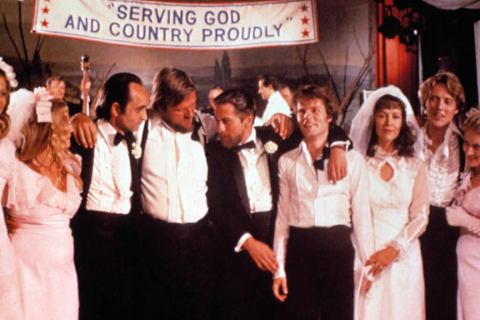
I saw The Deer Hunter so many times growing up on Long Island that I developed a kind of cinematic Stockholm syndrome. Back then, HBO had a relatively small library of movies that seemed to play on an endless loop, and The Deer Hunter was one of them. Whether it was the thrill of watching an R-rated movie while my parents weren't around or simply the magnetic performances by Robert De Niro and the rest of the cast—probably both—I came to regard it as something of a "starter kit" on how to be a man. Or at least perpetuate certain male stereotypes. 

I watched it again recently through what I like to think are adult eyes and couldn't help laughing at how self-important and oddly incoherent much of it is.

The Deer Hunter tells the story of three Pennsylvania steelworkers whose friendship is forever altered by their service during the Vietnam War. Along the way we're treated to the blistering conditions inside a steel mill, plenty of after-work male bonding, an extended wedding sequence, a funeral, deer hunting, napalm strikes, and, somehow, all three friends ending up together in a Viet Cong prison camp where they're forced to play Russian roulette.

The film contains many of the ingredients of a great movie, but they're assembled in such a rambling, almost improvisational way that it never quite comes together. At more than three hours long, it often feels less like a cohesive story than a series of scenes searching for one. Spoiler alert: there really isn't much of a plot. Any point the film attempts to make gets buried beneath its meandering structure. It's as though director Michael Cimino and his cast simply made parts of it up as they went along.

For the record, there is no credible historical evidence that American POWs were forced by the Viet Cong or North Vietnamese to play Russian roulette. The sequence is one of the film's most memorable—and controversial—fictional inventions.

What The Deer Hunter tackled, whether successfully or not, was a subject that Americans in the late 1970s desperately wanted to avoid: Vietnam. By then, the country had endured years of war, Watergate, political division, economic stagnation, and an energy crisis. Most Americans wanted to shut the door on that chapter and move on. Along with a handful of other early Vietnam films, The Deer Hunter forced audiences to revisit wounds that were still painfully fresh. Whether viewers found it profound or pretentious, they couldn't ignore it.

If the film has one undeniable strength beyond Vilmos Zsigmond's magnificent cinematography, it's the cast. De Niro, Christopher Walken, John Savage, John Cazale, and Meryl Streep would all become legends. Then there's Michael's 1959 Cadillac Series 62.

I've always been somewhat ambivalent toward 1959 Cadillacs, but no other car could have fit this movie more perfectly. Assuming Cimino intended it as symbolism—and with an art-house film like The Deer Hunter, it's tempting to assume everything means something—the Cadillac is much more than transportation. Of course, it's equally possible he simply needed a big car for the hunting trips and found one available.

Symbolism in film is meant to reinforce a story's underlying themes. While The Deer Hunter is ostensibly about steelworkers, its larger concern seems to be America itself after Vietnam. Michael's battered Cadillac becomes a visual reminder of a nation that had only recently been overflowing with confidence, optimism, and swagger.

The irony, of course, is that the story itself is set before the war is over, while audiences in 1978 viewed it through the lens of everything that followed.

Judging by its condition, Michael's Cadillac has clearly seen better days. Much like America after Vietnam, Watergate, inflation, oil shortages, and recession, it's bruised but still moving forward. As for Michael himself, it's harder to explain. He's portrayed as intelligent, disciplined, and emotionally resilient, yet he lives in conditions bordering on squalor. Had De Niro played him more like Travis Bickle from Taxi Driver, his lifestyle might have made more sense. Instead, it's another aspect of a movie that never quite knows what it wants to be.

Then there's the practical matter. While it wouldn't have been impossible for a steelworker to own a used Cadillac, would a serious deer hunter choose a gigantic, rear-wheel-drive luxury coupe with acres of overhang and delicate chrome trim? Probably not. A pickup or station wagon would have made far more sense. But as a metaphor, the Cadillac works beautifully.

Few American cars have ever been as polarizing as the 1959 Cadillac. Its towering tailfins, rocket-inspired styling, and unapologetic excess represented both the peak and the excesses of Detroit's chrome-and-fins era. Chrysler's dramatic 1957 "Forward Look" designs pushed General Motors to go even bolder for 1959, resulting in what are arguably the most flamboyant production cars America has ever built.

In many ways, the 1959 Cadillac reminds me of The Deer Hunter. Both are visually unforgettable. Both inspire passionate admirers and equally passionate critics. Both have become cultural icons despite obvious flaws.

Contemporary reviewers praised the Cadillac's luxury and performance while criticizing its enormous size and extravagant styling. Likewise, while Roger Ebert famously championed The Deer Hunter, other critics found it emotionally manipulative, heavy-handed, and surprisingly shallow beneath its ambition.

Yet history has been kind to both.

The Deer Hunter won five Academy Awards, including Best Picture, Best Director for Michael Cimino, Best Supporting Actor for Christopher Walken, Best Film Editing, and Best Sound. The American Film Institute later ranked it among the greatest American films ever made.

The 1959 Cadillac enjoys a similarly exalted reputation among collectors and automotive historians. Love it or hate it, few automobiles better capture America's confidence, optimism, excess, and contradictions at the height of the postwar era.

Perhaps that's why it fits The Deer Hunter so well. Both the car and the movie are oversized, deeply flawed, impossible to ignore, and enduring symbols of an America trying to understand itself after the illusion of invincibility had finally begun to fade.