Friday, October 13, 2023

1996 Chevrolet Caprice Classic - An Inglorious End


Based on engineering, passenger comfort, performance, handling and styling, Motor Trend awarded the Chevrolet Caprice its vaunted golden calipers as their "Car of the Year" for model-year 1977, beating out seven other nominees. Additionally, they congratulated Chevrolet for a new concept in passenger car engineering and design, and for recognizing the need for smaller, lighter, more fuel-efficient vehicles.  


"New concept in passenger car engineering and design"? If you say so, Motor Trend. At the risk of being contrarian, essentially, through my prepubescent goggles at the time, all I saw them do was downsize their wares to what they had been in 1965. An all-new 1965 Chevrolet Impala, Caprice was an Impala trim-package before becoming its own model-line in 1966, was 213-inches long and 79-inches wide riding on a 119-inch-long wheelbase. The 1977 Caprice was 212-inches long, 75-inches wide riding on a 116-inch-long wheelbase; essentially, what General Motors determined was an intermediate from 1973-1977. Curb weight was similar between a full-size '65 Chevrolet and a 1977. The two-models featured similar recirculating ball steering, power-assisted front disc\rear drum brakes, rigid live rear axles, leaf springs, coils, front-wishbones, front-engines and rear wheel drive. This was progress? 


Somewhat amazingly, stupefying even especially considering the drastic model-years changes or "planned obsolescence" that was a General Motors hallmark in the '50's and '60's, Chevrolet pushed out, for all intents and purpses, the same Caprice for 14-years. Suffice to say, an update was long overdue when Chevrolet introduced us to "Shamu", nick-named after the famous Sea World killer whale, for 1991.


Whereas the 1977 Caprice was a risk-aversive, calculated design, the 1991 Caprice was, being kind, a progressive and bold a design as GM ever came out with; especially to replace a long-established make and model. Like kind-hearted, supportive, well-meaning parents attempting to see any good in our children's most often-times terrible artwork, many a GM rear-wheel-drive, sedan-lover stuck these things to the proverbial fridge. I, candidly, was not one of them. And if I was ambivalent to what it replaced, imagine how I felt about these things. 


Buick got a version of this for 1992, Pontiac never did, Oldsmobile only got a wagon; Cadillac did, technically, come 1993. These only came in four-door sedan and wagon guises; they spared us coupe girls the ignominy of what one of those would have looked like. Just as well as Chevrolet hadn't made an Impala coupe since '82, a Caprice two-door since 1985. Try as I may to see the best in everything, though, which at times can be challenging, the new-for-'91 Caprice wasn't all bad. I mean, it was mostly bad inside and out, the interior had the soul of a Tupperware bowl, but from some angles and in the right light, it could be construed as somewhat handsome, or less ugly. Give me an LTZ (above) with the 9C1 cop package and I might be as happy as I am currently with my 2009 Toyota RAV4. It ain't sexy, I hardly love-it, love-it, but it gets me from point-A to B without much drama. With it's silly-powerful V-6, it can be quite fun at times too. 


The most polarizing design element of an overall odd blueprint, of course, was the Nash Rambler-esque  lower rear quarter panels. While I'm not a fan of the design in general, the "skirts" do give it some semblance of cohesion, theme and balance. Apparently, there were those inside either GM, Chevrolet or both who found little to appreciate about them. And I get that. 


For MY 1993, they saw-zalled them off turning "Shamu" into a 1992 Ford Crown Victoria doppelganger at best, cars that had removable rear fender skirts missing at worst. I remember seeing these cars at a new-car-expo on Long Island in the fall of 1992 and thought that while Chevrolet (probably) gave their customers what they asked for, they might have been best to put the skirts back on. Especially considering that was literally all they did to it. 


To illustrate my point, using "paint", and I'm no expert with it, I've doctored our 1996 subject here putting the "skirts" back on it Even with this crudely if woeful mock-up, we can see how little Chevrolet did to change the design of the car. Interestingly, the Buick Roadmaster's semi-rear skirts (or spats) remained on the car through the end of its production run in 1996. In my humble opine, the look worked best on the long-wheelbase 1993-1996 Cadillac Fleetwood. 


Under its massive hood there's more uniqueness or, depending on your point of view, oddness. Our '96 here doesn't have the full-tilt, 5.7-liter "LT1", which debuted in GM B- and C-bodies for 1994, but a smaller-bore, 4.3-liter version GM dubbed, "L99". The L99 made a palatable 200-horsepower but just 240 ft-lbs; adequate twist perhaps in the '80's, but even by the mid-'90's, it made for a pokey, two-ton sedan. What's more, there was minimal fuel-economy gains which was, allegedly, what the L99 was all about. The point of this engine, exactly? 


Shamu's sales, the ultimate litmus test of the success or failure of anything, were a fraction of what they were even in the 1980's. In fairness, spats, skirts or no such trivial quarter-panel styling, it wasn't the wonton styling that was the sole culprit. Rapidly changing consumer tastes and a never seen before competitive landscape doomed not only the Caprice, but the vehicle segment en masse. Well, eventually. Ford hung in there with their Crown Victoria through 2012.  


In the end, the "Shamu" Caprice was an inglorious end to a once storied staple of domestic automobile-dom. A curious GM offering in a day and age when the once world's largest corporation was in transition with feet firmly (more like shakily) in both the future and the past. 

If you're curious, this 148,000-mile red-on-red horror was for sale on Facebook Marketplace up near Detroit with a more than reasonable $1,995 asking price. Honestly, for the money, you could do worse. You could also do a hell of a lot better. 

Monday, October 9, 2023

1994 Buick Roadmaster - Everything Old is New Again. And Vice Versa.


My younger son loves to glom what he refers to as "vintage clothing" from my closet; he claims my janky wardrobe, well parts of it, is cool. Thanks for the (back handed) compliment, my boy; it's apparently true, as they say, wait long enough and things do come back in style. Other things that can become fashionable again includes music, movies, TV shows etc.. Cars, on the other hand, are a tougher putt; if something wasn't that in step with the times when it was new, all but safe to say it won't ever be in the future. Case in point, I'd find it hard to believe that even if Taylor Swift was seen driving a 1992-1996 Buick Roadmaster in one of her videos that all of a sudden there'd be a run on them. This '94 Roadmaster popped up on Facebook Marketplace this morning for sale near my triple wide on the west side of Cleveland, Ohio with a pre-Covid-like asking asking price of $1,500. Ad says, "OBO negotiated only in person". Gosh, if I had the room, I'd try and get it closer to a grand just for its engine and transmission. The rest of the car I'd just as soon see used as a reef in Lake Eerie. 


Chevrolet came first with these gigantic and dare I say homely "B-bodies" in 1991 updating their very long in the grill, "Class-of-1977" Caprice. The dramatically upsized and bulbous Caprice became known in some circles, due to it's shape, as "Shamu"; after the famous Sea World killer whale. Buick followed suit in '92 with a less polarizing, some would say "mature" design they, for whatever reason, dubbed, "Roadmaster". Seems somewhat fitting seeing it has disparate design elements of Buicks of yore, I mean, look at this front end, but, sheesh, Buick, did you have to call it, Roadmaster?  


Through my Boomer\Gen-X eyes, even before Buick's christening of the 1991 Roadmaster, the nameplate always reeked of, ahem, "Granny". My father's first car was a 1941 Roadmaster so the moniker goes back. Way back to 1936 actually. Buick used it off and on through 1958 ditching it semi-permanently in 1959 as part of a lineup overhaul replacing it with, "Electra". As everything new eventually becomes old, although "Electra" seemed geriatric when Buick heave-hoed it after 1990, it still seemed spritely compared to, "Roadmaster". Your opinion may vary, particularly based on how old you are. See dealer for details. 


Who was Buick targeting this thing at anyway? Retirees between the coasts who weren't aware of Lexus and Infiniti or whom had a doggedly misguided sense of patriotism? Granted, a 1992 Lexus LS400 stickered around twenty-grand more than one of these did, but you got what you paid for. After a flurry of sales (near 60,000) in 1992, they slid to around 28,000 or so through 1996, GM then converted the Arlington, Texas plant where these being built into a truck plant. Chevrolet moved more Caprices, but many of those sales were to fleets. 


If there's any saving grace, this being a 1994, under its massive hood is General Motors venerable, 1990's-vintage, 5.7-liter, LT1 V-8. The LT1 (not to be confused with 1970-1972's LT-1) first debuted in the 1992 Corvette then, in somewhat detuned guise, the Camaro Z28 and Pontiac Firebird Formula and Trans Am for 1993. For 1994, amidst ever stricter emissions regulations, GM ditched the throttle-body fuel injected 5.7-liter V-8 that had been using on these cars (Caprice and Fleetwood too) replacing it with the far more emissions friendly, fuel efficient, and powerful, port-fuel injected "LT1". 


Frankly, it's a stretch to call this version of the LT1 a "Corvette" engine but some people do; as if Granny and Pop Pop cared. It differed from the high-zoot LT1 in that it got iron heads rather than aluminum (less expensive), a milder camshaft and more restrictive, intake and exhaust, two-bolt mains rather than four as well. All in, still, it made 260-horsepower and 330-foot pounds of torque compared to 300-hp and 340-ft-lbs in the Corvette, 275-hp and 325-ft lbs. in the Camaro and Firebird. Contemporary road test pegged this blue hair mobile\grocery getter getting from zero-to-sixty in 7.8 seconds. Not bad. They said it would have been faster had the car had a limited slip rear end. No doubt. 


For a thousand bucks or so, I probably couldn't ask for a more turnkey package to drop into my 1977 Corvette, but aside from that, there's not much more I find to like about this big old Roadie; based on the price, I think the seller knows there aren't too many takers out there too. I know my younger son, who has not the slightest appreciation of anything vehicular aside using one to get from point-A to B, wouldn't be caught dead in it. Unlike some of my "wardrobe", some things, like I said, don't come back into fashion.  


Saturday, October 7, 2023

1986 Pontiac Grand Prix 2+2 - Bueller? Bueller?


I've wondered for the dark side of forty-years now why, in the 1980's, General Motors' late, sometimes great but more oftentimes just mediocre Pontiac division, never came with a performance version of their venerable Grand Prix. Chevrolet did with their Monte Carlo SS, Oldsmobile with their Hurst\Olds Cutlass\442 and Buick did with their Regal Sport Coupe\Grand National\GNX. After all, save for some minor suspension tuning and engines, they were essentially the same (G-body) cars underneath. Pontiac being GM's "excitement" division and all, you'd think a Pontiac version of an '80's interpretation of a 1960's muscle car, which is what they were, would be the hottest performing if not most flamboyantly and extravagantly styled of them all. Nope. Never happened. Closest we got to one was for model-year 1986 when Pontiac surprised us all with these bizarre things they called, "Grand Prix 2+2". 


What a site for sore eyes, right? Of course, I'm kidding. I'm sure there are fans of the aesthetics of these things out there, probably NASCAR fans, I'm not one of them. I don't care much for the Chevrolet Monte Carlo "Aerocoupe" either but put a grease gun to my head, I'd take the Monte Carlo. And only if I got a deal on one that was too good to pass on. 


There were just 1,118 Grand Prix 2+2's for 1986, 1,225 if you count the 107 of them that didn't get the janky rear window like this delicate, rare flower. Pontiac shipped GP's slated for the 2+2 treatment to an aftermarket company that installed the fastback window and modified the trunk opening; not only is the trunk lid tiny, but the rear seat doesn't fold down although the trunk is the same size as on a regular GP. Legend has it Pontiac shipped more GP's than that company had aero-windows so, voila. A smattering of GP 2+2's with no fastback. This I like in a "It Came From the '80's" kinda way. The Chevrolet Monte Carlo SS' aero-window was similar looking but it was different enough that the two were not interchangeable. 


Rather than just stop production like Pontiac did in 1977 when the mold broke for the rear spoiler for the Can Am, they just popped out 2+2's without the glass until the orders were done. Then, nothing for 1987. Chevrolet pushed on with their "Aerocoupe" into 1987 and while there was a 1988 Monte Carlo, they were leftover 1987's, there was no "Aerocoupe". 


Why Pontiac bothered with these things in the first place was because of homologation regulations for NASCAR Winston Cup racing. Ford was kicking GM's tailpipe in the '80's with their slippery Thunderbird so to counter, both Chevrolet and Pontiac baked up a rear window to improve drag. Apparently, it works quite well at speed. Around town you'd never know it but get one of these north of 80, 90 and 100-mph, if they could go that fast, the downforce on the rear end provided by the rear windshield does wonder for stability. 


Homologation, in NASCAR-ese, means what you raced on Sunday, you had to make available to the buying public, at least in theory, on Monday. Depending on what year you're referring to, those minimum number of cars fluctuated. These days, no one cares about homologation because since 2008, all NASCAR cars have been the same as footballs, baseballs, hockey pucks and basketballs are the same; it's all about the driver as it, frankly, should be. NASCAR cars are still referred to as "stock cars", but there's nothing "stock" about them. Not that there was back in the 1980's aside from a body "style". And the Pontiac and Chevrolet aero's were definitely a body style. 


Was GM concerned that a hopped-up Grand Prix would ape sales of the Monte Carlo SS, Oldsmobile Hurst-Olds\442 and Buick Grand National? Was it due to government mandated corporate average fuel economy (CAFE) concerns? For certain the Chevrolet, Oldsmobile and Buick triumvirate were certainly not miserly on gas. All of the above? Bueller? 


The "Grand Prix 2+2" name plate was a combination of two hallowed Pontiac monikers; at least they had the good sense not to call this a "Grand Prix GTO". 


Pontiac festooned "2+2" to a series of de-trimmed, sport-tinged Catalina's from 1964-1967 (above is a '64) so seeing that the Catalina and Grand Prix had much in common, there was some semblance of historical precedence set prior. Yes, for most of the 1960's, a Pontiac Grand Prix and 2+2 were full-size cars. Pontiac didn't find their Grand Prix mojo until it went mid-size with it starting in 1969. Chevrolet followed suit in 1970 with their first Monte Carlo and the personal luxury car boom was launched. 


All 1986 Pontiac Grand Prix 2+2's came with the then current version of Chevrolet's 165-horsepower, "LG4", 5.0-liter V-8. Through its 200-R4, four-speed automatic transmission and limited slip, 3:08:1 rear axle, you could get 0-60 in around 10-seconds, quarter mile in under 18; hardly fast even by the standards of the mid-'80's. Pontiac's Y99 suspension tuning was part of the package that also included a brace of luxury accoutrements including power windows, locks, buckets, console\floor-shifter, air conditioning, cruise control and tilting steering column with a steering wheel out of a Fiero GT. Heh? I know. All told, these cars stickered more than $2,000 more than a comparable Chevrolet Monte Carlo Aerocoupe. Not surprisingly, dealers couldn't give them away. 


Had these been stuffed with at least the Monte Carlo's 180-horse V-8 or, heaven forbid, a tuned port injection 5.0- or 5.7-liter engine or Buick's turbo V-6, all would probably have been forgiven. Well mostly. As these were or are in the case of my $19,000 Facebook Marketplace find here, they're all but forgotten 1980's-foot notes. Shoot, they might as well be the automotive equivalent of Kajagoogoo. 


Friday, October 6, 2023

2023 Ford Bronco Raptor 4 Door Advanced 4x4 - They'll Get By and Be Ok


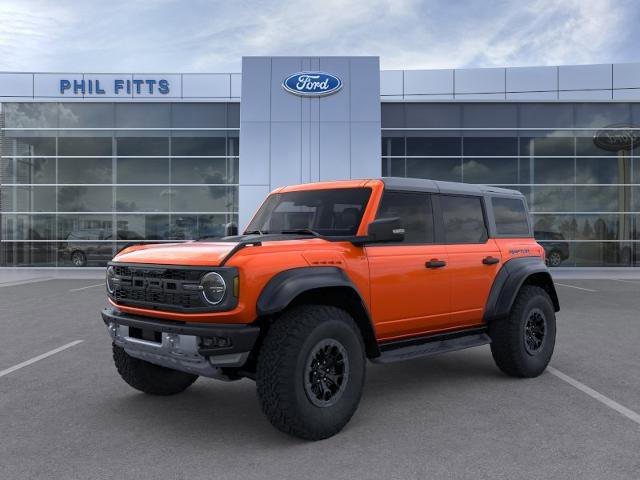
At first I didn't realize that there was something wrong with this ad for a new Ford Bronco. I know Ford Bronco's sell at a premium but I quickly although grimly accepted the reality that even bone strippers are commanding $97,200 these days. Holy smokes. Upon further review, I found this dealership west of Cleveland, Ohio is selling a Bronco Raptor "Advanced" 4X4 and not the rental-grade one pictured. I take it they wanted to get the ad posted but they don't have it in yet and don't access to stock photos of a late-model Raptor. But I only feel somewhat better. 


Here's what a Bronco Raptor "Advanced" 4X4 really looks like. This one stickering for $125,000; good grief! Who's affording these things? By the way, in my opinion, all the charm of the Bronco goes out the sunroof when dressed as a four-door; they're cartoon-like rather than cool. Your mileage may vary, see dealer for details. 


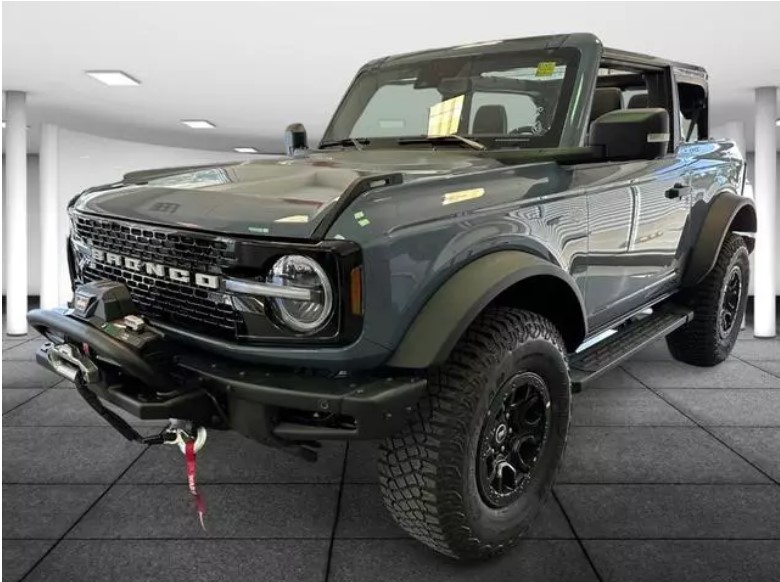
I much prefer the two-door Bronco, to me they're a poor-man's Range Rover Defender 90. I wasn't able to find a Raptor "Advanced" two-door on line so this "Wildtrack" will fill in. Such a deal as she stickers $50,000 less than our retina searing orange bomber. Yeah, as if "$75,000 is reasonable. 


Granted, I'm the cheap old shmuck who just paid $4,000 ($2,000 net out of pocket!) for a 2009 Toyota RAV4 so I'm not the target buyer but, c'mon, who in their right mine would drop six-figures on a car? Even half that amount is crazy but the cold, hard reality is that the average price of a new vehicle these days is more than $47,000. Here's the rub...people young and old are buying these things and paying that much for them and I think they're insane for doing so because nine-times out of ten, they really can't afford it. Or, at the risk of sounding judgey but I'll do it anyway, they shouldn't. 

There must be some visceral thrill I'm missing out on that some people get by saddling themselves with insanely high car payments. I understand house payments but that's (somewhat) understandable given they really have no choice. Not only are monthly car payments high, folks are burying themselves in car-payment-hell for inordinately long terms too. I've seen terms as long as 84-months; is 120-months not that far out of the question? At $1,786-a-month for five-years for a $97,000 Bronco Raptor, or whatever as there are other vehicles out there similarly expensive, that's more than $107,000 spent on a depreciating asset. 


It's said we should buy appreciating assets and lease ones that lose value. Hmm, ok. Lease payments over three-years will be similar to the purchase amounts but at the end of those terms, you'll have nothing. Unless you decide to pay the balloon payment and hold onto it. More and more people are doing that and we're not just talking about folks of modest means either. Still, most people stay on the leasing merry-go-round. 

My concern would be, and, yes, perhaps I'm more paranoid than the average bear, what happens if the gravy train gets derailed? Happened to a friend of mine recently. She and her husband are not only leasing an expensive car to the tune of nearly $1,000-a-month, they are leasing two-cars, the other one no cheapie either but more reasonable at some $600-a-month. Thing is, the hubs recently lost his high-paying job that he lucked his way into (he was plucked by a recruiter) and he's having a bear of a time finding not only a job that pays anywhere near what he was making, but any decent paying job in his field. To add insult to injury, she's way over mileage on her lease and has more than a year to go on it. But wait, there's more. She's leasing an electric vehicle. We know how bad resale value is on those turkeys.  


The kicker is, they have little to no savings and any prospects for his employment are standing down on taking him on board until after January 1st. When he had that super-high income job, they spent money like the his massive checks were going to keep coming in forever too; they spent nilly-willy like lottery winners purportedly do. And then, poof. Gone. Talking to her about their self-imposed and unfortunate financial strafe is like driving past a horrific car crash on the highway. You're mortified and empathize, you thank god it's not you this time too, but once you're past it, they're out of site, out of mind. Oh, they'll get by and be ok. Maybe. Who knows. I sure hope so. 


Granted, if you can swing these payments, more power to you. But, again, most people who can really shouldn't. Meanwhile, how the hell does Ford sell a Bronco, that's really nothing more than a tarted up Ranger, for $97,000?  


Thursday, October 5, 2023

1974 Buick LeSabre Luxus - The Low End of Cool

Nine out of ten days the transmission shop next to my office in Youngstown, Ohio has their lot packed with a gaggle of  ordinary, late model SUV's, crossovers, and appliance like sedans; old and not so old. On occasion, they'll have something mildly unique and different but ultimately doesn't hold my attention long. Then there are days when a visual tsunami like this 1974 Buick LeSabre Luxus convertible clotheslines me. In the best of ways, of course.

You don't see many of these gigantic, "family-sized" convertibles around anymore and you didn't see many of them fifty-years ago either. They never sold well because they were expensive, inherently impractical, and most importantly, weren't very good transportation conveyances. However, if you appreciate what these dreadnaughts have to offer, like I do, there's nothing quite like them. Although, I struggle at times to understand, let alone convey, what it is they offer I find so compelling. 

I say that because my wheel time in the very similar car it replaced, a 1973 Buick Centurion convertible, was terrifying; the Centurion was a "sport\luxury" version of the LeSabre that supposedly combined the luxury of an Electra with a tuned, performance suspension. I didn't find anything sporty or luxurious about that car. I thought it was a giant, jiggly, underpowered mess but it looked fantastic. You either get GM's enormous "Class-of-1971" full-size cars or you don't. Aesthetically I do, but, please, don't ask me to drive one; they're much more fun to be a passenger in. Especially with the top down and all you have to do is wave and smile at people. 

While most always construed as a luxurious frivolity, before factory air conditioning took off in the 1950's, convertibles were the most efficient way to ventilate an automobile. Packard is given credit for the first domestic manufacturer to offer A/C in 1939 but it was a complicated and unreliable system, they marketed as "weather conditioning", and they dropped it after 1941. Aftermarket A/C units dominated the market through the 1940's but it wasn't until GM first introduced factory A/C in 1953, in partnership with Frigidaire, that it really started to take off narrowing the convertible market even further. 

The Big Three offered convertible versions of their wares, usually based on two-door sedans, throughout the '50's and '60's, but started phasing them out in the early 1970's. Ford's last convertible Mustang\Cougar left the factory in 1973, Chrysler got out of the market after 1970. GM, bless their heart, hung in there although they continually limited their offerings. There was no Camaro\Firebird convertible after 1970, no intermediate after 1972. When GM rebooted their full-size line for 1971, convertibles were relegated to boutique status; the short-lived Centurion was Buick's sole "rag-top" through 1973, our LeSabre Luxus here replacing it in 1974. 

By 1976, the LeSabre convertible was gone along with Chevrolet, Pontiac and Oldsmobile versions of it. In fact, for 1976, GM's only "drop-head" was the Cadillac Eldorado convertible that was supposedly going to be the end of GM convertibles but that hiatus was short lived. Buick began selling a convertible Riviera in 1982, although they shipped partially completed cars to American Sunroof Corporation for the conversion. Cadillac followed suit with their similar Eldorado beginning in 1984. 

Convertible cognoscenti blame increasingly stringent, government mandated roll-over safety regulations for their demise, stipulations that never went into affect, incidentally, but the death of the convertible like our '74 here had a simpler reason - profit margins. Or, lack thereof. Convertibles were expensive to produce and they sold poorly. 

Still, the fact that I spent the time to walk next door and snap a few photos of this big, old luscious beast tells me there is something intrinsically alluring about these cars. Especially one in the fabulous shape this one is in. The interior and body are flawless although the paint finish is a good "five-footer". Just to make sure my instincts are on point, though, I sent a couple of these pictures to my 26-year old hipster son and asked him if this was a "cool" car or not. 

He doesn't pull any punches. Forgive my faux pas, I thought at first this was a 1975. 


Friday, September 29, 2023

1990 Cadillac Eldorado Touring Coupe - Etcetera


I wish this 1990 Cadillac Eldorado Touring Coupe was closer to my home here on the west side of Cleveland, Ohio. It's up in Romulus, Michigan, a suburb of Detroit and it's a good 2 1/2 drive for me one way, Just as well as i might fall in love with it. Just 88K on its 33-year-old digital ticker, Facebook Marketplace asking price is $3,000. 


Oh, how us Cadillac cognoscenti hated disliked these cars when they first stabbed our collective eyeballs when GM rolled these out for MY 1986. Sharing much DNA with the Buick Riviera and Oldsmobile Toronado, these starved to death little cars went a long way to tank any prestige the models had. Sales crated by some 60-percent 1985 to 1986 and they never recovered. Despite, in the end, some pretty gallant efforts on behalf of GM. 


A grafting of additional sheet metal fore and aft for 1988 improved aesthetics somewhat but there was only so much that could be done with a woefully compromised design. Cadillac redesigned their exclusive V-8 engine for 1987 increasing displacement to 4.5-liters, horsepower ticked up to 155 from 130-140. Port-fuel injection replaced the throttle-body set up for 1990 bumping bhp to 180. For 1990, the 4.5 was enlarged to 4.9-liters and horsepower rose to a nice round 200. 


That said, my 269-horsepower, 3,500-pound 2009 Toyota RAV4 V-6 will smoke this similarly weighty ETC. And it runs on regular unleaded too. What's more, I can't beat my RAV's build quaility, reliability and serviceability. Etcetera, etcetera. 


These cars were still too small and stubby but the "Touring Coupe" package, new for 1990. which included larger wheels, tires, thicker anti-roll bars, an electronically controlled suspension, and a quicker steering ratio than non-ETC's, dressed things up probably best they could be. 


In a vacuum, these were not bad looking cars and could perform like no other Cadillac's prior; save for the much pricier and even more gimmicky "Allante" that was nothing more than a two-passenger Eldorado on a shorter wheelbase. With an insanely expensive to build body.


But they were a flop. Problem was, well-heeled yupsters wouldn't be caught dead in them and they still weren't "Cadillac-enough" for their traditional clientele. 


Still, as far as cheap cars go, you could do a lot worse. Keep in mind, though, parts could be difficult to come by. Remember, this is a, he swallows hard, now a thirty-three gong on thirty-four-year-old car.