Showing posts with label HT4100. Show all posts

Thursday, January 11, 2024

1983 Cadillac Coupe deVille - Proverbial Dirt Nap


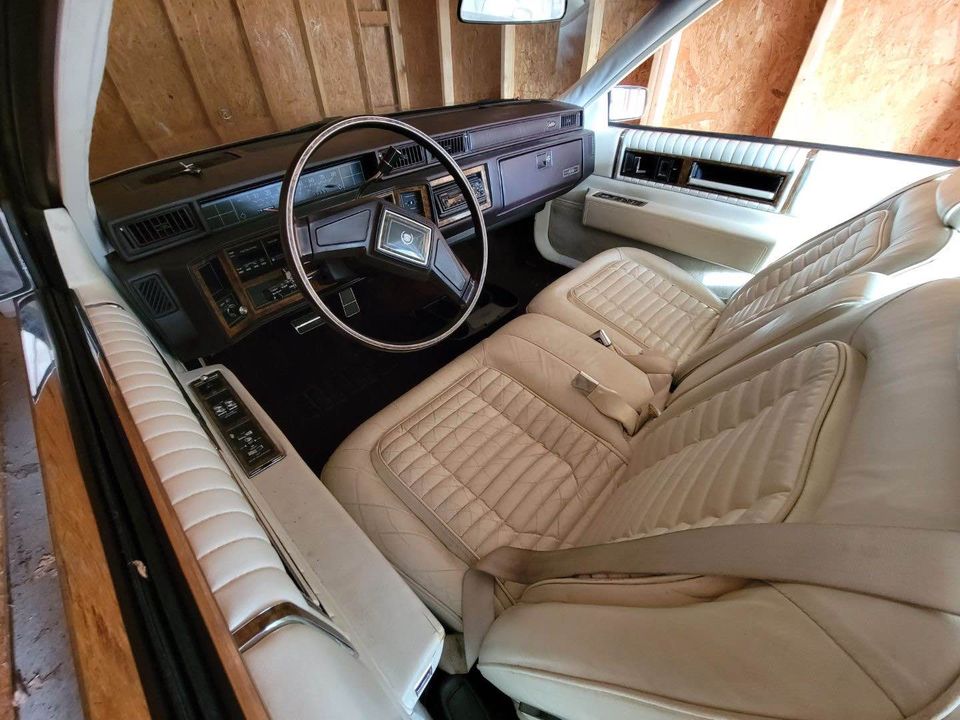
The early 1980's were not a good time for Cadillac. Questionable product planning along with poor execution at a time when younger-target buyers were gravitating to German makes and models almost doomed what had been one of the world's most respected if not hallowed automobile brands. In many ways, it's amazing the moniker is around today because of how bad things had gotten and gotten very quickly back then. This 1983 Cadillac Coupe deVille was a poster car of those woe begotten days although some of what ailed this one, in particular, have been remedied. 


That's because the engine it came from the factory has been replaced with a 1987-1995 GM 350-cubic inch V-8. There aren't any more details in the Facebook Marketplace ad about it other than the poster claims it has a new four-barrel carburetor. All GM "350's" made after 1986, even ones in trucks, had at least throttle-body fuel injection so some work has been done to it. Cadillac offered a 350-cubic inch, throttle body fuel injected in 1992 and it made 185-horsepower and 300-pound feet of torque. Nothing to write home about today but in the early 90's for a  Cadillac, that was quite improvement over what they had not long before under their hoods. Who knows, maybe this began life as a 240-horse, L98 with 330-foot pounds of twist.  


The engine this car was built with was Cadillac's infamous "HT4100". "HT" was for "High Tech" and many joke that stood for "hook and tow". The 4.1-liter V-8 was originally developed for Cadillac's front-wheel-drive "C-body", full-size cars that came to market for model-year 1985. With the abortive V8-6-4 of 1981 infamy, Cadillac had to do something. And quickly. Thing is, they made a bad thing worse stuffing the '82's with the HT. That's saying a lot too considering how bad the V8-6-4 was. 


In addition to being just plain gutless, early HT's inhaled head gaskets, had cooling and oiling issues, replacement parts were expensive and finding a shop to work on them was next to impossible. Many an  HT would conk out without warning too. Hopefully still within warranty but often times not.  


Why Cadillac rushed the HT into these cars and not replace the V8-6-4 with Oldsmobile's bullet-proof 307-cubic inch V-8 or, heaven forbid, Chevrolet's 305, both of which could get 20+ miles per gallon with a tall axle ratio and overdrive, is a question we'll never get an answer to. Thing is, even if they did, these cars, that were so crisp, new and highly regarded in 1977, had become woefully out-of-step with the times. 


I can't imagine a then 35-to-40-year-old "yuppie" (young urban professional) buying this; these they left to the blue hairs and old at heart. The sharper styled Eldorado was better but only so much so and it too was saddled with the HT. Old's diesel "350" V-8 was just as bad (maybe worse) making the credit option Buick 4.1-liter V-6 the best engine available. Again, not a good time for Cadillac. 


Not twenty-years prior, even fifteen, a Cadillac was what you drove to make a fashion statement that you had "it" or wanted to appear you did. You drove a new Cadillac in 1983 and the fashion statement you made was you were one step away from the proverbial dirt map. 


The engine in this car doesn't mean this is a screaming quarter-miler, mind you. Most likely it still has the 2.29:1 axle which would do nothing for get up and go. Being a Cadillac, it would also have over-boosted, slow steering and the suspension set up for a cushy ride so soft you might think something wrong with it. Swap the rear gears for at least a set of 2.73's if not a god's-green-earth 3.08, to make the most of the engine's beefier torque curve, add Bilstein gas shocks and thicker sway bars fore and aft and you might really have something. I'd swap the steering box as well with something like the F41 Chevrolet's set up. 


All that costs, though. The gear change and suspension upgrades would run you the dark side of $3,000. Cost of admission for this is $10,000 - that's almost double what average retail is and about two-grand more than high retail. Another case of someone charging for the moon for an engine swap. So, for thirteen-large you get a pretty solid that's not worth half that. I'd think that kind of money better burned on something a little older, in similar shape and more complete out of the box. 


Monday, April 10, 2023

1985 Cadillac Coupe deVille - Happy Easter


It was a lovely, sun splashed spring afternoon around easter time day on Long Island in 1984 when I first saw one of Cadillac's all-new-for 1985, front-wheel-drive deVille's. I don't remember if it was a coupe like this '85 decorated like the easter bunny but I do recall a sick feeling in the pit of my stomach realizing that my beloved General Motors had made another hideous mistake. 


Was there another time in the annals of automobile history when a manufacturer immolated themselves to the degree that Cadillac did in the early-to-mid-1980's? GM in general but what happened to Cadillac was particularly harrowing. Whether it was the hump-back 1980 Seville, V-8-6-4, HT4100 (engine) or the creme-de-la-creme, the Chevrolet Cavalier based Cimarron,  you didn't have to be an automobile connoisseur to appreciate that GM's luxury brand had run aground. And the hits just kept on coming. 


These cars were actually the second wave of shrinking to GM's full size line, the first of course occurring in 1977 when they began their great downsizing epoch. The front-wheel-drive deVille's were actually supposed to launch in 1982, but development issues tapped the brakes on their debut into 1984. In the old way of GM doing things, they launched them in early '84 and called them 1985's. No harm, no foul. Well, at least in terms of when they introduced them. Can't say that about the cars themselves. 

Irony of ironies, the one thing that was ready to go by 1982 was their engines. Well, supposedly ready to go. The 249-cubic inch, aluminum block, iron head V-8 developed exclusively for these front-wheel-drivers was dropped into Cadillac's existing models after the V8-6-4 debacle of 1981. That it made all of 135-horsepower and (good grief) 190-foot pounds of torque and was tasked with moving some cars weighing north of two-tons wasn't the biggest issue facing the "HT4100", catastrophic engine failure was. 


The HT or "High Tech" had such maladies as head gaskets blowing, cam bearings going kaput, oil pumps giving up the ghost and on and on. For a company that had such a stellar reputation up to that point with V-8 engine development, it was particularly vexing. They'd fix most if not all of the issues with the HT by the end of the decade but Cadillac took a serious kick in the giblets to their reputation at a time when failure was not an option. 

The styling, or lack thereof, is what depressed me the most. I could have cared less if these were front-wheel-drive with transverse mounted V-8's or not and handled better than any Cadillac before them. This college sophomore thought there were ugly. Apparently, I was fairly alone in that sentiment as these flew out of dealerships. At first. Not unlike the first MY for Chevrolet Citations and their various spinoffs. 


This pink-on-white CDV is for sale on Facebook Marketplace with an asking price of $990. A scant 67,000-miles on it's analog ticker. Why so cheap? Blown engine. Won't even crank. Sounds to me like its aluminum oil pump croaked and the engine is totally locked up. Sort of a shame but not really. I mean, seriously. And this came from the factory looking like this. 


General Motors famed design honcho Bill Mitchell retired in 1977 and the last designs he was directly responsible for where GM's class-of-'77 full-sized models and what would become the 1979 downsized E-body Cadillac Eldorado, Oldsmobile Toronado and Buick Riviera. You can see a familial resemblance in those designs harkening back to his glory days of the 1960's. He had nothing to do with the 1978 shrink-rayed intermediates and anything else that came after. Including, of course, these cars. 


The "heather-firemist" hue and padded landau top do the blocky, bolt-upright styling no favors. At least the interior is handsome and is as cavernous as the insides of the deVille these replaced. Perhaps more so given the lack of a driveshaft hump. To that degree, these were engineering watersheds. 

Even if this car was a different color and it didn't have the silly padded top, I can't do the mental gymnastics to make the more than fair asking price seem worthwhile. As far as the engine goes, there's no shortage of zesty options available but something tells me someone will scoop this up and gut the insides and throw out the rest. 


Not unlike what we do to easter eggs.