Showing posts with label Pontiac Trans Am. Show all posts

Saturday, September 9, 2023

Rocky Balboa's Car - 1979 Pontiac Trans Am


My recent soliloquy on a 1981 Pontiac Turbo Trans Am jogged my memory about my buddy Bill's 1979 Trans Am. It was black and outfitted in what you could say was the "Smokey and The Bandit" motif. You know, the gothic golden decals, stripes, the golden "Screaming Chicken" on the hood, the gold "Honeycomb" rims etc. You know, the epitome of '70's, disco-era car chic. It was a real nice car but being Long Islanders, no one chided him for trying to be Burt Reynolds. If anything, he got fist pumps for driving the same car Sylvester Stallone's character Rocky Balboa buys with some of the purse he receives from fighting Apollo Creed. If this is is news to you, you've either never seen "Rocky II" or you've forgotten about Rock's hilariously reckless spending spree in the movie. 


In retrospect, the producers casting of a black Pontiac Trans Am in "Rocky II" only appears to be as though Rocky is paying homage to Burt Reynold's "Smokey". That was most certainly not the case even though chronologically, it does make sense. "Smokey and the Bandit" was filmed in 1977 and was in massive circulation and raking in big bucks while "Rocky II" was being shot in 1978. If anything, though, the casting is coincidental. 


The "Smokey and The Bandit-izing" of black and gold Pontiac Trans Am's is a fairly recent phenomenon. Seriously, these cars were everywhere in the late '70's and into the '80's so it was only fitting that Burt Reynold's "Bo Darville", aka "Smokey", would drive one as reflective of automotive trends or tastes of the time; good or bad as there's no indifference towards these things. Same with Rocky buying one in "II". Amazing how the passage of time alters pop culture of the past.  


"Rocky II" was a surprisingly good movie. Was it great? No. Far from it, but it didn't have to be anything more than it was to give fans of the Academy Award winning "Rocky" exactly what they wanted -  to see Rocky beat Apollo out right. Along the way to the oh-so-predictable apex, we get to see Rocky and Adrian get married, they buy a home, have a son and of course, Rocky blows a wad of money on a black Trans Am. Rocky's spending spree all but bankrupting the young family, Rocky actually gives his T/A away because he can't afford it. It's the Balboa's financial strife that more than helps motivate Rocky to accept Apollo's repeated requests for a rematch. Well, that and he gets the ok from Adrian to do so. Win! WIN!
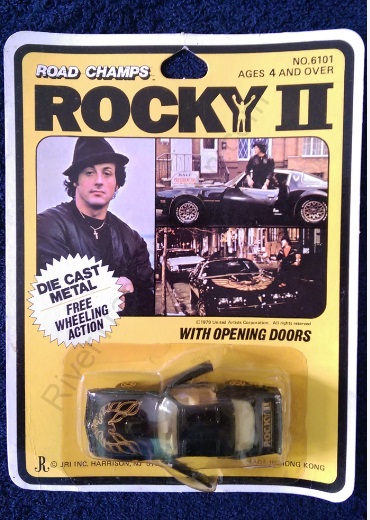

As movie cars go, Rocky's Trans Am of course hasn't gotten anywhere near the publicity in subsequent years that the T/A in the original "Smokey" did. That makes perfect sense since cars were centric to "Smokey and The Bandit" whereas  Rocky's car helped illustrate his newly found quasi-wealth; Rocky's spending his winnings like a drunken lottery winner one of the best things about, "II". 


Legend has it, four black, 1979 Trans Am's were used in "Rocky II" and they were all "6.6 LITRE" T/A's, "6.6 LITRE" on the shaker denoting they were powered by Oldsmobile, 403-cubic inch V-8 engines. Yes, an Oldsmobile engine in a Trans Am. Heresy! All "6.6 LITRE" T/A's had automatics. If they had Pontiac's own 400 engine, the shaker would have had "T/A 6.6" decals and a manual transmission. The heaving and surging of Rocky's T/A in the movie makes it appear as though he's having difficulty driving a stick, purportedly he doesn't even know how to drive but it's more like Sly is slamming the gas to the floor repeatedly to give the illusion of such. It's pointless but I remember the audience laughing out loud during the scene. 


Of curious note, it's telling how little thought the producers put into casting Rocky's car in "II". What with the movie supposedly set in 1976, although there's little if anything alluding to that, Rock's car is a 1979 Trans Am. That quibbling? Perhaps. But this is a blog about cars and nit-picking is what we do. Especially about movie cars. 


Allegedly, at least one of the T/A's from "Rocky II" is still around and belongs to a person who lives in New Jersey. There are no shortage of stories about people who own a Trans Am from "Smokey". My friend Bill wrecked his '79 on a rain slicked road. It was repaired but it was never the same. He sold it soon after he got it back from the body shop. 


Friday, November 18, 2022

1982 Pontiac Firebird Trans Am - I Could Make This Work


I'm so freaked out by the price of used cars these days that when I come across something interesting although I know is completely impractical if not absurd, yet is priced fairly reasonably, I'm kind of like, "yeah, I could make that work." Take this 1982 Pontiac Firebird Trans Am for instance. For sale about an hour or so from my home up here in Cleveland, Ohio with just 60,000 miles or so on its forty-year-old ticker, it has an asking price of "just" $7,995. No steal by any means but in a world where a ten-year old Honda Civic with this mileage would command twice as much money, perhaps even more, this, on paper at least, could work. Right? Ahem, riiiight. 


Along with its similar corporate cousin, the Chevrolet Camaro, the Pontiac Firebird was all new for 1982. Seven inches shorter overall than the very long in the tooth models they replaced, riding on a wheelbase almost seven inches shorter and weighing some five-hundred pounds less, critics lauded their handling prowess and good looks. Some scribes going so far to call them the best handling cars in America at the time which, when you think about it, wasn't saying that much. 


So, just how wrong would one of these be for me to knock the snot out of as a "daily"? Especially considering the used car lot is so desperate to get rid of this before winter that they'd knock another grand off the asking price for me? Well, my all-to-brief test drive answered just about every question I could have about it. 


As cameras tend to do, this looks much better in pictures than it does in person. It's got a fair number of chips and nicks, there's a "good" dent behind the passenger door that looks like someone tried to unsuccessfully pull out, the rear shocks are toast, the hood doesn't close all the way flush, and the driver's seat has some considerable wear to it. The good is the seating and pedal position are vastly superior to the odd layout in the fourth-generation Camaro's I've had, the engine started right up, sounded great, and acceleration, while hardly "sporty", was adequate. 


The bad was that while the seating position was good, the seats themselves, while appearing to be quite handsome, were dreadful. Flimsy. Cheap. Unsupportive. The wear on the driver's seat is all but hidden by this photo - it's bad enough that it would have to addressed immediately. Perhaps the seats would be ok on short jaunts, but for someone who'd be driving most times a hundred miles or more at a clip, there's no way my backside wouldn't be aching afterwards. And as compliant as the ride was, at least compared to what I remember these cars having, it was still quite flinty; the squishy rear shocks doing the whole car no favors. These cars have an element of crude some find charming and part of their visceral appeal. Fun, perhaps, as a weekend jaunter like my 1977 Corvette is, but as a "daily", I know the lack of refinement would grow old. Fast.  


I walked away feeling somewhat crestfallen although I knew it would have been a very long putt if I even really liked it. Even at seven-grand. This is a $3,000 car and even at that price the wife would be just a tad incredulous. There's also the reliability factor; the three fourth-generation Camaro's I've had, were hardly stalwarts when it came to being dependable. They are all but simple to work on though; these some of the last "old school" cars us shade tree hack mechanics can actually wrench on. 


Still, if I was looking for a weekend toy, I could do a whole lot worse than this little old bird although the price of admission is more than twice would I would be comfortable with paying. NADA pegs these average retail at $9,800, low around $6,000, high retail $15,800. 

Thursday, November 5, 2020

1979 Pontiac Trans Am - You Had to Be There

If I could be assured that I wouldn't have to endure the ninth grade again, I'd build a time machine to take me back to 1978-79 where I'd rob a bank and buy a hundred of these or so. Then I'd transport them back with me to now, sell them all except for maybe a black one or two and retire fat and happy. All the while scratching my head as to why anyone would pay the kind of money these things command. Don't believe me? This lovely 1979 Pontiac Trans Am is for sale outside Baltimore, Maryland with an asking price of $42,777. Say that asking price slowly and it's even more heart stopping. Forty-two thousand seven-hundred and seven-seventy dollars. Snowman, you got your ears on? 

These cars weren't always the pot-of-gold that they are now. Perhaps coinciding with the explosion in popularity of non-descript, soulless crossovers, it's only in the last ten, may be fifteen years that the values of these cars have gone through the sun-roof or T-Top. The values of the T/A's corporate sibling, the Chevrolet Camaro Z28 of this vintage are "up-there" too. Meanwhile, and ironically, the value of Corvette's of this vintage are languishing. I have a 1977 "C3", arguably more desirable than the heavier glass-fastback 1978-1982 C3's, and I know that even if it was in showroom condition, which (he laughs out loud) it's not, it would be hard to find a buyer who'd pay more than fifteen-grand for it. 

Back in 1979, a Corvette was a good four-grand more expensive than a Trans Am (that was  a lot!) and these days, if we're talking pie-in-the-sky original condition, a T/A commands two if not three if not four times what a '79 Corvette can. Even Camaro Z-28's are worth more than Corvette's. Why? 

Good question and I have my theories but let's not quibble about C3 Corvette's because today, we're all about late '70's Trans Am's. And rather than just shrug my shoulders and say that some things are what they are, or "it is what it is", there has to be something to it because, obviously, there is. 

As someone who lived through it, although I was rather young I was fully aware at the time, best I can tell you is there are several reasons for the appreciation in value for these cars and it's a lot more complicated than pin-pointing where Peter Frampton went wrong with his career. 

For starters, there's the engine. Or engines. These cars were the last of the "big-engine" muscle or pony cars manufactured in this country. Insurance surcharges, gas-mileage concerns and emissions regulations made muscle and performance cars all but verboten. On the Corvette, Chevrolet discontinued offering their "big-block", "454" V-8 after 1974 and the last big-block Camaro left factories in 1972. Ford didn't offer a "big" engine on their Mustang after 1971 and Chrysler dropped big motors on their Plymouth Barracuda and Dodge Challenger models after 1971 as well. I guess fittingly since Pontiac was billed as GM's performance division, Trans Am soldiered on with big displacement V-8 engines through 1979. Albeit ones that were somewhat wattered down to be in compliance with emissions and fuel economy regulations. They didn't do what they did because of horsepower - the big T/A's did it all with gobs of god's-green-earth-polluting torque

Our subject here is powered by the Pontiac 400 cubic-inch V-8 that makes it a bit of a rarity given that Pontiac stopped making that engine after 1978. Legend has it that a select few '79 Trans Am got left-over Pontiac 400's, most of them tenth anniversary T/A's that this one is not. The vast majority of T/A's in 1979 got 403 cubic-inch V-8's made by, Fred, are you sitting down? Oldsmobile. 

Like all good things, the big engines had to come to an end. Pontiac couldn't get the big mills to comply with new and far tougher fuel-economy and emissions stipulations that kicked in for 1980. The "big engine" in a T/A for 1980 and 1981 was a Chevrolet built 305 V-8 although the wobbly-kneed, turbo-charged, Pontiac built 301 V-8 on the "Turbo Trans Am" was technically more powerful. 

There was more to these cars than just tire shredding torque and relatively neutral handling. There's that "flaming" or "screaming" chicken on the hood. If  you don't "get this", all I can tell you is you had to be there. This was insanely cool back in the day; still is as it rifles me back to my oh-so-awkward junior high days. That's not my inner fourteen, fifteen year old saying that either. My twenty-three year old quasi-car loving older son loves this decal too. Even if it defies just about every convention for taste that's ever existed. It's kind of like early '70's Elvis in a jumpsuit before he packed on the ell-bee's. Somehow the largest decal ever installed from a factory on an automobile worked and worked fabulously. At least at first. Slapping this down on the the turbo T/A's of '80 and '81 was akin to Elvis in a jumpsuit just before his alleged passing. If you're wondering, it's official name from Pontiac was the "giant Firebird hood decal". 

However, time-travelers, and this might sound really silly, I'm of the opinion that the single biggest reason that these cars are as valuable as they are today is because of the 1977 Burt Reynolds literal and figurative star vehicle, "Smokey and the Bandit". 

Such was the power of a movie and particular star - you drove a "Bandit T/A" back in the day, regardless of the color scheme, you had it going on in ways that you just didn't if you drove a Corvette. And whereas if you drove a "Starsky and Hutch" Ford Gran Torino - folks snickered; not that Ford offered that stripe job but some people did get custom decal or paint jobs. Had Burt Reynolds driven a Corvette in "Smokey in the Bandit" perhaps late 70's Corvette's would've gotten the same lift in sales and later appreciation, but the film's director, Hal Needham, insisted on a black Trans Am for The Bandit. The rest, as they say, is history. 

Best is, our subject's asking price is "average retail" these days. High retail is over $61,000. Say that slowly. Now, anyone got a blue print for a time machine?