Saturday, September 12, 2015

1978 Pontiac Grand Prix - Certainly Didn't Help


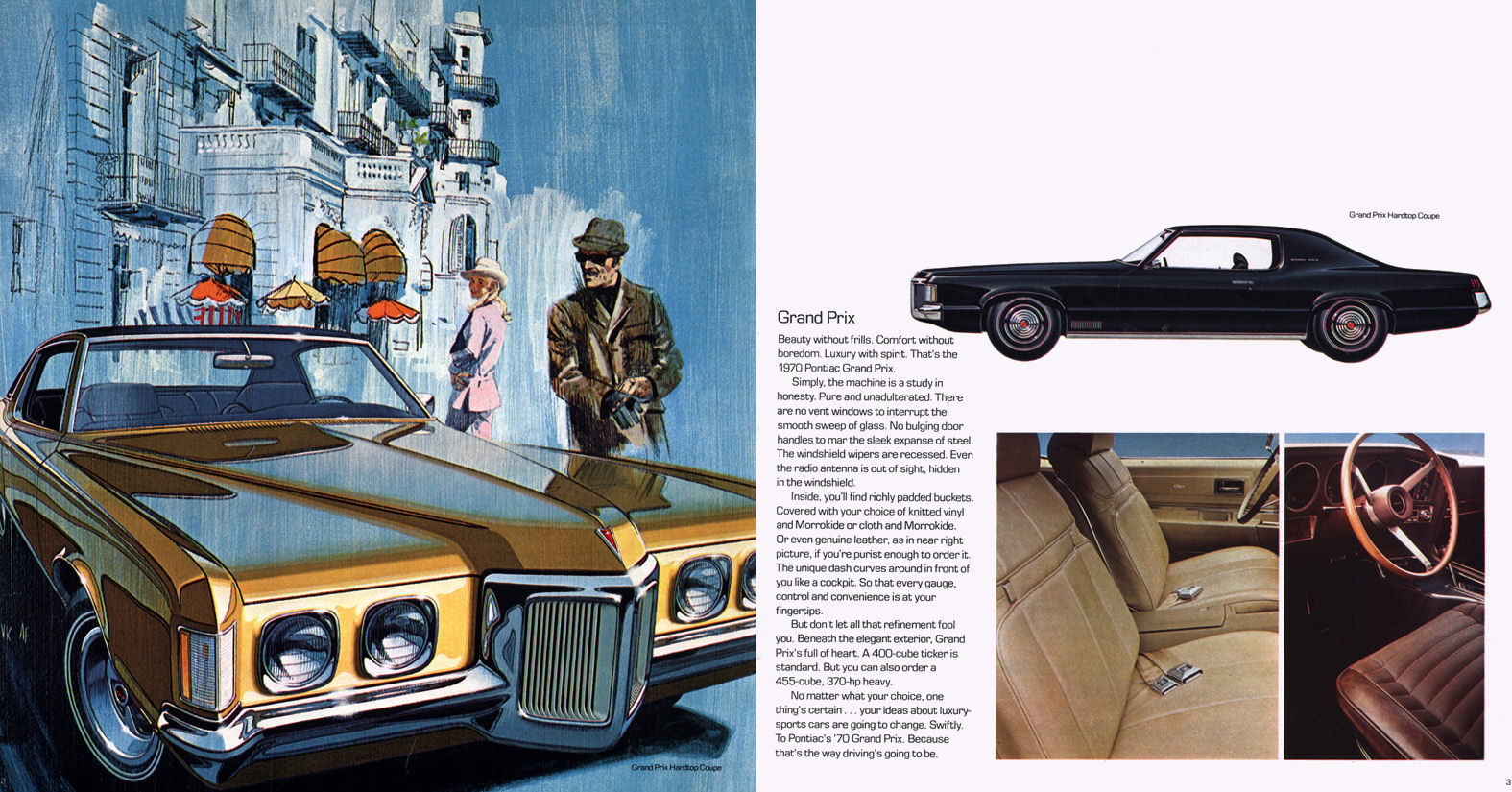
Like father like son I had bought into the "bigger is better" idiom that The Big Three corn fed Americans for thirty or forty years but it was more than just the sheer size of the cars that enamored me. It was their styling. Especially the fabulous GM makes and models from about 1960 up until the great downsizing epoch began in 1977. I was concerned about downsizing because my gut instincts told me that the grand designs I loved might lose their luster on smaller canvases. How right I was. While there wasn't a single 1977 GM full size car that I thought was a better design than what it replaced, things got even worse with the upsized compacts they called their midsize line a year later. Even my beloved Pontiac Grand Prix wasn't spared the ignominy of designers who'd lost their way. 


I wasn't alone in my sentiment either. Dealers coined the phrase "buyer resistance" to explain why the new smaller cars that, on top of everything else were more expensive than what they replaced, weren't selling. Contemporary reviews of the new cars were glowing if not chock full of hyperbole about how the cars performed, how much easier they were to maneuver, how much roomier the rear passenger area was (front passenger seating was actually slightly less) and how much farther they could go on a gallon of gas. Any mention of the styling was atypically cursory. 


To be fair, GM had to downsize with  ever stricter government mandated fuel economy and emissions standards stair stepping up. With today's engine control systems at the time in their infancy, they had no choice but to reduce curb weight and use smaller, less powerful  engines. The net result was smaller, lighter automobiles that were better on gas but where also, and seemingly by  happenstance, much better performing transportation conveyances. 


Introduced in 1962, the first Grand Prix was a "full-size" Pontiac two-door sedan that was somewhat downsized in 1969 with glorious results. Relaunched as a mid-size "personal luxury car" its long hood and short deck design proved to be quite popular with many giving it credit for defining the market segment that came to dominate sales during most of the 1970's. Downsizing can be good; could GM and Pontiac catch lightning in a bottle again come 1978? 


Nope. The great downsizing epoch came along and the smaller automobiles all lacked the styling moxie that made previous GM designs so wonderful; including the 1969 Pontiac Grand Prix. The '69 Grand Prix' may have been short on delivering the kind of performance it emulated save for anything in a straight line but certainly these stubby little foretold little of what they could possibly do. Why couldn't GM combine the best of both worlds? In the car business it's not so much what a car can do as much as what it appear it might be able to do or what positive reinforcement it can parlay for whomever is driving it. What does this thing say about it's driver? That they appreciate a less than 7/8 scale of what the car used to be and that it gets better gas mileage?  Oh, let me tell you about how good the handling is. Please. 


The lack of elan carried over to the interior as well. Amazing that there's just five model years between the fighter jet cockpit of, for instance, a 1973 Grand Prix and this 1978 model. All the new for '78 GM intermediates had the same basic interior layout; interchangeable interior bits and baubles a first for GM. 


Sales peaked for all the GM intermediates in 1979 but the brutal 1980 recession took the bite out of  whimsical, personal luxury cars. Just as well seeing they weren't anything like what they had been. Revisions to sheet metal fore and aft come 1981 while a welcome change did little to usage the ambivalence buyers now had toward the cars that just five years prior was a staple of sales. Would better looking, downsized personal luxury cars made a difference? Honestly, we'll never know. The confluence of circumstances conspiring to relegate personal luxury cars first to an even narrower targeted niche market then ultimately to the scrap heap. One thing for certain the 1978 GM intermediates, led by our Grand Prix here, certainly didn't help. 


Wednesday, September 9, 2015

1976 Buick Electra - I Like Big Buicks


With all due apologies and respect to Sir Mix-a-Lot and his classic if not seminal 1992 smash-hit, "Baby Got Back", "I like big Buick's and I can not lie". 


Although not my favorite big Buick, I find this 1976 Buck Electra 225 coupe far more compelling than the similar "posted" offerings from Oldsmobile and Cadillac. "Posted" referring to the center post or "B-pillar" that GM stuck on their big coupes starting in 1974 thus doing away with my beloved "hardtop coupes". Allegedly the post was to re-enforce the top of the car in case of a rollover; as if that sort of accident happened regularly, but the concern was the National Highway Safety and Traffic Administration (NHSTA) was going to insist on it as they had with the five-mile per-hour safety bumpers. How to explain that hardtop four-door models were still around at GM during that time you ask?  Umm, good question. Maybe they designed the coupes first and when they got around to the sedans they found out that legislation wasn't going to happen? Roll-over safety concerns supposedly doomed the convertible too but we all know that's bunk; bad sales killed the drop-top not Uncle Sam. 


Whether it's that the side window and landau roof doesn't align with the door like it does on the Cadillac Coupe deVille and Oldsmobile 98 coupe, through my foggy goggles the rear of this car looks less like stacked boxes as it does on the Cadillac and Oldsmobile. Don't get me started on the Buick LeSabre, Olds 88, Pontiac Grand Ville and Impala\Caprice B-body coupes (slightly shorter  wheelbase) of the mid-'70's. In particular the '74-'76 Buick LeSabre that somehow still had a roll-down rear window in front of the B-pillar making for a more cluttered design than any Ford designer could have come up with. Perhaps Bill Mitchell had senior-itis knowing that he was out the door at age 65 in 1977? 

 
Historically speaking, though, to those of us who find this sort of minutia interesting, our '76 here is special because it is the last of the big "C-body" Buick coupes. The party was over come 1977 when GM's great Downsizing Epoch started that was akin to someone calling the cops a good hour or so after the hookers showed up. Yeah, the party lasted too long but up until that time it was a blowout of a good time. If you like big cars that is. Really, really big cars. 


Speaking of size, you can't have any discussion about these cars and not go into at least some detail about how ginormous these things were.  Photographs don't do them justice - at 80 inches wide they were wider than most humans are tall and at 233 inches long they were roughly the same height as a two-story house. There's more than ten feet between the driver's head and the right rear tail light - no wonder this car still has vestigial tail fins as they're the only way the driver has any idea where the back of the car is. Trying backing this boat up in a tight parking lot. 


What's more incredible is that when Buick first introduced the Electra "225" in 1959, the "225" denoted the overall length of the car; if you're keeping score, that means our '76 here is a full eight inches longer. I take it that Buick Electra "233" didn't have the same ring to it as "225" did?  


So, why and how did Buick's get so big in the first place? Well, big on the outside that is. It's not like these cars were particularly spacious inside. Designed from the outside-in, leg, shoulder and hip room  was more like an afterthought. 


The bigger is better axiom started in the late 1950's when, whether GM over reacted to Chrysler's remarkably fresh and exciting 1957 lineup or not, starting in 1958, they came out with the most outlandish cars ever made. Not only that, but they were the longest and widest cars ever made as well. 

                                               
                                                  1957                                                 1958


                                                                            1959

The Buick Roadmaster leapt in length from a still large but manageable 216 inches for 1957 to 219 for '58. Then 1959 happened and all hell broke loose. Buick stretching their flagship to 225 inches and apparently being so proud of it they changed not only the name of the car to "Electra" but called out attention to its length by festooning "225" as a post-fix. Who knows why Buick ditched "Roadmaster" for Electra; probably because some suit thought it a more progressive moniker. Or someone wised up and determined, wisely, that the new '50's cheesey sci-fi movie inspired model wasn't worthy of the Roadmaster name.  


                                                   1970                                                    1971 

Through the 1960's and up through 1970, the '70 being my favorite, Buick kept the Electra 225's length more-or-less in check ebbing it back and forth between approximately 223 and 226 inches stem to stern. Still absurdly long but somewhat diminutive compared to what was to come. Even the fairly vilified '71's were under 226 inches long. Won-ton styling differences pushed out the '72's to just under 228. The front safety bumper for '73 made them 229 inches but it was a wholesale styling update for '74 along with a massive "safety" for the rear that stretched things out to 231 inches. A redesigned front end for '75 got the big Buick out to 233 inches where it remained for 1976. And then, poof. 


For 1977, Electra was eleven inches "less-long" although it was still a very substantial automobile at approximately 221 inches bumper-to-bumper; roughly the size of a 1958 Roadmaster. More importantly, since they were allegedly designed from the "inside-out", there was more genuinely usable interior and trunk space. Oh, but to 13, 14-year old me at the time and 57 year old me to this day, the styling came up way short of Buick's of yore. Yes, even the cartoonish 1959 Electra 225. Perhaps I'd feel differently about The Great Downsizing Epoch had it been generally successful but we all know how that story ultimately played out; kind of like you're favorite sports team starting out the season real well only to finish in last place. 


But I like Big Buick's and I can not lie. For me they're wonderful rolling sculptures even if they handle like crap and get eight miles per gallon. If you're lucky. They're also great values if you're looking to get into the classic car world; measure your storage space to make sure it'll fit. Our lovely cake-topper here has an asking price of $10,990 and that's priced about right. Figure you'd need to spend around that to get anything in decent condition right back to the early '60's models. The most expensive of the post-war Buick's, save for the "Rain Man" Buick's (that was a '49 Roadmaster convertible), somewhat, ironically, the '59 models. 


Tuesday, September 8, 2015

1982 Oldsmobile Omega - Paralell Park THIS

  
I was listening to the '80's channel on Sirius XM the other day and one of the recordings between songs referred to the '80's as the "Decade of Excess". Made me laugh. Really? The 1980's? Well, if you're not of that decade and everything you've gleamed about the '80's is from movies you could come to the conclusion that back then everyone was wealthy, drove DeLoreans and was pushing some crap up their nose. Reality check - the early '80s were a continuation of the miserable '70's as the country struggled to recover from one recession after another. The economy recovered somewhat after 1982 into a half assed party that led, ultimately to another recession at the end of the decade that lasted well into the first half of the Clinton administration. If you're looking for one automobile that summed up that very up and down decade you're looking at it here. Domestically anyway. "Decade of Excess". Ha. The only thing excessive about this 1982 Oldsmobile Omega is that it was excessively bad.


Good times. General Motors massive downsizing started out generally successful in 1977. It's shrunken full size B and C body cars were heralded as being nothing short of marvels of engineering. However, honestly, they were more like redesigned 1973 A bodies than anything that was truly revolutionary. Same for the 1978 A bodies which borrowed heavily from the rear drive X bodies. It was the new, front wheel drive X bodies introduced in 1980 that were truly "revolutionary" since GM didn't have a template, so to speak, to work from. Sadly, revolutionary doesn't guarantee that the execution of the plan will be as sounds as the ideas behind it.


The X-body Omega, like its sister vehicles Chevrolet Citation, Pontiac Phoenix and Buick Skylark were some of the most trouble-prone vehicles that GM ever produced necessitating an astounding number of government-mandated recalls for braking problems (there was no rear proportioning valve installed), fluid leaks, suspension issues and who knows what else.


Ironies of ironies, my first experience with one of these was actually quite pleasant. I learned to drive in a white on red Oldsmobile Omega and found it handled, braked and responded far better than my father's shuddering mess of a 1972 Cadillac. In fairness I believe my Daddy's Caddy was a terrible example of a mediocre car (it may have been in a very bad accident and rebuilt) so that reference point is biased but my impression, nonetheless, was positive.


Except for the  mechanical oddity of the car stalling when the steering was pushed past its limits making parallel parking interesting if not outright dangerous, I really enjoyed driving it. I thought the styling homely but not nearly as gruesome as the hatchback Chevrolet Citation and Pontiac Phoenix. By the way, when was the last time you paralleled parked anyway?


While the Oldsmobile Omega was the only one of the four X-cars to sell better in 1981 than in 1980 (147,918 versus 134,323), starting in 1982, production fell dramatically. Only 77,469 Omegas were built in '82, with 53,926 in 1983 and 52,986 in swan-song 1984. That drop off in sales no doubt coming on the heels of the recalls. The "Decade of Excess" soldiered on with this car's somewhat better replacement, the 1985 vintage N-body Olds Calais.

Saturday, August 29, 2015

1973 Pontiac Grand Prix - Gone. Long Gone.


The new for 1973 Pontiac Grand Prix was the embodiment of a all too brief period of optimism in America in the early 1970's. It's new but at the same time familiar confident face told America that all was well and the future was bright and shiny. Fitting, since things were looking up for America after the brutal 1960's what with our involvement in Vietnam finally ending, albeit ambiguously, Nixon being reelected in a landslide and gas being thirty six cents a gallon. With the average household income in 1973 at $8983, $47,596 adjusted, and all things being equal, what works out to $1.46 a gallon in today's money was still a really good deal for gas. We can then understand why 10 miles per gallon in most American cars was acceptable. If you read the tea leaves correctly you could also see that the handsome 1973 Grand Prix was also a bellwether; it for told of pending problems and an American automobile industry ill equipped to deal with them.


The OPEC oil embargo of October 1973, a political quagmire that slashed oil production inducing long lines at gas pumps, quadrupled the cost of a barrel of crude and increased the price of gas ultimately by almost twenty cents a gallon. While Henry Kissinger was able to negotiate an increase in oil production that eliminated the long lines, he was unable to lower prices.


What became known as the first energy crisis also turned whimsical, claustrophobic, two ton, two door 5 1/2 passenger coupes like this delicious 455 cubic inch Grand Prix into gas guzzling pariahs. Even before the first gas crisis there was widespread sentiment about America's reliance on foreign oil but would have thought the spigots would ever get turned off?


Sales of these 10 mile per gallon, V-8 American cars screeched to a halt and the economy went in the dumpster as all of a sudden everything became more expensive. In other news, Nixon got implicated in the Watergate scandal and all of a sudden America's sense of optimism was gone. Long gone. While gas prices stabilized for a time through most of the rest of the decade, a second oil shock in 1979 further added to America's doldrums.  It would be only until we were deep into the Reagan administration that a cautious America would again have any of the sense of itself that it had after World War II.

  
President Carter, in his now famous and at the time much derided "Malaise speech" of July 1979, said that there was a crisis of confidence in America. Only after all these years do we appreciate fully how correct Mr. Carter was. Could you blame the country for feeling slightly beaten down? 


One thing is for certain, unlike America's confidence, which we've learned can take a beating but is if anything seemingly eternal, the Grand Prix as we knew it in 1973 never came back.


Wednesday, August 19, 2015

What Happend to Two Door Cars ?? And The Rise of Crossovers

 
I read a column in the most recent issue of Car and Driver about the fact that cross over sport utility vehicles are now the best selling type of "automobile" in America. Makes sense when you consider everything these appliance like little "cute-utes" have to offer. They're easy to drive, are very practical, have all wheel drive, are relatively easy on gas (especially the hybrids) and have a modicum of savoir fare or style that larger SUV's have in a much more manageable package. Designed for a woman but men like them too, they're the automotive "everything" unlike anything we've ever seen before. As a "car guy" who grew up with "utility first" station wagons, I feel as though the world has gone to hell in a hand basket.
 
 
About ten years ago or so I had a feeling the market was shifting when I asked my neighbor's then 15 year old daughter what kind of car she wanted when she got her driver's license. Imagine my incredulity when she said she wanted a Chevy Equinox. Ugh. When I asked her, jokingly as to not insult her, why she wanted to drive what I considered a mom-mobile she replied that she wanted something big and safe that she could handle and also something she could haul all of her friends around in. Oh. Hmph. Well, appears that millennials might be a tad more pragmatic than us Baby Boomer/Generation X types. Who'd have thunk that?


Alls I knows is is that back in my day I wanted to be as far away from anything "family-car" as I could get. Y'see, my family personified the dysfunction in dysfunctional family and with my old man driving  a 1968 Ford Ranch Wagon just like this frumpy blue fedora, you might begin to understand why I flinch at the words, "family car". 
 
 
That's why I like coupes; they're cool above and beyond anything else. Those who drove them when I was a kid were, to me at least, the debonairs who weren't afraid to put themselves first. Sorry, as selfish as that may sound, I believe it's perfectly fine to hold onto your individuality even if you have a family. You need a van to haul stuff or a truck for a project? Go rent one. Back in the day, cars like this 1977 Ford Thunderbird, as remarkably impractical as they were, ruled the roost. Now, were folks back then more self centered than they are now or were station wagons really that bad? 
 

So, why did coupes fall out of favor? Driven almost purely as fashion statements, for there is certainly nothing inherently practical in a two door car regardless of how many passengers it can carry, ugly lumps like Ford's new for 1980 Thunderbird didn't help matters. Combine that with GM's semi-abortive 1978 downsizing of their A body intermediates, and the coupe or personal luxury car began it's long, slow, inevitable decline.
 
 
In Ford's case, these Fox bodied Thunderbirds were infinitely superior to anything that came before it; even the hot selling LTD II based 1977-1979 Thunderbirds. Didn't matter much, though. To those who put projecting some sort of image above all else, personal luxury cars/coupes, suddenly began to look like leisure suits. Enter the age of the sport utility vehicle to replace padded landau half roofs and opera windows.
 
 
It's so bad out there these days for us coupe people the only domestic coupe on the market, and I'm not counting pony cars like Mustang, Camaro and even Challenger, is Cadillac's very expensive (and small) ATS coupe. There is no Thunderbird, Monte Carlo, Grand Prix etc. I plan on doing a deeper dive in the near future on the history of the two door car. Stay tuned.
 
 
I asked my wife the other night that if I could get her any car she wanted what she want. She didn't waste a half second telling me she'd like a two door Mini Cooper. Is it any wonder we've been married 23 years and counting?


Wednesday, July 22, 2015

1988 Buick Regal - 1988 Is Calling.


Wow. Look at this; one of the automobiles General Motors introduced in 1988 to compete with the Ford Taurus and Mercury Sable; the GM-10 based Buick Regal. While certainly better than what it replaced, the 1988 Buick Regal was clearly, and this is me - a big fan of these cars being brutally honest, not (good) enough.
 
 
In every way imaginable even including, subjective as it is, styling, the front wheel drive, 125 horsepower, 2.8 liter V-6 Regal was a massive improvement over what it replaced. The problem with the Regal was that it wasn't any better than what Ford was doing and was absolutely inferior to what Toyota, Honda, Nissan et al from Asia were offering.
 
 
What's more the Regal and very similar offerings from Oldsmobile and Pontiac were all coupes. As much of a coupe geek as I was and still am, even I knew back then that was odd. Especially considering that GM spent $7 billion (poof!) developing these cars. And they only made coupes? Incredibly, four door versions of the Regal, Cutlass (Olds) and Grand Prix (Pontiac) didn't appear until 1990. Ford didn't even offer two door versions of their Taurus or Sable. Clearly the market was shifting away from "personal luxury cars"; apparently Roger Smith didn't get the memo. Let's not even begin to talk about what a Camry or Accord was like back then compared to even the Ford Taurus. It wasn't even close.
 
 
Still, this fan of all things with two doors would jump on this before any two door CamryAccord even if he does know better. An '88 Ford Taurus? Even an S-H-O would get past over for this little blue on blue gem.
 
 
You either get that...or you don't. Look at all those buttons. Utterly ridiculous. Don't you just love it?
 
 
1988 is calling. Asking price is a very reasonable $3995. Answer the call before I do.  


Saturday, July 11, 2015

1972 Chevrolet Impala - Babies Love Their Mothers


My affection for these cars has more to do with my liking what was new when I was a child as opposed to appreciating the cars for themselves. Not unlike a child loving their mother regardless of whether their mother is Mother Theresa or The Bride of Frankenstein; whomever that person is is going to be adored.


Most "car people" don't share my appreciation for these massive automobiles. Those of us who do love them for what they are are a small lot as opposed to the masses who believe the 1957 Chevrolet,  the most beautiful or coolest car ever made. Sorry. I think the 1957 Plymouth was a better looking 1957 Chevy than the Chevy was. And the 1972 Impala, as big and overwrought as it was, was the better looking car as well. Love is blind and most importantly has no reason.

 
There are more affecionados of this '68 that came before these 1971 vintage dreadnaughts. Remarkably, this '68 is but an inch and half shorter than our '72.   
 
 
The '72's smaller "shoulders" on the rear flanks lending the eye to tell the brain that the car is larger than the car it replaced. While it is a bit larger, it is no where near as large as it would appear to be. 
 
 
I've yet to find any evidence that there was any point to the '72's bulk; its cautious, evolutionary styling further suggesting a car that soldiered along with very little attention to purpose or concept. If you've spent any time behind the wheel of one of these you know that these things are quite the handful in anything more than being driven in a straight line as well. Then again, most if not all cars of this vintage were pondering oafs as well. The big GM's actually better than similar sized fairings from Chrysler and Ford. As big as this car is, starting in 1973 it got bigger. Government mandated safety bumpers pushed the front end out an additional five inches. Another five inches got tacked on in 1974 when the rear safety bumper was bolted on.
 
 
If you share in my appreciation of these cars and this one in particular let me know. While ambitiously priced at $8,000, I'm sure you could talk the owner down to a more reasonable six grand or so. The color doesn't help the value of this thing either but if you're looking for an old ride at a reasonable cost, you could do a lot worse. The owner claims 37,000 miles on her for what that's worth. Car is located in Pittsburgh.