Saturday, October 17, 2015

Bye, Bye, Sedans. We Never Liked You Anyway.

 
The death of the sedan is like that person you didn't like at work who leaves the company. You respected their ability but you're ambivalent about their leaving. 


Need proof the sedan is slowly disappearing? In a booming new vehicle market, one that projects to be the biggest since 2005, sales of the Toyota Camry are down just under 15% August 2014 to August of this year. The Honda Accord actually outsold the Camry in August but year to year sales are down 20%. Those are big numbers. The Nissan Altima is the only one of the top three that held steady gaining just .5% this month over August 2014.

 
These lower sales numbers aren't an anomaly either. For the year sales of the Accord are down nearly 15% and the Camry is down nearly 5. Altima sales up just over 1%; why is Altima up? Incentives? Rebates? It's not like the Nissan Altima does anything any better than Camry or Accord and styling is subjective. I'd be hard pressed to believe that anyone could tell the difference between the three cars at ten feet. No one is pounding their chest because of a 1% bump up anyway but being up in a down market is something to take note of.
 
 
So, if this year is so big, where are the sales coming from?

 
From the sale of trucks, SUV's and CUV's. The Ford F-Series sales are up nearly 5% and the Chevrolet Silverado is up 12%. The Nissan Rogue, a cross over, is up 29%, the Ford Explorer  is up 22%. The Ford Edge, which I'm not sure is a CUV or minivan is up 36%.  At this rate, in the next 10 years we won't see a sedan in the top 5 on a list of best selling vehicles.

 
The popularity of pickup trucks still escapes me but I get what SUV's and CUVs have to offer; practicality and style. When you can combine both you've got a winner. CUV's are quite car like in how they ride and handle too. Factor that with being practical and looking good and you have the hottest vehicle segment in the market today. What's killing sedan sales? CUV's.

 
With CUV's offering literally everything you could ever ask for, why would anyone buy a sedan these days?

 
When my wife and I replace our Tahoe someday, no doubt we'll replace it with some sort of super cool, hip CUV. Maybe even a hybrid. Meanwhile for myself, I'm thinking this tomato soup tinged Mustang when it's time. You like? As for sedans, well. Forget the ambivalence; we never liked them anyway.


Tuesday, October 6, 2015

American Graffiti - The Wolfman Gonna Get Ya

The big, white, Chevrolet Impala featured in American Graffiti is about to be sold at auction for what experts some say could be more than $1 million. That's an amazing amount of money for a car that was cast for the film by accident.


"American Graffiti" is a study of the cruising and rock and roll cultures of post World War II baby boomers coming of age in Modesto, California in 1962. What there is of a "story line" is told in a series of vignettes about a group of teenagers and their adventures over a late summer evening just before two of them head "back east" to college. One of many things that makes the film interesting today is that while it's set in 1962 it was made in 1973,  and unwittingly, neatly bookends one of the most tumultuous periods of time in American history. George Lucas and Francis Ford Coppola knew exactly what they were doing in making the film about as "apolitical" as possible. It's also a great car movie.
 
 
There are six perfectly cast modes of transportation in American Graffiti that are as centric, if not more so, than the actual cast or setting.


There's the 1955 Chevrolet than Harrison Ford's character, Bob Falfa, drives. Could Ford's arrogant, hickey, dim witted Falfa have driven anything else but a hopped up '55 Chevy? For the record, thanks to a not-period-correct, somewhat modified 454 Chevrolet V-8, Falfa was beating Milner in the drag race at the end of the movie before he crashed. Note the fuzzy dice hanging from the rear view mirror.


Hot rodder John Milner, played by Paul LeMat, drove this 1932 Ford "Deuce Coupe" with a 383 stroker V8 (which would have been highly unusual in a 1962 vintage car),  Man-A-Fre intake with four two barrel Rochester carburetors, Muncie M21 4-Speed transmission and 9-Inch Ford rear end. Much like the car, Milner is a one dimensional softie who knows his relevancy is limited and the only way for him to get noticed is to drive a car like this. A car that just looks cool and really can't do much of anything.  This '32 Deuce was originally a full-fendered, red, street rod and was purchased by the film crew mainly because it had the chopped top the film's original script called for. 
 
  
Note the THX 138 license plate or tag. Director George Lucas carried something from his previous films into his next ones as  a good luck charm. THX 138 refers to  "THX 1138", a sci-fi movie he filmed in northern California prior to American Graffiti. BTW, if you look very closely in Star Wars, you'll see some fuzzy dice hanging in the Millennium Falcon; they're the dice from Falfa's Chevrolet. 
 

Suzanne Sommer's character, who is simply known as "a vision" to Richard Dreyfuss' "Curt", drives a 1956 Ford Thunderbird. Could such "a vision" drive anything less than such a delicate, feminine automobile?  All we know of the car was that the producers of the film found the car on a street in Pentaluma, CA and left a note on it asking the owners to call them to ask if they could use the car in a movie. Legend has it the car was originally painted red and the owners of the car painted it (historically correct) white sometime after 1960. Legend has it the white Ford Thunderbird featured in the video for Bruce Springsteen's "I'm On Fire" is the same Thunderbird from American Graffiti. 


Richard Drefuss' "Curt Henderson" drives a 1967 Citroen 2CV. It's a 1967 model, which like the 454 engine in Balfa's '55 Chevrolet and to some extent Milner's 383 powered Duece Coupe, is historically incorrect. Doesn't matter, though; it fits Dreyfuss' studious, diligent "Curt" to a tee. You don't have to be perfect to be great.
 

While not a car, the 1959 Piaggio Vespa GS 160 that Charles Martin Smith’s, "Toad" toils on is pivotal to any conventional plot that "American Graffiti may have. When Steve offers Toad his Chevrolet to take care of til Christmas, part of Toad's glee is that he doesn't have to ride the Vespa any longer. At least for a little while.


Which brings us to the 1958 Chevrolet Impala Sports Coupe that is about to be sold at auction.


The casting of a 1958 Impala in American Graffiti wasn't because of the Impala's handsome good looks or it's 348 V-8 engine - although it's far out sheet metal certainly couldn't have hurt. The film's original script called for the character of Steve Bollander to drive a car that had a "tuck and roll" interior. Tuck-and-roll refers to hand-stuffed channels that are used to form decorative panels in automotive interiors. It's a time consuming and expensive process but the results are quite  dramatic especially on a big automobile with a large, expansive, cavernous interior like a '58 Impala has.
 
 
Apparently, after the filming of American Graffiti, the car was sold at auction for $325. Understand that there are many films filmed that do not become hits and their props, which producers want to get rid of, become all but worthless. Also, seeing this film was shot in 1973, a 1958 Chevrolet was not exactly a hot commodity. More than likely the most "valuable" car from American Graffiti at the time of the filming was probably Milner's Deuce Coupe. Honestly, although I'm a big fan of this car, it's appreciation recently escapes me even if it's a famous "movie car". Perhaps it won't sell for nearly the million that is projected. We'll see.
 
 
All I know is, if you have an old car that you bought years ago, don't think it's all of a sudden going to appreciate through the roof like "Steve's Impala". I'm hard pressed to find '58 Impalas in great shape going for more than $50,000. Let's see what happens.


And while we never find out what kind of car "The Wolfman" drives or if he drives at all, there's no denying how important a part he plays in all of the cars in "American Graffiti".
 
 
Hey, I got a dedication here that's for a friend of the ol' Wolfman. And he wants me to play the next song for a blonde young lady in a Thunderbird. A white T-bird, you understand? Now my friend's name is Curt and he wants to talk to you out there, baby. So you meet him at Burger City, or you can phone Diamond 3132. Now he's a friend of mine, you hear, and little girl, you better call him, or the Wolfman gonna get ya.


Friday, September 25, 2015

2006 Cadillac SRX - Go Figure

 
This black beauty sits in the parking lot behind the building my office is in here in Cleveland. For the life of me I can't understand why these didn't sell better than they did years ago. I always thought them to be great looking and driving vehicles.

 
Based on GM's mid size rear wheel drive "Sigma" platform, which also underpins the CTS, the original SRX was introduced in 2004 and won spots on Car and Driver's Five Best Trucks list in 2004, 2005 and 2006 and was nominated for the North American Truck of the Year Award award for 2004. No small feat for any "truck" maker let alone Cadillac.
 
 
Despite the accolades, Cadillac never sold more than 23,000 of these a year in any of its five year production run. I'll be the first to admit that I have a challenge with luxury trucks and SUV's like the QX56 but cross overs - which this most certainly is - I have no problem with since they are passenger vehicles first and foremost. A car, more or less, beefed up with some trucky accoutrements? That I like; trucks gussied up to be luxury cars I most certainly do not.
 
 
This particular example even has a vaunted Northstar V-8 making 320 horsepower. I spent some time in one of these V-8 smoothies in Dallas and, granted, it was the lighter RWD only model, it could really move. Quite fun. The base V-6 with 255 horsepower had moxie as well. Add the all wheel drive equipment which is all but a requirement up here snowy, frigid, Northeast Ohio and performance gets bogged down somewhat.
 
 
Much like trying to pick hit records, you can not factor in your own personal taste when it comes to what is or isn't going to work with anything in life let alone automobiles. While I found the original SRX very appealing and I find it's 2010 vintage replacement to be nothing more than a fancified Chevrolet Equinox, which it is, I, once again, am fairly alone in that regard. Sales of the new SRX have all but been consistently double of these SRX. Go figure.


Thursday, September 24, 2015

Infiniti QX56 - Gourmet Meatloaf


The mere notion of full size, luxury sport utility vehicles wasn't a decade old when Nissan rolled out their F-Alpha pickup truck based Nissan Armada and Infiniti QX56 SUV's in 2004. Just like that, all other luxury SUV's else seemed if not outright tame at least restrained compared to the QX56.
 

The original QX' most distinctive styling touch, which it shared with the similar looking Armada, is its swoopy/hump roof that flows fairly seamlessly into a straight as a billiard table rear roof line. The recessed rear door handles helping add to the illusion that this is a pickup truck with pop up camper in the bed. Huh? Yeah. Can't make this stuff up. I'm not of the pickup truck persuasion but I find it hard to imagine that anyone who owns a pickup truck with a camper in the bed is proud of the way their mini motor home actually looks. If you can afford filet mignon, would you go for gourmet meatloaf instead?  
 
 
It's probably no surprise then that when Nissan updated the Armada and QX for 2010, the pickup truck and pop up camper lines on the QX went into the river. It stayed on the Armada, tough. That making as much sense on the Armada as it did on the QX but then again what do I know being from Long Island and all. Long Island, especially where I grew up a stone's throw from Kennedy airport, not exactly a bastion of pickup trucks not to mention pop up campers.
 
 
It might just be the Long Islander in me but even though I have had a Chevrolet Tahoe for years now and love the damn thing, luxury trucks and luxury SUV's still escape me. In my myopic New York City esque point of view, trucks should be for work or at least utility first and foremost. Ineed, the utility of my Tahoe is what I appreciate most about it. Tarting up an SUV into a luxury vehicle makes as much sense to me as a construction working wearing dress shoes to work.
 
 
I am fairly alone in my dismay of these things, apparently. Fancy tanks like this sell quite well and turn a healthy profit. Sales have been strong for the QX with the new QX56 outselling Infiniti's other SUVs, the crossovers EX and FX, as well as the Lexus GX and LX luxury SUV's.
 
 
The QX56 was renamed the "Q80" during Infiniti's bizarre model name change for 2015. The new name makes as much sense as a luxury SUV.


Friday, September 18, 2015

1976 Cadillac Coupe de Ville - Bigger Is Not Always Better


Forty years ago, what made a Cadillac a Cadillac? If nothing else, the size of one.
 
 
That said, it's hard to imagine this massive 1976 Cadillac would have gotten any larger had it not have been downsized along with all the other GM B and C bodies in 1977. The Cadillac this 1976 Coupe was based on, which was new in 1971, was already a formidable 225 inches long before the  government mandated "safety bumpers" were tastefully bolted on. Actually, GM did a nice job of being government compliant. At least with these full size cars. Those massive bumpers, which were added to the front in 1973 and the back in 1974, added a total of five additional inches to the car pushing overall length to a parking lot maneuver challenging 230 inches. To put that sheer length into perspective, if Cadillac's new sedan flagship due in 2016, the CT6 (gorgeous car, hideous name) is 204 inches long and looks massive at that, imagine a car that's just under two and half feet longer. In case you're wondering, the enormous new Escalade, which some would argue is Cadillac's flagship, is a tad shorter than the CT6, if you can believe that. This 1976 Cadillac Coupe de Ville was big.  Really big but back then, the size of a Cadillac was literally a big part of what made a Cadillac a Cadillac.

 
It's only been recently that Cadillac's have not been "big" or relatively big compared at least to what else was on the road. While the new CT6 comes on board next year, Cadillac's "flagship" sedan at the moment, at just 196 inches long, is the relatively diminutive CTS. Before the CTS was crowned GM's top drawer sedan, the de Ville or "DTS" was the "big" Caddy and that car never got longer than 207 inches long. By the way, drive one and you'll come away with the feeling that it's the biggest thing ever made. Not even close. Pundits of large Cadillacs say that the last "real" Cadillac was the B body based Fleetwood Brougham that was discontinued after 1996. At 225 inches long, it was, at least in sheer size, more in tune with Cadillacs or yore than anything available today.
 
 
What's ironic is that despite the bulk, Cadillacs these big old Cadillacs never had any more leg, hip and shoulder room than even mid size cars of its vintage let alone other big cars. In fact, when the downsized Cadillacs came out in 1977, GM bragged that the new Cadillacs had more interior room than the cars they replaced.
 
 
Another part of the (old) Cadillac mystique was their big V-8 engines. The new CT6 won't even have a V-8 engine when launched next year. In 1949, Cadillac introduced an over head valve V-8 engine that was revolutionary and, save for Oldsmobile who also introduced an OHV engine that year, unique to Cadillac. Technological advancements in addition to luxury amenities were part of the allure of Cadillac after the war. However, by 1976 most if not everything available on a Cadillac was available on just about everything else GM offered. All that Cadillac could crow about was this 500 cubic inch engine being the largest V-8 engine in the world. Seeing that it was just a couple of years after the crippling gas crisis of 1973-74, again, bigger was not better. Also, there was no discernable increase in the car's ability to accelerate quickly given this large engine.


My late parents who were both born in the early 1920's and were of the "Greatest Generation", were of the notion that there was truly something special about a Cadillac. Shame that by the time this car was brand new, what made Cadillac Cadillac was a thing of the past. By 1976 Cadillacs sold on what they represented as opposed to being anything that was any better than a Chevrolet Impala.
  
 
Then again, I'm of the generation that has challenges with accepting that Cadillacs of today are the equal if not better of anything from Europe. If I had the money to spend on an expensive car I'd certainly look at a Cadillac but given that Cadillacs are just as expensive as a comparable Mercedes, I'd go Mercedes. Or BMW or Audi. Luckily for Cadillac, many millennials, aka tomorrow's buyers, have no such notions and think Cadillac in the same light as anything from Europe or Asia. Size of the car be damned.


Wednesday, September 16, 2015

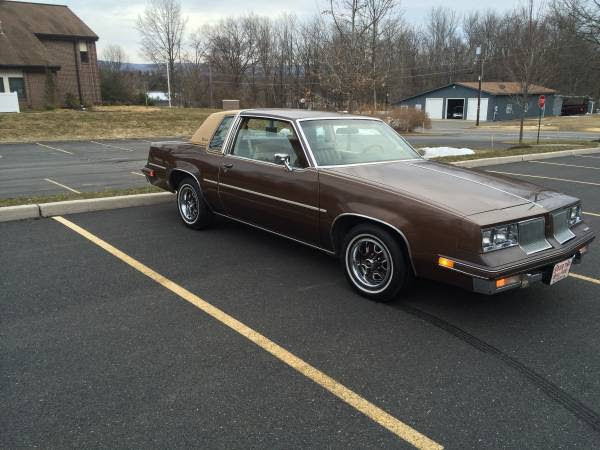
1981 Oldsmobile Cutlass - Double Whammy

 
GM's 1981 reboot of their 1978 A body coupes transformed the formerly bizarre (Monte Carlo and Grand Prix)  to drab (Cutlass and Regal) mid size two door sedans into handsome (if not all very similar) looking automobiles. Even if the homogenization was deliberate, there were many parts interchangeable between the cars, GM hit the aesthetic jackpot. Even if it was very hard to tell a Cutlass from a Monte Carlo. The four door versions  of these cars soldiered on in their interminably boring 1978 interactions until the last one passed in oblivion after 1987. You think telling a Grand Prix from a Regal was hard, try telling a Cutlass sedan from Regal sedan.
 
 
For 1981, Cutlass got this new "jaw" out front and a svelte new tail as well. Subtle as the changes were, especially compared to the goofy Monte Carlo and to a lesser extent the Grand Prix, the Cutlass was transformed into a handsome automobile. Even in base "stripper" mode like our subject here.
 
 
Alas, while coupes sold very well in the 70's, by 1981 the plug was out of the tub. "Tastemakers" on the coasts had all but stopped buying American cars in general and coupes in particular and had moved onto more expensive makes and models from Europe and to some degree Asia. The Yuppie movement was taking over. Growing up in Nassau County, New York, I'd see some of these (rarely brand new) on the working class South Shore where I grew up  but I'd be hard pressed to believe anyone on the tonier North Shore would be seen in one. This car was the working class hero's ride.  
 
 
This car, unfortunately, has the double whammy of a 260 V-8 (at least it's not the Olds 350 diesel) and the infamous THM 200 or "Metric" transmission.  Metric transmissions burned up with freakish regularity leading to recalls and lawsuits and wouldn't you know it? This car's Metric is busted - thus the modest asking price of just $2800. Nothing a Chevy crate engine and a 700R4 couldn't cure, though. Anyone got an engine crane and tranny jack they can loan me?
  
 
Oldsmobile put these cars to pasture in 1989 and replaced them with the front wheel drive (no hump) GM-10 Cutlass. The GM-10 Cutlass actually debuted in 1988 but Olds put the word "Classic" on the last of these. Classic indeed. The rest, as they say, is history.  
 

Sunday, September 13, 2015

1967 Pontiac Grand Prix - Stab It And Steer

 
While the advancement in automobiles over the twenty or thirty years makes cars of this vintage  seem quite crude, by the time that I became of driving age in 1981, new cars had become so bad that I believed that "older" cars like this were considered to be superior to them. The whimsical design of this 1967 Pontiac Grand Prix only adding to the mystery of older cars for me.  
 
 
I've never been the biggest fan of these bulky, big Grand Prix' but I have to admit there is a certain elan to them that makes them oddly appealing. It could certainly have a place in my fantasy garage although I can't say that it would get that much use. There's a fine line between ugly and cool and this old beast really (fender) skirts it.
 
 
The nothing if sporty looking sporty interior hides a GM B body frame and everything good and bad that went along with that. Loosey goosey, over boosted steering, under boosted brakes and unsupportive seats. Note that lack of seat belts. Optional still in 1967. That's not two radios, incidentally, the one in the center of the dash controls HVAC.
 
 
The new for 1967 400 cubic inch V-8 with a nary an emissions control device at the ready. Stab it, hold on and steer best you could; this thing can move.
 
 
Unlike chocolate and peanut butter, some things do not go well together. Like sweet, alcoholic drinks, sexy cheerleaders at football games and a luxury car with sporting pretensions. Mag wheels with white walls and fender skirts? Seriously? Not to mention the wretchedness of vinyl tops. The color of this car screams "old man" as well.
 
 
The asking price for this well preserved "big GP" is near $15,000 and I find that money to be extraordinarily high for a car with very limited appeal. That's almost GTO money, not mint condition GTO but still GTO money,  for a car that many would scratch their head and go, "what is that?" If you're into collector cars that's one question you hear at car shows that really means, "nice car...hope you didn't spend too much on it."