Showing posts with label Buick. Show all posts

Thursday, September 3, 2026

1967 Buick Skylark - Holy One-Off, Batman

This 1967 Buick Skylark had been trying to get my attention in a Facebook ad on my wall for a week or so. At first, I thought it was a Buick LeSabre, been there done that over and over, then I realized it was a Skylark. Wow. Holy one-off's Batman.  

Buick first used the Skylark nameplate in 1953 and 1954 on a limited-production convertible based on the Roadmaster, commemorating Buick's 50th anniversary. The Skylark name returned on a compact for the 1961 model year, although technically the Skylark designation wasn't applied to the Buick Special until 1962. It shared General Motors' Y-body architecture with the Oldsmobile F-85 and Pontiac Tempest.

Come 1964, "Skylark" was used on an intermediate, or "mid-sized," car based on General Motors' new A-body platform. The A-body designation had been dormant since 1958, when GM's former A-body cars were moved onto the larger B-body platform. It was revived for 1964 for GM's new intermediate cars, including the Chevrolet Chevelle, Oldsmobile F-85/Cutlass, Pontiac Tempest/LeMans and Buick Special/Skylark.

GM redesigned its A-body intermediates for the 1968 model year, necessitating an entirely new body and body shell. So, for 1967, Buick's A-body went out in style with a unique, one-year-only body so handsome that even fender skirts can't muck it up.

Fender skirts, which I don't care for on intermediate sized cars, gave the car a more formal, full-size appearance and were standard on the 1967 Skylark. They were not used on the performance-oriented GS models, which had open rear wheel wells to accommodate their wider tires. The "GS 340" and "GS 400" suffixes denoted Buick's new-for-1966 340-cubic-inch V-8 and new-for-1967 400-cubic-inch V-8, respectively.

Back in the olden days, kids, General Motors' myriad divisions made their own engines. No doubt it was an expensive, time-consuming proposition and ultimately a frustrating one for vehicle owners and mechanics, since many of the engines shared, technically anyway, the same displacement and sometimes even appeared similar, although they were often very different designs.

Those unique engines helped make the makes on GM's pricing ladder distinctive, even if there wasn't necessarily anything intrinsically better about a Buick-built engine than an Oldsmobile-, Pontiac- or Chevrolet-built one. And, most certainly, a Cadillac engine, although generally larger and more expensive, wasn't automatically any more reliable than a Buick engine.

1967 was also the last year Buick offered its 225-cubic-inch V-6 in the Skylark. If this car did have the V-6, which it doesn't, it would make this truly unique as you simply don't see many '67 Skylarks anymore not to mention ones with the V-6. 

This car has the 340 V-8 presumably in lower-compression, regular fuel swilling, 220-horsepower, two-barrel guise. Step up to the "Wildcat 375" version and you got a 260-horsepower, premium-fuel, four-barrel engine - the extra cost of the engine and the pricier gas it will use doesn't seem to me to be worth just 40-hp. The "375" in Wildcat 375 referred to torque output. 

Buick, based in Flint, Michigan, sold the tooling for its V-6 to Kaiser-Jeep after the 1967 model year. Kaiser-Jeep used the engine as the Dauntless 225 through 1971. After American Motors acquired Jeep, the tooling eventually made its way back to Buick/GM in the mid-1970s. The engine evolved into the 231-cubic-inch V-6 and its descendants, remaining in production in various forms until 2008.

The 1967 Buick Skylark also featured a dual-circuit brake system, four-way hazard flashers and an energy-absorbing, collapsible steering column and wheel, along with other federally mandated safety equipment. The age of government-mandated automotive safety regulations had arrived.

"Lesser Buicks," though, have always vexed me. As someone who believes in structure and a chain of command, the fact that Buick sold cars back then that stepped on the tires of similar Oldsmobile, Pontiac and Chevrolet models—and vice versa—is counterintuitive. Then again, Cadillac was the only GM division that essentially sold one basic type of car, and although historically GM's most profitable division, it never sold that many cars year-over-year compared with Chevrolet.

So, from a business perspective, I get it. As a marketing guy, though, that's where things get more than a little dicey. Then again, by 1967, the lines of distinction between GM's makes and models had long been blurred.


Wednesday, October 1, 2025

1998 Buick Riviera - People in Cleveland, Ohio Can Be Very Funny


This 1996 Buick Riviera popped up on my Marketplace feed today and it made me laugh. People up here on the "North Coast" can be very funny even if they don't mean to be. Give me a second or two and I'll tell you why this one made me chortle. 


Buick's first "Riviera" in 1949 wasn't a model in and of itself but a designation to denote their hard top models, cars that had the profile of a convertible without being one; actually, they were convertibles with a steel roof attached. The first Buick Riviera introduced as separate model was the legendary 1963 that every Riviera afterwards paid some homage to. Even if some iterations just used the distinctive "R" logo. I


Introduced for 1995, these cars were built on the same platform the 1995-1999 and 2001-2003 Oldsmobile Aurora were built on. Fun facts, there was no model year 2000 Aurora.  


I've always been a fan of these cars. I love every line on them, although, while somewhat interesting looking, I found the dash design not befitting the extravagant exterior. I found these cars, comfortable, roomy, sure-footed and, everything being relative, the supercharged versions I thought were very fast. I'll also say they were quite the quantum leap forward from the suck-wodian 1986-1993 models. More fun facts, there was no 1994 Riviera. 


The poster of the ad for this one claims it's in very good condition with no rust. Asking price is $2,800. Have to wonder why it has at least two flat tires, though. Anyways, there's only one teeny-tiny problem with this car...


It needs a steering column. Heavens to mergatroids, what the heck could have happened there? Looks like the sucker just plum broke free. 


Like I said, people in Cleveland, Ohio can be very funny. 


 Very good condition no rust no mechanical problems only needs a steering column

Sunday, November 12, 2023

1959 Buick Invicta - Sorry, Harley


Pontiac ad wizard Jim Wangers coined the term "muscle car" to promote the GTO in 1964, but from 1936 through 1942 and 1954 through 1958, Buick, of all GM divisions, sold a "muscular car" they called, "Century". While "Century" might not have had the machismotic ring of "GTO" or "4-4-2", it was in fact quite fast. So fast that Buick called the car, which was Buick's entry level "Special" stuffed with the Roadmaster's engine, "Century" to denote the car's top-speed of over 100-miles-per-hour. Come 1959, when Buick introduced all new models complete with new model names, what had been the Century became known as "Invicta". Our patina-soaked subject here is a '59 Invicta I found for sale on Facebook Marketplace recently. Asking price is $4,500. Well, can't fault the seller for asking that much. 


The Buick Invicta used the same formula Buick used with the Century - their largest engine, in this case, the 401-cubic inch engine from their newly named Electra, which had been the Roadmaster, stuffed into the somewhat smaller bodied new LeSabre, that had been the Special. I say somewhat smaller because all Buick's as well as all GM's makes and models through 1959 were built off similarly sized chassis. The biggest difference between them wheelbase length. 


Contemporary road tests of the Invicta were mixed. Critics applauded the "push" of the larger engine, its ease of steering thanks to its optional power steering and what they deemed the best brakes in the business. That, if you've ever driven a 1950's automobile, wasn't saying much. They dinged it, however, for being too big, heavy, softly sprung and reading between the tactfully written, advertiser friendly lines, horrible interior ergonomics and packaging. That's a bad ass dashboard, though. 


They stayed away, for the most part, as auto scribes usually do, from the most subjective of matters, the car's styling. Above is what our '59 would look like if it didn't have all the surface rust and its interior didn't like wild animals had been using it as a nest for fifty- or sixty-years. 


Frankly, my personal jury's out on whether or not 1959 was the high- or low-point for General Motors design. Either way, it seemed things were coming to a fevered, obsessive head what with "planned obsolescence" driving GM design honcho Harley Earl and his team to literally and figuratively reinvent the wheel each model year. Throw in some real motivation like Chrysler's tailfins-to-the-moon, snot-locker-cleaning 1957 models and Mr. Earl's pending retirement and you had the impetus for some of the most outrageous or, depending on your point of view, ridiculous designs in automobile history. 


I attribute a personal lack of context for my inability to get my arms around cars from the '50's; I didn't see many growing up in the '70's. Ones I did see looked incredibly old and dated, they were like set pieces in a period TV show or movie. Their driver's instant "B-level" celebrities; they might as well have been time travelers. On some level, my perspective of them as pure and honest as my 26-year-old, quasi-car enthusiastic son's is. 


I do like the sweeping, dramatic flair of this car except for this bull-nosed front-end; sorry, Harley, that's just plain awful. For 1960, Buick flattened the hood and aligned the headlights making for a much more handsome car in my humblest of opines. Little else was changed. Big changes came for 1961, though, as Buick and all GM divisions radically redesigned their wares making the 1959 and 1960 models look like three-day old leftovers. Not a bad thing if you weren't a slave to fashion and didn't mind not having the latest and greatest. 


Buick sunset the Invicta nameplate after 1963 replacing it with the "Wildcat", which had been an Invicta subseries on 1962 and 1963 Invicta's. The Wildcat had more exclusive sheet metal than the Invicta or Century ever had, although it was fairly obvious it was gussied up LeSabre. Buick replaced the Wildcat in 1971 with the Centurion. After '73, the Centurion and whole notion of a full-size, "performance" Buick was never seen again. 

Friday, October 27, 2023

1986 Buick LeSabre Estate Wagon - What Killed off Station Wagons?


What killed off the dinosaurs? It's been surmised that 66-million years ago, a 50-mile wide, 110-trillion-ton meteor known as the "Chicxulub Impactor" crashed into Earth off what is now the Pacific coast of Mexico leaving a crater 90-miles wide and 12-miles deep. Its collision caused massive tsunamis, wildfires and a cloud of debris and aerosols that led to the eventual extinction of most life on earth, including almost all dinosaurs. 


What killed off giant station wagon's, however, was just as succinct although the metaphorical meteor that struck the wagon market, Chrysler's 1984 minivans, were a heck of a lot smaller than the "Impactor". One of the giant station wagons it eventually smothered out of existence was Buick's Estate Wagon. Our lovely subject here is a 1986 Buick LeSabre Estate wagon. 


Through 1989, Buick had two "Estate Wagons", there was s LeSabre and a plushier trimmed Electra Estate; after 1990 Buick wagons were simply, "Estate Wagons". The difference between them basically interior trim baubles and bits - the cars were the same underneath. Buick blurring the lines further selling LeSabres with the woodie-wallpaper like our '86 here has. It's a look you either "get" or think as goofy as sneakers worn with high-end dress suits like the sports wonks on TV do. 


Seeing how long it took GM and Ford to come out with front-wheel-drive minivans of their own, Ford in 1989 and GM in 1990, you'd think The Big Two were asleep at the minivan wheel. Truth is, they weren't - they quickly returned fire by 1985 but their recipes for a mini-van were decidedly different than Chrysler's - they both based their vans on existing, compact pickup trucks. And there was a universe of difference between a car-based minivan like the Chrysler's were and the truck-based ones Ford and GM pushed out. 


Therefore, seeing how half-arsed their attempts were at a "mini", it's fairly easy to see why GM (and Ford) continued to sell car-based station wagons like our '86 LeSabre Estate here; they didn't take Chrysler seriously. Problems rose quickly as their truck-based minis failed to take off in sales and their wagon sales began imploding. Meanwhile Chrysler rode the lack of competition all the way to the bank. 


As a young twenty-something with little interest in wagons at the time, I found it fascinating to witness the metamorphosis of the family truckster from a "mom-mobile" to something that screamed "mom-mobile" even more. 


Ford's 1989 car-based Windstar was a better salvo than the Ranger-based Aerostar but it had only minor impact on Chrysler minivan sales. GM answered back with their laughable "Dustbuster" minivans in 1990, they too had little effect on the mighty Chrysler's. While GM refined their minivans over the years, they never quite got the recipe right. Ford too for that matter. 


Personally, if I was of family-rearing age at the time, I'd have gone for a GM wagon and if I had the means, one like this. Even resplendent in "woodie-guise". Part of GM's class of 1977 downsized full sizers, these handled with an aplomb the glorious, oversized wagons of yore could only dream about, if cars, in fact, could dream. 


Our 34,000-mile '86 here is for sale on FB Marketplace with a more than reasonable asking price of $9995. Get it closer to $7,500 and put the savings towards a crate engine, it's phleghmy, 150-horsepower (if that) Olds-built V-8 has to go, or, heaven forbid, an LS swap to turn it into the sleeper of carpool lane nightmares. 


Wednesday, October 25, 2023

1973 Buick Centurion - A LeSabre in a Dinner Jacket


In ancient Rome, a "Centurion" was a commander of approximately 100-soldiers that were known as a "century". Fifty- or so years ago, a Buick "Centurion" was a "sporting", full-size car available in two- and four-door hardtop and convertible. Our subject here is a 1973 hardtop two-door; I wouldn't call this a "coupe", I found on Facebook Marketplace recently with a, hold onto your battle helmets, $7,500 asking price. 


Actually, that's not too bad considering what you'd be getting. Despite some rust and a front bench that needs reupholstering, this car has a fairly sorted-out suspension (for its time) and a freshly rebuilt to "factory specification", 455 cubic-inch Buick V-8 engine. That means 260-net-horsepower and 380-foot pounds at just off idle. It also means about 8-miles per gallon around town. Stab and it and steer as we used to say. 


Years ago, full-size cars that had a modicum or dollop of performance were referred to as "banker's hot rods". Never big sellers, they were profitable enough that the Big Three tried their hand at them multiple times although sporadically. Chrysler's "letter series cars" of the 1950's and 1960's and the Ford Motor Company's mid-1960's "Mercury Marauder" were examples of such. Throw in the 1966, 7-liter Ford Galaxie XL too but those cars, much like Chevrolet Impala SS', were more full-size muscle cars than cars the president of a bank, who liked to drive fast, would drive. 


Buick, though, had the niche all to itself with their 1936-1942 and 1954-1958 "Century". The  (original) "Century" was Buick's entry level "Special" stuffed with the engine from their Roadmaster while trimmed with some of the Roadmaster's interior baubles and bits. As part of Buick's 1959 model upheaval, the "Century" became the LeSabre based, Electra powered "Invicta", which, in turn, was replaced by the LeSabre-esque "Wildcat" from 1963-1970. Lastly and certainly not leastly, based on the sheer bulk of the things, the Centurion replaced the Wildcat from 1971-1973. 


Typical of the era, auto scribes damned these cars with faint praise. They noted less body roll and improved directional stability, Frankly, there's only so much a smartly tuned suspension can do for a car that weighs in on the dark side of two-and-half-tons. Especially riding on balloon tires the gigantic sidewalls. Styling was pleasant if not handsome. A LeSabre in a dinner jacket, if you will. 


Despite the improvement in ride and stability, these cars still wallowed and rolled; that was by design, though. The customer Buick was targeting at the time - Folks of my parent's generation who lived through The Great Depression and fought World War II, grew up with cars that many times were crude, spindly, wooden-wheeled affairs that kicked and bucked like horse-drawn carriages did. Softly sprung cars that were whisper quiet inside and floated down road were the lap of luxury. My parents wanted nothing to do with any car that reminded them of the stiff-legged rides of their youth. 


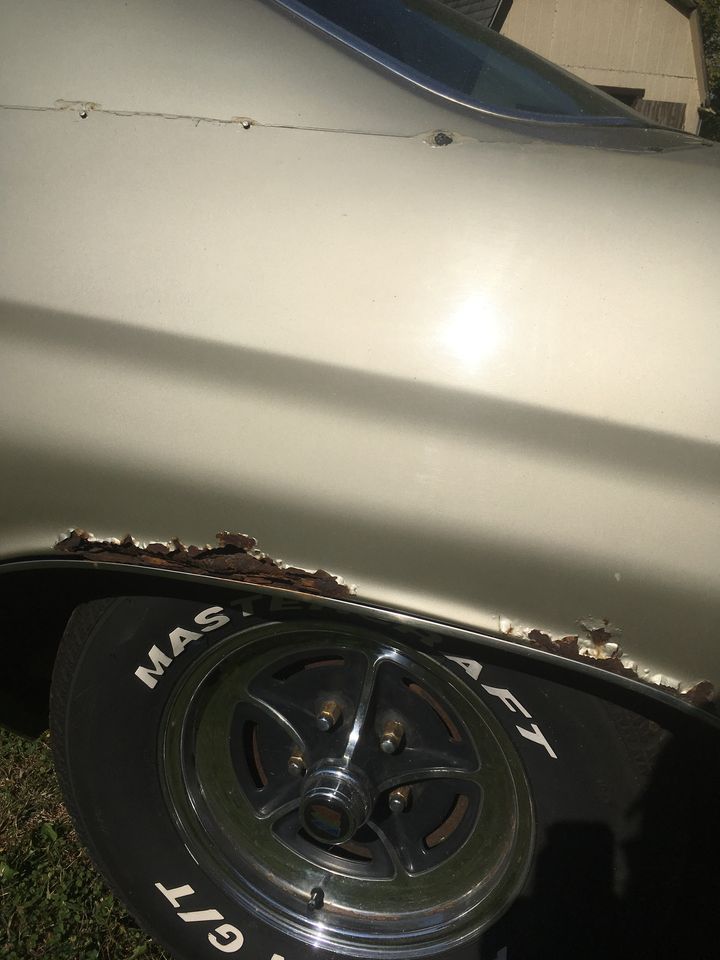
Biggest no-no on our '73 here is the rust, of course. It's not an easy fix and many body shops stay away from it because it's not worth their time. Get it up on a lift and get somebody who knows what to look at to stick their head deep up and into the wells of this car. Considering this is for sale less than an hour northwest of Cincinnati, I'm a little surprised there's as much rust as there is. You get up here close to Lake Erie, and this sort of thing is an everyday occurrence. Even on cars less than ten-years old. Looks like the vinyl top was pulled too and they left the rivet holes for its trim pieces. Looks like you may have to spring for an entire re-spray. Ka-ching, 


Technically, the Buick LeSabre "Luxus" replaced the Centurion for 1974 but the Centurion\Wildcat\Invicta\Century slot on the Buick lineup was actually replaced by the new-for-1973 Century model that could be ordered in "Regal" trim with a 455 CID Buick engine. We all know how that story ended with the OPEC embargo just as the 1974 model year began, making any car, big or small, with a V-8 a pariah. That admonishment of gas-guzzlers was fairly short lived, but big cars with the pretense of performance were, save for boutique editions, like the Roman Empire, gone for good. 

Thursday, September 28, 2023

1977 Buick Electra Limited - All Grown Up


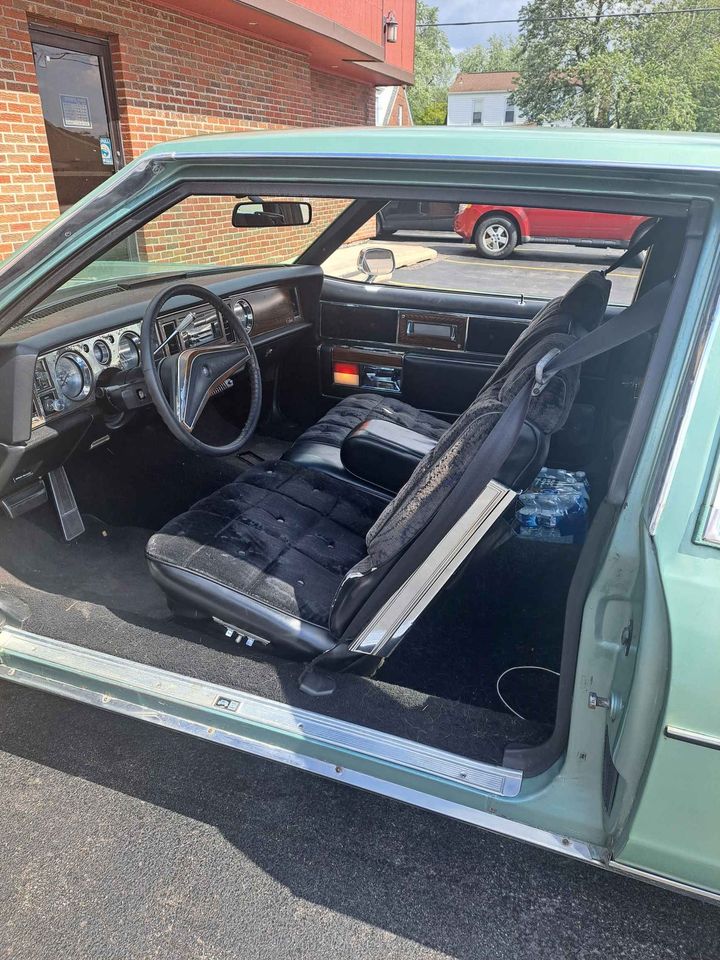
I've surmised my appreciation of 1977-1979 Buick Electra two-door sedans, can't really call them "coupes", stems from my brief experience inside one during the summer of 1978 during my parent's inane used Cadillac search. Bored silly with the sales process and my parent's incessant jack hammering of salespeople, I had wandered off on the dealership lot where they would end up buying the 1972 Sedan deVille, that would define the earliest if not darkest days of my driving life, and was delighted to find the driver's door unlocked on a powder blue, used, 1977 Buick Electra two-door, not unlike this 1977 Electra Limited. Then as now, I knew a good opportunity when I saw one. I slowly, gently and carefully opened the huge door and slithered inside making sure not to have the door touch the car for sale next to it. 


I fumbled around with the power window buttons that were off, the power-door locks that did work and, much to my delight even though, again, the car was off, the power driver seat worked. I was fourteen at the time and short for my age at maybe five-feet-four, maybe five and I was terrified of the thought of driving my father's impossibly large 1970 Electra. On that '77, however, with the seat jacked all the way up and as close as possible as I could get to the wheel and have my feet touch the pedals, little young me felt he could actually drive it. The cushy velour-ish seats felt decadent too and way nicer than any of the Cadillac's my parents were looking at with their austere and hard, Ostrich-leather. I was in the lap of luxury and I thought I could actually drive it. That was how the "other half" lived and I liked it. A lot. 

Unlike many an automobile enthusiast of my, ahem, vintage, I'm not the biggest fan of General Motors "Class of 1977", downsized full-sized cars, especially the four-door models. I don't outright dislike them, but I find their styling bland if not laisse-faire, their lack of engineering advancement, seriously, they were nothing more than a somewhat shrunken rehash of what GM had been doing for over fifty-years at the time, disconcerting. As they say, though, there are exceptions to everything. And whether or not it was puckish, tweenie me playing with one or not four-and-a-half decades ago, the 1977-1979 Buick Electra two-door sedans are that exception. 


I must really like these cars because I can see past the sickly, puke-green exterior and blue velvet seats that look like Elvis threw up all over on this one. As they say, love is blind.  The 1970's were full of horrendous color combinations like this and this is relatively tame compared to other schemes from back then. Throw a white, $99 "Earl Sheib paint job on this one and you've have a sweet ride. Cost of a "real" paint job might run you half the $9,000 asking price for this car. Will you be paying by check or cash? 

General Motors' "Great Downsizing Epoch" sawzalled eleven-inches and some 800-pounds from the 1976 Electra but it was still a BIG car at 222 inches long. And while there isn't one "Class-of-1977" full size GM car that I'd want in my "Jay Leno Fantasy Garage", alright, maybe an Electra for old time's sake, even though I'm an ardent fan of the oversized 1971-1976 GM full-size line, I can tell you first hand that those cars were comically too large. It wasn't just that they were so freakin' long either - it was their damn width that freaked me out. At just under eighty-inches wide, they might as well have been assembled by Peterbuilt. My palms still get sweaty thinking about driving one on the oh-so-narrow, "Pre-War" streets I grew up on back on Long Island just east of the City line.  The downsized '77's comparatively anorexic at 77-inches port-to-starboard. 


1977-1984 Buick Electra's share their chassis body shells, doors, roof panels, transmissions and many ancillary components with the Cadillac deVille and Oldsmobile 98. Said "Downsizing Epoch" also brought about "divisional sharing" of engines - our green machine here sports an Oldsmobile built, 185-horsepower, 403 cubic-inch chuffer. Yes, an Oldsmobile engine in a Buick; blasphemy. What's more, you could also find that 403, which was a bored out version of the venerable Oldsmobile "350",  under the hood of 1977-1979 Pontiac Trans Am's equipped with automatic transmissions; So, what's more nefarious, the big Olds engine in a Buick or in a Trans Am? Then again, did or does anyone really care? Some things are important only if you make them out to be; sometimes it's best to under-communicate. Pontiac also used the 403 on their 1977-1979 Bonneville and Catalina in high altitude areas and in California.

One thing I'd insist on if I had to have this '77 is I'd make sure it came with the optional 3.08 gears and not the standard 2.41's. And if it didn't, even though the 3.08's with the torquey 403 would probably deliver pre-downsizing gas mileage, I'd have them swapped in. No one's going to be using this as a daily driver or taking it cross-country anyway. C'mon, let's make the most of what this has to offer without going crazy modding the engine. 320 foot-pounds out of the box! Drop it in "D", stab the gas and watch that Electra hood ornament shoot up to the sky. 


GM updated their 1977 full-size line for 1980 with what is referred to as their "aero-treatment" and it did wonders for them aesthetically although, through my foggy goggles, they jumped the shark with what Buick did to my Electra. Gone was the sharp, crisp lines that would make Don Draper weak-kneed, the rear windshield formalized, the whole package got old man dorkified. Let's not go there with what they did under hood. Standard V-6, anyone? At least they had the good sense not to make the Olds diesel the default mill. 


Nothing brings back memories for me like an old car. To this day I think of that brief moment when I was behind the wheel of that '77 Electra and I felt all grown up feeling that not only could I actually drive, but that I could drive a big car like that.