This 1967 Chevrolet Chevelle caused a bit of a dust up on the General Motors appreciation page I follow on Facebook. Some members taking exception to the $29,000 price the owner is asking for. Here's the rub - NADA pricing guidelines indicate it's not unreasonably priced. Yikes. That's a bit of a head scratcher but it is what it is.
I get that some would be upset. $29,000 might be a somewhat pie-in-the-sky given this car obviously needs a paint job and some interior mending. However, its numbers matching and a Tennessee car! Anybody got a trailer they can loan me?
I also get how many chafe at what these are going for these days. Back in my day this was a $1,500 beater and then many would say I wasted my money on some old Chevy that doesn't have power steering or brakes. What's more, if I said it was going to appreciate greatly they'd think I'd really lost my mind.
Back in the 1980's when cars like this started taking off in value, there was some quasi-discernible line in the sand dictating what cars were worth more than others. Some drew it at the drop in compression ratios in 1971 and 1972, others said safety-bumpers mandated by the government in 1973 and 1974. Meanwhile others say it was the advent of catalytic converters in 1975. Suffice to say, most cars made after 1975 aren't worth nearly as much as anything made before then.
Nowadays, seeing that everything old seems to be commanding a premium, those lines are less important or matter. Even that lime green Pinto wagon I found the other day has an asking price that defies reason. Keep in mind, that one was a pre-safety-bumper Pinto. I say that rolling my eyes.
The values of first (and second) generation Chevelle's has been great for decades now and over the last ten to fifteen years they've gotten, frankly, insane. I can't help but imagine the expression on my wife's face if I was to attempt to justify spending any where near 29K for this red-head in particular. And then dropping, in theory, that much more in restoring it.
My greatest concern, and I've been saying this for years now, is how much more are cars like this and countless others going to appreciate? And who's going to buy them? Who would buy this now? Granted, they've always found buyers but these days I'm more concerned than ever.
Why? Because kids today, in general, don't care about cars let alone "classics" like this. To them, cars are mere appliances to get the from point A to B because they haven't developed a teleportation app yet.
Even my semi-car crazy older son, who's about to turn twenty-five, is fairly ambiguous when it comes to old cars. Sure, he loves the look of them but he knows better than to think that an old Chevelle like this would come anywhere near the driving experience of his 2017 Chevrolet Camaro 1LT/RS.
Can't say I blame him but he's more cognizant of the differences between antiques like this and modern automobiles than most young adults his age. Chalk that up to his dear old dad who refused to resto-mod our 1977 Corvette. Everything I do to our plastic-fantastic is to restore it as close to its 1977 glory days as possible.
To most kids today, even older folks who don't know better, the driving experience of a car like this would have them thinking that there was something wrong with it. Nope. There's nothing wrong it, kiddo. It's just from a different time. Now get off my lawn.
Oh, and if you find that teleportation app in the app store please let me know. That might come in handy.
I like to tell my staff to find a long established parade, jump in front of it and claim it as our own. Sure, at first folks bristle at the notion but if we do it repeatedly, over time, that parade becomes our own. Especially if we improve upon what it was. Such was the case of Pontiac and their 1964 Tempest GTO.
The notion of a big engine in a small car was certainly nothing new come the fall of 1963 when Pontiac introducted the Tempest GTO. Frankly, neither was the muscle car.
Years prior moonshiners had either modified existing engines or stuffed larger, more powerful ones into their "Rum-Runners" so they could out-run the police.
They even raced their cars when they weren't "working". After Prohibition ended, "hot-rodders" continued to modify their cars and by the the late 1940's and into the '50's, the market for "go-fast" parts had become a cottage industry.
Somewhere along the line, Detroit got wind of the speed-craze even if the major manufacturers were, officially at least, vehemently opposed to supporting racing.
Now, we can debate all day as to what the first "muscle-car" from an automobile manufacturer actually was.
Whether it was the 1949 Oldsmobile Rocket 88, 1955 Chrysler C-300, 1956 Studebaker Golden Hawk or even the 1957 Rambler Rebel, what we do know for certain is it was General Motors' Pontiac division that first used the phrase "musicle-car" when they introduced their intermediate size Tempest "GTO" for model year 1964; regardless of whether or not it was the first. After all, what's in a name?
Revisionist history being nothing new, the combination of the GTO's fiendish good looks, performance moxy and the "muscle" of General Motors marketing department blurred the lines such that the 1964 Pontiac GTO is generally regarded as the one that started the oh-so-short muscle-car craze.
Talk about jumping in front of a parade and making it your own.
My recent critically acclaimed and award-winning soliloquy (no one fact checks anymore, right?) about the 1971 film "Vanishing Point" and the 1970 Dodge Challenger R/T featured in it reminded me I'm way over due in blogging about the '70 Challenger's stablemate, the also new for 1970 Plymouth Barracuda. Grab your tie-dye and bell bottoms and let's get at it.
Of course, I can't leave well enough alone - I have to include a history (below) of the Barracuda's that came before the mighty 1970 rendition. Let's also back off the aquarium tank and acknowledge the Plymouth pony car's namesake which is a predatory, salt-water fish. Adorable, no? Might as well have named the car the Plymouth Piranha; the alliteration sounds catchier too.
A "barracuda" is also a less than flattering slang for a sexually aggressive woman or someone behaving underhandedly. The mighty Wilson sisters 1977 rock anthem paying homage to such people and behavior and not the fish or Chrysler built automobiles. Thank goodness the Plymouth Barracuda was long gone by the time this song came out; who knows what cheesy commercials would have been made using the song as an underscore. Gosh, those first couple of Heart albums where fabulous where they not?
Born into the murky waters of a market segment that had yet to be defined, the Plymouth Barracuda faced more problems than just a questionable namesake. The original debuted on, of all days, April Fool's Day, 1964 which was, notably, a good two-weeks plus ahead of Ford's debut of the Mustang. It was all downhill or upstream from there.
The original Barracuda, based on Chrysler's capable compact "A-body" chassis, was actually branded as a Plymouth Valiant Barracuda and perhaps done-so by the product-planning and marketing team that branded the 1960 Valiant as a "Valiant by Chrysler" and not as a Plymouth Valiant. That transgression quickly rectified come model year 1961. Chrysler dropped the Valiant pre-fix for 1965 and they, wisely, never brought it back.
The only tangible difference between a Valiant and a Valiant Barracuda was this gigantic rear windshield, or "back-light". Chrysler partnered with Pittsburgh Plate Glass to fabricate this thing that was and remains the largest piece of automotive glass ever produced. Nothing if not distinctive, it added approximately one-hundred pounds to the curb weight of a Valiant and was heavily tinted so as not to turn the insides of the air-conditioning free Valiant, err, Barracuda, into a greenhouse or sauna. Aside from that, the '64 Valiant Barracuda was all Valiant. Well, save for the availability of a high-performance version of Plymouth's 273 cubic-inch V-8 engine on Formula S models. For 1965 and beyond, Barracuda was a separate model from the Valiant even if it stayed looking like a Valiant with a huge rear window. You wouldn't be alone in thinking the design somewhat attractive if not cool while also being cluttered and awkward.
Unlike what Ford was able to do with their Falcon based Mustang, purportedly, what with millions spent and lost on the abortive 1961 downsizing of Plymouth and Dodge models, Chrysler did not have the financial resources to fully develop the Barracuda into a uniquely styled automobile. The fact that the Barracuda was a lightly disguised Valiant along with Plymouth calling it a Valiant Barracuda for 1964 being the auspices that have been decided as being the circumstances that did in Barracuda; the thinking goes buyers were unable to decipher the car from the economy car based Valiant.
To make matters worse, Plymouth marketed the utility of the Barracuda what with its fold-down rear seat and generous cargo area afforded by the massive back-light. Can you mix business with pleasure? On paper, maybe, but rarely could you do so back then. Today's do-everything-well cross-over utilities are a different story but back then a practical sporty car was akin to taking mom along on a hot date. Although that hot date had a habit of balancing picnic baskets on her head.
Plymouth slogged on through 1966 with the Barracuda making minor styling updates to the Valiant based two-door as designers headed back to the drawing board. Less than one-hundred thousand 1964-1966 Barracuda's found buyers meanwhile Ford literally and figuratively ran all the way to the Mustang bank to the tune of more than a million sold during the same time.
It's easy to say that Plymouth should have come out with this car in 1964 and not what they came with instead.
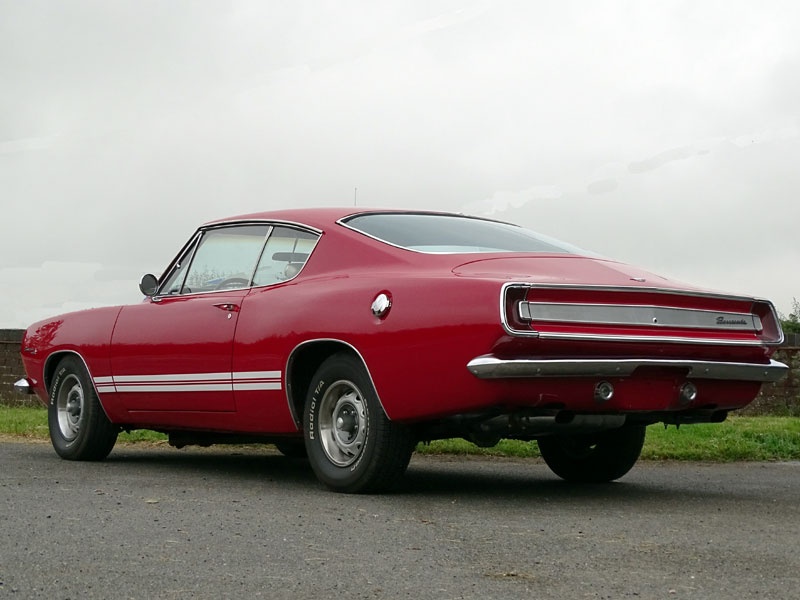
Available in notch-back, convertible and fast-back with a smaller more conventional looking back-light like this, the 1967-1969 Barracuda was still A-body based underneath but featured all-new, unique sheet metal up top that was construed as a stylistic success. From some angles I'd concur; from others not so much.
However, sales were still disappointing with this generation of the Barracuda best sales year, 1967, below the best years of the 1964-1966 models. A large part of that was most likely due to a market segment that now included a redesigned Mustang and a version of it from sister division Mercury. Don't discount GM's world beating twin-ponies, the Chevrolet Camaro and Pontiac Firebird. The market for these types of cars may have increased and expanded but it could only so by so much. Choice, after all, is great for customers but terrible for business.
Seeing that by the late 1960's what had become known as "pony-cars" had became a lucrative market segment commanding thirteen percent of all vehicle sales, somewhat remarkably, Chrysler executives tried for a third time to make inroads with an all-new Barracuda for 1970. Have to hand it to Chrysler in those days, they were nothing if not diligent.
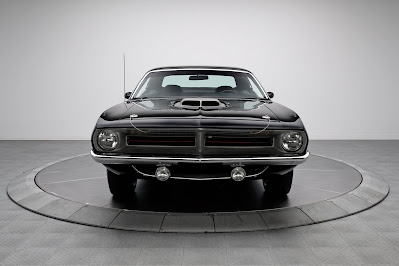
Which brings us to today's main attraction. Ladies and gentlemen, may I present the greatest looking muscle or pony car of all time, the 1970 Plymouth Barracuda.
If I thought that Chrysler should have come with the 1967 Barracuda in 1964, then Chrysler should have come with this car in 1967. I hate the word, "should" but sometimes no other word is appropriate,
Bigger in every way from 1964-1969 Barracuda's except in actual length, the 1970 Plymouth Barracuda and it's stable mate Dodge Challenger began their development. Chrysler starting with their intermediate "B-body" chassis that also underpinned the Plymouth Satellite and Dodge Coronet.
Essentially a mid-size car with a shortened wheelbase, the 1970 Barracuda was available in notch-back and convertible only; the fast-back design gone from the line up but lived on, somewhat, in a new "A-body" based design at Plymouth known as the Duster.
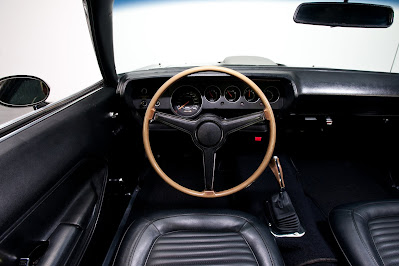
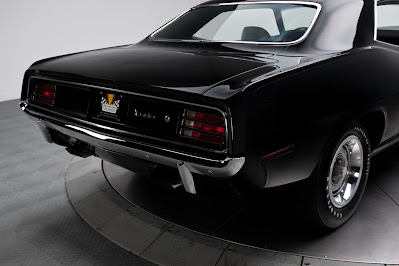
Subjective as it may be, my blog, my rules, pardner, what Chrysler came with in 1970 with the Barracuda was and remains, to me at least, one of the greatest looking automobiles of all-time. Note I said "looking".
Curiously, the story goes that Chrysler did little suspension work on these believing that as fast as the cars where, if they could handle well it would have been even more dangerous. Makes no sense now, of course, as a high-performing car is actually a safer car. Well, usually. If you've ever had a car that was fast as hell but handled poorly, you know how quickly that gets old. As they say, it's much more fun to drive a slow car fast than drive a fast car fast.
That was too bad given how spectacular the design was and how well they could go in a straight line. The 1970 and 1971 models with Chrysler's mighty 440 cubic-inch V-8 in particular. The "Hemi" models as well but I'm of the opinion that the 440 engine was a better day-in, day-out street engine than the street-legal race engine that was the Hemi. "Legendary" doesn't always mean "good". I'd also opt for a 'cuda with the 340 "Six-Pack" but that's just me. Again, power is over-rated; it's control you want. Well, power and control.
Wouldn't you know it, though? Sales of these-generation Barracuda's, while better in 1970 compared to 1969 models, were extremely disappointing. Approximately fifty-five thousand found buyers in 1970; Dodge sold more than seventy-six thousand Challenger buyers but it's been said those sales came out of the bumpers of Charger sales and not Barracuda's. I know, weird but that's what they (der experts) say. . Barracuda sales dropped to around an abysmal eighteen-thousand for 1971, 1972 and 1973 sales hovered around a twenty-two thousand. In 1974, the model year most affected by the 1973 OPEC embargo, less than twelve-thousand Barracuda's left dealer lots.
So, how could such a handsome car as this fail so badly at the box-office? Blame a confluence of circumstances the most significant of which being rote bad timing.
Chrysler coming with this gorgeous albeit overinflated, ill-handling gas-guzzler just as the performance car market was beginning to wane. That due in large part to insurance company surcharges on any vehicle construed as a performance car. Couple that with less than stellar reviews because of it's ponderous handling capabilities, or lack there-of, not to mention a market by 1970 literally clogged with options for buyers and it's fairly easy to see what happened to the Plymouth Barracuda.
Also, to use a vernacular of the times, "dig-this"; if you were of the age and of the means to buy a sporty compact in 1970, what with the gaggle of makes of models available to you, which one, all things being equal and you wanting the best car for your money, would you buy? Keep in mind GM's Camaro and Firebird were freshly updated and were gorgeous and performed better overall and the 1970 Mustang and Cougar were updated as well. You also had a Plymouth Duster that handled better and went like stink when optioned with the right go-fast engines. Choices. Choices. Too many choices, actually. Remember what I said about choices.
An all-new Barracuda was planned for 1975 but Chrysler didn't move forward with it seeing the automobile market was changing so quickly. 1974 was the last model-year for Plymouth's fish-car with approximately just one-hundred fifteen thousand "third-generation" models sold.
Ironically, 1970-1974 Plymouth Barracuda's, especially the 1970 and 1971 models, more than likely due to their scarcity and the fickle nature of the collector car market, have become some of the most sought after and valuable cars of this era.