Monday, April 10, 2023

1985 Cadillac Coupe deVille - Happy Easter


It was a lovely, sun splashed spring afternoon around easter time day on Long Island in 1984 when I first saw one of Cadillac's all-new-for 1985, front-wheel-drive deVille's. I don't remember if it was a coupe like this '85 decorated like the easter bunny but I do recall a sick feeling in the pit of my stomach realizing that my beloved General Motors had made another hideous mistake. 


Was there another time in the annals of automobile history when a manufacturer immolated themselves to the degree that Cadillac did in the early-to-mid-1980's? GM in general but what happened to Cadillac was particularly harrowing. Whether it was the hump-back 1980 Seville, V-8-6-4, HT4100 (engine) or the creme-de-la-creme, the Chevrolet Cavalier based Cimarron,  you didn't have to be an automobile connoisseur to appreciate that GM's luxury brand had run aground. And the hits just kept on coming. 

These cars were actually the second wave of shrinking to GM's full size line, the first of course occurring in 1977 when they began their great downsizing epoch. The front-wheel-drive deVille's were actually supposed to launch in 1982, but development issues tapped the brakes on their debut into 1984. In the old way of GM doing things, they launched them in early '84 and called them 1985's. No harm, no foul. Well, at least in terms of when they introduced them. Can't say that about the cars themselves. 

Irony of ironies, the one thing that was ready to go by 1982 was their engines. Well, supposedly ready to go. The 249-cubic inch, aluminum block, iron head V-8 developed exclusively for these front-wheel-drivers was dropped into Cadillac's existing models after the V8-6-4 debacle of 1981. That it made all of 135-horsepower and (good grief) 190-foot pounds of torque and was tasked with moving some cars weighing north of two-tons wasn't the biggest issue facing the "HT4100", catastrophic engine failure was. 


The HT or "High Tech" had such maladies as head gaskets blowing, cam bearings going kaput, oil pumps giving up the ghost and on and on. For a company that had such a stellar reputation up to that point with V-8 engine development, it was particularly vexing. They'd fix most if not all of the issues with the HT by the end of the decade but Cadillac took a serious kick in the giblets to their reputation at a time when failure was not an option. 

The styling, or lack thereof, is what depressed me the most. I could have cared less if these were front-wheel-drive with transverse mounted V-8's or not and handled better than any Cadillac before them. This college sophomore thought there were ugly. Apparently, I was fairly alone in that sentiment as these flew out of dealerships. At first. Not unlike the first MY for Chevrolet Citations and their various spinoffs. 


This pink-on-white CDV is for sale on Facebook Marketplace with an asking price of $990. A scant 67,000-miles on it's analog ticker. Why so cheap? Blown engine. Won't even crank. Sounds to me like its aluminum oil pump croaked and the engine is totally locked up. Sort of a shame but not really. I mean, seriously. And this came from the factory looking like this. 


General Motors famed design honcho Bill Mitchell retired in 1977 and the last designs he was directly responsible for where GM's class-of-'77 full-sized models and what would become the 1979 downsized E-body Cadillac Eldorado, Oldsmobile Toronado and Buick Riviera. You can see a familial resemblance in those designs harkening back to his glory days of the 1960's. He had nothing to do with the 1978 shrink-rayed intermediates and anything else that came after. Including, of course, these cars. 


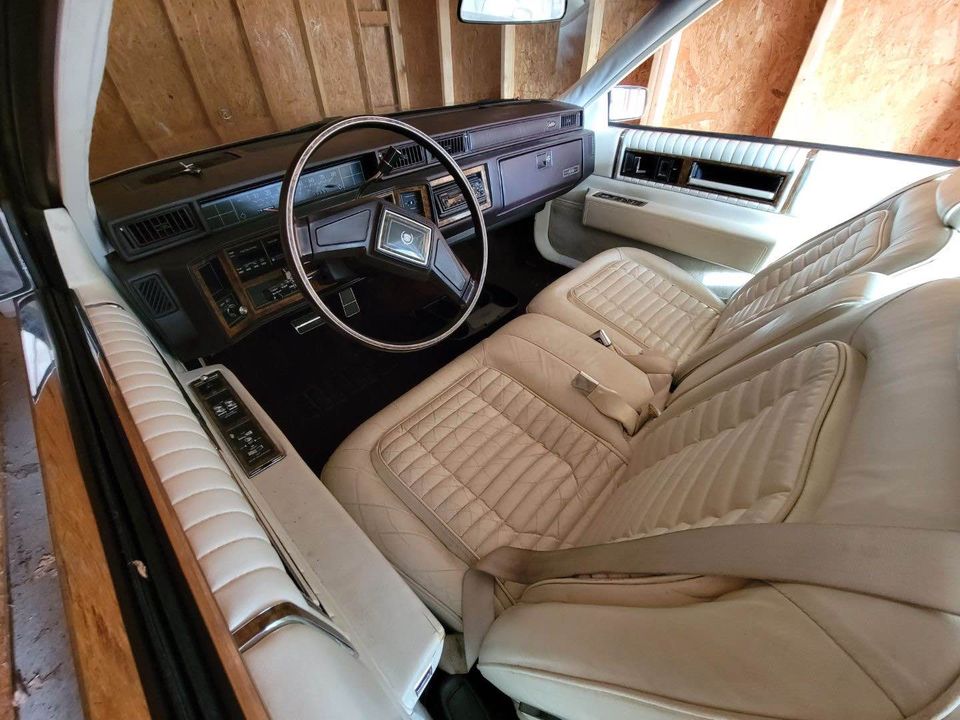
The "heather-firemist" hue and padded landau top do the blocky, bolt-upright styling no favors. At least the interior is handsome and is as cavernous as the insides of the deVille these replaced. Perhaps more so given the lack of a driveshaft hump. To that degree, these were engineering watersheds. 

Even if this car was a different color and it didn't have the silly padded top, I can't do the mental gymnastics to make the more than fair asking price seem worthwhile. As far as the engine goes, there's no shortage of zesty options available but something tells me someone will scoop this up and gut the insides and throw out the rest. 


Not unlike what we do to easter eggs. 

Saturday, April 8, 2023

1972 Cadillac Coupe deVille - The Wizard of Oz


1972 Cadillac Coupe deVilles aren't my favorite Cadillacs but they were, in my opinion, the last Cadillacs to uphold or attempt to uphold all of what a Cadillac was supposed to be before, much like Richard Nixon after 1972, things really went down hill. 

And what, exactly, was this Cadillac attempting to uphold? Frankly, nothing more than the mantle of what was once referred to as the "Standard of the World". Sounds like a big responsibility but that mantle had little more going for it than a Chevrolet Caprice that could be had at some 25- to 30-percent less. With nothing more going for it than image, this car might as well be the Wizard of Oz. And Toto was about to pull the sheet off the old man. 


Sure, you could get some niceties on a Cadillac you couldn't get on a Chevy like these rock hard leather trimmed seats, a scooch more rear passenger room due to a longer wheelbase, an insanely thirsty proprietary engine and a funky trunk closer, but not much else. Buyers did get to say they had a Cadillac and that notion still meant something in 1972 to a lot of people; my mother included. Times were about to change, though. Big time. 

1972 was the last year before the safety-bumpers came in 1973 and 1974 that along with the center post on the coupes, ruined the flow of the design. The OPEC oil embargo of 1973 made fuel-swilling Cadillac's even more pariah like and those who really "had it", were opting not for Cadillacs but rather Mercedes-Benz'. The hits just kept on coming for decades as Cadillac attempted meekly to stand down the luxury imports. 


So, what exactly made a "Cadillac" a "Cadillac" in the first place? Well, it wasn't vestigial tail-fins, sheer bulk, or a premium sticker price - it was engineering innovation. That combined with lavish styling and masterful marketing. All that and in reality, no real competition. 


Named after Antoine de le Mothe Cadillac, the founder of Detroit, an independent auto maker until bought by General Motors in 1909, Cadillac was the first manufacturer to offer interchangeable parts, electric engine starters, fully enclosed passenger cabins, "Synchromesh" transmissions, mass-produced V-8 engines, shatterproof safety glass, power steering and more. 


General Motors drive to keep profit margins at the incredible levels they were in the decade or so after World War II led to compromises in design and engineering. With Cadillac comfortably perched at the top of General Motors vaunted pricing ladder, starting around 1950, GM put Cadillac development on cruise control as many of the luxury trinkets Cadillac pioneered trickled down to lesser makes and models. 

That's fine but Cadillac all but stopped innovating. Beg to differ, but perhaps aside from sentimental lighting introduced in 1964, and that was hardly as seminal as the electric starter, name a single engineering innovation Cadillac came out with between 1950 and 1972 that changed the automotive industry for good. 


Didn't matter much to Cadillac buyers in 1972 as it was a record sales year and a Cadillac was still construed as something special although it was all smoke and mirrors. The average worker's buying power was at an all time high in the early '70's as well making a Cadillac quite affordable to the work-a-day bourgeois. 


Somewhat inexplicably, in the summer of 1977, out-of-the-blue, my mother insisted my father trade in his 1968 Ford Ranch Wagon and replace it with a Cadillac. Granted, I was delighted that she finally saw the light that we should shed ourselves of that rental-grade appliance, but I was not enthralled with her insistence my father get a Cadillac. 

I knew how silly it would look in our blue collar, working class neighborhood to go from a humble station wagon to, of all things, a Cadillac. "Look at us, we're rich now!" No, we weren't. We owned a trapping of the wealthy; we was still the same poor bunch of slobs we always was. 


I recall my mother ultimately being less than enthralled with the 1972 Sedan deVille they ended up with although I was never quite sure what she was expecting in the first place. To be showered with adulation like British royalty parading outside Buckingham Palace? To explode in orgasmic bliss each and every time she rode in it (she never learned to drive). The thrill of telling people she had a Cadillac got old real quick too. But, she got her Cadillac. 


Sunday, April 2, 2023

1974 Chevrolet Nova Hatchback - What Was Not to Love?


I've always had a soft spot for 1968-1974, two-door Chevrolet Nova's with a "350" badge on the front fenders denoting a 350-cubic inch Chevrolet V-8 under the hood and the hatchback option. These cars even looked pretty good with the battering-ram, five-mile-per-hour, government-mandated safety bumpers. Ah, such the stuff of "first-car-dreams" that went unfulfilled. 


Alas, on this $2,500 Facebook Marketplace find, the 350, which was available in three-states of tune up to a 185-horsepower barnburner, and it's partner-in-crime, it's "Turbo 350" transmission, are long gone. Judging by the rust on the frame and suspension here, looks like gone a very long time. Most of these 350 Nova's came with 145-horsepower, "350-two-barrel's", a 160-horse, four-barrel available for '74 as well. Please hold your laughter regarding the asking price for our subject until the presentation is completed. Thank you. 


Somewhat curiously, General Motors came out with a hatchback option on these cars in 1973 which was only two-model years before a fairly substantial reboot of the line for 1975. Any Nova, or any of their "clones", are tough finds these days. Hatch's rarer still. 


America's ambivalence towards hatches has always vexed me since they were oh-so-practical and, in my opinion, added a sportiness to the rear styling. Fold down the rear seat and you've 27.6-cubic feet of storage space too. More than enough room for a 19-century wicker picnic basket and lacrosse equipment. Yes lacrosse. What was not to love about a hatchback? Granny-mobile Nova four-door's? Never. Nova hatchback? Yes. Yes, please.  


The practice of platform-sharing was all but as old as GM by the time the 1970's rolled around but doing little more than festooning different names to the same cars got a jump start in 1971 when Pontiac started selling a Nova they dubbed, "Ventura". The Buick Apollo and Oldsmobile Omega came in 1973 - put 'em all together and their first letters spell-out, "N-O-V-A". 


"Nova" is derived from the Latin term, "novus", which means "new". Speaking of new, just in time for the 1973 OPEC embargo, all the Nova's all got new 21-gallon, rear-suspension compressing gas tanks. That "350" may have been cool but it was thirsty and the monster sized tank helped extend range a good 40-60 miles. Your mileage may vary, see dealer for details. 


Sales brochures for these cars lauded their manageable size as much as anything even though they were, at least by today's standards, hardly small. Classified as compacts, big-bumpered Nova's were some 196-inches long and 72-inches wide, all but the same as a 2023 Honda Accord that no one would consider a "compact car". The real upside was they were perhaps the best handling cars made in the U.S. at the time. 


General Motors replaced these neat little-big-cars for model-year 1980 with their infamous Chevrolet Citation's; Pontiac and their Phoenix, Oldsmobile their Omega, Buick their Skylark. Together their first letters spell, C-P-O-S; that mean Chevrolet Pieces of Shit? All of the CPOS', save for the Buick, came with hatchbacks. 

Friday, March 31, 2023

1966 Plymouth Fury - Insanely Good


Here's the definition of "cool" if you look it up in the dictionary - "fairly low temperature but not cold" or "showing no friendliness of indifference towards someone or something". Meh. Doesn't cut to the quick of how I feel about this 1966 Plymouth Fury III I found on Facebook Marketplace recently. Urban dictionary is far more apropos: "insanely good". Yeah...that's more like it. 

1965 was a unique model year in that GM, Ford and Chrysler all had new full-size models. If I was to declare a winner amongst the "low-priced three", between the new-for-'65 Chevrolet, Ford and Plymouth, the Plymouth gets my vote. By a wide margin over the Chevrolet too. Your mileage may vary, see dealer for details. There are subtle if minute differences between this '66 and a '65 but for the purpose of today's soliloquy, there' all but identical. 


Big Plymouth's for '65 rode on a new full-perimeter frame, Plymouth's (and Dodge's) first new full-size chassis since the abortive 1962 downsizing. They kept the old "'62" full-sizers around making them the underpinning for a defacto mid-size line that was freshly fanciful at GM and Ford. 

That, to a large extent, explains why Chrysler intermediates were always a bit bigger than GM and Ford's middle-children meanwhile these new full-size Plymouths were slightly smaller  than "their" big boys. They're sized right if you ask me. 


You wouldn't be alone thinking what were marketed as intermediates at Plymouth (and Dodge) were full-size makes and models as well. Back then it was like Plymouth and Dodge had two separate lines of full-size cars. 


The first Plymouth to wear a "Fury" badge was a sub-model of Plymouth's then top-of-the-line "Belvedere" in 1955. Fury became its own series above the "Belvedere" in 1959. In 1965, the "Belvedere" moniker, which I've always thought was a simply gawd-awful name for a car, remained on the aft-forementioned 1962 circa platform officially becoming an intermediate what with the Fury now riding on the new and larger platform or chassis. The Belvedere nameplate finally swam with the fishes after MY 1969. 


Fury came in five different trim levels. For 1966, there was the rental grade, bone-stripper Fury "I" bought by rental car companies and municipalities. Then there were the Fury II's and III's that were better appointed with niceties like power steering and brakes, automatic transmission, air conditioning and 17 different exterior color schemes; Fury I's only had 9. 

Slotted above the "III" was the coupe only Fury "Sport" and lastly and leastly if you ask me, akin to Ford's "LTD" and Chevrolet's Caprice, the Fury "VIP" that was all but a luxury car with plush interiors, fake-wood trim and, of course, that bastion of luxury car denotation, fender skirts. Even on VIP-coupes. Well, no one's perfect. 


Unfortunately, there's a lack of details about this car in the Facebook Marketplace ad and while I was surprised to find it still posted when I searched for it again this morning, that could be an indication of trouble. Or someone looking to flip something they bought and quickly realized there was a whole lot to do on it they didn't anticipate. Been there done that. Note that big blob of blue paint on the hood - this oldie but goodie got resprayed a long time ago. 


Only 57,000-miles on her 57-year-old ticker but low mileage on an old car and $2.75 will buy you a ride on a New York City subway; in other words, in general, it doesn't matter.


Lack of photos of the front seat and the dash is disconcerting. Along with the resprayed paint failing there's some trim falling off but all-in, based on the pictures, not a bad looking Fury III. Especially up near Detroit where the tin-worm is as popular as it is down here in Cleveland. 

These things can be bought in even better shape for around $12,000 these days which tells me as well that the used car market is coming back down to earth. A year or so ago this would have been priced around ten-grand if not more; makes me feel a little bad for anyone who overpaid for a car during the height of the Pandemic-driven, hyper-price inflated days. 


Much of the credit for 1960's Chrysler's I appreciate goes to the famed designer Elwood Engel who his staff said had an uncanny eye for "commercial viability" of designs. I'd say he was insanely good at it. 


Saturday, March 25, 2023

1978 AMC Matador Wagon - Non Playable Character


From my, "you sure don't see many of these around these days" file, I bring you this very generic looking blue-on-blue station wagon. It's so run-of-the-mill, save for that "WTF front end", it's almost like a non-playable-character in some video game. But this isn't an "NPC", it's an AMC Matador wagon from the last year long gone AMC pushed them out, 1978. 


I'll do my best to adjust my ocular nozzles to see this thing through my woe-be-gone, "Wonder Years" goggles and what I remember was that any folks who had one did so because they were less expensive than anything The Big Three offered. Value first and then they were somewhat less large than what GM, Ford and Chrysler sold as well. Therefore, I could surmise, I'm somewhat amazed my father didn't have one because an AMC Matador, sedan or wagon, has my old man's name written all over it. These also came in a funky, not in a good way, two-door coupe that rode on a shorter wheelbase and shared not a single body stamping. 


Same buyers of these things not unlike purchasers of anything from Hyundai or Kia today - they see value first and foremost. Or they did. Hyundai has certainly come a long way, make that a very, very long way, in shoring up their brands in the public vernacular as being more than affordable. I still would never be caught dead in one. 


AMC, which in a good year might have sold half of what Chrysler did and Chrysler sold about half of what Ford would do, sold many a Matador sedan and wagon to fleets; particularly police departments who found them to be quite reliable. Such a deal for local municipalities who'd buy then en masse. Of course, Sherriff Taylor would park his Matador behind the station at night and drove home in his Ford or Chevy. 


"AMC", an acronym for "American Motors Corporation", the result of the 1954 merger of Nash and Hudson, had cut it's front grill at first on being purveyors of compact and midsize models. Once The Big Three dipped their bumpers in their world, their golden goose was cooked. They countered with somewhat mainstream looking designs that were all but rehashes of what The Big Three baked up. The Matador, which replaced the Rebel in the AMC portfolio, was perhaps AMC's best attempt to make inroads in the lucrative family sedan\wagon market. 


For 1978 buyers had a choice of a gaggle of compacts at AMC from the Concord to the Pacer, the Gremlin and then the big jump up to the "full-size" Matador which was sized around what The Big Three marketed at the time as a mid-size car. Well, that was until GM started the great down-sizing epoch. Anyway, AMC even had a sporty version of the Gremlin they called, "AMX". Note to self, find a 1978 vintage AMX with the AMC 360-cubic inch V-8 to blog about.  


Plunging sales of the Matador, no doubt due to swanky and heavily marketed smaller wares from GM and Ford, forced AMC to the pull the plug on the whole fleet for 1979. That's not to say they went about flopping around like a fish-out-of-water. AMC rolled out their game changing four-wheel-drive Eagles for 1980; they had the hardware for it in house since Jeep was part of AMC at the time. Hard to understate what a seminal vehicle those homely-as-sin things were. 


AMC was absorbed by the Chrysler Corporation in 1987 who only wanted the company for one thing - Jeep. Chrysler promptly rebranded any existing or then in the pipeline AMC products as "Eagle"; the bones of the Eagle Premiere eventually underpinned the Chrysler "LH" series that debuted to great fanfare in 1993. 

I found this 1978 Matador wagon on Facebook Marketplace and is for sale with an asking price a pie-in-the-sky $9,500. It has only 47,000-miles on it and appears to be in great shape. Perhaps someone would see the "value" in this much like the original owner did. 


Friday, March 24, 2023

1977 Ford Pinto Squire - Living The Dream


Now don't be all like, "I hate Pintos" on me now. Not all of them were bad. Well, ahem, they were, actually but I mean aesthetically. Take this 1977 Pinto Squire in "arrest-me-red" for instance. This was listed on Facebook Marketplace for a scant $4,500 and if I didn't think my wife and my boys would disown me I might be inclined to kick it's tires and factory Ford Mag wheels. 


I mean, shoot. Look at the amount of cargo space this thing has with the back seat down. That's a 57.2-cubic foot hole back here. With the seat up, you still have some 36-cubic feet. I don't wish I still had my 2006 Chevrolet Tahoe and it's 106-cubic foot canyon with the seats down or out, but there are times I sorely miss it. 


And an off-beat little utility vehicle like this would be the perfect thing for those Saturday morning mulch runs to Lowes. The wagon canopy also, in my opinion, makes for a far better looking vehicle than the stubby, almost AMC Gremlin like standard coupe. I'd stop short of saying it handsome like a Vega Kammback, but it's close. 


Again, my family would kill me but what makes this really interesting is it has the optional "Cologne", 2.8-liter V-6. Although making all of 115-horsepower and 138-pounds of twist, in a 2,500-pound car, this thing is going to be pretty zippy. I spy no power-brakes or power steering. She does have an automatic, though. 


She fast? Well, not by today's insane standards but for a vehicle from the deepest, darkest throes of the so-called "Malaise Era", you could do a lot worse. Love these buckets and look at those super-clean rocker panels. This car has been adored and cared for and is one of the best looking "cheapies" I've seen in awhile. Someone hide my debit card! Steering wheel is not stock. 


A buddy of mine in high school had a vomit green, '74 Pinto (non-wagon) and he took a fair share of ribbing about it. And that was in the early '80's too before the legend of the Pinto became ingrained in the public vernacular as a bad thing. Then again, our high school did have a fair amount of richie-riches rubbing elbows with us poor slobs. Thing was, his Pinto was a blast to drive thanks to rack-and-pinion steering enabling it to handle like a go cart compared to just about anything else at the time. 


Ah, but she's red. And it has that woodie-wall paper that kids today hate with a vengeance. I don't blame them. And, yeah-yeah, the whole exploding gas tank thing. I get it. But if I can live my dream of living out in the country on multiple acres with no-one around and I need something to "go into town" in, this could be my muse. And a whole lot better on gas than some pickup truck. 

1974 Cadillac Coupe deVille - Still King


Whoa, nellie. I can't tell you the last time I saw a Cadillac Coupe or Sedan deVille in my favorite color combination of all-white on top of luscious Cadillac red leather. Not to mention a love 'em or hate 'em, '71-'76 decked out this way. And certainly, it's been decades since I've seen one like this '74 in condition this good all for "just" $7,500. This wouldn't look out of place in Elvis Presley's garage let alone mine. 

Our Elvis cake-topper here was part of GM's all new for 1971 full-size models that were longer, wider and heavier than ever. Not by much compared to the models they replaced but they continued GM's axiom of "more is more" although many a pundit say the "'71's" were not as good as the storied 1965 vintage models that came before them. 


These 1974's nearly four-inches longer than the '71's since they had government mandated 5-mile per hour "safety" bumpers front and rear; the '73's had them only up front. The safety-bumpers had a shock absorber system behind them that made all the sense in the world at the time; the delicate ribbons of chrome that passed for "bumpers" were little more than ornamental before then. Funny how what seemed  modern, exiting and the right-thing-to-do in general didn't age well. These days, pre-1973 classic cars, generally speaking, are worth more than those made afterwards. 


Model-year 1974 was a a mid-production cycle re-fresh for the class-of-'71's although there were minor changes in appearances from year to year prior. '74's got a new dashboard that featured a panel of warning (idiot) lights at the top of it, windshield wiper controls were now on the left side of the new dash instead of on the driver's door and there was a new steering wheel design. Much to my chagrin, a center-post on the Coupe deVille eliminated the hardtop aesthetic that had been a Cadillac staple back to 1949 - that done, legend has it, in anticipation of the federal government's mandating improved rollover safety. It never came to be and hardtops, if you ask me, died unnecessarily. Oddly enough, the Sedan deVille remained pillar-free. Well, that was until the Great Down-sizng Epoch of 1977. 


1974 was also the first year for what would become that oh-so-Seventies styling accoutrement, the padded-vinyl landau roof option on the Coupe that, having lived through it, seemed the epitome of luxurious decadence at the time. Now it seems akin to Liberace toilet seat. It also accentuates the center-post and through my foggy goggles, makes it seem as though the front-end of the car doesn't belong with the rear. 


Mercifully, our '74 here doesn't have it. Either someone removed it over the last half-century or so or this was a custom order. If that's the case, three-cheers to the original owner for their impeccable taste. For '74, Cadillac continued to offer an entry-level "Calais" that didn't have the landau top or leather seating areas. 


Under the hood, 1974 was the last year the deVille's had Cadillac's exclusive, 472-cubic inch V-8 that was deemed an engineering marvel when it debuted in 1968. Starting in 1975, all Cadillac models got the Cadillac 500-CID brute that had been Eldorado exclusive since 1970. '74 also the last year Cadillac's were catalytic converter free. 

That said, I've never driven a 472- or 500-cubic inch powered Cadillac and was enthralled by its performance. Perhaps mortified by it's low-to-mid single-digit gas mileage but as far as being impressed by its muster? Not so much. Legend had it that Cadillac had plans to push the 472\500 out to 600-cubic inches. 


Speaking of gas mileage, timing being everything, good or bad, this car debuted into the teeth of the first gas-crisis of October 1973 through March of 1974. Just-like-that, gas-guzzlers were verboten; Cadillac sales were down some 62,000 units but they increased market share in a very down year for the auto industry. Go figure. Then again, rich people are different from you and me. 

As part of the negotiation to get OPEC to start exporting oil back to the U.S., the Nixon administration agreed to allow OPEC to keep prices sky-high. The "N-R-G Crisis" drove the price of a gallon of regular from 29- to around 60-cents. Sounds fairly trivial today - we see those kinds of fluctuations in the price of gas regularly today but average household incomes in 1973 hovered around $10,500. Granted, most folks making that weren't driving $8,500 Cadillac's like this, but, again, everything's relative. Even if you had the means to afford one of these, what with the gas-mileage it got, you would at least notice you were spending a lot more on gas. 


Although by the time this '74 car was shinier and new it was already usurped on the snob-o-meter by makes and models from Europe costing almost twice as much, on the south shore of Long Island where this impish, car-crazy kid grew up, a big Cadillac was still king. Doctors and lawyers drove Mercedes-Benz', the blue collar, work-a-day stiffs in my neighborhood longed for one of these.