Wednesday, November 22, 2023

1971 Cadillac Coupe deVille - Elvis Has Left The Buiilding


I know I'm not alone in my appreciation for these ridiculously large, over-bearing land yachts. I do find my admiration for them somewhat curious, though, as they play against the types of cars I typically appreciate - that being muscle, pony and sports cars. All I can say is, for some reason, I grew fond of them during my wretched, woe-be-gone wonder years, particularly the stylish two-door variants like this freakishly well-persevered 1971 Cadillac Coupe deVille. 

I know, I know. My blog needs another soliloquy about a 1970's Cadillac like Elvis needed another peanut butter and banana sandwich. But, indulge me. When you come across one as nice as this one, you make exceptions to your own rules. 


What I euphemistically refer to as the "Great Cadillac Epoch" began in the summer of 1977 when my parents replaced their humble, DI-NOC free 1968 Ford Ranch Wagon with, of all things, a dreary, blue-on-black, 1972 Cadillac Sedan deVille. It took them over a year to find that wretched bomb and along the way through their endless shopping, I came to appreciate the subtle elan of the Coupe deVille over it's far for more formal four-door brethren. The Coupe deVille for the jocular type, that I portend to be, whereas the staid sedan was for the more rigid, uptight and regimented. 


GM rebooted their entire full-size line for MY 1971 and the update included some of the largest automobiles ever made. The Cadillac Coupe deVille nearly an inch longer and half-inch wider than a 1970 model - which was by no means a small car. Come the advent of five-mile-per-hour "safety bumpers" in 1973 and 1974, the Coupe deVille would grow to nearly 231-inches long stem to stern. 


Sheer bulk for the sake of sheer bulk; these cars were derided by pundits for their space-inefficient interior design. Interior designs, mind you, that didn't look all that much different from the insides of a Buick Electra, Olds Ninety-Eight or, dare I say, a Chevrolet Caprice. In many cases, the "lesser" GM brands interiors looked richer.   


Externally, the sheet metal is rather becoming, in my opinion. Much of the design cues harkening back to the glorious Cadillacs of yore that helped make the moniker what it would become in the heady years after World War II. Sumptuous designs complimenting a brace of engineering innovation. Sadly, by the early 1970's, what had made a "Cadillac" a "Cadillac" had fallen drastically by the wayside. The really tangible innovations stopped coming, the designs became less sophisticated, materials used cheaper and were simpler to ease in assembly. 

Sure, you got better fit and finish due to the slow-moving Cadillac assembly line, but for all intents and purposes, you weren't getting much for what amounted to a 60-percent tariff to purchase a Cadillac compared to a Caprice. Contemporary road tests actually found the Caprice to be the better car not to mention a better value. Ouch. 


My mother literally steered the boat on my parents wretched Cadillac search - my father could have cared less what he drove but my mother was all about making pretense - if we had a Cadillac in front of our house, then our neighbors would think we were doing well. Nothing could have been further from the truth, mind you. And I'll never forget the look of disappointment in my mother's eyes when she realized that "her Cadillac" wasn't anything special at all. 

The delightful red hue of the ostrich-leather hides of this car, though, do wonders for cheering up the cabin. This one if for sale not far from my office and is commanding a $33,000 asking price. I know. As if. 


It has only 15,000-miles on it and appears to be all but flawless, but I think the only person that would pay that much for this creme-de-la-creme puff is some European magnate with a penchant for American automotive beefcake. That or some die-hard Elvis fan or impersonator. 


NADA price guidelines peg one of these "high retail" around $12,000. That seems incredibly low but it's more of an outline than anything. Still, thirty-three-grand for this? Not ten-years ago, one of these in this shape would go for something in the mid- to high-teens. 


Elvis has left the building. 

Wednesday, November 15, 2023

1979 Chrysler 300 - Cop Motor, Cop Suspension, Cop Shocks


As the world's foremost expert and appreciator of all things 1975-1977 Chrysler Cordoba, well, somebody has to be, I've never been a fan of the reboot Chrysler did to "my car" for 1978. In my humblest of opines, all of what made those cars distinctive and decidedly "un-Chevrolet Monte Carlo" went flying out the proverbial opera window leaving a car that looked dense, heavy, ungainly, portly and unsophisticated looking. Oddly enough, I forgive most if not all of the sins of the class-of-1978 Cordoba with these 1979-only, "300's" that are based on those updated Cordoba's.  


These cars purportedly emulated the famed Chrysler 300's of the 1950's and 1960's although, unlike Dodge's 2008-to the present Challenger, that unabashedly resembles the iconic 1970-1974 originals, save for the crosshair grill, these things look nothing like any 300 before them. Or, seeing how many iterations of Chrysler 300's there have been in the last twenty-five-years or so, nothing like any of them either. 


Upwards of 4,000 or so "300's" were produced for 1979 and for their $2,040 tariff over a regular Cordoba, "300" buyers got the "E58", 360-cubic inch "4V", 195-horsepower "Cop Motor" V-8 which was the most powerful passenger car engine Chrysler offered that year. To make the most of the thrust, a 3.2, "performance" rear-axle-ratio was part of the package and to handle everything with a modicum of aplomb, they added a heavy-duty suspension with "firm-feel" power steering. The whole set up essentially what Dodge offered police departments with on their Monaco, four-door sedans. Incidentally, the fun stuff was also available on Cordoba's. That along with a laundry list of exterior and interior baubles and bits that made a 1979 Cordoba a "300". 


That included a unique "300" grille, front fender louvers, body-colored bumper guard cushions and bumper rub strips, body-colored dual remote mirrors, red\blue pinstriping, Spinnaker white paint, red, "Corinthian" leather seats, console with shifter, an "engine-turned" dash applique, a more comprehensive gauge package and a gaggle of "300" badging so no one would ever confuse a "300" with a Cordoba. 


All the doo-dads worked together, again, my two-cents, quite well to create a "super-Cordoba", if you will. What can I say? The tape and decals stoke my inner twelve-year-old and I could care less if there was "more car" than ones that didn't have the schmaltzy, ersatz add-on's. Don't get me wrong, though, I most heartedly appreciate any beefing up of the car. Although, it would have been nice if Chrysler started with at least the suspension they offered on the 300 and firmed things up from there. 


Seeing that performance cars were all but verboten in the late 1970's, the 1979 Chrysler 300 was a head scratcher - the answer to a question it seemed no one was asking. Best I can guess, someone at Chrysler was a fan of the 300's of yore and whipped one up based on the out-going Cordoba. That it cost Chrysler probably next to nothing to gussy up a Cordoba and make it a "300", and anything made above and beyond the sticker price for a Cordoba money in the bank, suits upstairs must have been like, "sure, go ahead". They had bigger fish to fry anyway in the early days of Iacocca administration. You know, like not going under. 


I swear I've seen this car at car shows near where I live just west of Cleveland, Ohio. How many of these could there be still out there anyway? If it is that car, these pictures make it appear better than it is - the one I've seen is pretty rough. And the $6,500 price of admission is pretty steep for a car that needs quite a bit of work. Mechanically, the parts are a dime a dozen but the various trim pieces, especially the grille, if you can find them, will be very expensive. 


Closer you could get it to $4,000 I think it well bought. I can't find it, now, could it have been sold? Arse for every seat, as we say. 


Legend has it Chrysler had plans to continue building a "300" based on their downsized, R-body, 1980 Cordoba, but they changed direction and labeled what was to be the 300 the Cordoba LS. 

Sunday, November 12, 2023

1959 Buick Invicta - Sorry, Harley


Pontiac ad wizard Jim Wangers coined the term "muscle car" to promote the GTO in 1964, but from 1936 through 1942 and 1954 through 1958, Buick, of all GM divisions, sold a "muscular car" they called, "Century". While "Century" might not have had the machismotic ring of "GTO" or "4-4-2", it was in fact quite fast. So fast that Buick called the car, which was Buick's entry level "Special" stuffed with the Roadmaster's engine, "Century" to denote the car's top-speed of over 100-miles-per-hour. Come 1959, when Buick introduced all new models complete with new model names, what had been the Century became known as "Invicta". Our patina-soaked subject here is a '59 Invicta I found for sale on Facebook Marketplace recently. Asking price is $4,500. Well, can't fault the seller for asking that much. 


The Buick Invicta used the same formula Buick used with the Century - their largest engine, in this case, the 401-cubic inch engine from their newly named Electra, which had been the Roadmaster, stuffed into the somewhat smaller bodied new LeSabre, that had been the Special. I say somewhat smaller because all Buick's as well as all GM's makes and models through 1959 were built off similarly sized chassis. The biggest difference between them wheelbase length. 


Contemporary road tests of the Invicta were mixed. Critics applauded the "push" of the larger engine, its ease of steering thanks to its optional power steering and what they deemed the best brakes in the business. That, if you've ever driven a 1950's automobile, wasn't saying much. They dinged it, however, for being too big, heavy, softly sprung and reading between the tactfully written, advertiser friendly lines, horrible interior ergonomics and packaging. That's a bad ass dashboard, though. 


They stayed away, for the most part, as auto scribes usually do, from the most subjective of matters, the car's styling. Above is what our '59 would look like if it didn't have all the surface rust and its interior didn't like wild animals had been using it as a nest for fifty- or sixty-years. 


Frankly, my personal jury's out on whether or not 1959 was the high- or low-point for General Motors design. Either way, it seemed things were coming to a fevered, obsessive head what with "planned obsolescence" driving GM design honcho Harley Earl and his team to literally and figuratively reinvent the wheel each model year. Throw in some real motivation like Chrysler's tailfins-to-the-moon, snot-locker-cleaning 1957 models and Mr. Earl's pending retirement and you had the impetus for some of the most outrageous or, depending on your point of view, ridiculous designs in automobile history. 


I attribute a personal lack of context for my inability to get my arms around cars from the '50's; I didn't see many growing up in the '70's. Ones I did see looked incredibly old and dated, they were like set pieces in a period TV show or movie. Their driver's instant "B-level" celebrities; they might as well have been time travelers. On some level, my perspective of them as pure and honest as my 26-year-old, quasi-car enthusiastic son's is. 


I do like the sweeping, dramatic flair of this car except for this bull-nosed front-end; sorry, Harley, that's just plain awful. For 1960, Buick flattened the hood and aligned the headlights making for a much more handsome car in my humblest of opines. Little else was changed. Big changes came for 1961, though, as Buick and all GM divisions radically redesigned their wares making the 1959 and 1960 models look like three-day old leftovers. Not a bad thing if you weren't a slave to fashion and didn't mind not having the latest and greatest. 


Buick sunset the Invicta nameplate after 1963 replacing it with the "Wildcat", which had been an Invicta subseries on 1962 and 1963 Invicta's. The Wildcat had more exclusive sheet metal than the Invicta or Century ever had, although it was fairly obvious it was gussied up LeSabre. Buick replaced the Wildcat in 1971 with the Centurion. After '73, the Centurion and whole notion of a full-size, "performance" Buick was never seen again. 

Thursday, November 9, 2023

1986 Pontiac Grand Prix - Old Man Smell


Back in 2002, I was commuting to Manhattan on the Long Island Railroad and having had my then daily driver broken into and vandalized at the train station more than once, I bought a well-worn 1986 Pontiac Grand Prix, not unlike this '86, as a "station car". Or so I told the wife. Total out of pocket was $300. Asking price for this one for sale outside of Indianapolis on Facebook Marketplace is $1,200. Poster of the ad claims it runs but the brakes and the battery are bad. "Bring a trailer" as the saying goes. I know inflation is out of hand but give me a break. 


I dreamt of hot-rodding it turning it into a 1980's "GTO" complete with a crate engine, shortened rear end, Hurst shifter, track suspension, big wheels and tires, black paint to go over its patina soaked white paint and so on. Little did I know at the time I was ahead of the curve. Older, what are known as "G-bodies", were still de rigueur to classic car cognoscenti, but over the past ten- to fifteen-years, as those classic Chevelles, Monte Carlos, Cutlass' et al have appreciated up and out of the stratosphere, much love has bloomed for the last bastion of General Motors, body-on-full perimeter frame, rear-wheel-drive goodness and simplicity. 


Problem was, with the GP I bought only 16-years-old at the time, replacing its asthmatic little Buick V-6 wasn't so simple. Sure, pulling the engine and dropping in something interesting would be straight forward enough, but things got complicated what with the car having to pass very strict New York State emissions. I couldn't just go onto Craigslist, find something and drop it in - again, it had to be something that could get under the e-check bar for all vehicles made in that model year. That limited my options not to mention jacking costs up past the point of reason. 


I never got around to doing anything with it. I never even plated it; my wife hating it didn't help matters either. Its interior was that lumpy, GM "throw pillow" that looked comfortable but broke your back. It also had that musty, old man pee, wet dog and stale cigarette stench that plagued many a GM car back in the day too. With a young family and my insane commute, I had little time for it. 


I stored it in the garage of my in-law's condo until they sold the place. On the occasional Saturday or Sunday morning I'd take it out on back roads where I knew cops were scarce. It handled well enough, but it had no go and of course, the smelly interior. I ended up selling it for $400 to a guy who thought he had roped the moon. 

Wednesday, November 8, 2023

1980 Cadillac Coupe deVille - It Can't Be This Easy


"Malaise Era" is used often to lump together automobiles made between approximately 1970 and 1990, exact years are debatable. The term, stemming in part from President Jimmy Carter's famous July 15, 1979 "Crisis of Confidence" speech is rather apt as it pertains to automobiles; back then, The Big Three and a Half not knowing whether to, using a phrase my father used often, "shit or go blind" when attempting to comply with federal mandates regarding safety, emissions and fuel economy. In my opinion, few cars sum up America at that time better than this 1980 Cadillac Coupe deVille. A car deeply rooted in tradition whilst struggling to move forward. Just like America at the time. 

Downsized originally for model year 1977, Cadillac, along with GM's other divisions, revised their full-sized cars with new, aerodynamic sheet metal for 1980. The results, in my opinion, were arguably mixed. Whereas the update did wonders for the blocky, under-designed Oldsmobile's and Pontiac's, the Cadillacs were left looking bloated and oversized, like someone overweight attempting to stuff themselves into clothing that may have once fit them. It may have worked short term as they appealed to Cadillac's older clientele corn fed on tail fins and the axiom of the size of the car in your driveway denoting your lot in life, but did little to appeal to Baby Boomers maturing into their prime earning years.  


Changes were more than skin deep, however. Under their long hoods, to help GM compliance with "Corporate Average Fuel Economy", or "CAFE", for the second time in four years, Cadillac downsized their exclusive engine that had DNA going back to their famous 472-cubic inch V-8 in 1968. Cadillac had increased displacement of the 472 to 500-cubic inches for 1970, with marginal if any improvement in performance, and as part of the Great Downsizing Epoch of 1977, in an effort to make their engine more fuel efficient, redesigned it to displace "just" 425-CID for 1977; it was 100-pounds less heavy too. With 1980 came smaller cylinder bores dropping displacement to 368-CID, the smallest or least large Cadillac engine since the 365-cubic incher of 1955-1958. 

The dictionary defines "malaise" as a general feeling of discomfort, illness or uneasiness whose cause it's difficult to identify. If our 1980 Cadillac Coupe deVille gave its owners a feeling of malaise, however, it was easy to determine why; it's new smaller engine was gutless. The Rochester Quadrajet version, like our Coupe deVille here has, lost thirty-horsepower and fifty-five-pound feet of torque compared to the 425 engine it replaced. A fuel injected version, standard on the Eldorado and available on the new-for-1980 Seville, made thirty-five less horsepower, fifty-less foot-pounds. 


The loss of chutzpah was readily apparent - a 6.0-liter deVille waltzed from zero-to-sixty in more than 14-seconds, nearly two-seconds slower than a deVille with the 425 engine. Worst was, fuel-economy gains were minimal, approximately 1-to-2-mpg in the real world. The optional Oldsmobile diesel engine provided even more sedate performance although fuel economy was better. All said and done, though, our 1980 Coupe deVille could have had it worse. It could have had the Oldsmobile diesel or the variable displacement, "V-8-6-4" of 1981 infamy.  

If your benchmark for what makes an engine "good" is smoothness of operation and dogged reliability, the Cadillac 6.0 was in fact a good engine. However, it's legacy is tarnished as it was the basis for the V-8-6-4, one of the worst engines General Motors ever manufactured. 


On one hand, the V-8-6-4 was a good idea. Operating on four-, six- or eight-cylinders based on driving conditions, throttle input and load, running on fewer cylinders, in theory at least, would use less fuel, and the engine would provide all the performance of an 8-cylinder engine when called upon to do so. Again, that's relative given the lack of beans the 6.0-liter, non-V-8-6-4 had. 

What's vexing, especially in retrospect, was Cadillac thinking they were up to the task of building a computer-controlled mechanism that could finagle all the real-world scenarios the V-8-6-4 would encounter. Computer controlled engine technology was in its infancy at the time and even on engines without the complexity of variable displacement. ran poorly. To think it up to the task of controlling the V-8-6-4 akin to believing your athletically gifted ten-year-old ready for the major leagues. Even today, the best of variable displacement engines don't operate with the seamlessness of conventional engines and they operate, typically, between just two modes, the V-8-6-4, herked, jerked, hemmed, hawed and shuddered between three modes. 


Many if not most buyers opted to have the system bypassed and\or, the fuel-injection system replaced with a good old Quadrajet. Find a 1981 Cadillac for sale with a working V-8-6-4 system and you've found a unicorn. You've been warned. 

In a case of the cure worse than the ailment, Cadillac replaced the V-8-6-4 with what they called the "HT4100", 4.1-liter V-8 for 1982. Originally developed to power the front-wheel-drive replacements for deVilles and Fleetwoods, the "High Tech 4100" had its own myriad issues. It blew out head gaskets, oil pumps failed without notice leading to cataclysmic engine failure not to mention teething issues inherent with its primitive electronic engine controls. Pity the Cadillac buyers whose "HT" blew up outside the warranty window. Same for buyers of Olds diesel and "V-8-6-4" powered Cadillacs. 


If you need more evidence about just how "Malaise-y" Cadillacs were back then, for 1981 and 1982, the best engine option for buyers who had to have a Cadillac was Buick's 252-cubic inch, or 4.1-liter, V-6. Making all of 125-hp and 205-foot pounds, at least it didn't dynamite itself like the V-8-6-4, the HT and the diesel did. Our '80 Coupe deVille must have seemed like a car from the "good old days" to buyers of any rear-wheel-drive deVille up through 1984. 

Due in large part to product execution and planning gaffes, not hard to fathom why Cadillac's share of the luxury car market shrank from 31-percent in 1980 to just 22 by 1990; it's just 7-percent today.  Granted, Cadillac faced and faces a competitive landscape they hadn't seriously had to deal with in the '50's, '60's and '70's, but still, don't give Cadillac a hall pass for error on top of error they made back in the '80's. As a fan of the brand, especially pre-1977 models, it was like watching a friend or relative down on their luck not being able to help themselves. In the 1980's, BMW and Mercedes Benz executives must have been like, "it can't be this easy". 


Friday, October 27, 2023

1986 Buick LeSabre Estate Wagon - What Killed off Station Wagons?


What killed off the dinosaurs? It's been surmised that 66-million years ago, a 50-mile wide, 110-trillion-ton meteor known as the "Chicxulub Impactor" crashed into Earth off what is now the Pacific coast of Mexico leaving a crater 90-miles wide and 12-miles deep. Its collision caused massive tsunamis, wildfires and a cloud of debris and aerosols that led to the eventual extinction of most life on earth, including almost all dinosaurs. 


What killed off giant station wagon's, however, was just as succinct although the metaphorical meteor that struck the wagon market, Chrysler's 1984 minivans, were a heck of a lot smaller than the "Impactor". One of the giant station wagons it eventually smothered out of existence was Buick's Estate Wagon. Our lovely subject here is a 1986 Buick LeSabre Estate wagon. 


Through 1989, Buick had two "Estate Wagons", there was s LeSabre and a plushier trimmed Electra Estate; after 1990 Buick wagons were simply, "Estate Wagons". The difference between them basically interior trim baubles and bits - the cars were the same underneath. Buick blurring the lines further selling LeSabres with the woodie-wallpaper like our '86 here has. It's a look you either "get" or think as goofy as sneakers worn with high-end dress suits like the sports wonks on TV do. 


Seeing how long it took GM and Ford to come out with front-wheel-drive minivans of their own, Ford in 1989 and GM in 1990, you'd think The Big Two were asleep at the minivan wheel. Truth is, they weren't - they quickly returned fire by 1985 but their recipes for a mini-van were decidedly different than Chrysler's - they both based their vans on existing, compact pickup trucks. And there was a universe of difference between a car-based minivan like the Chrysler's were and the truck-based ones Ford and GM pushed out. 


Therefore, seeing how half-arsed their attempts were at a "mini", it's fairly easy to see why GM (and Ford) continued to sell car-based station wagons like our '86 LeSabre Estate here; they didn't take Chrysler seriously. Problems rose quickly as their truck-based minis failed to take off in sales and their wagon sales began imploding. Meanwhile Chrysler rode the lack of competition all the way to the bank. 


As a young twenty-something with little interest in wagons at the time, I found it fascinating to witness the metamorphosis of the family truckster from a "mom-mobile" to something that screamed "mom-mobile" even more. 


Ford's 1989 car-based Windstar was a better salvo than the Ranger-based Aerostar but it had only minor impact on Chrysler minivan sales. GM answered back with their laughable "Dustbuster" minivans in 1990, they too had little effect on the mighty Chrysler's. While GM refined their minivans over the years, they never quite got the recipe right. Ford too for that matter. 


Personally, if I was of family-rearing age at the time, I'd have gone for a GM wagon and if I had the means, one like this. Even resplendent in "woodie-guise". Part of GM's class of 1977 downsized full sizers, these handled with an aplomb the glorious, oversized wagons of yore could only dream about, if cars, in fact, could dream. 


Our 34,000-mile '86 here is for sale on FB Marketplace with a more than reasonable asking price of $9995. Get it closer to $7,500 and put the savings towards a crate engine, it's phleghmy, 150-horsepower (if that) Olds-built V-8 has to go, or, heaven forbid, an LS swap to turn it into the sleeper of carpool lane nightmares. 


Wednesday, October 25, 2023

1973 Buick Centurion - A LeSabre in a Dinner Jacket


In ancient Rome, a "Centurion" was a commander of approximately 100-soldiers that were known as a "century". Fifty- or so years ago, a Buick "Centurion" was a "sporting", full-size car available in two- and four-door hardtop and convertible. Our subject here is a 1973 hardtop two-door; I wouldn't call this a "coupe", I found on Facebook Marketplace recently with a, hold onto your battle helmets, $7,500 asking price. 


Actually, that's not too bad considering what you'd be getting. Despite some rust and a front bench that needs reupholstering, this car has a fairly sorted-out suspension (for its time) and a freshly rebuilt to "factory specification", 455 cubic-inch Buick V-8 engine. That means 260-net-horsepower and 380-foot pounds at just off idle. It also means about 8-miles per gallon around town. Stab and it and steer as we used to say. 


Years ago, full-size cars that had a modicum or dollop of performance were referred to as "banker's hot rods". Never big sellers, they were profitable enough that the Big Three tried their hand at them multiple times although sporadically. Chrysler's "letter series cars" of the 1950's and 1960's and the Ford Motor Company's mid-1960's "Mercury Marauder" were examples of such. Throw in the 1966, 7-liter Ford Galaxie XL too but those cars, much like Chevrolet Impala SS', were more full-size muscle cars than cars the president of a bank, who liked to drive fast, would drive. 


Buick, though, had the niche all to itself with their 1936-1942 and 1954-1958 "Century". The  (original) "Century" was Buick's entry level "Special" stuffed with the engine from their Roadmaster while trimmed with some of the Roadmaster's interior baubles and bits. As part of Buick's 1959 model upheaval, the "Century" became the LeSabre based, Electra powered "Invicta", which, in turn, was replaced by the LeSabre-esque "Wildcat" from 1963-1970. Lastly and certainly not leastly, based on the sheer bulk of the things, the Centurion replaced the Wildcat from 1971-1973. 


Typical of the era, auto scribes damned these cars with faint praise. They noted less body roll and improved directional stability, Frankly, there's only so much a smartly tuned suspension can do for a car that weighs in on the dark side of two-and-half-tons. Especially riding on balloon tires the gigantic sidewalls. Styling was pleasant if not handsome. A LeSabre in a dinner jacket, if you will. 


Despite the improvement in ride and stability, these cars still wallowed and rolled; that was by design, though. The customer Buick was targeting at the time - Folks of my parent's generation who lived through The Great Depression and fought World War II, grew up with cars that many times were crude, spindly, wooden-wheeled affairs that kicked and bucked like horse-drawn carriages did. Softly sprung cars that were whisper quiet inside and floated down road were the lap of luxury. My parents wanted nothing to do with any car that reminded them of the stiff-legged rides of their youth. 


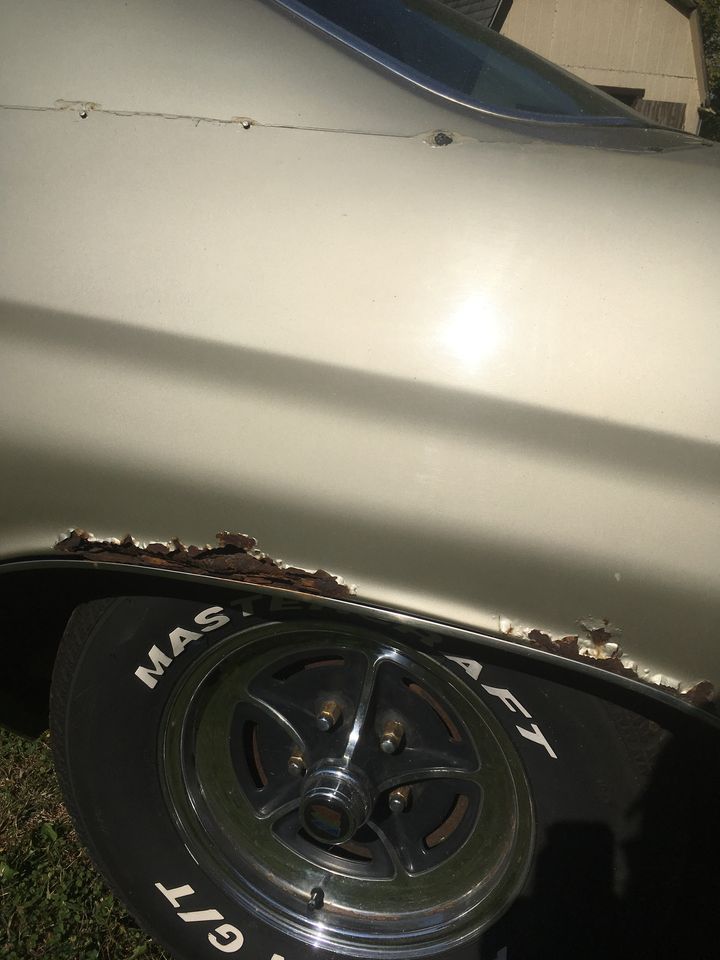
Biggest no-no on our '73 here is the rust, of course. It's not an easy fix and many body shops stay away from it because it's not worth their time. Get it up on a lift and get somebody who knows what to look at to stick their head deep up and into the wells of this car. Considering this is for sale less than an hour northwest of Cincinnati, I'm a little surprised there's as much rust as there is. You get up here close to Lake Erie, and this sort of thing is an everyday occurrence. Even on cars less than ten-years old. Looks like the vinyl top was pulled too and they left the rivet holes for its trim pieces. Looks like you may have to spring for an entire re-spray. Ka-ching, 


Technically, the Buick LeSabre "Luxus" replaced the Centurion for 1974 but the Centurion\Wildcat\Invicta\Century slot on the Buick lineup was actually replaced by the new-for-1973 Century model that could be ordered in "Regal" trim with a 455 CID Buick engine. We all know how that story ended with the OPEC embargo just as the 1974 model year began, making any car, big or small, with a V-8 a pariah. That admonishment of gas-guzzlers was fairly short lived, but big cars with the pretense of performance were, save for boutique editions, like the Roman Empire, gone for good.