Showing posts with label Ford Mustang. Show all posts

Saturday, August 29, 2026

1989 Ford Mustang LX 5.0 - Lies. All Lies.

Back in the late 1980s, my best friend Phil and I made several trips from Long Island, New York, up to New Bedford, Massachusetts, to spend a weekend drinking our faces off with our friend Marty, who was working overnights at a radio station up there. Before one of our jaunts, I had the bright idea to rent a "Five-Point-Oh" Ford Mustang just like this one that recently sold—or, more accurately, failed to meet its reserve after bidding reached $24,500—on Cars & Bids.

On paper, at least, the idea was sound, but you know what they say about good intentions. Renting a car kept the miles off Phil's new Acura Integra and ensured we'd make it all the way there and back, given the tender state of the 1982 Buick Riviera I was using as a daily at the time. That it was a Mustang with the "5.0" on the sides was cake frosting on top of cake frosting as far as I was concerned. Or so I thought.

Phil actually picked the car up because the rental place where we got it was closer to where he lived. He picked me up well past rush hour on a Friday night to begin the 215-mile, roughly four-hour slog on I-95 north through Providence, Rhode Island, and down into New Bedford, Massachusetts.

New Bedford was a depressed former whaling capital, made famous—or at least infamous—by Jodie Foster's 1988 movie, The Accused, which was loosely based on the notorious 1983 gang rape at Big Dan's Tavern in the city. The movie wasn't actually set in New Bedford, but the real-life case that inspired it was.

Phil, at first, was mesmerized by the power of the car.

"The pickup of this thing is incredible," he said between puffs of his Marlboro Light, which he strategically exhaled out the window so as not to leave a trace of smoky-treat stank in the car.

After an abortive stop for beer in eastern Connecticut—you couldn't buy beer in package stores there after 8 p.m.—Phil says to me, "Chucker, you wanna drive?"

He didn't have to ask twice, although I quickly understood why he asked.

Getting onto I-95 from the mile-long entrance ramp was exhilarating; everything's relative, of course. My '82 Riviera had a 140-horsepower Oldsmobile "307" V-8 that provided barely adequate scoot. The Mustang, significantly lighter and spurred by a 225-horsepower "302," accelerated with a ferocity I had never experienced before. 

"Holy shit!" I yelled as I pushed the little pony near 100 mph, then backed off. I high-fived Phil, who seemed to have lost some of his enthusiasm for the car.

By 1989, the Ford Mustang LX 5.0 was little more than a Mustang GT without the GT's goofy body cladding and debatably racier wheels. Underneath, the two cars were remarkably similar. The LX 5.0 got essentially the same performance hardware as the GT, including the 5.0-liter V-8, larger front brakes, Quadra-shocks and the performance-oriented suspension and steering components. It also got 15-inch alloy wheels, although the styling was different from the GT's: the LX wore 10-hole alloys, while the GT got turbine-style wheels.

And, yes, that "5.0" wasn't quite 5.0 liters. The engine was a 302-cubic-inch V-8, which works out to about 4.95 liters, but Ford marketed it as a 5.0-liter.

Best of all, if you were so inclined to buy one, the LX 5.0 coupe was about $1,800 less expensive than a GT hatchback in 1989: $11,410 versus $13,272. Back then, that was some serious beer money.

Only problem with the Mustang was the ride was punishing, the seats were uncomfortable, the exhaust drone quickly grew tiresome and it inhaled gas. No wonder Phil gave up driving it; compared to his highfalutin Acura, the Mustang was Fred Flintstone-mobile primitive.

Speaking of which, when we crossed over into Rhode Island, we found we couldn't buy beer there either, at least not where we looked and not that late. Rhode Island package stores could legally sell until 10 p.m. in the winter and 11 p.m. in the summer, so apparently we simply weren't looking in the right place. Same deal down in Massachusetts. Oh, well, Marty will have beer, right?

He did not.

So that meant that after driving over five-hours in a car that turned out to be a rolling torture chamber, we did a bar crawl.

We hooked up at a nightclub with our friend Donna from college, who was working in radio in Providence. Phil and I hit it hard. I mean, hard.

The next morning I woke up in a cold sweat on the floor, completely unaware not only of where I was, but how I got there. Phil was comatose on the couch on the other side of Marty's "living room."

"Phil?" I asked. "How did we get home last night?"

"Oh, shit, I don't know!" he said.

Then I said, "Where's the Mustang?"

Phil said nothing.

Assuming it would be near the front door of the dump of an apartment Marty was living in, I sprang out the door to find it.

No such luck.

I walked around the block.

Still, no Mustang.

It was a Saturday, and Marty had already left to work at the radio station that day, so I couldn't ask him.

I ran back to Marty's place and called Donna.

"Hey, how are you lunatics doing?" she said, laughing after she picked up.

"You have any idea where that Mustang is we came up in?" I asked, panic-stricken.

"You and Phil were in no shape to drive last night, so I drove it back to Marty's neighborhood for you. Then Marty drove me back to my place."

"Whew. Thanks! But...where is it now?" I said.

"Couple blocks over from Marty's. I had trouble finding a spot, so I wedged it between two parked cars. You better move it because half the car is on the sidewalk."

I found the keys on Marty's kitchen table and hopped over the couple of blocks to where Donna said it was.

And it was there, half in the street and half on the sidewalk, just like Donna said it would be.

A City of New Bedford ticket was tucked under the driver's-side windshield wiper, flapping in the breeze.

Along with a notation for a $100 citation, there was a handwritten warning on the ticket:

"IF VEHICLE IS NOT MOVED BY 10 AM, IT WILL BE TOWED AT OWNER'S EXPENSE."

It was 9:45.

I started the beast up and gingerly backed it off the sidewalk.


Head pounding, I moseyed on back to Marty's.

Nice guy he was, Phil agreed to split the ticket with me. We chugged some coffee and jumped back in the Mustang to see the sights of, umm, New Bedford.

After a stop at McDonald's for "brunch," we bought a couple of suitcases of Bud and a bottle of Jack and Bacardi at what the locals call a "packie"; that's short for "package store," the kind of store up there that sells hooch.


Hungover and tired as hell, I was still enthralled with the power of the 5.0, although growing increasingly annoyed at its brutal, punishing ride, especially on the moon-crater-like streets of New Bedford. Although it handled well compared to my oafish Buick, the steering was numb and had no road feel.

I began to realize that having one of these as a daily might not be a good idea. Still, I soldiered on. After all, the car looked cool, it was a 5.0, and Phil and I could give Don Johnson and the other guy from Miami Vice a run for the money, too. Even as badly hungover as we were.

With nothing to do, and Marty on the air at the time, we decided to drive over to the station, which had a glass front window into the studio overlooking the street it was on. I parked right in front of the glass with Marty on the air, Marty eyeballing us when he was on the air, knowing I might do something.

And I did.

As soon as Marty opened the mic, with the car in park, I floored the gas, the roar of the 5.0 echoing throughout the neighborhood. Marty smiled, knowing the racket was bleeding through on the air.

Well, that quickly grew tiresome. So I pulled out of the spot and backed the car up square in front of the window, engine idling, waiting for Marty to go on the air again. Just as we heard him start talking, I pushed as hard as I could on the brakes and floored the gas. I let off the brake pedal for a split second and then partially put it down again, lighting up the tires in a hail of smoke and flying rubber.

Great fun. Until a New Bedford police cruiser pulled up right behind me.

"You boys having fun?" he asked, eyeballing the unopened beer and liquor in the back seat.

"Sorry, sir," I said, doing my best to drum up the altar-b0oy charm of my youth that allowed me to get away with sketchy shenanigans. "This is a rental car and I'm not used to the power of this thing," I said.

He took my license and the car's registration back to his cruiser. Phil was laughing his ass off while hammering a Marlboro Light.

"This one's on you, Chucker," Phil said.

The cop came back with a $20 summons for reckless driving.

"Look," he said, "I know you're from out of town and all, and your driving record is pretty clean, so I'm going to let you go with this and little more than a warning. I catch you doing that again, you're going to be in some serious trouble. You understand?"

"Yes, sir. And thank you," I said.

I crept away from the scene of the crime as slowly as I could, the burble of the 5.0 nothing more than a liability at this point.


The rest of the trip was uneventful, save for another night of heavy drinking, although this time at Marty's place, where a bunch of his work buddies showed up to help us pound through our beer and liquor.

The next day was a Sunday, and we headed back to Long Island, hungover worse than we were Saturday morning. We should have taken the Port Jefferson Ferry back to the Island out of Bridgeport, Connecticut, but all the boats were booked solid for the rest of the day. Traffic was biblically bad all the way "around the horn," as we say. I don't think we got above 30 mph from the Rhode Island-Connecticut line until we crossed the Queens-Nassau line on the Island.

I, for one, had enough of the kidney-crushing ride, the cheap seats, lifeless steering, the endless drone of the exhaust and the terrible fuel economy; couldn't have been better than 11 or 12 miles per gallon.

I dropped Phil off at his house after nearly eight hours of agony. I returned the Mustang that night, vowing to never own one, let alone drink again.

Lies. All lies. 


Friday, August 14, 2026

1980 Ford Mustang - Doesn't Get More "'80's" Than This

Chances are, if at the drop of a hat you were asked to name a quintessential "1980s car," you wouldn't knee-jerk answer, "Oh, 1980 Ford Mustang!" Neither would I, frankly. But when I came across this '80 Mustang for sale on Marketplace about 45 minutes west of The Triple Wide, it fish-hooked me back to the '80s in a way your stereotypical "80s cars," like a DeLorean, simply don't.

After five years of the Pinto-based Mustang II, Ford introduced what became known as the "Fox-body" Mustang for 1979. The Fox platform itself debuted for the 1978 model year under the Ford Fairmont and Mercury Zephyr; the Mustang followed a year later. The "Fox" name was reportedly inspired by the Audi Fox, although the precise origin of the name isn't entirely settled.

The Fox platform would go on to underpin scores of Ford, Mercury and Lincoln models through the 1980s and early '90s. The original Fox architecture lasted through 1993, although a heavily revised derivative carried the Mustang through 2004. So, technically, saying the Fox-body ran all the way to 2004 needs an asterisk—but considering the basic architecture's extraordinary longevity, "Fox" certainly had one hell of a run.

Arguably, the most famous and certainly the longest-running nameplate application of the Fox architecture was the Mustang.

While it was no Chevrolet Camaro or Pontiac Firebird, I thought the Fox-body Mustang was a most welcome breath of fresh air when it debuted in 1979. I even like this factory installed carriage top. The Fox Mustang was roughly four inches longer than a Mustang II and rode on a wheelbase roughly four inches longer—100.4 inches versus 96.2. Goes to show you what a couple of inches here and there can do for an automobile's design.

Have to wonder: if the Mustang II had simply been downsized and remained on the Falcon-derived architecture used by the original Mustang, would it have made a big enough difference aesthetically that it wouldn't be the black sheep of the Ford Mustang stable it is today?

As much better looking than a Mustang II as they were, and far more in line with the loosely defined "pony-car" classification, everyone I drove left me vexed, perplexed and confused. They ride stiffly and feel primitive in ways that other Fox-body-underpinned cars, like the 1983–1988 Ford Thunderbird, simply don't. I say the same about my 2005 S197 Mustang GT: its inherent crudeness feels purposely dialed in.

Although there are no pictures of it, our '80 here is powered somewhat curiously by Ford's 200-cubic-inch, or 3.3-liter, pushrod, one-barrel inline-six. At the risk of sounding like a punk-ass, know-everything Gen Z car blogger who goofs on the cars us Gen Xers grew up with, the little engine that could not cranked out all of 89 horsepower and 143 lb-ft of torque. 

Here's where the story goes off the rails. Ford had intended the Cologne, Germany-built 2.8-liter, 60-degree V-6 to be the optional six-cylinder engine in these cars, the 2.3-liter four was standard. While the 2.8 was offered in the 1979 model year, Ford ran into supply problems with the 2.8, and midway through 1979, replaced the V-6 with the old 200-cubic-inch inline-six. The 2.8 V-6 was then dropped from the Mustang lineup for 1980, leaving the 3.3-liter six as the optional six-cylinder engine.

Couple the little sixer with its light-duty C3 three-speed automatic and factory-standard 3.08:1 rear axle, and it's safe to say no one has driven this little pony very quickly over the last 46 years and 66,000 miles. 

So, what to do with this thing? Sky's the limit. Do we drop a junkyard-truck 351 Windsor in her? A fuel-injected "HO" 5.0? How 'bout we go nuts and go Coyote, leaving the body as-is? A pure, modern-day-ish rat rod. I find that oddly appealing. We can gussy up the suspension, so it doesn't ride like a truck with square wooden wheels too. 

There's a network of Fox-body aftermarket parts out there to rival any Camaro, Firebird or even Corvette. It's a $2,900 asking price, low enough that I'd like to think you could probably take this off their hands for closer to $2,000, if not less than that.


Monday, June 12, 2023

1968 Mercury Cougar - My Kinda Party


"My Kinda Party" was the title song of Jason Aldean's fourth studio album that was released late in 2010. The single peaked at number-two on the Billboard Hot Country songs chart and was certified "Platinum", denoting sales of at least two-million. "My Kinda Party" was written and originally recorded by Brantley Gilbert in 2009. Warning, incoming old fashioned name drop incoming, the first time I met Brantley, I asked him what kind of car he was referring to in the lyric from the song, "got the cover off the sixty-eight". He didn't miss a beat saying, "'my '68 Cougar". 


I knew I liked this kid. Here is a very young B.G. with his literal and figurative '68 he said he sold once for $4,000 to pay for his band to get back home to Georgia after a show in Texas. The guy he sold it to said he'd sell it back to him for what he paid for it but when Brantley went to do so, the guy went back on his word demanding $25,000. Long story short, after some negotiation and cajoling, Brantley got his '68 back. 


The Ford Motor Company's late and most often time not-so-great middle priced division produced a "Cougar" in various guises on-and-off over 34-model years. In my opinion, the only model years that mattered are 1967, the first year it came out, and 1968 like B.G.'s and this $15,000 Facebook Marketplace find; save for side markers on the front fenders on '68 Cougars in compliance with federal regulations, the cars are the same. Subsequently, those were boom years for the nameplate and for the market segment Ford all but, excuse me, sired in 1964, when they, ahem, foaled the Mustang. 


Ford sold nearly 681,000 Mustangs between its April 17, 1964 launch and the end of 1965 and by the end of the 1966 model year, Ford totaled near 1.3-million Mustangs sold making it the most successful new vehicle launch in automobile history. Not surprisingly, Mercury executives wanted a "Mustang" as well. A Mercury version was actually in the works alongside the original Mustang but Ford hedged their bets plowing all their marketing resources into one car and not two. Seeing the success of the Mustang, you could construe they focused and spent their money wisely. However, what was internally known as the "T-7", was to be a softer riding, luxury themed or tinged version of the Mustang. When Ford updated the Mustang for model year 1967, they allowed Mercury to introduce the "T-7"


Despite unique and quite handsome sheet metal stretched out on top of a three-inch longer wheelbase than the Mustang had, there were challenges with these cars right from the get go. Most of them circumstantial having nothing to do with the cars themselves. 


First, with a softer suspension tuning and lacking some key luxury accoutrements like power windows, with the Cougar's on average $300 higher price tag, customers who bought into the pretense of an "American Jaguar" were hard to come by. And despite finding some 150,000 buyers in 1967 and around 113,000 for 1968, Ford surmised those sales came at the expense of not only the Mustang, but sales of Mercury Comet's, Mercury's at the time intermediate offering. Not only did Mercury's market share not increase, the Ford Motor Company's as a whole didn't either. 


At least it had its to-die-for good looks. Along with funky, pointless cool doo-dads like concealed head lights and rear turn signals that blinked like the sequential tail lamps on Ford's hallowed Thunderbird did. Mercury even marketed these cars as being for the, get this, "man on his way to a Thunderbird". Ford had been experimenting with the this slotted, electric razor type front end for years before finally dropping it on the Cougar. 


Circumstantially, in 1967, General Motors came out with two ponies to compete with Ford's duo splitting the pony car blade of grass further. Sales were remarkably strong for the segment through the end of '60's, Chrysler's pony was the Plymouth Barracuda (Dodge didn't get one until 1970), but by the end of decade, it seemed those who wanted one got theirs and didn't repeat buy or were put off by insurance surcharges that tacked on a steep tariff to anything remotely construed as a performance car. 


Mercury built the Cougar on the same chassis as the Ford Mustang through 1973 doing a debatably ample job of disguising its Mustang's underpinnings. For 1974, Mercury lightly disguised a Ford Torino Elite as a "Cougar" thrusting the moniker into the burgeoning "personal luxury car" niche where it stayed stuck through 1997. A snappy performing but odd-looking coupe based on the Ford Contour debuted for MY 1998 through 2003. Them, sorry, Brantley and Janson, but the party was over. On an upside, Mercury sold more "Cougars" in their various guises than any other of their nameplates over its protracted 71-year existence. 

Wednesday, April 12, 2023

1976 Ford Mustang - It's Not Bad at All, Really


Most Ford Mustang cognoscenti want nothing to do with 1974-1978 Mustang's, the Pinto-based "II's" that the "II" haters claim either "wasn't a real Mustang" or all but eradicated a decade of seminal pony car pioneering up to that time. This is a 1976 "II" for sale up in, appropriately, Dearborn, Michigan with a $3,700 asking price. No vinyl top, notchback, alloys and a "Cologne" 2.8-liter V-6 - aside from a rather high asking price for any mid-'70's car that needs a fair amount of work, is this really such a bad car? 


In a vacuum, I don't think so especially compared to other Ford designs of the 1970's. This car may be festooned with Mustang badging, but squint or blur your eyes for a second or two to see a strong, familial resemblance to the Ford Gran Torino\Mercury Cougar or dare I say Thunderbird of the vintage. Then again, depending on your point opinion, that might not be such a good thing either although I do find at least some dash and elan to the fish-mouthed 1972 Torino's. 


Squint again and you may come to some to see what this car really is - a luxurious, longer-wheelbase version of the Ford Pinto. The Pinto association, as much as anything else, may explain the vitriol  Mustang fans have for the II's that were replaced by the Fox-body Mustang in 1979. Shoot, this ain't even a Maverick in disguise. 

It is somewhat amazing if not miraculous that Ford introduced this car as the Mustang II in 1974 given where the Mustang had been in the few short years since it's most successful launch in 1964. Based on the compact 1960 Falcon, Ford had sold more than a million Mustangs in an elongated first MY run between April of 1964 and the end of 1965. Tack on another 400,000 or so before a rebooted 1967 Mustang and you have one of the most successful vehicle launches in automobile history. Problem was, as was or is almost always the case, subsequent updates of the Mustang where all longer, wider and heavier and the fatter the Mustang got, the more sales declined. 


Coincidentally or not, the market had changed by 1967 and Ford needed to update the Mustang to keep pace with General Motors; competition something Ford didn't have to contend with until 1967. Technically, Chrysler had a competitor with their Plymouth Barracuda that was even introduced some two weeks prior to Ford's rolling out the Mustang in '64, but due either to it either being a lightly disguised Valiant, half-arsed marketing campaign or combination of both, it sold poorly. 

Much of the credit for the "II" goes to, all of all people, that big car loving Ford honcho, Lee Iacocca. Iacocca agreed whole-heartedly with critics of the 1971 Mustang that Ford's foal had gotten too big and ordered a smaller Mustang dimensionally akin to the '64 to be introduced for MY 1974. And rather than use the compact Maverick chassis, he insisted the Pinto's underpinnings be used; that in-and-of-itself not a bad thing given the Pinto's rack-and-pinion steering and light weight. However, Lido insisted what would become the Mustang II not have an available V-8 engine. That changed come 1975 but the dye was cast with Mustang Nation - the Mustang II was first and foremost an economy car.  


Timing being everything, just as Ford pulled the sheet off the Mustang II, the first gas crisis hit in the fall of 1973 and buyers flocked to the 20-MPG "little" Mustang. Ford sold more than 400,000 "II's" that first model year, best since 1967. Soon as the earth cooled and gas prizes stabilized, though, Mustang sales came tumbling down never reaching half of what they were during the dark days of the gas crisis. Meanwhile, sales of General Motors Camaro and Firebird recovered nicely although their replacements were sold along side them in Chevrolet and Pontiac showrooms. "Replacements" based on the Pinto's GM competitor, the Chevrolet Vega. Apparently, cooler heads or more passionate fans of the Camaro and Firebird were able to convince GM suits that gluing "Camaro" and "Firebird" on gussied up Vegas was not a good idea. 


Again, much like what Linus said of the Christmas tree Charlie Brown bought, "it's not bad at all, really". Perspective, then, is everything. Some see a car that almost killed off what has become an American automobile institution while others may see it for what it is - either a large Pinto or, dare I say, a smaller Thunderbird. Either way, it was one of the few bright spots for Ford in the 1970's and a Mustang that may have saved the, ahem, breed. 


Thursday, April 28, 2022

1976 Mercury Cougar XR7 - Cigarette Burns Included


Hard to believe that in 1967 when The Ford Motor Company's Mercury Cougar was first introduced, not only did it win Motor Trend's "Car of the Year" honors, but some automobile scribes christened it an "American Jaguar". Although that claim was rather hyperbolic and Motor Trend has given their "golden calipers" to far more scrubs than hall of famers over the years, by 1974 that "American Jag" became a bloated, soggy and slow "personal luxury car". Our triple-blue subject (blue paint, blue vinyl top and blue interior) hails from the bicentennial model year of 1976. 

How in the name of Watergate, bell bottoms, disco and pet rocks did that lithe, sexy little sports car get so fat? And in just eight model years too? 


Well, for starters, it was amazing that Ford whipped up the original Cougar that was inexplicably equal parts pony car and luxury car and oozed European elan in the first place.  Even if it was just a long wheelbase Mustang with some tasteful sheet metal and a really nice interior. Without question, however, it stole as much thunder from the new for '67 Mustang as General Motors dynamic pony car duo (Chevrolet Camaro and Pontiac Firebird) did. That said, in the vaunted halls of Dearborn, many suits had the Cougar in their literal Lincoln-Mercury crosshairs. 

Since (at first) Cougar and Mustang were bolted together at the bumper, when Mustang got an update, so did the Cougar. 


Hence the longer, wider, heavier and flabbier 1969-1970 Cougar and then the abortive 1971-1973 "big" Mustang and Cougar. Although, in fairness, in a vacuum, the 1969 and 1971 Mustang and Cougar weren't all that bad. Well, looking at least. However, they were damned by comparison because of what came before them. Had the 1971 Mustang been a new "Thunderbird" and the Cougar been a Montego or "Marauder" and things might have been different. Might. Have been. Who knows. Fun to ponder, though.  


Ye olde tipping point was model year 1974. With the crash landing of the 1971-1973 Mustang, under the leadership of Lee Iacocca, who'd take credit for sunny day if he could have, seeing the rising popularity of imports and smaller cars, Ford rolled out the Mustang II on an elongated Pinto chassis. Mustang fans cried foul, not foal of course, but the Mustang II sold almost as well as the original Mustang did. The October 1973-March 1974 OPEC embargo obviously had something to do with that but don't tell Lido that. 


Since Lincoln-Mercury had also been peddling the Ford of Europe sourced Capri (since 1971), it made no sense to also offer a Pinto-based "Cougar II". So, instead, to give Mercury a Chevrolet Monte Carlo fighter, Ford product planners and marketing wonks festooned "Cougar" to the flanks of a Montego coupe. 

All but impossible to say or tell what the difference was between a Montego two-door and a Cougar was, but Cougar sales were roughly double over 1973 although roughly half of what they were in 1967. Remarkable too since model year 1974 was a dramatically down year considering the impact of the OPEC embargo. 


For 1977, Mercury dropped "Montego" from their nameplate lineup and all Mercury intermediates became "Cougar's". There was a Cougar coupe that was all but indistinguishable from a new for 1977, and very successful, downsized Ford Thunderbird. Prior to that, Thunderbird was built on the same chassis as the Lincoln Continental Mark series. 
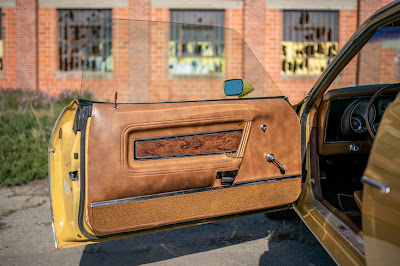
The Mercury Cougar and Ford Thunderbird, like the Cougar and Mustang were from 1967 through 1973, were corporate cousins through 1997. From 1998 through 2002, Lincoln-Mercury sold a front-wheel-drive, Ford Contour sourced Cougar. More of death throe or spasm as the personal luxury car market was withering, the little Cougar sold well (88,000 units) at first, but sales dropped by some fifty percent each subsequent model year. 


Best or worst that can be said of 1974-1976 Mercury Cougar's, in retrospect, is that rarely had something so much more been actually so much less. Check values of these beasts compared to even the 1971-1973 cats that came before them to say nothing of the '69-'70 models and of course, the painfully cool '67 and '68's. This one's for sale in Kokomo, Indiana with an asking price of $9,850. Price includes ash trays and cigarette burnt upholstery. 

Wednesday, February 16, 2022

1973 Ford Mustang - How Weird


Ask a Ford Mustang cognoscenti to name their favorite and they'd probably have a hard to choosing between the originals, the Fox-bodies, S-197's and the most recent iteration. Ask them what Mustang they like least and no doubt they'd say the 1974-1978 Mustang "II's". If they even mention them. These "big" 1971-1973 Mustangs get more than their fair share of disdain too. Our subject here is a 1973 Mustang Grande. "Grande" was a luxury trim option and not a descriptor of the car's size or weight. 


I think the vitriol these get is a bit unfair. In my opinion, in a vacuum at least, these boats or "biggest of all time Mustangs", are just as handsome if not more so than any Torino or LTD coupe of the same time period. I think if Ford badged these as a "Thunderbird" they would have been touted as seminal, watershed designs. Then again, the early 1970's were still a time period when Detroit held steadfast to their "bigger is better" axiom. Even if, in retrospect, it was the tail-end of it. 


Where these Mustangs run aground is in comparison to the lithe ponies that came before them. Although the 1969-1970 Mustang pushed the envelope itself as to what a "pony car" was. And this dyed-in-the-wool GM girl will tell you that a 1970 Mustang is the embodiment of cool meanwhile these are...well...just pretty nice. Although, frankly, a 1970 Mustang pales in comparison to my beloved Chevrolet Camaro's and Pontiac Firebirds. Even Plymouth Barracuda's and Dodge Challenger's. 


So, how did the Mustang get so big and heavy and so quickly? I mean, wow - four practically clean sheet designs in eight model years with each one getting longer, wider and heavier? Well, let's take a step or two backwards and shed some light on the era these were, ahem, foaled in. 


Ford had sold more than 1.4 million Mustangs between April of 1964 and the end of the 1966 model year, but starting in 1967, competition from GM and even Ford itself with a Mercury knock-off of the Mustang had taken the gallop out of sales. Choice is great for the consumer, not good for business. 


Furthermore, insurance companies surcharging for anything remotely construed as a performance car slowed sales of muscle and sporting cars to a near standstill. To that end, you have to applaud Ford for attempting to go where they perceived the buying public was going what with their growing fondness for larger, more "luxurious" automobiles.


Even if these Mustangs look like a third-generation Corvette and a 1971 AMC Javelin got jiggy one night. You either get this design or you hate it. I never not "got it" although, again, there's certainly better-looking domestic designs from this time period. 


"Howie", a peripheral member of a group of guys I called "friends" in high school, had a '73 Mustang just like this save for his having full wheel covers and not the luscious alloys this one has. Compared to the placid, non-descript appliances of varying degree and condition any of us were driving at the time, especially me in my shit-box, squeaky Comet, it was a freaking rock star. As always, everything is relative.  


Howie was socially awkward, nerdy and painfully-shy-around-girls; a Dungeons and Dragons type doing his best to hang with an obnoxious group of sword-swinging alphas. We despairingly referred to him as "How Weird". A couple of years older than we were, people-pleaser that he was, he delighted in buying us beer and liquor and herding us around in his Mustang. How as many as five us shoehorned into that big-little car is a mystery to me now. 


The two or three of us that knew a thing or two about cars were very enamored with it. The hype around it was so extreme that each time I drove it my excitement overshadowed my ability to appreciate it for what it was. Or, frankly, see it for what it wasn't. "Holy shit! I'm driving Howie's car! But I'm sitting too low, I can't see over the too-tall dashboard, the view out the back sucks and it handles like a bathtub full of water with square wheels. But I'm driving Howie's car!"


Howie bragged that his Mustang had the exotic sounding "351 Cleveland". Ford built the "Cleveland", Cleveland, Ohio not far from where I live now, in various guises from 1969 through 1974 but the "351C" in Howie's car was the white bread, low revving, low-compression "2V" version. Making all of 164 net-brake-horsepower, it made 276 foot-pounds of torque just off idle and driven purposefully as Howie did, meaning he had the most leaden of right feet, the car seemed hedonistic-ally fast. In reality, especially in light of how powerful even the lowliest of new cars are today, those numbers are far from adequate to haul around a 3,500-pound automobile. Especially packed with a good thousand pounds of sweaty, farty teenagers. 


To impress us "kids", Howie took any and all reckless, wild chances he could at the drop of a hat. I cringe now knowing that we were just lucky that nothing ever happened. I see stories of cars packed with kids crashing and there being serious injuries if not fatalities and my heart sinks. That could have been us. 


Snaps to Howie, though, risks be damned, for being able to handle that car the way he did. 


I ran into him years after that group had dissolved into adulthood and conversation went straight to cars, naturally. I kept the conversation going talking about his driving exploits, I even went so far as to flatter him telling him I thought he was a "great driver". Right or wrong, in certain situations, I have a penchant for telling people what they want to hear. In reality I thought he was the most dangerous driver I had ever ridden with save for someone that I knew was drunk behind the wheel. 


When I asked him whatever happened to that Mustang, he shrugged his shoulders and laughed saying, "oh, that thing. I wrecked it." I wasn't surprised. And I felt very lucky.