Showing posts with label Ford Ranch Wagon. Show all posts

Saturday, October 3, 2026

1968 Ford Ranch Wagon Custom 500 - Brittany Blue


Amazing what you find when you're not looking for it. Probably since the day I started this blog, I've been searching for a 1968 Ford Ranch Wagon in "Brittany Blue" just like the one I grew up with. While this one I found on Haggerty's auction site is a bit fancier "Custom 500" than my father's car was, all things being equal, this is the same car of my woe begotten "wonder years". 


Let's swing open or pull down her "Magic Tailgate", kick the "poverty" hubcaps and take this memory machine for a figurative drive down memory lane. 


First, some context as I attempt to see this car again through my then six-year-old, car-obsessed eyes. 


Late summer of 1970, I was thrilled to learn the "block was cracked" on my father's 1961 Rambler Classic, four-door sedan. While I didn't know what that meant, all I needed to know was we were getting rid of the damn Rambler and we were getting a "new", or "new-to-us", "new car". 


Long story short, my father picked up a literal rental grade 1968 Ford Ranch Wagon from a Hertz' used car lot not far from Kennedy Airport to replace it. I can still hear this impossible to baton down properly spare tire banging around behind it's plastic cover. 


Suffice to say I was disappointed and in more ways than one. Not only was I not thrilled with the dreary, featureless, utilitarian to a fault Ford wagon, but I was more upset my father bought it without consulting with me about it. 


Yes, I was all of six-years-old but still. Then again, my father was clueless when it came to stereotypical, father son bonding. We never played catch in the yard let alone go car shopping together. 


Knowing my father, he did what was most convenient and bought the first car he saw that fit whatever price point he was comfortable with. He rented from Hertz out at Kennedy Airport often as he traveled frequently for his job, they had a used car lot selling off some of their rentals and, voila. He bought a station wagon.  I doubt he even consulted with my mother about it. 


Back in the 1960's and 1970's, station wagons were big business for The Big Three.  For 1968, Ford sold seven different iterations of their full-size models, but they also sold intermediate- and compact-wagons. Note from this Ford sales brochure, "Ranch Wagon" is at the bottom of the wagon totem. 


The piece de resistance on this car, though, are these fold-down, "facing" rear jump seats; the stuff of prepubescent kid dreams back in the day. These non-removable seats increased passenger capacity up to, well, in theory anyway, ten people. For comparison's sake, the current Chevrolet Suburban has seating for up to nine. 


Fold the seats and rear seat down and you've got hauling capacity to rival a pickup truck. In my father's car, there were metal panels that opened and closed north-south giving access to a cavernous, subterranean trunk; in my father's car, a trunk loaded with sandbags to help give it at least some modicum of traction in winter. 


Owing to the ala carte nature of the way these cars could be optioned, this car is a bit an oddity. For instance, it has a column mounted three-speed manual, the proverbial three-on-the-tree that even by 1968 was increasingly rare; my dad's car had an automatic. Also, as we get under the hood, appears this car also lacks power-steering that my father's car had as well. 


Then again, my father's car had been a rental, Hertz no doubt wanted a car as accessible to the masses as possible. 


Like my father's car, this one has the new-for-1968, 302-cubic-inch Windsor V-8; I don't see a power steering pump. Smooth and torquey, my father, who was not a car guy, loved its power and, sign-of-the-times, thought the 17-miles-per-gallon highway it got the pinnacle of thriftiness. 


Adding to my verklempt was that the family across the street from us had a 1968 Ford Country Squire loaded with every accouterment on the options list. You name it, it had it. Including pie-in-the-sky air conditioning, a hedonistic option given that my parents didn't own even a single window air conditioner. We roughed it with these side-vent windows that opened via a separate crank from the regular door window cranks. I can still smell my parents' cigar and cigarette smoke whirl winding through the car when these vents would be open. 


Bidding on this, last I checked was at $2,800. Despite its indirect history with me, I have little interest in it. Blame the three-on-three-tree, lack of power steering and these shot-to-pieces front seat covers that, I have to imagine, are impossible to find anything close to OEM for. My father's car's front seats were split like this as well. Note the lack of head rests; who's up for some whiplash?


I do love its patina which I hope whoever buys it keeps. 


Nope, I'll pass on this one and simply bask in the very mixed, bittersweet memories I have of my father's Ranch Wagon. Even to this day and at my age, I vacillate, either laughing or coming to near tears reminiscing about the misadventures my parents put my brothers and I through in their Ranch Wagon. 


As far as cars go from back then, the Ranch Wagon was fairly reliable. Sure, it had its issues, but it was no lemon. If I recall, though, forgive me, it's a been a minute, my mother believed the Ranch Wagon "beneath us"; ironic since she didn't drive. After seven-years of "slumming it" (her words), she put her foot down demanding my father buy her a Cadillac. Took a while but dutiful husband he was, more like a sycophant, he eventually did. 


Wednesday, July 5, 2023

1967 Plymouth Fury III Wagon - Are We There Yet?


Some of my earliest childhood memories involve me and my family "going on vacation" to resorts in the Pocono Mountains the last week of August coming home on Labor Day. Living a stone's throw from Kennedy Airport and traffic being what it was and still is there, we didn't go far, hence, the nearby Poconos. Seriously, the task of just getting off the Island and getting through The City could take two-and-a-half to three-hours. The traffic and being shoehorned into my father's 1961 Rambler Classic, the 125- or so mile traipses to some resort in the Pocono Mountains in northwest Pennsylvania felt as though we had driven to Europe. 


One year we stayed in our home state and traveling roughly the same distance, we stayed in a motel and partook of the amenities of several of the Catskills' staple resorts that were straight out of "Dirty Dancing"; again, we didn't stay at those resorts we just visited them. Nice to see how the "other half lived" and all. The highlight of the trip, for me at least, was a dark blue Plymouth station wagon my father rented for the trip that was just like this dark red 1967 Fury III wagon I found on Facebook Marketplace recently. Asking price is $4,500. Are we there yet? 


I couldn't have been more than five, maybe six at the time so my memories of the big Plymouth are mostly random flashes. I do recall being all alone out back waving to folks in traffic and being delighted when they'd wave back. Some did not. Perhaps they were like, "who the hell let's their kid bounce around in the back of a station wagon with a rear facing jump seat?" And with no seat belt on to boot. 


Through what I construe are adult lenses, I find it somewhat humbling to realize that the staple of familial hauling as we came to know it was not even twenty-years old when this big Plymouth rolled off the assembly line; you grow up with something you think it's always existed. Like how my twenty-something sons view the internet. "Station wagon" had been around for years before The War but they didn't really gain traction in this country until after it. 


The Big Three quickly tapped into the market potential for car-based utility\family haulers and Chrysler had a large part in pioneering them with their series of wagons across their Chrysler, Dodge, Desoto and Plymouth divisions. Their 1955-1975 Imperial division never got one. Wagons become so popular that for 1967, Plymouth had three succinct lines of them - there were these full-size Fury's in I, II and III trim levels, the somewhat smaller "Belvedere" line, can't call them truly mid-size, and the compact "Valliant". 


I can put two and two together now and surmise that big Plymouth was the impetus for my father purchasing the 1968 Ford Ranch Wagon from Hertz that would be the familial chariot of my woebegone wonder years not long after. Difference was, the rental Plymouth was equipped decadently whereas the Ranch Wagon was as bare bones as a Conestoga Wagon. Rear jump seat? Nope. Just a flat, steel floor back there. Roof rack and air conditioning? Please. 


I blame my parents both being children during the great depression for the reason why they were unscrupulous penny-pinchers. The last night of that Catskills trip they took us to an all-you-can-eat "smorgasbord". Arriving late, the place was closing but my mother was able to coerce the staff to let us eat, we were the only ones in the place. The food had the unmistakable texture and taste of stuff that had been under heat lamps for hours and in the middle of the night and by the next morning, we were all violently ill. I don't recall waving to any one in traffic on the way home the next day. That trip even longer than the trip up there due to frequent, ahem, rest stops. 


Thursday, October 27, 2022

1968 Ford Galaxie 500 Convertible - Not My Father's Ford Ranch Wagon


Up until I was around eight years old, my father worked as an executive in the Manhattan office of Burlington Industries, a fabric making company based in Greensboro, North Carolina. At least once a month, often times more, he would travel down there for meetings. He'd be gone early Monday and not return until Friday evenings, sometimes Saturday mornings. Sad thing is, I can't say I actually missed him, we were not close, but when he was away, there was relative peace in my house because my parents wouldn't be at each other's throats. That and his homecomings usually meant dinners of Coke and pizza. Also, he'd bring the pizza home in what he referred to as "company cars" which I came to learn were more like "company paid for rental cars". One time he came home in a car that sort of resembled his 1968 Ford Ranch Wagon but it, for certain, was not my father's Ranch Wagon; it was 1968 Ford Galaxie coupe like this red convertible Galaxie 500. 


I was not a fan of the Ranch Wagon. Story goes that when my father's wretched '61 Rambler cracked its engine block, he replaced it with a blue, 1968 Ford Ranch Wagon from Hertz Used Car Sales. Figures since he spent so much time at the Hertz counter at JFK and LaGuardia that he'd pick up a used rental. His car was light blue like the Ranch Wagon in the foreground in this photo from a 1968 Ford brochure is. It didn't have a roof rack, nor did it have side chrome moldings. Ford "dog-dish" or "poverty" hubcaps finished off the sorry, spartan, no-frills "Grapes of Wrath" motif.  At first, I thought it just another "company car" until he started putting the damn thing in the garage.
.

Meanwhile, across the narrow street from us, neighbors with kids around my age had a 1968 Ford Country Squire like the one pictured above from another brochure. Power-everything and facing rear jump seats. Jump seats - the dream of every kid born between say 1960 and 1975. That Country Squire made my father's Ranch Wagon have all the industrial charm of a school bus.  


So, when I saw that Galaxie, I was smitten. Although the car had nothing in common with my father's Ranch Wagon from the A-pillar back, I thought it the most fascinating car in the world. Mind you, it was a hard top coupe; I may have burst into flames seeing a hedonistic convertible like our redhead here. Although, coming to know the man who was my father, playing catch with Joe Namath in my backyard was more of a possibility than us ever owning such a car. 


In hindsight, I've come to the realization that my father's Ranch Wagon was the embodiment of the man, we are what we drive, after all. Or whom we wished to be seen as. More Willie Loman than the swaggering, confident John Wayne meets Frank Sinatra I wished he was, my father was a simplistic, blue-collar guy caught in the crossfire of the executive mumbo-jumbo and posturing of "Mad Men" era New York City. That show pegged those guys dead on; my father told a tale or ten of the consequences of liquid lunches. And the car he chose to replace his hoary Rambler with was a carpenter\plumber\electrician's special rather than an executive express like Don Draper's Cadillac. Pick a lane, old man. And stay there. He just didn't get that. 


Sadly, my father lacked the intrinsic mechanical aptitude, skill and work ethic of his immigrant father making him a wannabee in two very different universes and not particularly good in either. He changed jobs frequently. Throw in a most difficult homelife and his self-medication to deal with his miserable life and you might be able to at least start to appreciate my taking solace in the small things like his not being around, Coke and pizza and of course, cars. My father and I were like two orbs occupying the same space barely acknowledging each other. Not unlike the way my dog and car interact with each other. A benign, listless and at the end of the day harmless coexistence.  I didn't ask for anything more than he could provide. Which wasn't much. 


For model year 1968, Ford offered twenty-one variations of their quite good, new-for-1965 full size car.  And who knows why too although GM did the same thing. Chrysler to a somewhat lesser degree. Did they really need two different types of two- and four-door models? Two different Country Squires as well if the only difference between the two is one has the, literally, killer rear jump seats and the other doesn't. Oh, look. You could also get the jumpers in the Ranch Wagon. 

It's been said that one of the reasons for the shoddy build quality of domestics back then was because there were too many different ways an automobile could be configured. Our Galaxie 500 drop-top here is near the top of the second row. Not too near the top and certainly a long, long ways from the bottom of the lineup. 


For my money, I'd opt for this car back then rather than splurge for an XL convertible. Especially stuffed with Ford's "FE" (Ford-Edsel), 390 "4V" (four-venturi, sounds better than nozzle) "Thunderbird" V-8 engine. Despite single digit city fuel economy. Can't be that much better on the highway. The front end on these cars is cleaner and simpler and isn't bogged down with the fussy headlight doors of the XL convertible too. Not quite sure the Ford mags were available on these cars and the raised white letter tires for certain were not. But they look marvelous with the rims on this car. Why spend more than you have to? 


I found this memory machine on Facebook Marketplace for sale near my home in Cleveland, Ohio with a price reduced ask of $12,500. It's a North Carolina car which means it's going to be pretty free from rust, which is so important on an older car, especially really old cars. NADA pegs this average retail at $18,100, high retail at $29,400 so the seller might be looking to onload this rather than store it for the winter. Finding relative bargains like this another reason I love car shopping this time of year up here. No, I'm not going to go for it, but it is nice to think about. You get this closer to ten-grand and I'll writhe with jealousy.


As for my father's Ranch Wagon, he traded it in during the summer of 1977 on a 1970 Buick Electra 225 four-door hard-top I steered him towards after my mother decided it was time to get rid of the wagon. All of thirteen at the time, I had no idea how pretentious it may have seemed going from the Ranch Wagon to the Electra, but I didn't know better. Not that I cared, I just loved that car. And after my father was left to his own devices after the Rambler croaked, I wasn't going to take any chances. 


Friday, August 20, 2021

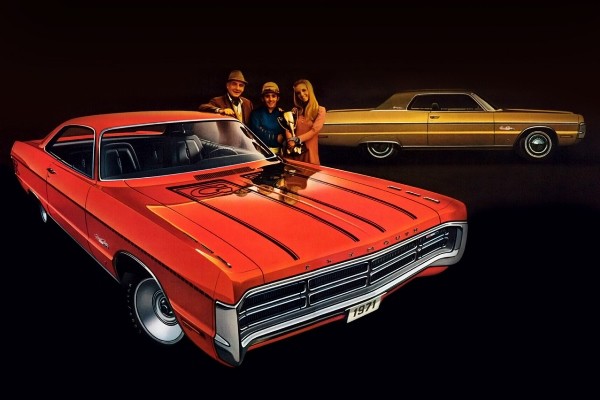
1971 Plymouth Fury - A Perfectly Wonderful Way to Start the Day


When I was very young my father worked as an executive for Burlington Industries based in Greensboro, North Carolina. He rarely talked about what he actually did save for a time or two that he joked about someone as color blind as he was being in charge of ordering bulk amounts of fabric in varying color shades. 

He work out of their Manhattan office and decades before "Zoom-calls" could even be imagined, at least once a month, sometimes more, he'd fly to Greensboro for meetings. He'd cab it to LaGuardia or Kennedy and sometimes Newark from our home in Baldwin, New York and most often times he came back so late at night it was easier if not safer for him to rent a car. One of the more memorable "company cars", as he called them, was the time he came home in a block long and block wide, dark green Plymouth Fury convertible just like this blue and white one here. Seeing my father left Burlington in 1972, chronologically my memory of that car syncs up. I'd guess that "company car" was a 1970 or 1971 model. 


After the Plymouth's return to "full-size" convention for '65 and subsequent lovely reboot in '67, they came with these brutes that even a big car lover like me was like, "what is this"? And that was more like  "what the hell is this" as oppossed to, "what is, this?"  


That big Plymouth was part of Chrysler's 1969-1973 "fuselage" look. The fuselage look was allegedly a subtle cylindrical shape reminiscent of an  airliner. That doesn't even become readily apparent even after that's directly pointed out, does it? To me these hulks looked as though the designers made only peripheral changes to a huge block of clay and called it a day. These cars made even early '70's full-size Ford's look like GM designs in comparison. 


All Chrysler full-size models on the Chrysler C-body chassis got the fuselage treatment. My father's "company car" Fury riding on the "shortest" wheelbase at 120 inches. The Dodge Polara rode on a 122 inch wheelbase, Chrysler s on a 124 meanwhile the Imperial had a 127 inch long wheel base. To make maters worse, all big Chrysler's looked so similar, save for, arguably, the Dodge Polara, it was hard to tell a Plymouth from an Imperial. 


That wasn't that unusual seeing that as far back as the late '50's Chrysler advertising highlighted that all  Chrysler's were, more-or-less, simply trim levels of the same basic design. 


As a wee-nipper all but living for the mornings when I'd see a "company car" in front of the god-forsaken Ford "Ranch Wagon", the time my father brought home that gigantic Fury was a morning I'll never forget. 


It was a beautiful, sun-splashed fall morning with a little bite in the air and my father was to drive my brothers and I to school. My brother Kevin is ten-years-older than me and sat up front with dad meanwhile I shared the back seat with my younger brother, Chris. Sitting in the back seat of the foreboding Plymouth, I puckishly asked my father if he would put the top down. 


Amazingly, seeing how little time we had for such frivolity and how chilly it was that morning, my father obliged. He and my older brother undid the latches on the windshield, my father flicked some switch and a cacophony of motors, gyros, servos and leprachauns started whirring and the top lifted towards the sky. I was delighted. 


Only problem was, my dear old dad never saw a detail that he paid attention to. No sooner did the roof start to go up that it got snagged on a tree limb; the motors fighting against the tension of the big branch. When my father realized what was happening he went to put the roof back down but the branch cracked and the canvas roof jerked up past it; the branch dropping not only sticks and twigs into the car, but what was left of its dewy leaves and who knows what other "tree-crap". Amazing that the roof didn't get punctured. With the broken tree limb hanging over the center of the car with the canvas top half open, my father had no choice but to put the top all the way down and move the car out of the way. 

With the top down, I was memorized how different the world looked sitting inside a car with the roof off; everything was different and was somehow...better. The sun was shining more brightly, the leaves on trees more colorful. I asked my father if he'd drive us to school with the top down and he ignored me thus snuffing out my joy. Now he was running out of time and with a car full of tree junk he'd have to clean out before returning the rental and it being so chilly he had to get the top back up. Problem was when the roof came back down onto  the top of the windshield, the roof was out of alignment and wouldn't latch down. Seemed the convertible top's frame got bent when it got bound up against that tree branch. 

So I got my top-down drive to school. Froze my butt off too but for those few fleeting moments, I was living high on the hog. My father mumbling sarcastically under his breath that it was a perfectly wonderful way to start the day. 


As far as I was concerned it most certainly was.