
When I was very young my father worked as an executive for Burlington Industries based in Greensboro, North Carolina. He rarely talked about what he actually did save for a time or two that he joked about someone as color blind as he was being in charge of ordering bulk amounts of fabric in varying color shades.
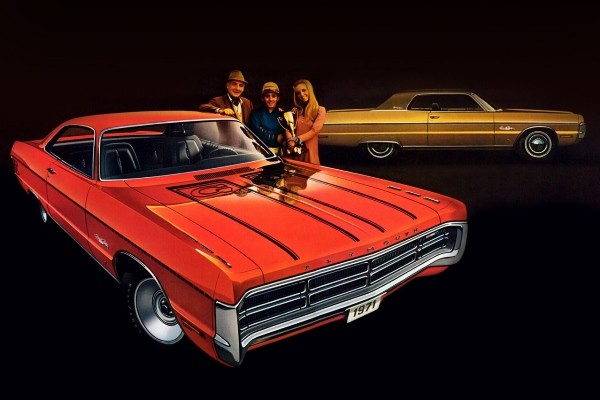
He work out of their Manhattan office and decades before "Zoom-calls" could even be imagined, at least once a month, sometimes more, he'd fly to Greensboro for meetings. He'd cab it to LaGuardia or Kennedy and sometimes Newark from our home in Baldwin, New York and most often times he came back so late at night it was easier if not safer for him to rent a car. One of the more memorable "company cars", as he called them, was the time he came home in a block long and block wide, dark green Plymouth Fury convertible just like this blue and white one here. Seeing my father left Burlington in 1972, chronologically my memory of that car syncs up. I'd guess that "company car" was a 1970 or 1971 model.

After the Plymouth's return to "full-size" convention for '65 and subsequent lovely reboot in '67, they came with these brutes that even a big car lover like me was like, "what is this"? And that was more like "what the hell is this" as oppossed to, "what is, this?"

That big Plymouth was part of Chrysler's 1969-1973 "fuselage" look. The fuselage look was allegedly a subtle cylindrical shape reminiscent of an airliner. That doesn't even become readily apparent even after that's directly pointed out, does it? To me these hulks looked as though the designers made only peripheral changes to a huge block of clay and called it a day. These cars made even early '70's full-size Ford's look like GM designs in comparison.

All Chrysler full-size models on the Chrysler C-body chassis got the fuselage treatment. My father's "company car" Fury riding on the "shortest" wheelbase at 120 inches. The Dodge Polara rode on a 122 inch wheelbase, Chrysler s on a 124 meanwhile the Imperial had a 127 inch long wheel base. To make maters worse, all big Chrysler's looked so similar, save for, arguably, the Dodge Polara, it was hard to tell a Plymouth from an Imperial.

That wasn't that unusual seeing that as far back as the late '50's Chrysler advertising highlighted that all Chrysler's were, more-or-less, simply trim levels of the same basic design.

As a wee-nipper all but living for the mornings when I'd see a "company car" in front of the god-forsaken Ford "Ranch Wagon", the time my father brought home that gigantic Fury was a morning I'll never forget.
It was a beautiful, sun-splashed fall morning with a little bite in the air and my father was to drive my brothers and I to school. My brother Kevin is ten-years-older than me and sat up front with dad meanwhile I shared the back seat with my younger brother, Chris. Sitting in the back seat of the foreboding Plymouth, I puckishly asked my father if he would put the top down.

Amazingly, seeing how little time we had for such frivolity and how chilly it was that morning, my father obliged. He and my older brother undid the latches on the windshield, my father flicked some switch and a cacophony of motors, gyros, servos and leprachauns started whirring and the top lifted towards the sky. I was delighted.

Only problem was, my dear old dad never saw a detail that he paid attention to. No sooner did the roof start to go up that it got snagged on a tree limb; the motors fighting against the tension of the big branch. When my father realized what was happening he went to put the roof back down but the branch cracked and the canvas roof jerked up past it; the branch dropping not only sticks and twigs into the car, but what was left of its dewy leaves and who knows what other "tree-crap". Amazing that the roof didn't get punctured. With the broken tree limb hanging over the center of the car with the canvas top half open, my father had no choice but to put the top all the way down and move the car out of the way.
With the top down, I was memorized how different the world looked sitting inside a car with the roof off; everything was different and was somehow...better. The sun was shining more brightly, the leaves on trees more colorful. I asked my father if he'd drive us to school with the top down and he ignored me thus snuffing out my joy. Now he was running out of time and with a car full of tree junk he'd have to clean out before returning the rental and it being so chilly he had to get the top back up. Problem was when the roof came back down onto the top of the windshield, the roof was out of alignment and wouldn't latch down. Seemed the convertible top's frame got bent when it got bound up against that tree branch.
So I got my top-down drive to school. Froze my butt off too but for those few fleeting moments, I was living high on the hog. My father mumbling sarcastically under his breath that it was a perfectly wonderful way to start the day.
As far as I was concerned it most certainly was.


