Showing posts with label GM. Show all posts

Wednesday, August 19, 2026

A Four Door Camaro? They Can't be Serious, Can They?

Rumors have been swirling for months that Chevrolet was reviving the Camaro nameplate as an EV-only, four-door sedan. The latest scuttlebutt suggests that while Chevrolet does appear serious about bringing the Camaro back, it won't be EV-only. In fact, current reports point toward a rear-wheel-drive, internal-combustion Camaro, with a turbocharged four-cylinder likely serving as the base engine and a V-8 available in higher-performance versions.

There's been speculation that GM's new-generation small-block V-8 could find its way under the Camaro's hood, although exactly which engine it would be—and how much power it would make—remain unknown. I've heard nothing credible about the twin-turbo 3.0-liter V-6 currently offered in the Cadillac CT5-V being part of the Camaro lineup. The latest musings out of Detroit also suggest that an EV version isn't part of the immediate plan, despite all the earlier rumors about an electric Camaro.

The real kicker is that GM appears to be hell-bent on making the next Camaro a four-door, with no definitive indication that a traditional two-door coupe will accompany it. Right now, "they're saying" the new Camaro is expected to ride on an updated version of GM's rear-wheel-drive Alpha architecture, share its underpinnings with the next Cadillac CT5 and a forthcoming Buick sedan, and enter production at Lansing Grand River in Michigan. The latest reports put it on track for the 2029 model year.

Seems like a last-ditch effort to revive "the automobile" as we once knew it. If this thing fails, my money is it will, looks like future highways will be filled with nothing but "trucks" 

Based on these A.I.-generated renderings, Chevrolet is going back to the "retro Camaro" well yet again, something it first did with the fifth-generation Camaro introduced for 2010. That car deliberately channeled the 1967–69 first-generation Camaro, particularly the iconic 1969 model. The sixth-generation Camaro, introduced for 2016, was essentially an evolution of that design rather than a clean-sheet departure.

The styling of the fifth- and sixth-generation Camaros has always left me flat-footed, though. I find them cartoonish in ways the first four generations of the Camaro simply weren't. Maybe that's just my old-car bias talking, but there's something about those later Camaros that never quite worked for me. They're great cars—my older son has a 2017, and despite its shortcomings, it's an amazing ride—but in terms of "look back at it after parking it" appeal? Meh. Not so much.

Don't tell him I told you that. I need him to pick out a nice nursing home for me. 

The auto industry is interested in one thing above all else: making money. Automakers aren't interested in nostalgia and tradition for old-time's sake. If they can move "units" because of a retro theme or design, they're going to do it. If they can't, they won't bother.

And the best-selling vehicles in the country don't have a shred of throwback about them. The Ford F-Series, Chevrolet Silverado, Toyota RAV4 and Honda CR-V are about as modern and utilitarian as it gets. The Toyota Camry, America's best-selling traditional passenger car in 2025, isn't exactly dripping with nostalgia, either.

And then there's Dodge's new Charger, which supposedly oozes old-school charm. I don't get it. Whatever nostalgia Dodge was shooting for, buyers haven't exactly been beating down the doors. Dodge sold 7,421 electric Charger Daytonas in 2025. There were also 2,141 gas-powered Chargers reported for the year, although that figure included some previous-generation cars still sitting around on dealer lots. The new gasoline-powered Sixpack arrived so late that it had essentially no impact on 2025 sales; production began in December.

I'll bet you a nickel the big sixer has little impact on sales.

Alas, stylish two-door cars, which were a staple of my car-crazed youth, have been falling out of favor for decades. Once pillars of the industry, today's surviving two-doors are mostly niche products—and many are expensive ones. Chevrolet sold 24,533 Corvettes in 2025, Ford sold 45,333 Mustangs, and Dodge's new Charger Daytona managed just 7,421 electric sales in its first calendar year.

Back in the 1970s, the combined sales of the Chevrolet Camaro, Pontiac Firebird and Ford Mustang could approach 900,000 in a single year. In 1979, for example, the three totaled roughly 864,000 sales. That's still an astonishing number compared with today's market, but it wasn't quite the million-plus figure my memory wanted it to be.

Frankly, the world didn't end when Ford labeled its first EV crossover "Mustang" back in 2021. Although, if I'm not mistaken, most people call it the "Mach-E" anyway. And "Mach"—a nod to the iconic Mach 1 Mustang—somehow seems less offensive than calling what's essentially a four-door crossover an actual Mustang. Ford, for its part, explicitly positioned the Mach-E as an expansion of the Mustang family and an all-electric member of the Mustang stable.

So, in the end, the world will be just fine if Chevrolet comes out with a four-door Camaro, even if it doesn't offer a two-door version. It doesn't necessarily mean Chevrolet will move a lot of Camaros if they have four doors, two doors, three doors, or if you have to jump through the sunroof to get inside them.

The market has moved so far away from sedans that it may be too far gone to come back.

The rational side of me totally gets it. The Camaro-lover in me, however, wants to jump out a window.

I mean, they can't be serious, can they? Newsflash, Camaro-boy. They can be. 


Tuesday, July 6, 2021

1967 Pontiac Tempest - Cammer


I don't know if it's more amazing that this 1967 Pontiac Tempest has never been cloned into a GTO or that it still has its original six-cylinder engine. The period correct Crager's and heavy duty leaf springs are amazing too. 


In a day and age when V-8 engines ruled the roost, Pontiac's overhead-cam six was certainly a horse (power) of a different color.  Something tells me that had this '67 been powered by Chevrolet's more mundane six-cylinder engine it would have been tossed decades ago. 


Also known as the "Pontiac Cammer", Pontiac built them from 1966 through 1969 and dropped them in into the base models of Tempest's and Firebird's. Why? That's a good question seeing that Chevrolet's  six had been the base engine in the Tempest from 1964 and 1965. And after the Cammer was dropped, Pontiac went back to using it as well.  


Legend has it or not, and the story varies somewhat depending on who you're getting it from, but the idea for "OHC-6" stems from the early '60's brainchild of the then head of Pontaic's Advanced Engineering team, John DeLorean. Yes, that DeLorean. DeLorean championed a Pontiac sports car that was similar in concept to Chevrolet's Corvette with one of the big differences being instead of being powered by a V-8 like the Corvette was, it would have a six-cylinder engine. Ah, but not just any six; Mr. DeLorean implored his team to think outside the box and take inspiration from Mercedes-Benz. 


GM executives ex-nayed DeLorean's Pontiac sports car known as the Banshee, although many styling attributes of it found its way into the 1968 Corvette. They did, oddly enough, green light  it's engine. At least for a little while. 


Why the expensive and complicated cammer made it into production is a head scratcher considering that it, save for a performance setup that was available on it, didn't provide significantly stronger performance than the Chevrolet-six did. Also, Pontiac's "base" 326 cubic-inch V-8 engine was cheap as dirt and made more horsepower and torque. Engineering for the sake of engineering's sake? Perhaps and there's nothing inherently wrong with that but it ain't a good way to run a railroad. With few takers for it, easy to fathom why it wasn't around very long.  


The Pontiac OHC-6 is now little more than a footnote in the annals of GM engine history; if anything its fiberglass reinforced timing belt rather than a chain helped advance the state-of-the-art of overhead camshaft engines. Personally, I bristle at the idea of separating this car from it's original engine after all these years - regardless of its unique and different pedigree. Perhaps the series of owners its had over the years has felt the same way. 


Wednesday, March 3, 2021

1971 Oldsmobile F85 Town Sedan - Invisible

This beast popped up on my Facebook Marketplace feed the other day and of course I had to blog on it. Not sure what more I can say about a vehicle type I've blogged to death over the years but here goes. This is a 1971 Oldsmobile F85 "Town Sedan" and it's for sale near my home here in bucolic Cleveland, Ohio with a, I kid you not, asking price of $4,000.  

I'm not quite sure who or what the target market would be for a fifty-year old Oldsmobile four-door sedan that's not even a Cutlass. Yes, it's technically part of the Cutlass series but by 1971, what had been the model designation for Oldsmobile's "senior compacts" had been pushed to the bottom of the Oldsmobile pricing ladder and denoted their least-expensive mid-size model. However, as an old friend in the used car business used to say, "there's an ass for every seat". Perhaps the low-mileage and it being a "CALIFORNIA CAR" would be a selling point to someone up here. Although, four-grand for a car in Northeast Ohio would buy you a fairly nice, somewhat "old" but not fifty-years old, low-mileage driver. Who knows. Maybe a movie company would scarf this up as a set up piece. 

Of all of GM's wonderful 1968-1972 intermediates, the Oldsmobile's are my least favorite. Save for a two-door 1970-1972 Cutlass Supreme, so perhaps that fact drives my ambivalence towards this sorry old boat. Funny, how if it were a station wagon I'd be all over it, despite it being an Olds, especially with this patina but as this is, no way. Although I wouldn't mind kicking it's tires and stabbing the gas as hard as I could to see if the "350 Rocket" still had it or not. 

 Us car people are a fickle lot. I don't even bother trying to explain to my wife anymore what I see in one old car and don't see in another. Although, this car's invisibility to me helps me understand what folks who don't "get-cars" don't see in them either. My wife, bless her heart, does know me well enough that I believe two-door cars are good, convertibles are over-rated, five-door cars, as in stations wagons, are good too. Four-door cars are not good and should be drained of fluids and used as barrier reefs if not crushed and reborn. 

. 

It's not all bad, though. This '71 is a real time-machine that takes me right back to high school in the early '80's when I was shopping for my first car. I would have killed to have a V-8 powered sled like this in high school even if it had four-doors. Back then a finish-less, rusty, ten or eleven year old mid-size GM sedan would probably go for between a thousand and fifteen hundred bucks. I still wouldn't touch this now for that amount but it is interesting see something like this going for as much as it is. Is $4,000 really the present day $1,000? 

Thursday, September 24, 2020

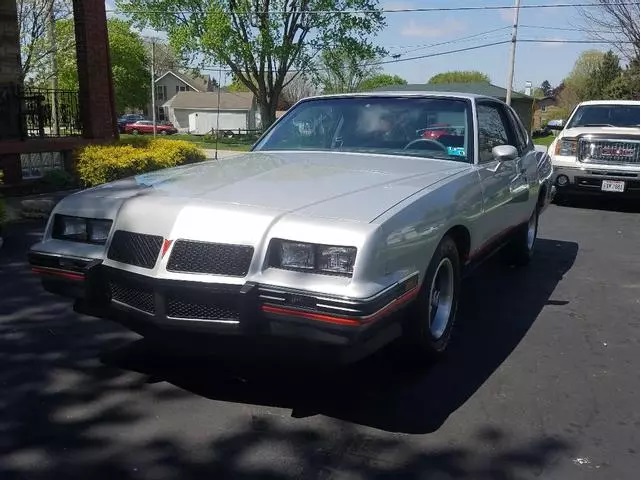
1986 Pontiac Grand Prix 2+2 - Distinctly Different Bubba


I really liked Pontiac's 1981 update of their 1978 downsized Grand Prix. Although, honestly, they still lacked that "gotta-have-it" swagger of the "classic" GP's of 1969-1972 and even to some extent the 1973-1977 "colonnades". I blame that on these cars being just too darn small for a design that was "that big". Like we've discussed before, some designs look better on larger canvases. Of course, the inverse is true as well. They where hardly the worst looking things on the road at the time  and certainly had more of the "spirit" of the older GP's than than the 1978-1980 did. 


Unlike Chevrolet, though, Pontiac never offered a Grand Prix of this vintage with anything remotely construed as a performance engine or even a handling package. Even when it appeared that would have as in the case of these odd looking 1986 only, Grand Prix 2+2's. Allegedly, just 1,225 were built so Pontiac could be in compliance with NASCAR's even at the time archaic rule that whatever raced on their tracks had to be available for sale to the public. Even in such limited quantities. Chevrolet offered a similar looking Monte Carlo SS they called "Aero-coupe" for 1986 and 1987. Incidentally, the 2+2 moniker hearkened back to the a trim package Pontiac offered on their Catalina from 1964-1967. 

Outwardly, the biggest difference between the Monte Carlo SS "Aero-coupe" and a Grand Prix 2+2 was that while the Monte Carlo SS kept the same front end other Monte Carlo SS' models had, Pontiac drew up this (eek!) "shovel nose" front end. As we say, though, "there's an ass for every seat". Folks gobbled everyone of these up quick as they could. No doubt most were NASCAR fans although I'm sure a few were sold to folks who had no idea what the design inspiration for them was. 

Inside buyers got power windows and door locks, still considered higher-end items in the mid 1980's, and buckets and a console enclosed floor shifter which were the epitome of "sporty" back then. There's also that steering wheel that looks like it was pulled from a Fiero. And, oh, that plastic wood grain dash. May have worked on "lesser" GP's but on one with sporting pretensions like this thing, it's as bad as the nose job this car has. 

Although I love the paint scheme, stripes and those "Rally II" rims, as a GM die-hard. then as I inexplicably remain today, I could almost look past the funky (not in a good way) front end and rear window had their been some serious power under the hood. All of these came with nothing more potent than Chevrolet's one-hundred sixty five horsepower 305 V-8 engine. That's too bad. Can you imagine one of these hopped up with the mighty Buick turbo V-6 from this era? All sins forgiven! 

While we're talking engines, it always struck me as odd that GM never offered the fabulous "Tuned-Port-Injection" or TPI 305 engines they offered on Z28's and Trans Am's on these cars. If there was no 305 offered I wont' even mentioned the 350 version of it. Even on the Monte Carlo SS which never had any more than one-hundred an eighty horsepower from the factory. As if someone would buy a Monte Carlo or Grand Prix that could really move over a Camaro Z28 or Trans Am. I mean, some would. Yes. But by and large they were to two distinctly different Bubba's. And seeing that the owner of this car wants almost twenty-grand for it, spending that much on this and then doing a proper motor swap makes no sense what-so-ever.