Showing posts with label Oldsmobile Toronado. Show all posts

Tuesday, August 15, 2023

1969 Oldsmobile Toronado - White Elephant


If you're interested in getting into the collector car universe, don't want to spend much, don't want some broken down jalopy and tend to lean towards the quirky or unusual, might I interest you in this 1969 Oldsmobile Toronado? Facebook Marketplace asking price for this Martian spaceship is $10,000 but seeing how old the listing is you might be able to get it for less; the closer bought to $7,500 I think the the better. Why is this seemingly solid oldie going for so little? Good question. Has it been wrecked? Implicated in a crime? Lost title? There weren't many details in the ad for it. More than likely there just aren't many takers for these cars - especially in this rather unfortunate color scheme. "Toronado" is a made-up word, but it might as well mean, "white elephant"? 


This car harkens back to an age and time when General Motors' myriad divisions were at the top of their autonomous and inter-company competitive powers. Legend has it Oldsmobile was jealous of the success that Buick got within GM with their Riviera, which is ironic given that the Riviera was a "corporate" design offered to all GM divisions, even Cadillac, and was turned down by Oldsmobile. Not to be out done by Buick, Oldsmobile came with a personal luxury\personality car for 1966 that was, arguably, one of the most outrageous cars GM had ever come out with. Certainly the craziest Oldsmobile ever. 

Crazy in design, no doubt, but the "Twilight Zone" styling overshadowed engineering that GM had never offered before: front-wheel-drive. It was also the first domestically produced front-wheel-driver since the Auborn owned Cord of 1929-1932 and 1936-1937 fame. 

Things was, despite the superior traction that FWD affords a vehicle, all of the interior packaging efficiencies of it were all but mute on such a large car. Who needs more room when you have all of it in the world to begin with? Can a car be too big? Take it from someone who's maybe only five-foot-nine, yes, they can be. 


This car and it's Cadillac Eldorado corporate kissin' cousin of the same vintage are so big, I can't have my left elbow out the driver's side window meanwhile having my left hand on the wheel. 

Oldsmobile had experimented with an intermediate sized front-wheel-drive design but GM executives reasoned they would not be able to amortize development costs on a mid-sized car. Therefore, a compact car would have made even less sense; the thought being smaller cars mean small profits. Sad thing was, when front-wheel-drive became fashionable during "The Great Downsizing Epoch" of 1977-1986, none of the engineering that went into pulling instead of pushing these cars was used. 


To push instead of pull, all Toronado's from 1966 through 1985 utilized what GM referred to as the "Unitized Power Package" or "U.P.P.". In a nut shell, torque was diverted from the rear of the engine to a transmission mounted under it. The "package" was so compact, despite the use of enormous engines, GMC and other manufacturers used it to "pull" motorhomes. 


Driving dynamics wise, one of these drives and handles not unlike just about every other full-size GM make and model of the era. That's damning the U.P.P. with faint praise - it was so good no one noticed it was there. And with there being no tangible benefit to it, these cars were, if anything, a technical or engineering novelty. 


And, an expensive one as it was Oldsmobile's most expensive model, their flag ship so to speak. NADA pegs one of these average retail today at $23,400; even that's reasonable money for a 1969, full-size GM two-door in, again, what appears to be very good condition. If you're interested, comment below and I'll do my best to contact the seller if it's still available.

Saturday, July 29, 2023

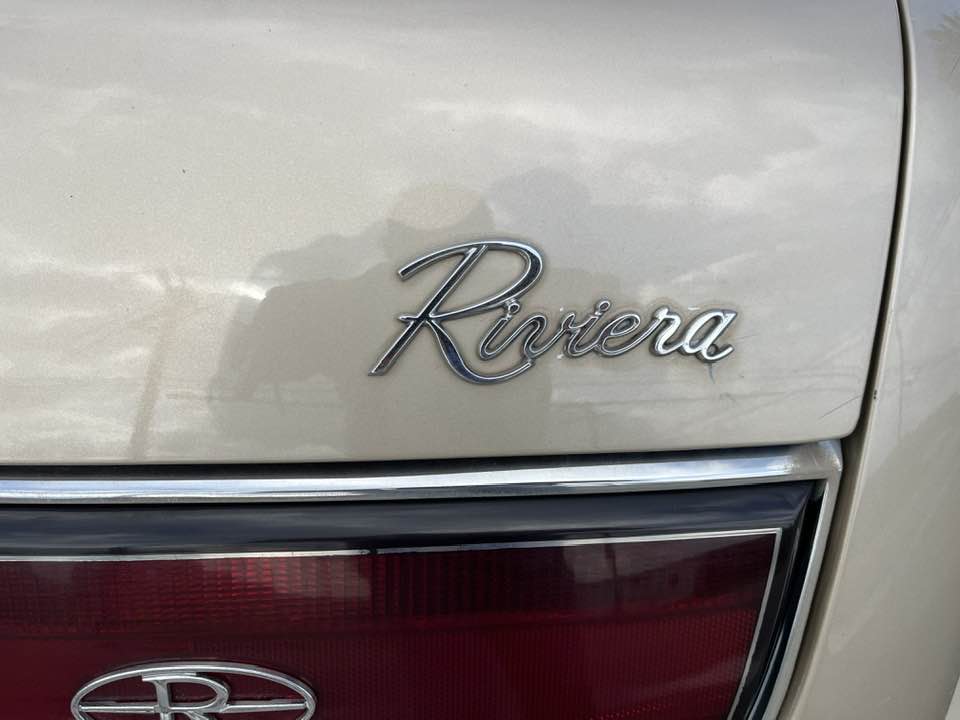
1992 Buick Riviera - Old and Grumpy


My office is next door to a transmission shop and on occasion, something interesting shows up over there like this 1992 Buick Riviera did the other day. For the record, I find many things "interesting", that doesn't mean I necessarily like them. 


General Motors' "Great Downsizing Epoch" started out well enough with their shrink-rayed full-size cars for 1977; they were far less successful hacking away at their intermediates for 1978. However, there was a ray of hope and promise in 1979 when they introduced their downsized "E-body", Cadillac Eldorado, Oldsmobile Toronado and Buick Riviera. Not surprisingly, those cars were designed by Bill Mitchell who retired in 1977, and while he had a strong influence on the downsized 1977 full-size cars, he did not have a hand in the design of the 1978 intermediates. GM downsized the "E's" again for 1986 and botched the reboot so bad it damn near killed a market segment. 


Sales imploded. While Buick sold over 65,000 Riviera's in 1985, the last year for the 1979 era design, they sold just over 22,000 of the downsized little stinkers for 1986, a whisper over 15,000 for 1987 and a laughable 8,600 or so for 1988. They redesigned them for 1989 smearing on cake frosting to make the cars look more like Riv's of yore and it worked to some extent as sales bounced back to 1986 levels for 1990 and 1991. Then the sales began circling the drain again for 1992 and 1993. 


In fairness, the shrunken "E-bodies" were roomy inside, comfortable, feature laden and rode and handled better than any "E" before them. Several problems, though. GM grossly underestimated how important the axiom of "size matters" was to their core E-body customer; the smaller "E's" weren't much larger than lesser GM makes and models and they cost twice as much. They also had myriad warranty issues and, lastly but not leastly, especially the Riviera, they was ugly. The Eldorado and Toronado didn't win any awards for inspiring design either. 


Cadillac and Oldsmobile did a nice enough job upsizing their "E's" as well for 1989, I wouldn't kick an Eldorado Touring Coupe or Toronado Trofeo of that vintage out of my garage. Buick, on the other hand, was far less successful with their rehash of the Riviera, they only made a bad thing worse. 


When I saw this car the other day, I first thought it was aging better than I ever thought possible. The closer I got to it I realized I was wrong. I didn't take my own word for it either because sometimes you don't know how something you've known for half your life has aged or weathered over time. I texted a couple of photos to my twenty-six-year-old, semi-car crazy hipster son and asked him for his take on it. 

Here's his reaction. 


Regardless of whether I like it or not, seeing an oldie at the transmission shop next to my office while a most pleasant way to start the day for me, is most often times not a good thing for the vehicle owner. A quick chat with Peter the shop manager and he told me he can't find the parts he needs to fix its busted THM 440-T4. 
\

The owner has options, though. He can search for parts himself, sell it "as is" for next to nothing, sell it for parts or drive onto a frozen Lake Eerie in wintertime. 


T

Friday, December 16, 2022

1978 Oldsmobile Toronado - Big Ole Slice of Malaise Era Luxury


Today's Facebook find reeks of someone trying to ditch their old car before they have to pay the stipend to store it. Originally listed at $4,600, the price has been sawzalled to $3,200. Only 34,000-miles or so on its 44-year-old analog ticker too. Still available today five weeks after original listing. That's not a good sign. I mean, who wouldn't want a 1978 Oldsmobile Toronado? 


This darn thing is so "cheap", I might feel inclined to jump on it although, with this being the only picture of the interior, and this to show off its super low mileage, I get the sneaky feeling there might be something up with the insides. My concern would be getting stuck with it after I grew tired of it. Three-grand is still three grand, after all. 

If you're curious, "S" on the transmission selector is for "SPORT", although "sport" on an almost five-thousand-pound car powered by a 185-horsepower engine is relative. "SPORT" was simply a third-gear lockout. "L", or "low", locked out second and third gear. 


There is some quasi or semi-interesting history to this car what with it being a 1978, 1978 the last year for these cars before GM shrink-rayed them to a more manageable albeit still substantial size. It also has, debateably, the last great or really good V-8 engine built by Oldsmobile, that being the good old 403-cubic incher. Making all of 185-horsepower, which, give or take ten-to-forty horsepower, was about the most any engine made by the Big Three and a Quarter back then, it did make a stout 325-foot pounds of torque that gives this car a fighting chance to get up to freeway speed without it getting clobbered. No engine pictures either. This a barn find and they only detailed the exterior? 


You'll still get clobbered at the gas pump, though. Perhaps not as bad as what the Oldsmobile 455 engine would do to your wallet or debit card; the 455 the engine the 403 replaced starting in 1977 because GM believed they would never be able to get the 455 to pass ever stricter emissions and fuel economy standards. I'd figure seven-to-nine mpg around town, maybe twelve, thirteen if you're lucky on the highway. 


The coolest thing about these cars, although few would notice, was that these are front-wheel drive. While most cars today are "pulled" by their front wheels, back in the day, most cars were "pushed" by their rears. Thanks to what GM referred to as the "Unified Power Package", or "U.P.P.", the engine, transmission and differential were lumped together as one unit in front of the firewall. Pretty trick piece of engineering. It was so good and so seamless, there was zero torque-steer, unsuspecting drivers never noticed. Or cared. 


Why GM decided to use it only on the Toronado and very similar Cadillac Eldorado is a question us mortal car geeks will never get answered. Certainly, would have made more sense to use it on at least their mid-size models or even their compacts given the interior packaging efficiency front-wheel drive enables. You ever sit in a rear engine, 1960-1969 Chevrolet Corvair? Positively cavernous without the tunnel and the hump for the driveshaft. Rumor has it the "U.P.P." was initially intended to be used on intermediate sized cars but that plan was scrapped by GM higher-ups. 


Oh, but how will she drive? Well, despite being front-wheel drive, typical for the time period, actually. That means soft, cushy and silent. Over boosted power steering will providing little to no road feel and the front end will wander and need constant attention to keep in a straight line. Solid beam rear axle doing handling no favors save for providing isolation from the road.  


Combine the floaty ride and handling with sluggish engine performance, and what you have here is a big-ole slice of "Malaise Era" luxury. Yum. Gosh, what did I ever see in cars like this when I was younger?   


Looks like I've talked myself out of this thing. Which is therapeutic. Like I said, when I was younger, and for reasons that all but escape me now, old iron like this were "my thing". Now all I see is what they are or portended to be. What that was, much like old trappings of the wealthy, escapes me now too. 

Friday, October 14, 2022

1983 Oldsmobile Toronado - Flipping Cars

I toy around with the idea of making extra money "flipping" old cars. Then I think better of it even when something like this 1983 Oldsmobile Toronado pops up on my Facebook Marketplace feed that appears to be pretty clean. Asking price is all of $1,500 too and there's just 48,000 miles on its thirty-nine-year-old analog ticker too. You'd think this the perfect muse for me to flip, right? The poster of the ad claims it needs brake work, but I know better to than to think that's the only thing this will need. 

Turns out the front brake lines are rusted through making the car undrivable. The rears still work, but rear brakes are more or less "back-ups" to the front brakes; the majority of a cars braking done by the fronts. Brake lines aren't something that you can buy at Autozone, NAPA or O'Reilly Autoparts either. They have to be custom bent, and the ends need to be properly "fit"; not something I ever want to try again. Trust me. Been there done that. Pull-A-Part yards usually won't let you glom brake lines either. Same with fuel lines. Not that I'd find one of these there anyway. 

Conveniently or not so conveniently, this car is in the same town my office is in. That's great. But my office is one-hundred-miles from where I live so this would need to be towed. Although I have up to two-hundred-miles per year towing included with my A.A.A. membership, this could get expensive for me in time and energy spent. Not to mention money. 

This generation of Oldsmobile Toronado is the kissin' cousin to the 1982 Buick Riviera I had when I first met my wife. That car, that my wife to this day still refers to as that "Old Man's Car", was the worst daily-driver I've ever had. I say, "daily driver" because my beloved 1977 Chevrolet Corvette is without question the worst car I've ever had at least in terms of reliability but it's not a "daily". At the end of the day, all things being equal and aside, reliability is the most important thing about any vehicle. Will it get you from point A to point B without any drama?  

This Toronado and my Riviera share much with the creme-de-la-creme of the class of 1979 General Motors "E-bodies", the Cadillac Eldorado. And of the three of them, on my short list of preference, the Olds Toronado is third behind the Riviera. A distant third I might add. Aesthetically. The cars are all but the same in terms of driving dynamics. 

They all share one of the most underappreciated pieces of General Motors engineering prowess of the 1960's, yes, the 1960's, what was referred to as the "Unified Powerplant Package" or "U.P.P.". 

The U.P.P. essentially combined the engine, transmission and differential into one compact "package" that laid in front of the firewall. Yes. These cars are front-wheel-drive. GM came out with the U.P.P. on the original Toronado in 1966, the Cadillac Eldorado got the same system, save for using a Cadillac V-8 and not an Olds engine, in 1967. Although starting in 1966 Buick used the same chassis and shell on their Riviera that Oldsmobile used on the Toronado and Cadillac on the Eldorado, they were allowed to eschew the U.P.P. for the at the time more conventional front engine, rear-wheel-drive layout. Ah, the days of real GM divisional autonomy. 

Buick eventually used the U.P.P. on the 1979 Riviera which, again, shared much with the also new for 1979 Oldsmobile Toronado and Cadillac Eldorado. 

Oddly enough, the only other General Motors application of the U.P.P. was on their front-wheel-drive, fiberglass and aluminum bodied motorhome they sold through GMC from 1973 through 1978. 

Thanks to the U.P.P. my Riviera was remarkably spacious for a car that was much smaller in length than the car it replaced, my 1975 Chrysler Cordoba. That's about the only good thing I can say about that bomb that plagued me and my bank account for just under two-years years ago. 

Why GM didn't use the remarkably space efficient U.P.P. on intermediate or compact cars is a question us mere mortals will never get an answer to. 

I've thought better than to pursue this car which is little more these days than a cheap relic of a bygone luxury car era; the way things used to be so to speak. With its oh-so-limited niche market "appeal", I wouldn't want to be stuck unable to unload it and being so ambivalent towards it, I most certainly wouldn't want to keep it. Regardless of what shape it's in. I mean, seriously, who the hell wants a 1983 Oldsmobile Toronado anyway? 


Thursday, August 11, 2022

1975 Oldsmobile Toronado - Filter-Less Pall Malls


This 1975 Oldsmobile Toronado came up during my most recent "cheap car" search. You know, those Sunday morning time wasters where I type in a lowball dollar amount into cars.com, throw the net out one-hundred miles from my zip code and then I sort by "oldest year". By the way, thanks to inflation and Covid, I've had to increase the dollar amount from $10,000 to $15,000. Shoot, it used to be $5,000. Doesn't mean I found anything worthwhile this past Sunday although I found a thing or two that was interesting. Like this big old Toro. 


From 1966 through 1992, Toronado was Oldsmobile's top-of-the-line model and was defined as a "personal luxury car". Although, frankly, there's certainly nothing "personal" about a car that's nearly 19-feet long, almost 7-feel wide and weighs closer to two-and-a-half-tons than two-and-a-quarter. 


However, for a car this big, these are fairly cozy if not "personal" inside. Then again, that big-on-the-outside, small-on-the-inside ethos was the design axiom back when cars were designed from the outside in. Gosh, as a kid, I remember seeing cars with these tufted, over-stuffed-pillow, velour like interiors and thought they were the epitome of luxuriousness. Now all I see is an aching back and seats that smell like a wet dog mixed with cigarette smoke from filter-less Pall Mall's. 


To the casual observer, this looks like any big Oldsmobile from the 1970's. If you cock your head and blur your eyes a little, you see a lot of then-current Cutlass Supreme. However, in addition to this being built on an entirely different platform than the bread-and-butter Cutlass of the time period, there's a whole lot more to the Oldsmobile Toronado than meets the eye. 


What made these cars special and unique was they were front-wheel-drivers. "Front-wheel-drive" in, save for a handful of European and Asian makes and models, a rear-wheel-drive world. And they were GM's first ever "front-drive" automobiles and the first American front-drivers since the Cord 810\812 of 1936-1937. And did America care? By-and-large? Nope. Well, I'm sure that a handful of people appreciated the engineering that went into these cars, but folks bought these things because they liked their styling or what they perceived them to be as opposed to whatever trickery engineers used to get torque to the front wheels. 


Early (1966-1970) Toronado's were marketed as large, semi-sporty, muscle-car-like, grand touring cars and got outsold by their similar but far more luxurious, and more expensive corporate cousin, the Cadillac Eldorado. That all changed for model year 1971 when both were redesigned. That redesign made the Cadillac even bigger and softer and Toronado became more like the previous version of the Eldorado. Just-like-that, Toronado sales more than doubled. 


Our '75 here is part of that Toronado reboot. This one's for sale for $12,500 which sounds like a ton of money but keep in mind, and somewhat ironically too, that a Cutlass in this shape, would be listed for at least twice that if not two-and-half times more. The irony being that in 1975, this car stickered for some $6,700 meanwhile the Cutlass sold for $4,100. Big bucks back then during the Ford administration. And between us cool-cat, Seventies car lovers, I'd rather have the Cutlass. And I'd take it in this awful eggshell blue hell as well. Comment below with your thoughts.