Showing posts with label Cadillac Eldorado. Show all posts

Saturday, September 5, 2026

1970 Cadillac Eldorado - Baby Blue

Shame the Corinthian Blue paint on this 1970 Cadillac Eldorado is as worn down as it is, having spent its 56 years getting pounded by the weather up here on the coast of Lake Erie. It's peeling in places, too. The fact that this needs a new paint job is one of the reasons the asking price is just $6,000.

There are rust bubbles under the vinyl roof, too. This needs to come off completely, of course, and the body underneath it repaired properly. This, along with the paint job, could easily run $15,000. No sense in cheaping out, either; the rust will just come back. Whether you replace the vinyl top or not—I wouldn't—is up to you.

What's most disconcerting are the rusting, more like disintegrating, rear structural mounting areas. This is where things get interesting with the Eldorado's unusual construction. The 1967–1970 Eldorado used a semi-unitized body shell with a long subframe carrying the powertrain and front suspension. That subframe extended rearward to roughly the area of the forward rear-leaf-spring mounts. It wasn't a conventional full-length frame like you'd find under a traditional body-on-frame Cadillac.

Can this even be fixed? Good question. I'm sure some hack with a blowtorch would be willing to give it a shot. The proper repair would mean cutting out the rotten metal and replacing it with properly fabricated structural sections. Finding replacement structural pieces could be another matter entirely. You also have to be concerned about the rust having spread into the surrounding body structure as well.

This would be what would make me walk from the deal. Where there's smoke, there's fire, as they say, and where there's rust, there's more rust. When structural mounting areas are compromised this badly, there's bound to be other places where it's soft.

Cadillac first came out with an Eldorado in 1953 to commemorate its 50th anniversary; the name actually originated with a 1952 Golden Anniversary show car. In 1951, Cadillac's advertising agency held an internal "name-that-car" contest, and a secretary in Cadillac's merchandising department, Mary Ann Zukosky, came up with "El Dorado." She didn't get a new Cadillac Eldorado, but she did receive a $25 U.S. Defense Bond.

The Eldorado went through myriad changes over the next decade or so, at times devolving into little more than a fancified deVille convertible. That changed in 1967 when Cadillac introduced this front-wheel-drive Eldorado, which shared little structurally with what it replaced.

These were Cadillac's first front-wheel-drive production cars, but unlike the front-drivers it came out with in the 1980s, the engine wasn't transversely mounted. It was mounted longitudinally, like the engines in rear-wheel-drive cars.

That meant the engine's output had to be redirected from the rear of the engine to the front-wheel-drive transmission. That was accomplished through a specialized "split" transmission and transaxle arrangement using a two-inch-wide "Hy-Vo" chain.

The engineering was remarkably sound, and torque steer was well controlled despite these cars being powered by some of the largest engines ever installed in a passenger car. The 1967 Eldorado was powered by Cadillac's 429-cubic-inch V-8, which had debuted in 1964. That engine was itself an evolution of the 390-cubic-inch V-8 introduced for 1963.

For 1968, Cadillac introduced its clean-sheet 472-cubic-inch engine. For 1970, the 472's basic architecture was enlarged to 500 cubic inches, but the 500 was exclusive to the Eldorado that year. Hence, this Marketplace gem here has the 500, which for 1970 was rated at 400 SAE gross horsepower and 550 lb-ft of torque.

Hard to determine exactly what that 400 gross horsepower would be in net horsepower. There isn't a simple formula for converting one to the other, since SAE gross and net horsepower were measured under different conditions. Suffice it to say that the net figure would have been substantially lower. Using my crazy "Charley Math", I wouldn't be surprised if this engine netted roughly 250-horsepower. Your opinion may vary. See dealer for details.

Contemporary road tests of the 1967–1970 Eldorado were generally pretty benign. They noted that the cars rode just like any other luxury car of the day. Other than the lack of a driveshaft hump, there was little indication from behind the wheel that the car was front-wheel-drive.

Surveys of Eldorado buyers found that the vast majority didn't buy the car because it was front-wheel-drive; they bought it because they liked its styling. I get that. These cars are really special. The clownish parade floats that replaced them from 1971 to 1976? Not so much, as I see it through my foggy goggles.

So, what happens to baby blue here? Good question. Perhaps the seller will grow desperate and let it go for a fraction of the asking price. $6,000 is still $6,000, although it seems five- and six-grand is like two grand from 20 or 25 years ago.

I just hope someone doesn't pay anywhere near the asking price and then find out they've been had. That's why it's always best to get the car in the air and have it checked out from top to bottom before purchasing. If the seller refuses to let you do that, well, they're telling you, in not so many words, everything you need to know about the car.






Saturday, July 29, 2023

1992 Buick Riviera - Old and Grumpy


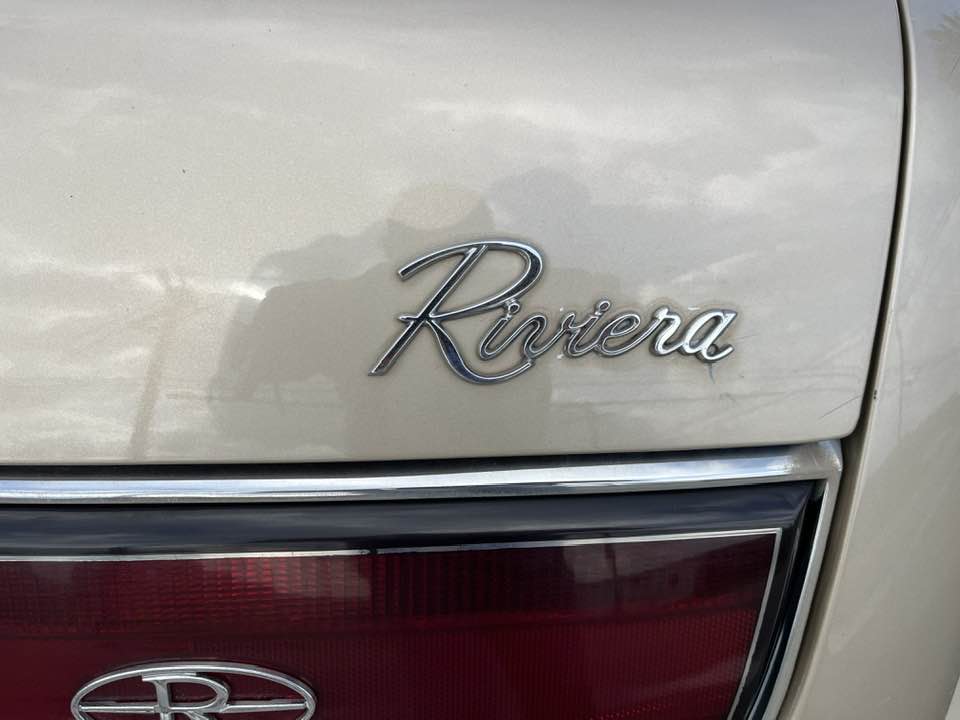
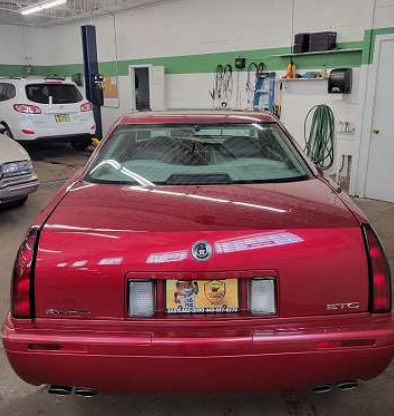
My office is next door to a transmission shop and on occasion, something interesting shows up over there like this 1992 Buick Riviera did the other day. For the record, I find many things "interesting", that doesn't mean I necessarily like them. 


General Motors' "Great Downsizing Epoch" started out well enough with their shrink-rayed full-size cars for 1977; they were far less successful hacking away at their intermediates for 1978. However, there was a ray of hope and promise in 1979 when they introduced their downsized "E-body", Cadillac Eldorado, Oldsmobile Toronado and Buick Riviera. Not surprisingly, those cars were designed by Bill Mitchell who retired in 1977, and while he had a strong influence on the downsized 1977 full-size cars, he did not have a hand in the design of the 1978 intermediates. GM downsized the "E's" again for 1986 and botched the reboot so bad it damn near killed a market segment. 


Sales imploded. While Buick sold over 65,000 Riviera's in 1985, the last year for the 1979 era design, they sold just over 22,000 of the downsized little stinkers for 1986, a whisper over 15,000 for 1987 and a laughable 8,600 or so for 1988. They redesigned them for 1989 smearing on cake frosting to make the cars look more like Riv's of yore and it worked to some extent as sales bounced back to 1986 levels for 1990 and 1991. Then the sales began circling the drain again for 1992 and 1993. 


In fairness, the shrunken "E-bodies" were roomy inside, comfortable, feature laden and rode and handled better than any "E" before them. Several problems, though. GM grossly underestimated how important the axiom of "size matters" was to their core E-body customer; the smaller "E's" weren't much larger than lesser GM makes and models and they cost twice as much. They also had myriad warranty issues and, lastly but not leastly, especially the Riviera, they was ugly. The Eldorado and Toronado didn't win any awards for inspiring design either. 


Cadillac and Oldsmobile did a nice enough job upsizing their "E's" as well for 1989, I wouldn't kick an Eldorado Touring Coupe or Toronado Trofeo of that vintage out of my garage. Buick, on the other hand, was far less successful with their rehash of the Riviera, they only made a bad thing worse. 


When I saw this car the other day, I first thought it was aging better than I ever thought possible. The closer I got to it I realized I was wrong. I didn't take my own word for it either because sometimes you don't know how something you've known for half your life has aged or weathered over time. I texted a couple of photos to my twenty-six-year-old, semi-car crazy hipster son and asked him for his take on it. 

Here's his reaction. 


Regardless of whether I like it or not, seeing an oldie at the transmission shop next to my office while a most pleasant way to start the day for me, is most often times not a good thing for the vehicle owner. A quick chat with Peter the shop manager and he told me he can't find the parts he needs to fix its busted THM 440-T4. 
\

The owner has options, though. He can search for parts himself, sell it "as is" for next to nothing, sell it for parts or drive onto a frozen Lake Eerie in wintertime. 


T

Saturday, June 17, 2023

1972 Cadillac Eldorado - Are They Really Alive?


I've written so much about Cadillac Eldorado's in all their good, bad and indifferent guises and iterations, that I believe I'm plum tuckered out of things to say about them. I guess I felt bad for this old lion when I saved some of the photos from the Facebook ad for it decided to write something about it. If for no other reason out of respect for it. 


While a 1967-1970 Eldorado might have a place in my Jay Leno Fantasy Garage, these 1971-circa reboots, that I think turned the once proud, cutting edge designs into parade floats, I'd rather see used to help prevent beach erosion. These came in convertible form too which only accentuated their floppiness. 


This patina rich Eldo strikes a chord with me reminds me as it reminds me of when I would visit my father in various nursing homes he was shuttled around to at the end of his life. One in particular with an indifferent staff and stinking of cheap institutional food, bleach, urine and feces - a god awful place. Many rooms filled with ghastly old people staring blankly at the ceiling with mouths agape. No one with them, heart monitor beeping slowly. I hope they were high as kites oblivious to their situation. Where they really alive? 


Who would buy this and why? Asking price is $4,000 which I think fair but still, a lot of money to put down on something that'll need twice that to stop people from putting their noses up. It probably has a ton of heart warming stories to tell if it could. That bug deflector tells me it was perhaps a retired couple's dream car and they used this gas-inhaling hog to tour the country. Then one of them passed and the other lost the drive to make such trips and it got stored, maybe for a time outside so the elements got the best of it for a while. We'll never know. Best to look away and pretend not to see it - like I did seeing those poor souls in that nursing home my father was in years ago. 
 

Monday, June 6, 2022

2000 Cadillac Eldorado ETC - Somebody Else's Problem

This 2000 Cadillac Eldorado ETC (Eldorado Touring Coupe) came up in my latest "cheap car search" this past weekend. With 90,000 miles on its twenty-two-year-old digital odometer and with an asking price of just $6,995, on paper at least, this is the car of my dreams. Knowing how an innocent enough find can turn into something, for better or for worse, I made the forty-minute drive to see and test drive it. I did more than kick its tires too. I didn't abuse the car, per se, that would be, ahem, childish, but I did feel like 17-year-old me again standing on a powerful car for the first time. Gosh, do kids beat on their parent's cars anymore? 

Long and short, I wasn't so much disappointed with this car as I found it underwhelming. And it wasn't like the fact the air conditioner compressor was seized up, the power antenna wouldn't go up and the passenger side window wouldn't go down from the driver's door switch had anything to do with my ambivalence towards it either. Nope. While it was a whole lot more put together and sorted out than the Eldorado ESC I drove about a year ago, what a bomb that thing was, I found it "just ok". The ride was rather squishy, the brakes felt vague, steering had minimal feel when I leaned into it on highway on and off ramps too. The car felt enormous and not in a good way; I used to love big cars, what's gotten into me? Even when I tried to put the gas pedal through the firewall, the experience of spooling up the 300-hp Northstar V-8 wasn't as visceral as I thought it would be. This boat weighing in on the dark side of two tons no doubt had a lot to do with that but has speed and power become such a commodity that I'm not impressed by it anymore? 

Maybe the "Magnasteer" Speed Sensitive Steering, Continuously Variable Road Sensing Suspension, Stabiltrack Chassis Control and Electronic Level Control had all seen better days. All that stuff helping to jack up the original MSRP to more than $46,000. Holy smokes. Much like on any car portending to be a high-end luxury car, all that gear is scary expensive to repair. Frankly, I don't think they make for an altogether "better car" or one that's reliable and durable either. I've never seen a Cadillac of this vintage with the kind of miles my 2002 Dale Earnhardt Chevrolet Monte Carlo has on it: 253,000 and counting.  Seriously, have you? Could it be because stuff like "Stabiltrack" and what not cost too damn much to repair? The owner of the lot where this was said he had about $3,000 into it already and was just trying to recoup some of what he spent. I think it's going to need at least that much more to really get it right. 

Despite it being really soft, the ride was pleasant, though and I wouldn't mind it on my insanely long commute to and from the office. Cross country drives as well. The seats were like thrones and the leather was luscious. I loved the color combination too even if it felt a little too "old man-ish" for me. 

Unlike most people, I can talk myself out of just about anything. And to jump out of my matronly but beloved 2002 Dale Earnhardt Chevrolet Monte Carlo and into this simply because I could, didn't seem to me like the best use of my time and dollars. Had this sucked my bifocals off perhaps I'd think differently. Besides, I like the way my Dale rides and handles better. I really do. It might want for another fifty to a hundred more horsepower but aside from that, it's a comfy old shoe that gives me just enough steering wheel feedback to keep things somewhat entertaining. 

I'm glad I spent the afternoon with this handsome oldie, though. I got it out of my system, and I'll never be plagued with the dreaded "what if's" or "woulda-shoulda's". If this is about as good as these are these days, best I stick to what I know and keep the Dale around. And when the head gasket finally blows on this big aluminum lump, it'll be someone else's problem. 

This vintage of Eldorado was the last go-round for Cadillac's "personal luxury car" that was first introduced in 1953 as a show car to celebrate Cadillac's fiftieth anniversary. Introduced in 1992, it was based on the E-body chassis that Cadillac rolled out to disastrous results in 1986. Eleven inches longer than the model it replaced, Cadillac welding on three inches to the stubby '86 models in 1989 too, Cadillac made incremental changes to it through 2002. By then, the personal luxury car market had all but dried up. The last vestige of one meeting the grim reaper after model year 2007. That being, ironically enough, the Chevrolet Monte Carlo. 


Thursday, June 17, 2021

1971 Cadillac Eldorado - Nice To Think About


Another day as we say and another Facebook Marketplace gem. This time by way of relatively nearby Toledo, Ohio we have this 1971 Cadillac Eldorado convertible and I can't tell you how much I want to call on it to at least kick the tires in person and take it for a spin. While I'm at it ride on that swing set and hobby horse too. Of course I won't as the idea of doing so is most always more fun than actually doing it. I'm not into wasting anyone's time either. Still, fun to think about it. If it were a tad closer I might think more seriously about it but I have better things to do than drive three-hours round trip to joy-ride some old hoopty I have no real intention of buying. 


One of the most compelling things about this car is it has an asking price of a scant $6,500 and the only thing the seller claims it needs is a paint job. Well, to do it right that would not be cheap not but if that is all this needs, with a three to four thousand dollar paint job, all in for around ten-grand this might not be a bad investment. Challenge of course would be recouping expenses; in particular if I bought this with the intent to flip it at a profit. These cars in fair condition are valued by Haggerty at some $12,500 but nine times out of ten I've found those values to be generous. Makes you wonder why this one would go for so little. Then again, that hour and half or so traipse west might just answer that question for me. 


The first Cadillac Eldorado was introduced in 1953 as part of Cadillac's fiftieth anniversary celebration. Named by a Cadillac employee, through 1955 all Eldorado's where convertibles; a hard top model was added in 1956. The Eldorado was built on Cadillac's C-body chassis through 1966 and was switched to General Motor's E-body for 1967 sharing it with the Oldsmobile Toronado and Buick Rivera. Whereas Buick chose to keep the running gear of the Riviera "conventional", meaning front-engine, rear wheel drive, Cadillac chose to adopt the front-wheel-drive, "Unitized Power Package" that Oldsmobile used on the Toronado; only difference being Cadillac used their proprietary V-8 engine and not the Oldsmobile engine. There was no convertible Eldorado for 1967; the first time there was none since the model was introduced in 1953. 


That lack of a convertible Eldorado changed with the literal "big-reboot" for 1971. Cadillac overhauled their entire lineup for 1971 and along with a new deVille and Fleetwood line, Eldorado was changed significantly as well. Although less than an inch longer overall, the new Eldorado rode on a wheel base more than six-inches longer; no doubt the bump in wheelbase was to enable the optional convertible top to fold down on top of the rear deck of the car and not take up much if any space in the trunk. The Eldorado was the only convertible offered in the Cadillac line starting in 1971.  


In my opinion, these Eldorado's are one of the few automobiles that actually looks best in convertible form. Fixed room versions are pillared and the look, again, through my goggles, is awkward, clumsy and extremely bulky; I like a big car but even I have my limits. These are not svelte automobiles and along with the bulging rear fenders, a lovely if pointless throw-back styling detail that went into the dumpster on the 1973's, made the cars look even larger. The convertible top helps to trip the over all bulk of the design and add at least some sort of sporting elan to the whole thing. 


While the previous models were hardly "sporty" in terms of their road manners, Cadillac softened the suspension settings on these cars for an even more cloud-like ride. Riding like a cloud does a car no favors when the going gets choppy or twisty but Cadillac determined that kind of super cushy, floaty ride was what their target buyers wanted. They probably weren't wrong with that assessment seeing that folks with money back then grew up with cars that rode like farm implements with hard rubber tires or steel wheels. Couple that with primitive roads, and cars like this Eldorado riding on smooth pavement must have been dreams come true. 


These cars shared most of the same dashboard layout other also-new for '71 Cadillac's did; sadly, a wretched affair of hard, life-less injection molded plastic and hard plastic. The leather trimmed interior it shared with other Cadillac's was also inferior to the plusher high quality vinyl found in Buick's and Oldsmobile's. So, what did buyers get with this car that made it worth the substantial tariff to own one? If they weren't into the subtle brilliance of the torque-steer squashing front-wheel-drive hookup and the styling, not much more than perceived prestige and "pride-of-ownership" as you showed off you could afford it. 


That sort of thing doesn't row my boat but it sure did for people of my parents generation, what Tom Brokaw refers to as, "The Greatest Generation". My mother in particular was steadfast convinced to the day she died that there was something truly special about a Cadillac. That may have been true at one time but by the 1970's that sentiment, clearly, was not grounded in reality. 


Still, I'll take this car simply because I like it. Of course I won't but it is nice to think about. 


Thursday, May 20, 2021

1956 Cadillac Eldorado Biarritz - Congratulations, Mary-Ann

You ever see a celebrity in public and not believe it was really them? I felt that way the other night when I picked up pierogies at the supermarket down the street from my home on the west side of Cleveland, Ohio and stumbled across that big old white Cadillac. 

At first I didn't think it was that big of a deal. While you don't see 65-year old cars every day, not to mention 65-year old Cadillac's, when I obligingly crept closer to it I almost dropped my precious dumplings when I saw this wasn't just any 65-year old Cadillac but a 65-year old Cadillac Eldorado Biarritz. 

I can't recall ever seeing one of these before in person before let alone at a car show. Come to think of it, I don't think I've ever seen one at a show either. Cars like this are usually seen in museums, books or brochures - they don't really exist, do they? Well, apparently they do and in a most ordinary of settings and not even tucked away in a far off corner of the lot. I wonder what the owner was  picking up? Standing rib roast? Lobster tails? Dom Perignon? A suitcase of Miller Lite and a family size bag of Frito's? 

Cadillac's first "El Dorado", in Spanish it's actually two-words and translates to "the gilded one", was a 1952 GM Motorama showcase car meant to celebrate Cadillac's fiftieth or "golden" anniversary. For a limited production run of convertibles starting in 1953, "El Dorado" was shortened to "Eldorado". The use of either "El Dorado" or Eldorado was suggested in an in-house competition by Mary-Ann Marini who was working in Cadilliac's merchandising department. Congratulations, Mary-Ann, you named a freakin' legend. 

Cadillac did so well with the initial run of Eldorado's that they kept building the range topping coupes and charging a king's ransom for them; as much as a one-hundred percent stipend above a comparable Coupe deVille which, surprise, it shared a lot with. 

The Eldorado's price curve flattened somewhat by the mid 1960's before Cadillac switched the nameplate to GM's front-wheel-drive E-body chassis in 1967. For a while in the 1950's Cadillac Eldorado's where the most expensive cars made in the United States and "the rich"  and folks wanting to appear rich gobbled them up. Gobbled them up even if year after year, they became less exclusive and harder and harder to decipher from a Coupe deVille. All that changed in 1967 when Eldorado became an entirely different automobile. 

For 1956, along with the first major overhaul of Cadillac's vaunted overhead-valve V-8 engine that debuted in 1949, Cadillac also introduced a hardtop Eldorado they called Eldorado Seville. The convertibles like this were re-rechristened Eldorado Biarrtiz. 

Incidentally, Biarritz is a city in southwest France meanwhile Seville is a city an hour south of Cleveland. Supposedly there's also a Seville in southwest Spain the Eldo Seville was named after instead. Who knows. Such the stuff automobile historians quibble over. Cadillac used "Seville" on a series of mid-sized models from 1975 through 2004. Biarrtiz was exclusive to Eldorado. 

In my opinion, style-wise, Cadillac topped out with their 1956 models. Anything after this, with some exception, was a half-hearted attempt to out-do these elegant, somewhat understated beauties. That's saying something considering how extravagant they are but compared to the Cadillac's of 1957-1959, especially the star-crossed and utterly ridiculous '59's, these gorgeous thick-as-a-brick brutes are out and out conservative looking.  Note the expired temp tag. When you're rich you can get away with such things. 

I didn't take any pictures of the interior, folks tend to frown on that, but it's hysterical to see just how small and cramped it is compared to how huge the exterior of the car is.  This crazy pointless bumper doo-dad was called a "dagmar" and legend has it it was meant to denote...err, sorry. This is a family friendly blog. 

Back in the late 1970's, my mother insisted my father trade in the 1968 Ford Ranch Wagon he'd been driving for the better part of a decade and get a Cadillac. Much to my mild protest and filibustering that a Buick and an Oldsmobile where the equal if not superior to a Cadillac at that time, my mother could not be swayed - she insisted that there was nothing like a Cadillac and only a Cadillac would do. 

It's crystal clear to me now that what she wanted was a vehicle celebrity like our '56 Eldorado here and not the wannabee 1972 deVille she got instead. That broken down lump eventually replaced by a 1979 deVille that was an even bigger poser