
It's somewhat ironic I ran across this 1971 Cadillac Eldorado at the transmission shop next door to my office in perma-cloudy Youngstown, Ohio.
My father's 1972 Cadillac Sedan deVille "dropped" its "Turbo-Hydramatic 400" transmission as did the 400 in his 1970 Buick Electra 225 he had prior to it. The transmission in my 1982 Buick Riviera blew up as well albeit that was a "Turbo 325L", a lighter duty, overdrive equipped version of the "Turbo 425" found in this big old Eldo.

Back in the day before the earth cooled, it seemed a car needing its transmission replaced, rebuilt or repaired wasn't a matter of "if", but "when". I chuckle when I hear about how durable and bullet proof transmissions where years ago. Even the "Turbo 350" in my 1977 Corvette is not original to the car.
The GM Turbo 425 was a part of General Motors famed Unified Power Package that made this car, the similar Oldsmobile Toronado and a gaggle of motor homes, most of them built by GMC, front-wheel-drivers. That transmission was based off GM's "Turbo 400". The legendary rear-engine Vector V-8 of 1989-1993 used it as well to pass torque to the rear wheels.

A front-wheel-drive car is nothing out of the ordinary today but fifty years ago it most certainly was. In fact, our '71 here can trace its size-able DNA to the 1967 Eldorado that was the first front-wheel-drive Cadillac ever.
The Unified Power Package, or "UPP", worked so well, err, when it was working, that most drivers had no idea their car was being pulled rather than pushed.

The UPP first appeared in 1966 on the Oldsmobile Toronado. Cadillac got it starting in 1967 when they launched their new Eldorado.
The only tell-tale was a flat floor since there was no space-robbing "hump" or tunnel running down the middle of the car for the driveshaft. That and perhaps some drivers noticed a far greater degree of foul-weather traction since nearly sixty percent of the vehicle's weight laid over the front tires.

Surprised it wasn't more than that. Then again, there is an enormous amount of car behind the firewall as well. If my '82 Riviera did anything well, which isn't saying much, it's that it pulled like a tractor in bad weather. Especially snow.

The "UPP" which allowed for a longitudinally mounted engine and diverted torque to the front-wheels via a transfer case of sorts, was a remarkable piece of engineering. My 2002 Monte Carlo in the background here is FWD too, but it has a "transverse mounted" engine and torque is routed directly to the front wheels. The steering wheel tugs a bit on hard acceleration, that's what they call "torque steer", but there was all but zero torque steer on cars equipped with the UPP.
My question to GM product planners of the time would be why they didn't use the UPP on at least their mid-size cars let alone their compacts. And although expensive to manufacture and more complex than a standard front-engine, rear-wheel-drive car, why'd they only offer it on range topping personal luxury cars? Imagine a Corvair or F85 with a small V-8 and front-wheel-drive. Wow.

Imagine a fleet of gloriously roomy GM front-wheel-drive four-door sedans and wagons back then too; the packaging efficiencies of FWD (front-wheel-drive) allowing cavernous interiors relative to the size of the vehicle. No more big on the outside, tiny on the inside. Certainly, befitting the Autorama theme or aura of the 1950's and early 1960's don't you think? Those dreams that seemed to come to a grinding halt sometime in the mid to late Sixties. Dreams can be expensive.
Legend has it the Oldsmobile Toronado was originally intended to be a front-driver based on GM's new for '64 intermediate A-body chassis that under-pinned the likes of the Oldsmobile F85, Buick Skylark, Pontiac Tempest and Chevrolet Chevelle.

Bowing to the GM axiom of the day that the size of someone's car determined their lot in life, that plan was scuttled and the new for '66 full size Toronado and '67 Eldorado were literally christened.
GM used the UPP through 1985, 1979's E-body reboot that also included the Buick Riviera used, again, a lighter duty version of it they dubbed the "THM (Turbo-Hyrdamatic) 325". Overdrive versions like my Riviera had where called "325L's". I'll never forget the sickening feeling I had when I noticed that car taking for ever to upshift out of first gear. Swapping out that clunker cost me $1,800. In 1989. Ouch.
For 1971, GM rebooted the Toronado and Eldorado making the Toronado, which I thought ghastly looking through 1970, especially the 1966 and 1967 versions, look much like the 1967-1970 Eldorado. Meanwhile the Eldorado, which had been, remarkably, touted as luxury-sports-grand tourer, became a fluffy parade float.

Another "who-cares" was that these cars had 8.2 LITRE, or 500-cubic inch V-8 engines which was, and, kids, this will be on the test, the largest V-8 engine ever offered in a passenger car. Although, frankly, it didn't offer significantly greater performance than somewhat smaller displacement engines offered by Oldsmobile, Buick and Pontiac. Chevrolet too. Cadillac offered the "500" across their entire line starting in 1975. Well, save for the Seville starting in 1975.
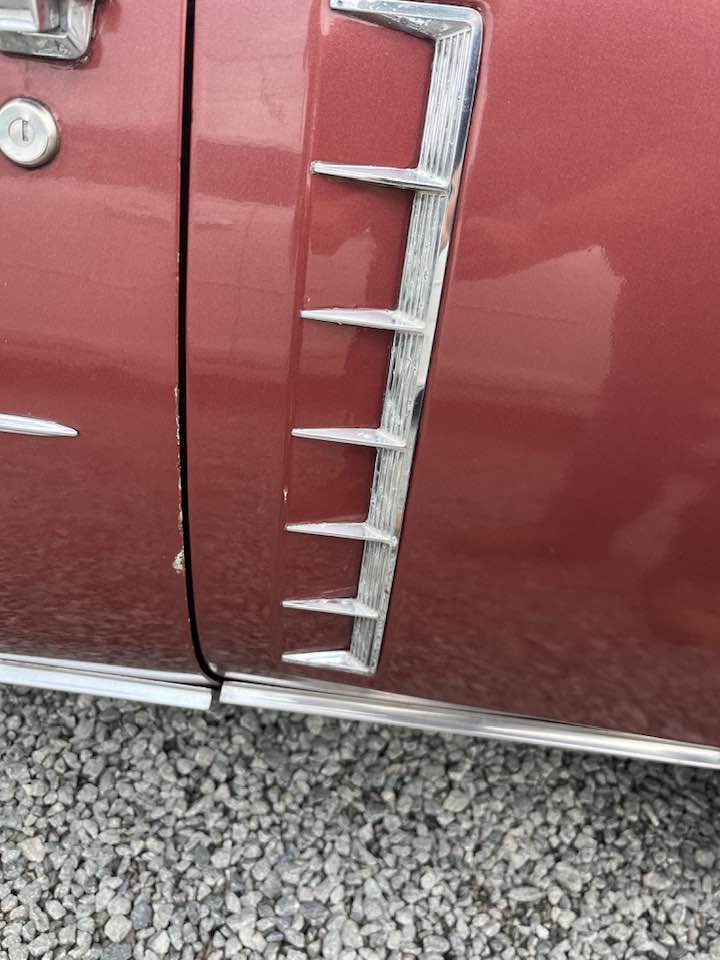
I've had little to do with these cars for as long as I can remember although it might be fun to turn this into a sleeper. Saving grace on this car, on the '72's as well, in my opine is this luscious, whimsical fake cooling vent intake design thing hearkening the original Eldorado of 1953-1956.

1973's don't have it making their flanks slab sided and lifeless. Again, my blog, my rules. There was minor updating for 1974. Same for the 1975 into 1976 and they have their fans. Especially the convertibles. 1976 was the last year for the factory-built drop-tops.
Next time I'm out at the office, if I happen upon one of the owners of the shop I'll ask about this car. It's a family-owned business and they're wonderful people. I have no doubt they'll tell me the THM425 is shot, and the owner has given up on it.
Quick check on NADA values pegs this car worth around $10,000 but that's got to be a fully functioning car. A new THM425 will set someone back a cool three-grand.


