Saturday, September 9, 2017

1970 Buick Electra 225 Hardtop Coupe - Keep This Between Us


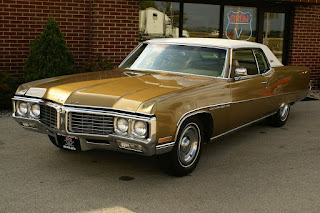
Good lord, not another Buick. And a 1970 Electra too. What can I say? I love these things and I'm nothing if not consistent. While I'm not a fan of the white vinyl top and wait until you see the interior, I love the 1970 Electra hard top coupe and this GM brownish/gold that was very popular on Buicks and Cadillacs from about 1965 through about 1980. Best is, compared to the convertibles, these are available for a song. And they're better cars too.
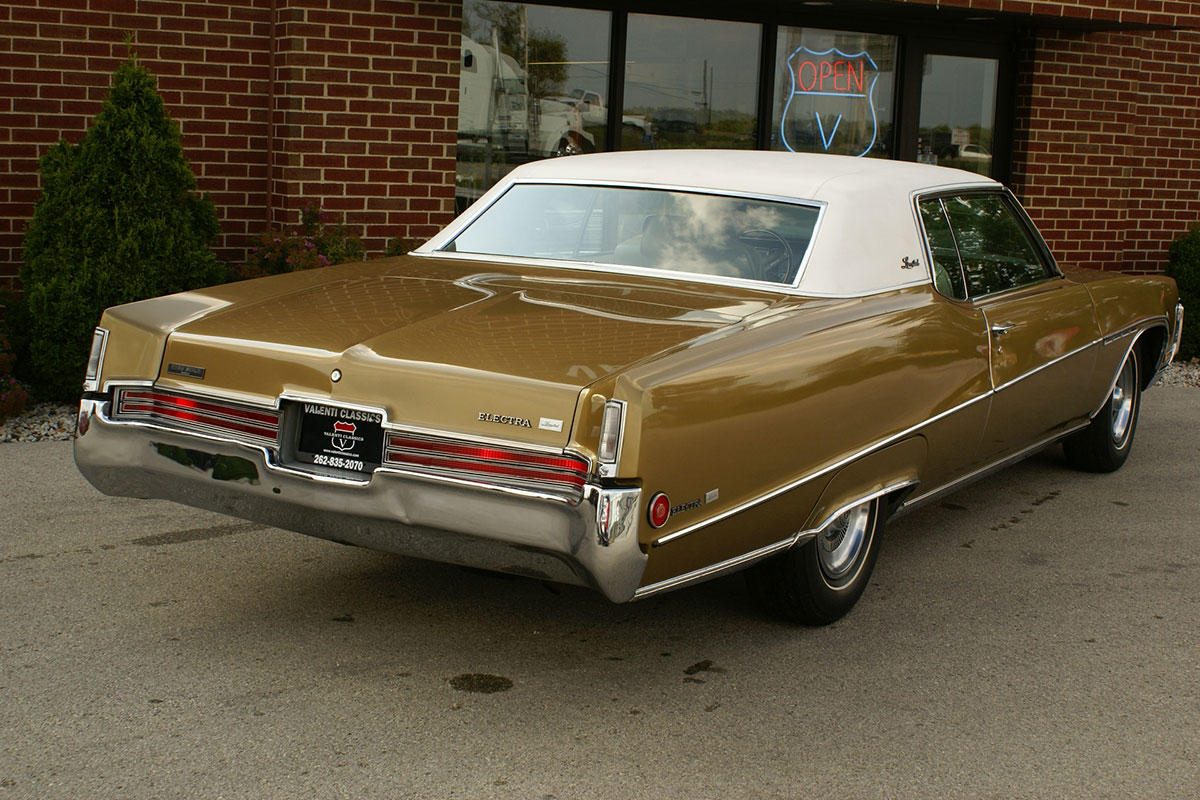

GM had a handful of designs back then that actually got better looking with each model year change. The '64-'66 Malibu went from ugly duckling to belle of the ball; so did the '67-'69 Camaro. Same could be said for the '68-'70 Buick Electra. The '68 and '69 Electra look very similar but they don't come close to the '70. And the '71 was a different car altogether. The slicing and dicing from model year to model year (planned obsolescence) paid off beautifully for this car in my very humble opinion, This, this is my idea of what an automobile should be. Big, grand, luxurious, comfortable, powerful and capable. Without being too ostentatious. The most modest house in the ritziest of zip codes; that's what I like.


Well, here's the interior and it is a horror. It's remarkable it's in the shape it's in but ugh. That upholstery looks like frilly old lady underwear. This interior is no means "don't buy the car" but I do wish it had the really nice vinyl interior like my father's 1970 Electra four door had. Yeah, vinyl; they called it "Naugahyde" and it was nicer than any leather interior Cadillac offered after 1964. Buick did not offer leather upholstery on any of their models back then. I know. Odd. Then again, GM. 


I never got to drive my father's Electra but by all accounts, that 370 horsepower, "455-4" down there was one hell of an engine. "455" is for cubic inches and the "4" denoted a 4 barrel carburetor. It was also advertised to make 510 foot pounds of torque. Heady stuff although those numbers are SAE "gross" and not "net". I'd approximate the net numbers to be closer to 300 and 400 respectively. That's still pretty impressive. That power came at a cost though. This thing murders a gallon of gas to the tune of five to eight miles per gallon. .


She's not perfect, though. On luxury cars of this vintage the driver was almost an afterthought. They had to be kidding with this dash layout but they weren't  Look where the head light nob is and is that an AM radio? Another good idea that actually wasn't - the horn pad for this car is embedded in the rim of the steering wheel. To blare the horn you squeezed the rim. Genius or madness?  Can't tell you how many times dad blurted the horn by accident. 


No shoulder harness marring the look of the interior - as horrible as it is. There was a shoulder harness tucked into the headliner; yours to use only if you chose to do so. Also, those rear quarter windows went up and down. Fabulous. Although, if the kids wanted a little fresh air back there but dad kept his window up, hold your breathe hoping that it would find it's way back up running along side the back of the front door window.


I'd trade my 1977 Corvette in for this in a half second given the opportunity although my family, especially my 20 year old, would kill me for doing that. I'm not sure why I find these cars in particular so alluring; it's not waxing nostalgic for my youth either. Trust me on that. I just like it. When people ask me what my favorite car is of all time, I hesitate about being honest with them and telling them I like 1970 Buick Electra's. I usually tell them 1970 Challengers or 1969 Camaros or what not lest they think I'm some grey haired fuddy duddy.

Just keep this between us, ok?

Thursday, September 7, 2017

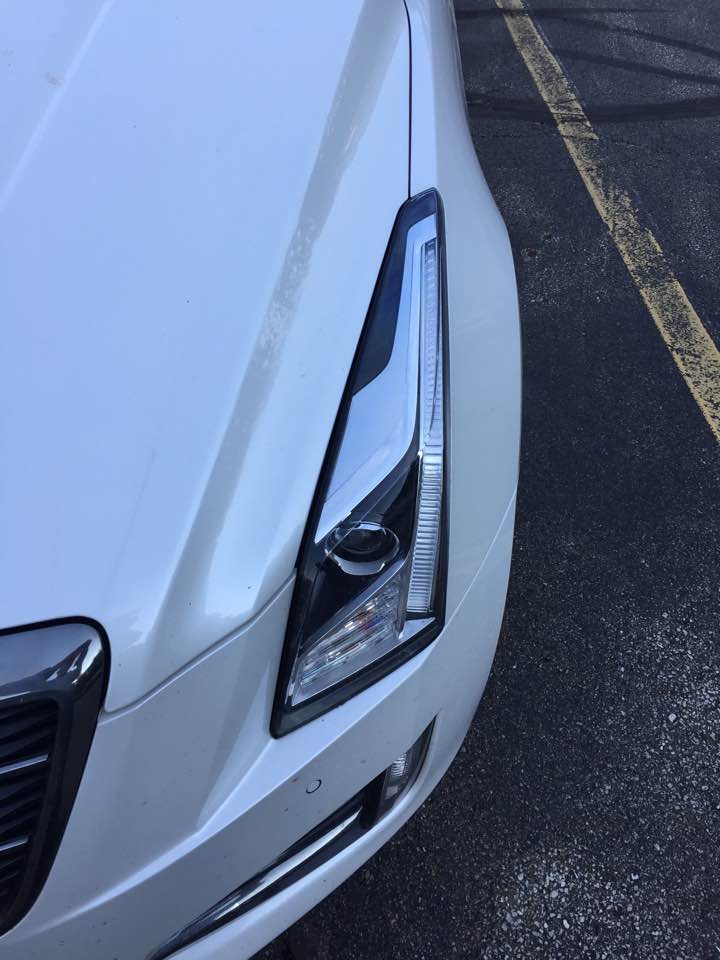
Cadillac ATS4 2.0T - Ummmm, No.


Last weekend I was doing the front brakes on my 2002 Chevrolet Monte Carlo when I noticed a fair amount of green fluid leaking from somewhere underneath it. I (hopefully) deduced that it was coolant - I think I over filled the reservoir last time I topped it off and the angle of the car on my jack stand may have drained out the excess. What else could it be? The quick and not so subtle panic attack it caused me to have got me seriously thinking though; good grief, what if I needed to replace my car! What I replace it, with?  How about a Cadillac ATS4 2.0T coupe? 


Umm, no. That wouldn't happen even if I had to get another car like, now! And the reason for that is quite simple - I just don't like this car enough to buy it. Even if used ones can be had for a relative song I just don't have a "jones" for it. And, when you're a car guy, a car guy who keeps their rides forever, deep automobile lust is key to making that 48-60 month commitment. Good lord, I've seen 72 and 84 month "paper" these days too. Incidentally, deep lust in any relationship goes a long way towards being happy.


Last time I ran into one of these things I was on vacation at my mother in law's place down in South Florida last Christmastime. That one down there was a hopped up ATS-V and not an "entry" level baby like our subject here I found in the back parking lot of the office building I work in outside of Cleveland Ohio. Darnedest thing, somehow it looks better in photos than it does in person. In photos you can't tell just how half a size here and there too small it is. It throws off any shot at balance and symmetry the design might have. Too bad. Based on GM's most excellent Alpha platform, that also underpins the latest Chevrolet Camaro, this is a strong performing "little" car.


Us coupe lovers are about as fickle a bunch as you're going to find and you would think I'd at least like this car let alone love it but it has always left me cold. And no matter how spectacular a performer it may be, I'd rather drive something that performs less well that stirs me emotionally. The current Camaro leaves me cold as well. Sigh.


Overall, I do like this better than the CTS coupe that this car replaced in the Cadillac lineup. Remember that thing with it's freaky 1950's sci-fi movie rear end? Oh, my eyes.


Since the weekend my Monte Carlo has been running well with no more dripping coolant and my new brakes are absolutely fabulous. Thank goodness. Because if anything were to seriously go wrong with my car I honestly don't know what I'd do to replace it.


Tuesday, September 5, 2017

1998 Buick LeSabre - Three Boxes


Not so long ago before the explosion in popularity of cross overs, "three box sedans" like this 1998 Buick LeSabre were the bread and butter of the American automobile industry. Three box sedans, so called because they resemble three connected boxes, all but defining American automobile design from approximately 1949 through today. I'm going to go out on a limb here and say that within the next ten years and certainly the next twenty five, the sedan as we know it will be all but a memory.


It's gotten so "bad" for the old family car already that Buick, for instance, will pull the plug on all sedans save for the LaCrosse starting in 2018. Giving credit where it's due, though, the rise in popularity of "CUV's" over the last twenty years is not without merit. Combining the utility of larger sport utility vehicles with a styling elan found on few sedans these days, it's easy to see why they're dominating sales. Most importantly, they've gotten the attention of female buyers. What would she rather be driving? A snappy new Buick Enclave/Envision (whatever) or something that resembles what Grand Pa drives? Our LeSabre here is a good example of what was right before the onslaught of cross overs which began in the late '90's.


Now, I'm not a fan of cross over per se but I'm less a fan of boring sedans like this Le SABRE; I guess I've been spelling that wrong all these years. Would a coupe version of this make any difference to me? Well, yeah...on paper it would, but I'm in the minority. A sedan is a sedan to most people regardless of the number of doors it has. Buick never made a coupe version of these 1992-1999 updates of their 1986 Le SABRE. Reminisce fondly if you will over the late "H body" Le SABRE coupe here.  Note to self: find a 1986 vintage Le SABRE T-Type to blog about.
 

Doesn't matter that sedans today are absolutely fabulous; no one cares about them. And that's really too bad. Even our ancient Le SABRE here was a pretty darn good "big" car back in its day.  Apparently, it was so good that it's still on the road after all these years. 


Back when our subject was shiny and new the mere notion of using a sport utility vehicle as a family hauler was absurd. To say nothing of luxury SUV's and today's influx of do it all wunderkind cross overs. Sedans don't stand a chance I tell ya.  

Friday, September 1, 2017

2014 Chevrolet Camaro - Pull The Trigger. Or Not.


Over the past two weeks or so my aging Monte Carlo's directional signals stopped working again and the passenger side window stopped going back up by the driver's side switch. That along with non working air conditioning and defogger, a check engine that won't go off (I think it's a bad O2 sensor) brakes front and back that both needing replacing, a leaky power steering pump and what I believe to be a leaky water pump and I'm looking at repair estimates in excess of $4000 if not closer to $5000 after taxes and the bull shit shop fees nonsense allowed up here in the state of Ohio. With 143,000 miles on it my car is worth only what it's worth to me; it's otherwise worthless despite it being a "Dale Earnhardt".


Last weekend, on a whim, I dragged my wife down to a used car lot attached to a Chrysler Jeep dealership just south of where we live to look at a 2014 Chevrolet Camaro RS with just under 9,000 miles on it. Internet price $18,900. Sweet. Much to my surprise my wife fell in love with the not so little black beauty saying emphatically, "I want that"! To make things even better, or worse depending on how you look at it, it had a six speed manual transmission; a liability for most people but another reason for us to fall in love with it. My wife in particular.

The test drive was pleasant. It still smelled new inside and the exterior was flawless. Although the car didn't have leather seats and there was no sun roof, it had literally every modern feature that any one could ask for. It had a backup camera and I'll be darned, it even had blue tooth. Blue. Tooth! Still, I found the car to be a lacking a certain specialness that I want my "new car" purchases but I'm that way with about every newer car on the market today.

These are not pictures of the car we test drove.


Our only serious noodle about the car was the six speed itself - as "notchy" as it is, reverse is obscenely difficult to shift into; my wife and I both lurched the car forward when attempting to back up. Clutch travel is absurdly long too. All stuff to get used to although I can't imagine our 19 and 20 year old sons who've never driven a manual getting used to it.

After the test drive my wife and I expressed interest in the car and we agreed that if "the numbers" made sense on it we'd seriously think about buying it.


Doing as much off line "Charley Math" as possible, I deduced that trading in my Monte Carlo and one of our 1996 Camaros for maybe $3000 combined could get us a monthly payment for sixty months under $350 a month. Not bad. Not bad especially considering what I know some people are paying each month for a car.

Our very charming sales person sat us down at his desk and he got to work going back and forth to his sales manager and pulling up comps on his computer. I knew what a great deal the car was at that price and with the mileage it had on it but it didn't have leather or a sunroof and it had a manual transmission. We braced for impact nonetheless.


First off, they wouldn't even consider a trade for cars as old as what we had to offer and the internet price of $18,900 was the lowest they'd go on it. The bottom line was out the door for $406 a month for sixty months and we had the balance of the GM factory warranty. In service date of July 4, 2014. Wow. A car with a warranty. What's that like?

My wife was all about it; I on the other hand hemmed and hawed and refused to pull the trigger. Perhaps it was my ambivalence towards the car in general, my fondness still for my Monte Carlo, my innate frugality or my inability to allow myself to have any fun but I wanted out of that dealership faster than I wanted to test the car in the first place. In those situations I feel like a girl who flirts and dates but plays hard to get with no intention of playing for keeps in the first place. If you think I'm exhausting to live with you're right. My wife is a saint.


What sealed the deal for us not to pull the trigger on the Camaro was reviewing the deal with our 20 year old finance major son. He's as much a car wonk as any young man his age is these days and was over the moon ecstatic at the prospect of us getting a car like a late model Camaro let alone seriously shopping for one. He became slack jawed when we told him of the financial commitment of $406 a month for sixty months. That's a lot of money and it's not a lot of money for a vehicle the age of that Camaro and in the condition that it is in; to a college student with a minimum wage job, though, that's all the money in the world.

 
We passed on the Camaro and I will attempt to keep the Monte running as long as I can as cost effectively as possible. If and when something "fatal" happens to it that changes our dynamic from a "want" to a "need", we'll make the jump and get something like that Camaro. In the meantime, well continue to bank that $406 a month.

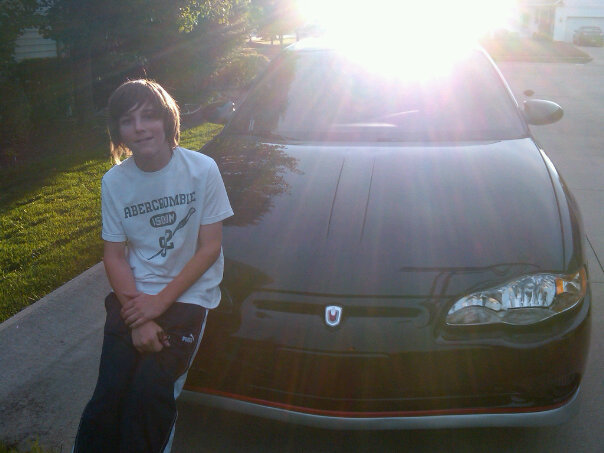
The dealership never called me to followup on our buying that Camaro. I can't find the car on cars.com any more so that probably means it's been sold. Just as well. That's our now 20 year old son the day I brought "The Dale" home back in 2010. 


Thursday, August 31, 2017

1983 Dodge 400 - Rest In Peace, Khan.


Something tells me that if I had been around during the time of the Model T I would have scoffed at the darn seeing how primitive and ugly it was. That would be a shame since I would be disrespecting one of the most seminal automobiles of all time but, hey, "Car Guy" here - we demand more from our rides than their just being basic transportation. Crazy Henry did sell a lot of T's though. Anyway, today we look at another seminal vehicle of sorts, part of the second round of the Chrysler "K cars" that helped save Chrysler, a 1983 Dodge 400.


You wouldn't be alone in never having heard of one of these as the Dodge 400 was only around for two model years and didn't exactly set the world on fire sales wise. Intended to be an upmarket version of the Dodge Aries K, it shared much with the very similar and equally as homely Chrysler LeBaron. The 400 was available only as a coupe.


Part of the allure of attempting to reach middle America and a wide swath of buyers was, allegedly, the K's simple, "honest" styling. I get that, to a certain degree although I think they went a little too far and came up with something that looked like it came out of communist block country. Gussie it up like they did with 70's styling clichés and it always looked like a homely woman with too much makeup on. There had to have been styling wonks at Chrysler who felt the same way. I mean, seriously. Look at this thing. 


A fancier, plusher interior and with clichéd exterior styling touches like an "ego thrust" front end and a padded landau top and Ricardo Montalban had a car he might, might, have wanted decked out with Corinthian leather. For the record, Mr. Rork never pitched anything that wasn't branded a "Chrysler" although he did hawk other Chrysler products that weren't Cordoba's. Who could ever forget his series of Chrysler New Yorker ads; the car that talks!  Scoff at my beloved Cordoba as you will, at least "our cars" looked like something other than a tissue box on wheels. Even the dreadful 1980-1983 models. Rest in peace, Khan. We miss you. 


Chrysler pulled the plug on the 400 after 1983 although it's lilliputian corporate cousin Chrysler LeBaron soldiered on through 1986 before it was redesigned with the jelly bean body that it was most famous for. Chrysler chose to focus their upmarket Dodge Aries K aspirations on the "600", something that was, remarkably, even homelier than the Dodge 400. Built off what was essentially a stretched wheel base K, the "E platform" 600 soldiered on through 1988 before being replaced by another oddly proportioned K car derivative, the Dodge Dynasty. 


Much like the Ford Model T, the charm and appeal of all K cars is lost on me and anyone, I believe, who looks at automobiles as something more than mere appliances. All of them, perhaps with the exception of the jelly bean body LeBaron, are just plain terrible looking, handling and cheaply assembled automobiles. Yet people bought them hand over fist. Just like they bought Crazy Henry's Model T. 


Monday, August 28, 2017

1979 Buick Electra - Greek Tragedy

 
For years, Buick named their top of the line model after a character in Greek mythology. Meaning "sparkling" in English, sparkling could describe some of the more overtly styled Electra's from the 50's and 60's but chances are GM's marketing department believed that "Buick" and "Electra" just sounded good together. Our very original 1979 subject here was part of the fifth generation of Electra's and was also part of General Motors famous downsizing regimen that begin in 1977.
 
 
Save for 1985-1990, Electra's were all about size and not necessarily about sparkle. With regards to size, originally, Buick marketed the top of the line Electra as the "two twenty five" denoting the car's length of 225 inches. While the lengths of Electra's fluctuated somewhat over the passing years, top of the line Electra's remained "225's".  Note - by 1979 Electra 225's had been relegated to the base model. A curious practice by General Motors wherein they would move top of the line models down on their pricing ladder or what was referred to as "debasing". Our subject is a mid level Electra Limited slotted between the base 225 and top of the line "Park Avenue"
 
 
The last 225 inch long Electra were the 1969 and 1970 models; starting in 1971 Electra's grew to 227 inches long. Government mandated safety bumpers pushed overall length to 232 inches by 1974. All but impossible to maneuver in parking lots for a person of average height, they also weighed more than 5,000 pounds and struggled to get 10 miles per gallon. The OPEC embargo of 1973 and subsequent gas price increases crushed sales of big cars and showed America just how reliant it was on foreign oil. While gas prices stabilized in the mid 1970's, GM got to work on putting their cars on a diet. Our '79 here, virtually identical to a 1977 model, is a foot shorter and 800 pounds lighter than a sparkling 1976 Electra.
 
 
The best part about the smaller full size cars was that they were just as spacious if not more so than the cars they replaced; they actually had a tad more hip and shoulder shoulder room in back. They sold well and GM's share of the market swelled to nearly 50% for 1979. Then, like a Greek tragedy, circumstances beyond GM's control like the ouster of the Shah of Iran, spun GM fortunes completely off course. So much so that it would appear that it's only recently that GM has gotten back on track; albeit a much smaller, downsized GM. Today, GM's market share is less than 20%. "Mikro" or "micro" is a greek term for smaller.


The Electra nameplate soldiered on through the 1980's at the top of the Buick heap even surviving the ignominy of the 1985-1990 front wheel drive years. Like a page taken out of a Greek tragedy, Electra was replaced by a sub model, "Park Avenue" for model year 1991.

Technically the C body, rear wheel drive Roadmaster replaced Electra as the top of the line Buick between 1991 and 1996.


Sunday, August 13, 2017

1972 Dodge Charger - Careful What You Wish For


I go back and forth between wanting to have been part of the generation that could have bought cars like this 1972 Dodge Charger brand new and feeling sorry for those that could. While I'm indifferent towards these big, swoopy, coke bottle body 1971-1974 Chargers, I applaud its devil may care form over function design. Seriously. Look at that blind spot. Insane. There were better looking cars out there in the early 1970's from General Motors that no doubt Chrysler was eyeballing when they came up with this design but this car highlights the fact that today's perfect if Prosaic automobile designs can't hold a candle to what Detroit came up with 45-60 years ago.


My twenty year old son is pretty crazy about old cars and we share the same sentiment about being born in the wrong era. He rolls his eyes when I tell him, though, that these were actually terrible cars; he thinks I'm just being cynical. In his almost five years of driving experience he's never had to experience a breakdown out on the road or even cold weather starting. Turn the key and go is all he's ever known. And that's saying an awful lot considering the 1996 Camaro he drives is even older than he is. And oh how we scoffed at electronic engine controls and fuel injection back in the day.


Charger was all new for 1971 and rode on an updated version of Chrysler's intermediate B body platform that had been their full size platform between 1962 and 1964. The best looking and most valuable Chargers are the 1968-1969 models which gained a lot of fame from the Dukes of Hazzard TV show. Dodge mucked up the design for 1970 before they jumped the shark completely in 1971 with this thing. Side note, on the Dukes of Hazzard, when the availability of 1968-1969 Dodge Chargers became scarce, producers of the show started using 1970 Chargers with trim pieces salvaged from wrecked 1968-1969 Chargers.


The engines were carry for 1971 but things changed for 1972 when Chrysler increased the bore on the venerable 383 pushing overall capacity out to 400 cubic inches. Blame ever increasing federal regulations. Ordered to reduce tail pipe pollutants, The Big Three dropped compression. To off set the drop in power that came with the drop in compression, they increased the size of their engines. That did nothing for gas mileage of course but at least buyers couldn't tell that their new car had less go than their old car. At least for a while. As the '70's droned on it became increasingly hard for The Big Three to hide the fact that engine performance was not what it used to be.


No doubt my son would swoon over this baby blue Charger (horrible color) and go on and on about how boring today's cars are. I look at these cars now and wonder how people used them as daily drivers. They're so big for being big's sake (this is a "mid size" car too), handle and brake horribly, fall apart just sitting there and inhale gas worse than today's biggest SUV's. No wonder the first energy crisis in October of 1973 was such an eye opener but what did American's know? What they deserved were better cars and most of them would have readily signed on the doted line for a vehicle that had less style and was more reliable and got better mileage. Careful what you wish for.


I forget where I found our subject here but it's for sale for around $35,000. Hardee. Har-har. Kid you not. That's a lot of money for an American car of this vintage that's not a Corvette and for anything made after 1967. What's more, it needs a power train swap and a suspension upgrade just to make it drive-able. I'd keep it stock looking but modernize everything else about it. How much would that run? Probably about $35,000. Now I'm feeling sorry for my bank account.

Sunday, August 6, 2017

1973 Ferrari 246 GTS - Grazie, Papa


If you've ever wondered what it would be like to date, marry or even have just a friendship with a celebrity, own an old sports car. The amount of attention celebrities and flashy cars get is absurd. And after five years of ownership of a 1977 Chevrolet Corvette I can tell you that owning one in the long haul is not all it's cracked up to be. What people don't see is the relentless heart ache that that they can foster not to mention being scary expensive to maintain and repair. One more thing, you have to completely comfortable with being the center of attention. It's that way with our Corvette and I can only imagine that our experience is taken to an extreme when you own a 1973 Ferrari 246 GTS.


People go "ga-ga" over the appearance of cars like this without so much as a thought to how well or not it performs. Much like the way they lose the marbles over seeing a celebrity regardless of whether said celebrity is famous for anything really tangible or not. Now, with regards to this Ferrari, you can't blame people for going nuts. I mean, look at this thing. It makes our Corvette look like a shrinking wall flower. In my opinion it doesn't get much better than this. Again, I make the comparison between our Corvette and this Ferrari because if we get an inordinate amount of attention whenever we take our car out for a spin I can only imagine what driving this would be like. 


Then again this car should garner that much more attention than we get in our car given that this car is on the market for nearly $400,000. We paid roughly 2% of that, maybe, for our Corvette five years ago. I bet we drive our Corvette a whole lot more than the owner of this car would too; understandable given that a kicked up rock nicking the hood will drive resale value down tens of thousands.  


So, what is a Ferrari 246 GTS anyway? Well, to make a long story short, they were the first "mid-engined" Ferrari's. "Mid engine" meaning their engines were placed literally in the middle of the car. Having the engine in the middle of the car is said to be the best way to distribute weight evenly; that bodes well for performance. What's more, they were the first Ferrari's to be powered by something other than a V-12 engine. In the case of our 246 here that's a 195 horsepower 2.4 liter double over head cam V-6 behind the passenger seat. The legendary founder of Ferrari, Enzo Ferrari, incidentally, was not a fan. 


He was so much not the fan at first that he wouldn't allow them to be called "Ferrari's". He relegated them them to the discount rack and ordered them festooned with just engine nomenclature and the name "Dino". Dino was the nickname for his son Alfredo who was a lead engineer on these cars and who also pioneered it's V-6 engine.  


After the Dino's most successful launch in 1967, when they were updated with a larger engine for 1969, the elder Ferrari allowed them to be called "Ferrari's". Grazie, Papa. 


Only about 3,500 of these cars were produced between 1969 and 1973 and that, combined with their fantastic good looks and the fact it's a Ferrari, drives their meteoric asking prices. The best part is that these cars are actually terrific drivers and are said to be the best over all performing Ferrari's of all time.


High praise considering the near perfection of the driving experience of modern Ferrari's. Even if 195 horsepower propelling just 3225 pounds puts this car in line with the power to weight ratio of our Corvette. Sacrilege. Indeed. 


In a world where people can be "Insta-Famous" and social media stars with having done little to be so, an automobile like the Ferrari 246 GTS can get very similar amounts of attention. The difference is, of course, this Ferarri deserves the attention it gets because not only is it stupefyingly gorgeous from every angle, it's, again, a magnificent performance car. By contrast, our Corvette, like social media stars, is nothing but famous. Trust me on that one. 


Maintaining a Ferrari, just like a Corvette to a great degree, is not for the faint of heart. You can't just take one of these to Midas for an oil change and a brake job. Much like you really can't take your celebrity spouse or friend to a McDonald's for dinner. As far as getting attention goes, well, given that most people have no idea what this car is, my wife and I will stick with our Corvette. It doesn't perform nearly as well but if it gets the same amount of "oh wow's" from people, not that we bought it for that, we'll stick with it and save hundreds of thousands of dollars. 

Ciao bella.