Thursday, August 18, 2022

1975 AMC Gremlin - The Gremlin Effect


An AMC Gremlin similar to this 1975 was parked on our block the other day and my twenty-three-year-old son, who could care less about cars, freaked out and said he wanted one. His mother laughed out loud about it and fondly remembered a couple of friends of hers who had them. She thinks they're cute as a button. I was, frankly, good-naturedly aghast. AMC Gremlins have that effect on people; you either love them or hate them. 

Much like the equally vexing Pacer, their ability to polarize has everything to do with their styling for certain what they are mechanically is nothing out of the ordinary. To say nothing of their driving dynamics. 


AMC, or "American Motors Corporation", certainly didn't set out to create a highly polarizing design that they launched on, of all days, April Fool's Day, 1970. 

During the mid-to-late 1950's, the company that evolved from the 1954 merger of Nash-Kelvinator and Hudson carved a fairly lucrative niche as purveyors of small or smaller cars than what GM, Ford and Chrysler, sold at the time. That all changed come 1960 when "The Big Three" introduced compact cars but AMC didn't miss much of a beat selling cars, branded exclusively as "Rambler", that were small and being kind, avant garde. There may have been some perceived superior quality as well with AMC vehicles; my father claimed their superior build was a deciding factor in his buying the 1961 Rambler Classic I remember him having when I was a young child.  


However, by the late Sixties, AMC's wares had become painfully dated, outmoded even. They even started to sell larger cars to be more competitive with the Big Three this muddying their marketing position. With Volkswagen eating their proverbial small car lunch by two-to-one and GM and Ford launching subcompacts of their own to compete with VW, AMC's goose was cooked. Keep in mind this was several years before Asian brands would have more than a toehold in this country. 

Enter AMC's "small" car named after a "mischievous sprite" responsible for unexplained mechanical faults. Might sound comical, if not cute on paper, but to name a car "Gremlin" under such an auspice must have seemed strange if not unusual at the time. Certainly, doesn't sound any less weird all these years later, although, we probably couldn't think of a better or more apt name for these cars. 


Having spent the majority of my career working for underfunded, understaffed operations, I more than empathize with the plight of AMC in the late Sixties; there's only so much money to go around. And seeing AMC spent liberally on introducing a replacement for the Rambler American, that being the new for 1970 "compact" Hornet, you have to work with what you have. 

To make a sub-compact out of the Hornet, which was all but a Rambler American with a different body, AMC hacked eight inches off the wheel-base and whipped up the funky rear end treatment to make it appear smaller. As sub-compacts go, AMC Gremlin's are pretty big. 


This is what's called a Kamm tail or K-tail and is a styling feature where the rear of the car slopes down before being abruptly cut off with a vertical or near-vertical surface. This being a '75, the rear "safety-bumper" blunts that "vertical-surface". affect. The rear end on pre-1974 Gremlin's look about as good, or less bad, as the design possibly could. Certainly the "hockey-stick" styling on the rear quarter window does the K-tail no favors either. Your opinion may vary. See dealer for details.


The Kamm treatment on the rear end is offset by a too tall roof line relative to the incline of the K-tail as well. The whole thing works for some people, like my younger son and his mother, for instance. I, again, am put off by it. But it's what makes an AMC Gremlin an AMC Gremlin and not some over stylized, two-door Hornet. 


The rest of a Gremlin is Seventies bread-and-butter cheapy car basic. You know the drill. Body on frame, front engine, rear wheel drive, ghastly heavy, overhead valve in-line six, rear leaf springs and so on. I don't see a power steering pump down there so you can imagine how hard this one would be to steer. It's for sale, if you're wondering, somewhere in New Jersey with an asking price of $5,000. 

NADA high-retail pegs one of these at $2,150. Low retail at $500. Which, frankly, sounds more than about right. Then again, NADA guidelines aren't necessarily in line with what's going on in the real world. Like a lot of us these days, not only do we see crazy asking prices for cars, dealers and folks are getting what their asking. 


I know given the opportunity and the right set of circumstances, my younger son would drop five-large on this one and have me flat on my back trying to get all the Gremlins out of his Gremlin. Which, of course, I would do with pleasure. 


Friday, August 12, 2022

1968 Plymouth Barracuda - Soft Spot


I've got a soft spot for 1967-1969 Plymouth Barracuda's. And for all the right reasons too. No sentimental, nostalgic non-sensical hogwash here. I just like like 'em. I like 'em a lot. 


My favorites are these hard top's although I wouldn't kick a "Sports Fastback" out of my garage. I like these things even with the vinyl top. Forget the convertibles. Top up or down. 

I wonder how it would have gone for the Barracuda had Chrysler come with these designs in 1964 rather than the slightly warmed over Valiants they did come with. And came with two-weeks before Ford introduced the Mustang. Timing, apparently, is not everything. 


Not that it mattered given the marketing resources Ford had at the time. Their marketing blitz having as much to do with the success of the 1964 1/2 - 1966 Mustang as much as their having no discernable competition. Sorry, the Chevrolet Corvair and the original Barracuda just didn't cut it. 


Not that I think the original Mustangs are really anything to look at. I know that sounds sacrilegious but I'm of the opinion that Mustang design didn't really hit its stride until 1967. And if Chrysler rolled out these delicate flowers in 1964, I'd have to imagine that although they wouldn't have a chance of outselling Mustang, they'd at least have had sold a whole lot better. Just my two-cents. And it's probably not worth that seeing that these updated Barracuda's sold no better than the originals.


Blame GM for that too. Just as Ford updated the Mustang and Chrysler got their act together, GM came with not one but two ponies that, aesthetically at least, were the equal of what Ford and Chrysler had. Don't discount the Mercury Cougar's effect on the market too. Amazing that these are based on the same chassis as the also new for 1967 Valiant. One of the dopiest, American Motors-est designs Chrysler ever came with. But what a time to be alive and have the means to afford a sporty car! 


As for this tired, soggy old soul. Well, what can I say. It's for sale in South Carolina with an asking price a not unreasonable $2,000. But seeing it's been sitting in a field down there for a very long time, based on how far it's sunk into the ground, you know it's got to have frame problems. 


Looks like it's been stored under a tarp so that might explain why and how the body is not more-rotten. Poor thing looks like it needs everything, and I just don't know if it's worth the trouble. 


1988 Oldsmobile Cutlass International Series - Mullet and All


Is it me or are prices of used cars starting to cool off a little. Might have more to do with a pending recession than anything else. Take this very nice 1988 Oldsmobile Cutlass International Series for instance. A scant 99,000 on its digital ticker and an asking price of $6,990. Price reduced a cool thousand too. I swear six to ten months ago this would have been a $10,000 car. It's for sale in Reynoldsburg, Ohio, east of Columbus and it's a solid two-hours from me. Oh, if it were only an hour or so closer. Then again, probably a good thing it's so far away. 


Seems like only yesterday I was picking up my god-forsaken, 1982 Buick Riviera from Celebrity Oldsmobile in Massapequa, New York on god's green earth Long Island in early January 1988. I was filling out the paperwork when one of these caught my eye in the showroom. For a rear-wheel-drive loving, all-American kid from Baldwin, home of Baldwin Motion I might add, it was the first time in more than fifteen years that a "new car" actually caught my eye. I felt like I was a kid growing up in the Sixties! Is that what it was like? Every fall getting blown away by some new offering from Detroit? I really was born ten to fifteen years too late. 


Of course, with my being all of twenty-three and my driving record looking like that of a felon, I couldn't touch the insurance payments on something like this let alone make the monthly payments on one. And my parents were in no financial shape to help me either. Not that I think it would have occurred to them to help if they could anyway. Sigh. That's why the cash purchase of that horrible Riviera sort of made sense. Well, at the time anyway. 


General Motors spent billions on their gaggle of 1988 intermediate coupes that also included the Buick Regal and Pontiac Grand Prix. Chevrolet had to wait until model-year 1990 for their first foray at the new "GM10" platform. And that first dalliance was the first four-door GM10 introduced at Disney Land; that's the one in California. Meh. The coupe came later, and I scarfed one up soon as I could to replace that crap-tacular Riviera. Over the past, gulp, thirty-two going on thirty-three years, I've had five "GM10" or "W-body" Chevrolet Lumina\Monte Carlo's. What can I say? If I could grow my mullet back and not look ridiculous, I'd do it too. 


Problem with the "GM10's" was that GM only offered them as coupes at first. Not a problem for me, of course, but with Ford having rolled out their game changing Taurus in 1986 as a sedan only, GM missed the opportunity to take Ford on bumper-to-bumper in the family car battle. 


The problem with the stylish Cutlass, especially the "International Series" like our lovely subject here, is that they were underpowered. GM played it safe and offered them at first with only their 60-degree, 2.8-liter V-6 that made all of 130-horsepower and 185 foot-pounds of torque. Not exactly a ton of power to motivate a 3,400-pound car. Especially with an automatic like this has. They did offer a five-speed but good luck finding one of those these days. I mean, these things moved if you floored the gas all the time but that gets old. And it kills your gas mileage. 


Meanwhile, their far more adequate 90-degree, 3.8-liter V-6 making 170-horsepower and 220 foot-pounds wasn't available. Fun fact, Oldsmobile never offered that engine in a GM10\W-body Cutlass. Most powerful engine ever offered in one was the "LQ1", 3.4-liter, "Dual Twin Cam" V-6 based on the 2.8-liter V-6. That engine has its fans, I'm not one of them. The infamous Quad4 was also made available as the base engine starting in 1989. Not much of an improvement over the 2.8 V-6 if you ask me. 


Yeah, I can talk myself out of most things and I think I've successfully talked myself out of this thing too. If it were closer and maybe had an asking price of $5,000, I shudder to think about what I might do. It screams "Eighties" and I'm not sure in a good way or not. My instincts tell me it's not. Also, I'd have to do a ton of mental gymnastics to convince myself I wouldn't care if I was construed as that old guy who's stuck in his past. Mullet and all. 


Thursday, August 11, 2022

1975 Oldsmobile Toronado - Filter-Less Pall Malls


This 1975 Oldsmobile Toronado came up during my most recent "cheap car" search. You know, those Sunday morning time wasters where I type in a lowball dollar amount into cars.com, throw the net out one-hundred miles from my zip code and then I sort by "oldest year". By the way, thanks to inflation and Covid, I've had to increase the dollar amount from $10,000 to $15,000. Shoot, it used to be $5,000. Doesn't mean I found anything worthwhile this past Sunday although I found a thing or two that was interesting. Like this big old Toro. 


From 1966 through 1992, Toronado was Oldsmobile's top-of-the-line model and was defined as a "personal luxury car". Although, frankly, there's certainly nothing "personal" about a car that's nearly 19-feet long, almost 7-feel wide and weighs closer to two-and-a-half-tons than two-and-a-quarter. 


However, for a car this big, these are fairly cozy if not "personal" inside. Then again, that big-on-the-outside, small-on-the-inside ethos was the design axiom back when cars were designed from the outside in. Gosh, as a kid, I remember seeing cars with these tufted, over-stuffed-pillow, velour like interiors and thought they were the epitome of luxuriousness. Now all I see is an aching back and seats that smell like a wet dog mixed with cigarette smoke from filter-less Pall Mall's. 


To the casual observer, this looks like any big Oldsmobile from the 1970's. If you cock your head and blur your eyes a little, you see a lot of then-current Cutlass Supreme. However, in addition to this being built on an entirely different platform than the bread-and-butter Cutlass of the time period, there's a whole lot more to the Oldsmobile Toronado than meets the eye. 


What made these cars special and unique was they were front-wheel-drivers. "Front-wheel-drive" in, save for a handful of European and Asian makes and models, a rear-wheel-drive world. And they were GM's first ever "front-drive" automobiles and the first American front-drivers since the Cord 810\812 of 1936-1937. And did America care? By-and-large? Nope. Well, I'm sure that a handful of people appreciated the engineering that went into these cars, but folks bought these things because they liked their styling or what they perceived them to be as opposed to whatever trickery engineers used to get torque to the front wheels. 


Early (1966-1970) Toronado's were marketed as large, semi-sporty, muscle-car-like, grand touring cars and got outsold by their similar but far more luxurious, and more expensive corporate cousin, the Cadillac Eldorado. That all changed for model year 1971 when both were redesigned. That redesign made the Cadillac even bigger and softer and Toronado became more like the previous version of the Eldorado. Just-like-that, Toronado sales more than doubled. 


Our '75 here is part of that Toronado reboot. This one's for sale for $12,500 which sounds like a ton of money but keep in mind, and somewhat ironically too, that a Cutlass in this shape, would be listed for at least twice that if not two-and-half times more. The irony being that in 1975, this car stickered for some $6,700 meanwhile the Cutlass sold for $4,100. Big bucks back then during the Ford administration. And between us cool-cat, Seventies car lovers, I'd rather have the Cutlass. And I'd take it in this awful eggshell blue hell as well. Comment below with your thoughts.  


Friday, August 5, 2022

1987 Oldsmobile 442 - Some Things Never Change


I was amazed at the number of late model cars in the student parking lots at St. John's University in Jamaica, New York when I went there in the mid-Eighties. SJU was primarily a commuter school back then and General Motors intermediate coupes were very de riguer and made my ten-year old Chrysler Cordoba stick out like the beater it was. The Monte Carlo was the most popular of them followed by the Pontiac Grand Prix (not included in the above Car and Driver article because there was no real sporty GP), Cutlass and then the Regal. If any sport model was in vogue like the cars in C&D, it was the Monte Carlo SS. The Buick Grand National was a unicorn because it was so expensive. Again, the Olds Cutlass was popular although its sport model, by the time I was at St. John's it was the 442 (nee Hurst\Olds Cutlass) and was about as rare as the Grand Nat. 


That's why when this 1987 Olds 442 popped up on my Facebook wall the other day I had to take a closer look. For sale for a relatively sane $4,500 asking price, with 30,000 on its thirty-five-year-old analog ticker, could this be the ride to take me back to Utopia and Grand Central Parkways? 


General Motors did a great job updating their class of 1978, downsized intermediate coupes for 1981. The four-door models stayed all but the same as did the wagons. While I've always felt these updated coupes were still far too narrow, the 1981-1987 Cutlass coupe I've always thought particularly handsome. Regardless of trim level. I wasn't alone in my sentiment as Cutlass coupes were one of the best-selling cars in America in the mid-Eighties. Fun fact, Olds actually built the Cutlass coupe through 1988 calling the last run of them, "Cutlass Classic" selling them alongside the new for '88, front-wheel-drive Cutlass. 


Oldsmobile's first came out with a "442" in 1964 as an "answer", as it were, to the Pontiac GTO. Denoting a four-barrel carburetor, four-speed manual transmission and dual exhaust, with a gussied up 330 cubic-inch V-8 and firmer suspension than stock, it was essentially the same package Oldsmobile sold to police departments.  They even sold it as a four-door in 1964 although legend has it less than ten were made. Was this America's first sports sedan? 


Somewhat amazingly, Oldsmobile offered a "442" originally and continually through 1980 before putting the moniker on a four-year hiatus from 1981-1984. They brought it back in 1985 after Oldsmobile's partnership with Hurst ended that sired the 15th and 16th anniversary celebration of the venerated "Hurst\Olds". 

After production ended on these 442's after 1987, Oldsmobile brought 442 back festooning it to a limited run of Quad-4 powered Calais' in 1990 and 1991. After that, "442" was gone forever. 


Not that it mattered, but our '87's "4-4-2" could denote a four-barrel carburetor, four-speed automatic transmission and dual exhaust. That four-barrel carburetor, a Rochester Quadra-Jet, bolted to a slightly warmed over, 307 cubic-inch Oldsmobile V-8. The Olds 307 either a bored version of their deadly-dull 260 cubic-inch boat anchor of 1975-1982 infamy, or a de-stroked version of the famed Oldsmobile "Rocket 350". Frankly, I've always thought it was the former rather than the later. Your opinion or knowledge base may vary. See dealer for details. 


Regardless, in a 442, it made all of 180-horsepower and 245 foot-pounds of torque, same as a '83-'84 Hurst\Olds save for the fancy, dare I say silly, Hurst "Lightning Rod" shifters. Seeing a 442 tipped the scales at some 3,500 pounds fully loaded, zero-to-sixty was a matter of eventuality as opposed to rapidity. At least it was somewhat quicker than a non-442 Cutlass. 


In the Car and Driver article on GM's "Modern Muscle" triumvirate, David E. Davis wrote that it seemed the 442 didn't have its heart in whatever it was it was trying to be. He did gush about the Monte Carlo SS and he said the Buick Grand National had an engine that deserved more car. 


I never followed up and inquired about this thing. I searched again for it recently and it was gone. Honestly, I have little use for another old bomb that needs a lot of work and I'm not about to drop the $20,000 to $25,000 or so on one that's in mint condition. 


I guess some things never change. 


Thursday, August 4, 2022

1996 Ford Thunderbird - Once Bitten, Twice Shy

If you're shopping for an older used car, I've learned there's no guarantee that a car purchased off the used car lot at a major dealership is going to be any better than one you'd buy off of Facebook Marketplace, Craigslist, the community bulletin board at Kroger's or one sitting on the side of the road with "FOR SALE" painted in shoe polish on the windshield. And if my track record is any indicator, you're probably better off not buying a used car from a dealership. Save of course for anything that's "certified" or has the bulk of its factory warranty left on it. Case in point, this 1996 Ford Thunderbird I found for sale at a big Ford dealership on the east side of Cleveland. 

It popped up on my Facebook wall the other day and I bit. I'm always looking for that oh-so-nice older car that no one wants that has low mileage and is in great shape. Only 60,000 miles on its twenty-six-year-old, (surprisingly still) analog ticker and although its asking price of $6,990 is on the high side of reasonable, I thought it a decent deal. Especially in these Covid-inflated times where a ten-year-old Chevrolet Impala's with 100K on it is going for twelve-grand. 

Getting a real handle on what this should be priced at, though, is easier said than done. Even in this day and age of easy info at your fingertips. NADA price guidelines peg this at $4,400 "high retail", KBB lists a trade-in value at $2,500. Quite the proverbial old spread. 

A nationwide search on cars.com doesn't have much info on Thunderbirds of this vintage because there aren't many out there. I tried to run "comps" anyway and found a '97 in Yakima, Washington with 66,000 miles on the odometer for $4,995 but there are no pictures of it. Another '96 in Grandin, North Dakota with a body cladding kit, 1986 vintage T-Bird Turbo Coupe wheels and driven just 26,000 miles in twenty-six years has an ask of $11,000. Lots of pics on that one, though. Cladding looks silly and the wheels are out of place on it too. 

On the way to the dealership, I figured the closer all-in to the asking price the better I might be. I'm talking tax, tags, dealer prep and whatever nonsense Ohio allows used car sellers to charge. Trust me, there's a whole lot more wiggle room on used cars than new and dinosaurs like this rear-wheel-driver in a "snow city", not to mention one with a big V-8 aren't exactly in high demand. 

Things started to go south when I noticed that the rust on the driver's side fender, that was, in fairness, disclosed to me prior to my ninety-minute slog up there, was a whole lot worse than what I was led to believe it was. That metal is super-spongy and it's ready to give way. And when it does, seeing that's where the fender bolts to the frame of the car, that's got to be fixed immediately. Pricey. Perhaps I could find a clean fender used and even if it's not white, I could get it painted and still be ahead of the game. 

This is how fast I can rationalize a vehicle purchase that has glaring signs that I should sprint away from it as quickly as possible. 

Trunk lid didn't sit quite right either but, after all, this is a twenty-six-year-old car. I do have to be reasonable. Well, try to be reasonable. Carfax report indicated it had been hit on the passenger front fender in 2004 but it was minor, apparently. Looked clean enough to me. 

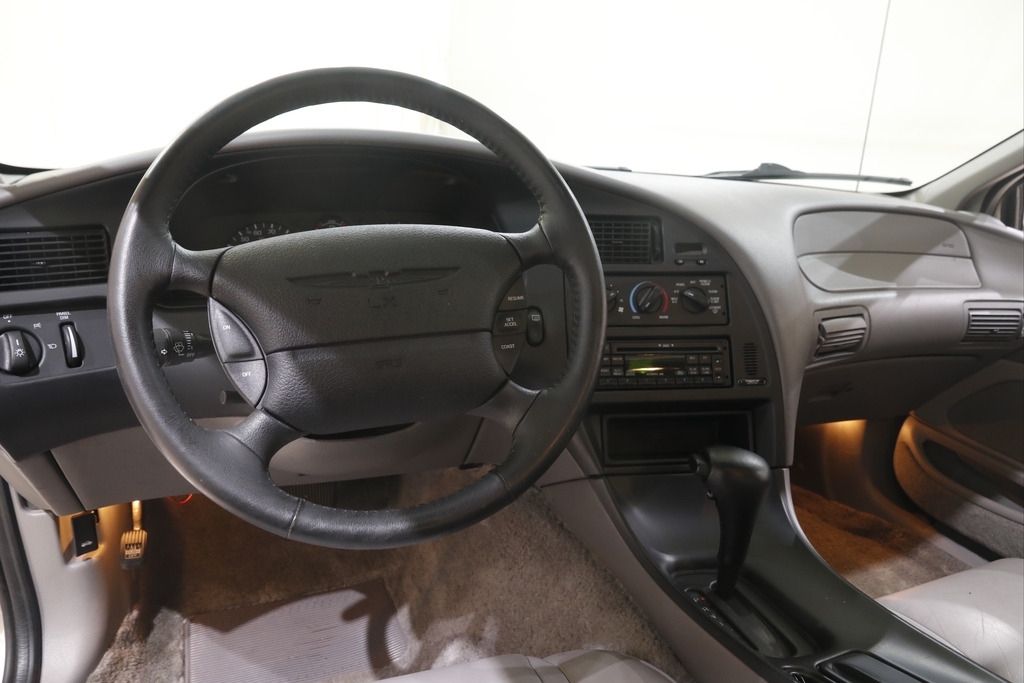
I find the styling just so-so on these Thunderbirds; I think the Mercury Cougar a better-looking car but the interior is to die for. Whatever your definition of luxury is, mine is seat comfort. And these are more supple, supportive and luxurious than the thrones in my wife's 1995 Lexus SC400. That's saying a lot too. Not to mention the very good seats in my 2002 Chevrolet Monte Carlo. 

I thought about how nice it would be taking this on the long road trip to visit my wife's niece at the University of Mississippi in September. The ice-cold AC wafting over us, the luscious leather buckets keeping us refreshed and comfy. My dreaming quickly came to a screeching halt when I turned the ignition key, and nothing happened. Nada. Zip. Zilch. Nuttin'. 

Figuring it was just a dead battery, my wonderful salesperson Kareem went and got a jumper. He certainly looked like he knew what he was doing when he attached the positive cable to the negative and vice versa. I swore that battery caught fire for a split second. He quickly deduced what he did wrong and put the cables on the right terminals, but the car still wouldn't start. Dead as a door nail. I told Kareem it was the starter. He looked at me like a deer in headlights. Nice kid. Not a clue about cars. 

I wish I could say I was my "best me" at that point but I wasn't. The rust bubble on the fender, the out-of-alignment trunk lid, the fairly high asking price and then the no-start had me caustically thanking them for wasting my time. Kareem's boss, who couldn't be older than my older son, smarmily snapped back, "sir, things break." I uttered a muffled, somewhat stymied eff-bomb with my back turned to them as I walked away. 

After I figuratively cooled off, the AC's not working in my younger son's Malibu that's my ride this week as the Monte Carlo is in the shop again, I was somewhat kicking myself for not low-balling them, buying it at a steep discount with no questions asked and having AAA tow it to my home. Then I thought about all the trouble I'd have fixing that nasty rust bubble. Having to buy rims for snow tires too and who knows what else.  

Pretty car, though. And, oh, those seats. But recalling how my son's Malibu I bought from a used car lot wouldn't start the day I picked it up, how the check engine light came on soon after I bought our Mitsubishi Eclipse Spyder from a Honda store, all the trouble the dealer bought Camaro I bought my older son gave me, not to mention how awful my 1982 Oldsmobile dealership purchased Buick Riviera was, I figured it best to let the earth cool and forget about it. You'd think you're better off buying a used car from a dealership but if you're buying something "as is", caveat emptor. 

Dealership emailed me the next day saying it turned out to be the starter like I suspected. They invited me back for a test drive. Thanks, but I'll pass. Once bitten, as they say. Twice shy. More like bitten a half dozen times. Had this thing started and I enjoyed it as much as I probably would have, who knows. There might be a blue oval in my driveway today.