Friday, September 8, 2023

1975 Oldsmobile Cutlass Hurst\Olds W-25 - It Ain't No Rocket


My oh my, what do we have here today? A 1975 W-25 Hurst Olds Cutlass for sale near the old triple-wide here on the North Coast (Ohio) with an asking price $24,900. 

On the very tail end of the muscle car era, many would say, me included, it was already dead and buried by then, Oldsmobile continued to sell a Cutlass with a Hurst shifter, some "sporty" ornamentation, and larger roll bars. W-30 versions of this car came with Olds' 190-horsepower, 455-cubic inch V-8, don't call it a "Rocket" as they dropped that moniker for 1975, meanwhile our subject here makes do with the 170-horsepower Oldsmobile 350. Again, it ain't no "Rocket". Literally and figuratively. 


This iteration of the venerable bestselling Cutlass first debuted in 1973 and is part of GM's polarizing "Colonnade" series of intermediate that included a gaggle of makes and models across all of GM's divisions save for Cadillac. 


And why Cadillac never offered one is a question for the ages. If they did, no doubt it would have sold quite well, and Cadillac wouldn't have had to come with their Chevrolet Nova based Seville either. Can you imagine what Bill Mitchell's crew could have done with this large of canvas? 


Anyway, through my foggy goggles, of all the GM "Colannades", of which I'm generally a fan of, I think Olds designers missed the boat on these. From certain angles it's plain dowdy looking to me, like something Granny would drive. Derided for their massiveness, again they were allegedly intermediates, our '75 here suffers the additional ignominy of having its opera windows covered over, I guess they thought it made it look NASCAR-ish? Who knows but holy blind spots, Batman. Things got better for 1976 before Mr. Mitchell showered his pixie dust on the '77's. right before retiring. After that, everything went to hell in a t-topped hand basket. 


If you're here you probably know of the story of not only the Olds 4-4-2's but of Oldsmobile's on again, off again relationship with Hurst Transmissions of Warminster, Pennsylvania. The partnership started in 1968 and ran through 1975, then again in 1979 and finally 1983-1984. If anything, a "Hurst\Olds" looked sporty and powerful which I've always thought played against the Oldsmobile "type", but what do I know. Oldsmobile popped Cutlass' out like movie theaters pop popcorn and America gobbled them up. Amazing still that less than thirty-years later Oldsmobile went belly-up. 


Fun fact, before the "Lightning Rod" 1983-1984 H/O's, more H\O's were sold in 1975 than in any year prior which is somewhat ironic given it was the height of the "Malaise Era"; performance cars were verboten. Some 2,500 of them with roughly half being W-30's and W-25's, 


You could get your '75 H\O in either "Cameo White" or "Ebony Black". Swivel buckets, t-tops and even a hood ornament on our subject here. 


Don't be call clogging my email for more information on this now. Please. 


1981 Dodge Mirada - There's a Sucker Born Every Minute


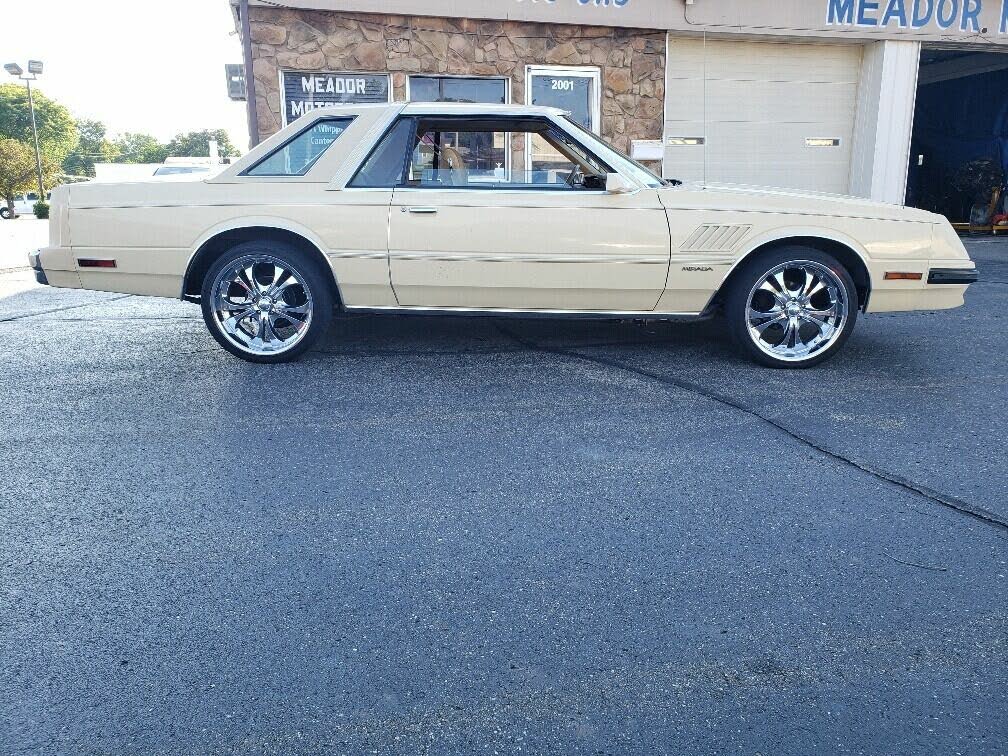
Here's something you don't see everyday and you didn't see many of them back in the early 1980's either. This is a 1981 Dodge Mirada (a what?) I found for sale on Facebook Marketplace. Asking price? Dramatic pause, please...$15,000. Yes, fifteen-thousand-dollars. Get this, it has 109,000-miles on its 42-year-old analog ticker too. I don't know what's crazier, the asking price or the "dubs" (wheels). Are those "20's"? Perhaps "22's"? How big do they make these things anyway? 


The Dodge Mirada was Dodge's replacement for their 1978-1979 Magnum which itself replaced their lightly disguised 1975-1977 Chrysler Cordoba clone they called "Charger". That Charger replaced their fabulous 1971-1974 vintage "fuselage" Charger that replaced the legendary 1968-1970 "General Lee" era Charger. The "General Lee" replaced the gruesome, sorry, that's harsh, 1966-1967 Charger. Got all that? 


Maybe the seller of this car will convince you that underneath its handsome but oh-so-angular sheet metal there's an updated version of Bo and Luke's steed but that's not the case. In fact, this car is more Plymouth Volare than anything as it rides on the Volare four-door's 112.7-inch long wheelbase. Dodge taking a page from Chevrolet and Pontiac's playbook - they too used the longer sedan version of GM's then current intermediate chassis to create their Monte Carlo and Grand Prix. That would be the 1969-1977 iterations of both not the farcical facsimiles that followed. 


Problem with this car being based on the Plymouth Volare was that the Volare rode on a mildly updated chassis that the Plymouth Duster was bolted to. The Duster harkened back to suspension technology that was questionably advanced at the end of the second Eisenhower administration. 


While I think the lines on this car are actually quite handsome, the way this car rides and handles is its weak point. Sure, it goes, turns and stops, but it doesn't do so happily or makes someone think they're a better driver than they are. It's solid-axle rear suspension combined with Chrysler's convoluted transverse torsion bar front set up didn't lend itself to laser precise handling prowess. Body-on-frame construction may have meant a nice, quiet, supple and compliant ride, but combined with seats that had little lateral support, this car's a handful to drive. To be safe, use both hands. And the large wheels and tires would only add to its primitive harshness. 


The passage of time has eroded away just how curious these cars were when they first came out in 1980. In the deepest throes of a second energy crisis in five years, and one that pushed the price of a gallon of gas over $1-per gallon for the first time, cash-strapped Chrysler came with this car (and a similar Cordoba and Imperial) that was not what the public wanted or needed at the time. Yeah, yeah, it came standard with a "Slant Six" bowing to fuel economy concerns of the times, but the golden days of the personal luxury car were coming to an abrupt end, a market segment once so molten hot cooling quickly into a boutique, niche market lump.  


That's not to say there's nothing to like about this car. There actually is plenty to appreciate. Again, I like it's angular lines although the front end, which emulates the 1978-1979 Magnum's, is wonky. The interior is at least cool looking, who doesn't love a "Tuff" steering wheel? The wheels are ridiculous but I'd look into whether or not the originals come with the car. Sometimes they do. This looks like it's for sale at dealership so maybe not. 


As far as the asking price goes, well, seeing how clean the engine is and that it's obviously had work done to it, is someone thinking they can recoup what they dropped on rebuilding it? How much could that have been?  I can't tell a Chrysler 318 from a 360 by just looking at it but safe to say that's nothing more exotic than a 360 down there. For '81, the only V-8 available on these cars was a 120-horsepower, 318-cubic incher fed with a two-barrel carburetor so if this is in fact a 360, it's a transplant. Throw in a 2.47:1 rear end and in stock guise, you'll have waited roughly 15-seconds for 60-mph to roll around and nearly 20-seconds for the quarter mile. At just 73-mph.  


The B&M shifter is a curious, sporty looking addition but this install here is not without issue s. Let's assume it works properly, but who ever put it in didn't change the steering column out. Look closely and you'll see the stock shifter on the column. Yes, that's major surgery and good luck finding a shifter free column but still, for $15,000 you'd expect more. 


J.D. Power pegs one of these high retail at $2,500 so there's a gigantic spread between "book value" and retail asking price here. To me, it's an insurmountable gulf, I mean, what are you going to do, offer half the asking price and hope to split the difference? Ten- or eleven-grand is still way too much money for this but as my friend in the business says there's an arse for every seat. And as P.T. Barnum is credited with saying, "there's a sucker born every minute". 

Thursday, September 7, 2023

1981 Pontiac Turbo Trans Am - You Rather Have Been Smart or Good Looking?


A girl in my high school had a brand-new Turbo Trans Am just like this '81 in luscious dark red. Beautiful car. She was way out my league too. The fact she not only drove a brand-new car but a Turbo Trans Am made her "Hollywood" in my eyes. 

I thought her car fitting for her as it was as unapproachable as she was. I'll give her the benefit of the doubt that she wasn't as shallow as these cars were. "All show and no go" as they say. Or, "all fluff and no stuff". Didn't matter because they both looked so damn good. The world's at your beck and call when you're young and beautiful. Everything comes out in the wash, though. 


On the heels of a surge in popularity after "Smokey and The Bandit" shot Trans Am's to the pinnacle of the public's automotive awareness, to be in compliance with federal fuel economy and emissions regulations, Pontiac had to drop the big engines that powered the Bandit era T/A's. Rather than stuff T/A's with the Chevrolet 350-cubic inch V-8 that powered Camaro Z/28's and Corvette's, Pontiac bolted the same Garret turbocharger Buick used on their blown 231-cubic inch V-6 to their 301-cubic inch V-8. An underwhelming legend was born. 


It wasn't all bad. At maximum boost, the turbo 301 spooled up 210-horsepower and 345-foot pounds. Not bad. Actually, on paper, that's more torque than the Pontiac 400 that made Bo Darville's car go. For the record, all the T/A's in Smokey and The Bandit, the original not the farcical sequels, were 1976 T/A's with the front ends from 1977 models affixed to them. There are conflicting stories about what was under the hood of the six T/A's used in "Smokey". For 1976, the standard Trans Am engine was Pontiac's 400-cubic inch V-8 and their 455 was optional. For 1977-1979, if a Trans Am has "T/A 6.6" on the Shaker, it has a Pontiac 400. If it says "6.6 LITRE", yes, "LITRE", it has Oldsmobile's 403-cubic incher. 


Problem was, the boost got spent quickly and after the reserve was gone, the engine wind milled. Buick's much smaller V-6 wasn't any better of course and GM only figured out how to make those engines run right with the advent of port fuel injection. Pontiac had planned to further refine the turbo 301 but GM scuttled Pontiac's engine program negating them to only pushing out (4-cylinder) "Iron Dukes". Fun fact, there's a hood bulge on 1982 and 1983 T/A's that was to make room for the turbo 301. 


My time in "Bandit era" T/A's was less than enthralling, perhaps not unlike going on a date with that girl that had that dark red '81 in high school. I found the ride harsh, flinty and truck like. Squeaks, rattles and moans and groans galore. They did handle well, everything is relative, and of course the big engines made the cars fly. And they looked so good. Damn. 


Back in high school, would you rather have been good looking or smart? 


Tuesday, September 5, 2023

1998 Jaguar XKR - Meow


Not many vehicles survived a protracted production run with as little outward change as Jaguar's 1975-1996 XJS. Granted, during those 21-model years, Jaguar made incremental changes, but wholesale, ostensibly, it's easier to tell a 1968 Corvette from a 1982 than it is to tell a 1975 Jaguar XJS from a 1996, a 1972 Mercedes-Benz SL from a 1989 as well. That all changed for model-year 1997 when Jaguar introduced the XK8 convertible and coupe. In one fell swoop, all the angst of waiting two-plus decades for a new Jag seemed like time well spent, the new XJS was an instant classic and satisfying in ways Chevrolet's long overdue replacement for the 1968 Corvette was disappointing, to some degree Mercedes-Benz 1990 SL as well. Jaguar followed it up in 1998 with a sporting "XKR" model. Our subject here is a "cheapie" XKR Facebook Marketplace find from 1998 and despite my knowing better, I want it. And I want it bad. Really bad. 


The differences between a regular, run-of-the-mill XJS, as if there is such a thing, and an XKR are few, you'd never know one from the other unless you knew or what told what to look for. Using the best of their own along with what they borrowed from others, Jaguar tuned its Computer Active Technology Suspension (CATS) on XKR's to ride firmer, or more sporting, on top of one-inch larger rims and tires. Mercedes calibrated their ZF, five-speed automatic transmission with shorter, more aggressive ratios and last but not least, Ford, with whom they were under the control of, bolted the same twin, air-to-liquid intercooled superchargers they strapped to the engine in their SVT Ford F150 Lightning pickup truck to Jaguar's "AJ", 4.0-liter V-8. Who says the filthy rich can't enjoy a Sloppy Joe?  


Ford's superchargers blew up horsepower on the AJ to 370 from 290 and torque swelled to 387 from 294 foot-pounds. Hardly numbers to brag about today, but back in the days of the second Clinton administration, an XKR's 5.1-second, 0-60 run was heady stuff. Incidentally, we tell an XJS is an XKR primarily by these luscious vents in the hood or what they refer to "over-there" as the bonnet. They are somewhat functional, cool air does flow through the vents, but there's no plumbing that helps ram the colder, denser stuff into the engine. So, they're more like seams on black stockings, they're alluring and by definition technically function, but they're there for appearances mostly. Meow. 


Just 206,0000-kilometers on this one's digital ticker, that's 128,000-miles to us knuckle draggers, and has an asking price of just $7,995. Seems like a bargain until you get a hold of yourself and remember this isn't a 27-year-old Lexus but a 27-year-old Jaguar. That means a mixed bag of disparate baubles and bits of questionable reliability that's, again, old. Really old. Speaking of tech, don't look too closely otherwise you'll notice that this thing is squatting at the front - something tells me there's something askew with its funky CATS suspension set up. That looks expensive to fix. Maybe there's a kit to bypass the CATS, who knows. Don't count on finding parts at the Pull-A-Part. 


Amazingly, factory navigation systems are still a thing even though it's pretty obvious they're on their way out. Or should be. Back when our XKR's wood trim was new and shinier, the  thought of getting directions on our phones was inconceivable. It's just a matter of time, though, before the economics of manufacturers offering in dash systems stops making sense. And do they even make updates for these old DVD-based systems? Shame they dedicated so much real estate on the dash to this too. I'd turn this into a picture holder. 


Average book on these is just $7,000, sometimes "classic" doesn't necessarily mean, "valuable", these stickered for more than $80,000 when new. This XKR reminds me of my late friend Dan who bought a 1985's BMW 528 years ago for around $1,000. He called it his, "one-thousand dollar, two-thousand dollar car" because every time something on it went, and that was quite often, it ran him $2,000. To which I say, "damn the torpedoes", get in my garage you sweet minx and maul my bank account, don't make me beg. 


Saturday, September 2, 2023

1993 Mazda MX-6 LS - A Dandy of a Little Car


Figures that I find this 1993 Mazda XM-6 LS for sale after I made a recent "cheap car" purchase. Just as well as my wife and I are quite happy with our friend's 2009 Toyota RAV4 I took off his hands about six-weeks ago. It ain't perfect but for four-grand, these days, it's the buy of a lifetime. Still, kind of stinks this popped up now because as much as we love our "new-to-us" RAV, nothing beats the way a good car rides and handles. And this car is a very good riding and handling car. Dare I say great. 


It's got the Mazda V-6 too albeit it their teeny, tiny 2.5-liter, DOHC, 24-valver that makes all of 164-horsepower. Ford used this engine in their Contour\Mercury Mondeo twins and their version of this car, the Probe GT. While a smooth runner, it's got nothing on the pot-whoppin', 269-horsepower, 3.5-liter V-6 in our RAV that hauls it like a fighter jet off an aircraft carrier. Gas mileage with our RAV is better too - EPA estimates for this engine were 21-city, 26-highway, I'd hedge the actual number closer to the city number. Our RAV gets a consistent 25-27 miles per gallon highway. I've pulled down 28-mpg on occasion too; around town it's a different story but I don't do a lot of "city" driving. 


Oh, man, it's a got Mazda's sweet 5-speed too, that ups the fun factor ten fold for me. Clutch on these things is sublime as well. Steering is "right now" responsive and the brakes are hard wired to your brain and right foot. Damn, where was this thing when I was looking?  


Only thing I can ding this car for is it's just not the most handsome thing in the world. Ford's Probe of this vintage was a better looking car, in my opinion, they did a terrific job of making it look like a whole lot more than this is. And it's red. Red's might be my favorite color but not on a car. That's ironic since I've five red cars in my life. The dark belt line molding does the lines of this car no favors either. Yuck. 


Mazda's first MX-6 debuted in 1987 and it was rumored at the time that Ford was going to use it as a replacement for their Mustang. That's always seemed like a publicity stunt to me but I get why and how Mustang fans got their hoofs all up in a pinch. Styling wise anyway. Behind the wheel, the circa 1979 Fox-body Mustang couldn't hold a candle to it. Especially the updated 1993-1997 models. The Mustang rode and handle like a crummy truck, these handled so well they made you a better driver. 


As much as I want this, I can't do the mental gymnastics necessary to make this work for my wife and I.  Especially with an asking price of $6,400. Although it's only got 76,000-miles on its thirty-year-old ticker, it still is a thirty-year old car albeit a Japanese one. Seriously, I think Japanese cars age but one-year for every year an American car ages two, or three. Good luck finding parts for it too and since it's OBD-I, best wishes to you finding a mechanic who can work on it. 


If I've learned anything, luck and timing are as important or more important than anything else in life. When we're young, we don't realize that. Which is a good thing otherwise we'd all sit around waiting for things to happen. It's said the harder you work the luckier you get and I've found that to be true. Sometimes it just doesn't work out and thing's just aren't meant to be and that's fine. Someone else will get a dandy of a little car here.  


Friday, September 1, 2023

1988 Pontiac Grand Prix SE - Old Man Smell


I found this 1988 Pontiac Grand Prix SE for sale on Facebook Marketplace recently, asking price is $1,500. I think that's for a 35-year-old Pontiac with 238,000-miles on it's ticker that's not at least a Formula Firebird. The body seems appears solid but the interior concerns me, good luck getting it redone. Looks like it has that "old man GM smell" too, you know, that delightful mixture of wet dog and cigarettes that many try to cover up with those Febreze fresheners on the AC vents. Poster of the ad claims the engine misfires but that doesn't sound too serious. Bad coil pack? Dead or dying injectors? 


Although this car won Motor Trend's "Car of the Year" honors for 1988, history has been less than kind to what were known as either GM10's or W-bodies. However, and this may be the GM fan girl in me, they were more a victim of circumstance than being terrible cars. That's worth noting because back in the 1980's, GM did push out some clunkers. 


These cars were different from what GM had been offering in their intermediate ranks in that they were front-wheel-drive. They weren't GM's foray into FWD, but up until that point, they were the first to (mostly) successfully combine styling elan with the powertrain configuration that would come to dominate the automobile industry. GM's first attempt at it, the infamous "X-body" Chevrolet Citation et al, had landed with a thud although their "A-body" brethren (Oldsmobile Cutlass Cierra) lingered on interminably through 1996. GM's first front drivers were the 1966 Oldsmobile Toronado and 1967 Cadillac Eldorado but they were more an engineering novelty than a necessity. 


The necessity that drove the migration to FWD was fuel-economy. The two oil shocks of the 1970's, and subsequent government mandated Corporate Average Fuel Economy regulations left Detroit scrambling and the panacea was, obviously, lighter, smaller vehicles. Problem was, especially with GM's class-of-1978 downsized intermediates, their interiors were cramped. Sure, they may have been able to carry five to six passengers, but even just two adults sitting in the back seat of one on a road trip might have needed therapy for claustrophobia afterwards. The answer to that challenge was to cram the powertrain in front of the firewall thus freeing up cabin space. Say what we will about the GM "X-bodies" but their interiors were remarkably capacious compared to rear-wheel-drive cars of similar size. 


But in addition to falling apart and being death traps, the X-bodies were homely affairs. Subsequent designs from GM and especially Chrysler weren't much better. Japanese imports, while vastly superior in terms of design and assembly, were sorry looking, appliance like affairs. To "Malaise Era" weary young me, front-wheel-drive, while obviously the way of the future, meant staid, boring cars. That changed wholesale when Ford introduced their "jelly bean" Taurus and Mercury Sable in 1986. While these cars were in development going back 1982, GM rolled them out a good two-model years later. The tip-of-the-spear? The 1988 Pontiac Grand Prix SE. 


A then close friend of mine's parents bought one of these brand new for him in the spring 1988 and it knocked me sideways First, that his parents dropped $17,000 cash for their then 23-year-old son on it, but more importantly, by how much I didn't hate it. In other words, I wasn't ultimately disappointed by it the way its immediate predecessor did. 


Styling aside, what I found most appealing about his car was its spacious interior. The dash layout? Not so much. Wow, what was with all the buttons? I still think it looks like it was inspired by some cheesy '80's video game. Good luck finding parts when it goes on the fritz too. 


His GP had ginormous leg room in the back seat as well as the front and these dual rear buckets were a joy. While not adjustable, they were more comfortable than any back seats in a car had to be; especially in anything from General Motors. The Oldsmobile version of this car, the Cutlass had similar seats, the Buick Regal Gran Sport had similar ones available. The Chevrolet Lumina, which came out more than a year later, didn't either. Just as well as these buckets make this car a four-passenger only affair. Albeit, an airy, comfy one. Oh, look. A trunk pass through for ski's because everyone who drove one of these ski's, right? 


I thought the styling somewhat goofy; it hasn't aged well either. The plus-side was, overall, the car didn't have that sorry, shrunken, too-small presence like its immediate predecessor did. Those cars always seemed smaller than there were whereas this one appears larger than it is. In reality, it is considerably shorter than what it replaced. 


Driving dynamics wise, up until that time, that brand new 1988 Grand Prix was the "best" car I had ever driven. Granted, that's not saying much considering my most enthralling behind-the-wheel moments were in a 4.3-liter, 1976 Chevrolet Monza and a 1981 Pontiac Phoenix, but my friend's new '88 GP was unlike anything I had driven up until that time. There were no jiggles, quivers, shakes, squeaking and creaking. It felt "all-of-one". He let me drive it full-throttle over a railroad crossing and it felt as solid doing as a cast-iron girder on balloon tires would. If I did the same in my 1975 Chrysler Cordoba, it would do the Watusi and some trim piece would fly off as the suspension rebounded. For that matter, part of the suspension would fly off too. Steering was heavy but responsive, the ride fairly harsh. The car felt and looked modern but at the same time gimmicky. 


I found his car seriously underpowered, but most cars back then were. It's little 2.8-liter V-6 made all of 130-horsepower and 160-foot pounds, hardly an engine fitting so much car. In the last days of semi-divisional autonomy, Pontiac spent the next ten-years experimenting with different engines in the GP until they finally got it right stuffing them with their (now legendary) 3800 V-6. 


With all this going for it, what went wrong? Well, if you consider that GM only up until recently stopped making a car based on the DNA of our '88 here, it's "failure" is hard to quantify. Sure, from a product planning stand point, coming with personal luxury cars at first when the market was shifting away from them might have been a mistake, but GM introduced sedan versions eventually., gruesome as they were. Circumstantially, yes, Ford beat GM to the punch in the mid-size, front-drive segment and then there were the superbly executed imports - something Detroit didn't have to contend with back in the days when the personal luxury car reigned supreme in this country. 


As for our Facebook Marketplace find here, sad that such a historically significant car could be had for so little. Ironic to some degree that a 1987 Grand Prix, even with a ratty, smelly interior would have an asking price five-times as much. Six times as much if it has a V-8. Perhaps more. Would be cool if someone does buy this and appreciates it for what it is. Or was.