Sunday, January 5, 2014

2014 Chevrolet Corvette - The Problem With Being Perfect


In the 1981 film, "The Four Seasons", Carol Burnett portrays Kate Burroughs, an editor for Fortune magazine. She's well-organized, well adjusted, attractive, friendly and personable. In a word,  perfect. Despite her perfection, she feels neglected and under appreciated by her husband, Jack, played by Alan Alda. During a heated exchange between them, Jack dismissively calls Kate, "perfect". Kate, furious, lashes back. "The problem with being perfect is I cease to exist. I'm invisible!"


I recently read a review of the new for 2014 Corvette. Aside from some minor noodles about some cheap interior bits the review was glowing. The author of the article claiming the new Corvette is as good, if not better, than any sports car in the world. After 60 model years and now 7 "generations", the Corvette is perfect. Congratulations, General Motors, you might as well have just made the Corvette invisible.
Later on that sun splashed Sunday afternoon, my wife and I jumped into our '77 and headed east along the shore way for dinner in downtown Cleveland. The AC didn't work, the ride jarring, the brakes were sloppy, it certainly didn't handle even as well as my 2002 Monte Carlo SS and to make matters worse, it overheated less than five miles from our home and we had to pull over. We limped home laughing twenty minutes later.


The new Corvette is nothing like our '77. My wife has commented that out '77 isn't even a "real car". What our car is, is awesome. As is the 2014 Corvette.
Cars today, in general, perform at levels far and above what even our '77 Corvette could ever perform at. They're also infinitely more reliable than they were years ago. The new Corvette performs at levels far above where today's high performing "normal cars" can. Again, that's saying a lot seeing how even cars like my wife's company issued, 2012 stripper Camry can run circles around my "sport suspension" equipped, '02 Monte Carlo. If you're so inclined to purchase the new Vette, be sure you somehow have access to a race track or race course where you can really open it up.  
Last summer was a tough one for our Little Red Corvette. Our car has a myriad of electrical gremlins and they got the best of me several times over. It seemed it was "offline" as much as it was "online".  That's ok, really. I enjoy working on it and get a great feeling of satisfaction when I fix something that went wrong. I do wish, though, that it was more reliable and it could perform at a higher level. Updated shocks and brakes should get it to at least the level of performance it was designed to be at. In a straight line, the L48 pulls like a locomotive engine. Quite fun.


While we don't use our Corvette as a daily driver, I have to imagine many buying the new Corvette would use it every day. I have to wonder, though, if, like many things could a car even as spectacular and perfect as the new Corvette just become another car after a while? 
  

We get our less than perfect Little Red Corvette out of storage the second weekend in April. We can't wait for another summer season of less than perfect.

Saturday, January 4, 2014

1984 Buick LeSabre - Meet Mike

They sure don't make 'em like this anymore.
 

I found this clean, I mean CLEAN, '84 Buick LeSabre outside the gym I go to. As my excellent luck would have it the owner was walking out just as I was going in. A quick, "I love your car!" was all it took to have "Mike", wave me over to give me his and the car's life story
 
 
A Korean War veteran and Middleburg Heights native, Mike, who's retired now, had spent thirty years working for NASA. He and his (now late) wife picked up this LeSabre at an estate sale in Evansville, Indiana back in 2009. It had just 25,000 miles on it when he first got it, just under 40,000 now. They found out about the car on Craigslist.
  

The car belonged to the grand father of the man Mike bought it from. When he passed away, the oldest son moved it into the back of a barn because he didn't have the heart to let it go. And there it sat, under a car cover for twenty years. In 2009, the family decided to move and Grand Dad's Buick had to go. Mike got it for $4,000. They had wanted $7500. Such the deal.


Mike's not the biggest fan of it although he's run into many people, like me, who are. He finds it difficult to maneuver and he says it's terrible in snow. He wishes it had more power but the upside is it gets about 20 miles per gallon. He likes the big trunk. It's made several trips to Florida in the time he's had it and he finds it a comfortable highway car.
 
 
He asked if I was interested in the car and I politely nodded yes. If it was a coupe or wagon I might have been really interested as I have little real interest in a sedan. He gave me his number and told me to call him in the spring if I was interested in buying it. He misses his Volvo. He offered to buy me lunch too so we could talk more about the car and his time at NASA (he could tell I was interested it what he did) but I had to get back to the office after my workout. He smiled, shook my hand and patted me on my shoulder. Nice man.

 
They sure don't make 'em like Mike anymore. 

The full size, rear wheel drive, V-8 powered, body on frame sedan went the way of the dinosaur back at the end of the 2011 model year when Ford stopped production of its Crown Victoria. General Motors stopped production of their rear wheel drive full size car, what us car geeks lovingly refer to as the "B body", at the end of the 1996 model year. Chrysler hasn't built a car like this in nearly a generation and half.

Wednesday, January 1, 2014

What's the Plural of (Oldsmobile) Aurora?


The original Oldsmobile Aurora, there were two, went out of production at the end of the 1999 model year. With only about 110,000 copies of the car made during its four year production run, they weren't, much to General Motors consternation, exactly commonplace. That's why it was very unusual to find two, let alone one New Year's Eve morning in a parking lot near my home. What's more, those two very rare Oldsmobile Aurora were parked in the same row of that parking lot.
 
 
GM's rocket division was fading fast by the time the Aurora was launched. Oldsmobile had moved more than a million cars in 1985 but had sold fewer than 400,000 by 1992. Introduced for the 1995 model year, could the Aurora turn around the Rocket division?
 
 
No, the Aurora could not. Oldsmobile introduced the Aurora in a (suddenly) very crowded segment (near luxury) and sales were underwhelming. Had Aurora been introduced 10 years earlier, before  Lexus, Infiniti and Acura would Oldsmobile be around today?
 
General Motors closed the Oldsmobile division in April 2004.  


Master Bedroom Rewire

This started as a video blog of my rewiring of our master bedroom. When I began editing the video, though, I realized, quickly, that I was boring as hell on camera. The subject matter didn't exactly lend anything to a memorable cinematic experience either. So instead, I cataloged the project with captioned screen captures of the video. By the way, I'm not an electrician and this is not a DIY  blog. If you get inspired to do a project like this, I suggest you do plenty of research first. And have the phone number of an electrician on speed dial.


When my wife went to Providence with the boys right after Christmas, I had a block of time on my hands I hadn't had since I lived by myself in Nashville. With the closest Civil War battlefield more than 300 miles away, I was left with only one thing to do. Rewire our master bedroom suite.

 
The problem with our master bedroom was that the switch to turn on that ceiling fan light was behind these French doors. 


I had added this lit switch to make it easier to find the switch in the dark. While it did make it  easier to find, it was still awkward to go around the door to access it. There had to be a better way.


There was and that was to be able to turn this light on from out in the hallway.


And if I had the hood up, I wanted to add control of the ceiling fan light from out here in our bathroom vanity area. I also wanted to maintain control of the ceiling fan light from the switch behind the doors.

 
To control a light from two locations requires three way switches. Since I wanted to control the ceiling fan light from three locations, I needed to install two three way switches and a four way switch. I've never wired a four way before. To do this required a bit of research.
 

There are several different ways to wire three and four way switches dependent on where the power supply is in the "flow" of the circuit. What made this project tricky, was that the original power supply for the ceiling fan was in the box that housed the existing switch for the light (behind the French doors). Since the power supply and the "hot leg" for the light can't be on the same three way switch, I tapped  power for the light from the bathroom vanity area. Luckily, the bathroom area was on the same circuit as the light. The hot leg for the fan would remain in the original box behind the doors. Fan power and control would remain in the original location.  
 
This entire project was made easier thanks to attic access to our bedroom walls and ceiling. Up here, after digging through a Great Lake of dust covered insulation, I found the three wire that goes from the wall behind the door to the ceiling fan. Next, I drilled three, 3/4 inch holes in the top plates of our bedroom walls so I could drop in new three wire. One line went behind the French doors and bathroom area for the three way switches, two lines went down in the wall in the hallway for the four way switch.
 
 
When I finally got to actual wiring, a well labeled circuit breaker box was a God send. We've been in this house 3 1/2 years and I've got every circuit in the house documented on the breaker door.
 
 
Some electricians have the patience and ability to pull cable through existing boxes. Not me. I pull out existing boxes if I'm adding wire. While it's an arduous, time consuming process, it's the efficient way I know to get new wire into existing boxes. 

 
I dismantled, labeled and made note everything that was in the existing boxes. I used different colored electrical tape to tell me what's what and then I made note of it. Red duct tape differentiates hot legs from the light and fan wires (all are black).  
 
 
Once everything is labeled, I slowly worked on removing the original electrical boxes. Biggest challenge was not doing too much damage to the walls.   

 
Out in the hallway, I also had to expand the existing hole so it could handle a new two gang (for two switches) box. Removing this box was much easier than the box behind the French doors because I made the hole significantly wider.

 
The first of two three wires for the four way is through. Onto the bathroom vanity area.  


The bathroom was last but not least. This is where I tapped the power for the light.


This was the least difficult box to work on because most of the heavy work had already been done. I had added a three way switch a couple of years ago so we could turn the vanity lights on out here by our closets. After I expanded this hole to be able to fit the three gang box, I dropped the three wire in and got ready to test everything for the first time. I triple checked my schematic and double checked all of my connections.

I turned the breakers back on and...

 
Money. Rinse and repeat two more times. Reassemble. Miller time.  


Monday, December 23, 2013

2002 Toyota Celica GT - You Look Good. I Mean, Real Good

 
Hard to believe it's been eight model years since Toyota sold a new Celica in this country. If you're of a certain vintage, you remember Toyota Celica's being everywhere. The thinking man's, or woman's, Camaro/Firebird/Mustang as it were. While they lacked the grunt of American 2+2's, they made up for their lack of beans with a level of refinement and build quality that put "us" to shame.
 
 
Toyota's never built anything that was anything less than superb but like the world's best four head VCR, if the world isn't clamoring for it anymore, no matter how great it is, or was, no one's buying it. While the Toyota Celica was the best at what it was, the market for 2+2's and coupes in general, has all but dried up. Will it come back? Bought a VCR lately?
 
 
It's doubtful that market will reemerge.  Why? Well, cars today, the most plebeian of sedans and even some sport utility vehicles and pickup trucks, are fantastic performers. A track suit of a car, like this 2002 Celica, offers little more than styling to lure today's buyers. Why wear jogging clothes when a pair of jeans will suffice? To make it compelling to buyers, above and beyond the swoopy sheet metal, today's sports coupes must perform at a level significantly above and beyond what a Camry (for example) can provide. Otherwise, what's the point? These cars are a pain to live with as daily transportation. Hard to get into. Poor visibility. Limited to zero practicality. Even then, if said 2+2 could perform at that high level, do you you really need a car that can pull .92 g's on a skid pad when the family wagon can pull .85?
 
 
Back in the olden days, when Celica's were everywhere, 2+2's delivered a level of performance you  couldn't get from ordinary family cars. You got to walk the walk along with talkin' that talk. And look good. I mean, real good.
 
 
There are several 2+2's available today and they offer a level of performance above and beyond ordinary cars. The new Ford Mustang GT, in particular, is absolutely spectacular. Ford sells about 70,000 Mustangs a year. Chevrolet pushes out about 80,000 of their tougher to drive Camaros (ironic). Chrysler moves 40,000 of their delicious Challengers. These are good but far from the great numbers of 2+2's that were sold 20 years ago.
 

Our teenage boys, those harbingers of all that's cool, think cars like this Celica fantastic looking. They swooned over our recent purchase of a 1996 Camaro, our "extra" family car. In its day, our Camaro could perform at levels far above what a Lumina could perform at. The Camaro is cramped, though, has a fairly stiff ride, is noisy, crude and is all but impossible to get in and out of without blowing out a disc. More often than not, of late, given a choice between going out in either our Tahoe or the Camaro, the boys will take the Tahoe leaving the Camaro in the garage.

Comfort 1. Cool, 0.


Wednesday, December 18, 2013

Cadillac - Not Just For Old People Anymore


Motor Trend's Car of the Year and a Car and Driver 10Best

I saw the new 2014 Cadillac CTS yesterday and thought it handsome if not "Euro generic". Apparently it's quite the thrill ride having received Motor Trend's Golden Calipers as their Car of the Year and a position on Car and Driver's prestigious 10Best list. I told my wife about it and all she could say was, "Cadillacs are for old people".

 
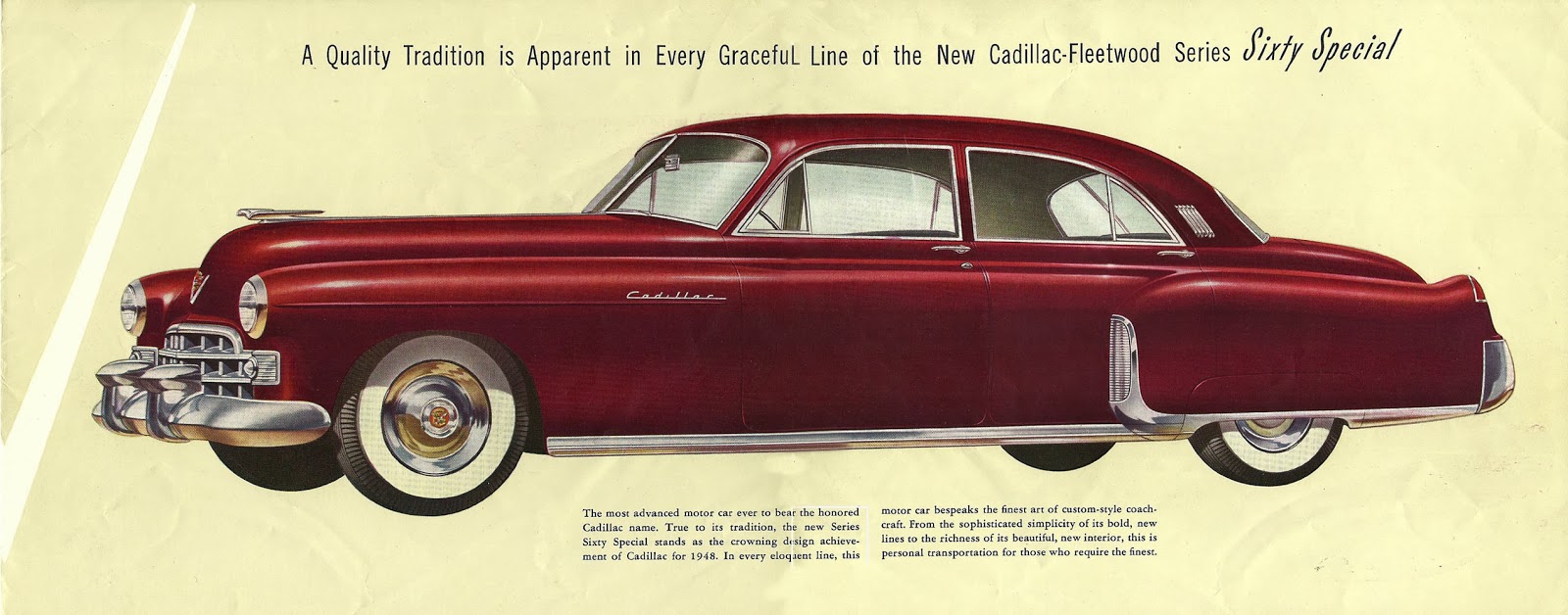
1989 Cadillac "Fleetwood", not to be confused with a "Fleetwood Brougham" (1977-1986). The Fleetwood was a front wheel drive automobile built off General Motor's C-body (or chassis). The "Fleetwood Brougham" was a rear drive automobile built off GM's D-body. The Fleetwood Brougham was renamed, "Brougham" for 1987-1992.

You can't blame my wife for her Cadillac perception. We both grew up with dowdy, frumpy "old" Cadillacs like the new for 1989 Fleetwood. If you think this is "old", check out a "Brougham".  While Cadillac has become the equal if not superior to any luxury brand in the world, there's no changing my wife's perception that Cadillac's are for old people.


There was a time that, "The Standard of the World", was more than just advertising shtick.

Cadillac's weren't always for "old people". Before World War II, Cadillac really was, "The Standard of the World". Renowned for engineering  prowess, innovation, craftsmanship, luxury accouterments and style,  Cadillac was sought not only by the well heeled but also by young, hip, taste makers. What happened?


In 1925, General Motors bought the Fleetwood Metal Company of Fleetwood, Pennsylvania to build custom car bodies for Cadillac.

At the risk of oversimplification, General Motors moved Cadillac down market to increase sales and reduced research and development dollars to increase margins. Cadillac became stagnant and lost the movie star swagger than defined the brand.  Ultimately, many of their target buyers, ever fickle, moved to more compelling aspirational automobiles from Europe and Asia.
 

Checking the "Fleetwood" box on your new Cadillac order form in 1989 got you fender skirts (or spats). Odd and handsome looking at the same time (the entire car's proportions are weird), the skirts did nothing to improve performance. They did, however, make rear tire removal difficult.

While those makes from Europe took many Cadillac buyers, those that remained loyal to the brand where left with fender skirts (or spats) on their top of the line purchase. Best of all, it's a Cadillac, after all.
 

Monumentally superior to the "Fleetwood Brougham" , the "Fleetwood" was no match for anything from BMW, Mercedes, Lexus or Infiniti.  

With cars like the new for CTS (and ATS), Cadillac has made a fantastic turnaround and is  remarkably, cool again. Cool in ways that transends what many think Cadillac is and isn't. Here's to hoping it stays that way.
 
For the record, my wife still thinks Cadillacs are for old people.


Thursday, December 12, 2013

1971 Buick Electra 225 - What If?

 
"Alternate History" is the fascinating discussion of "What If?" Example, what if Napoleon's First French Empire was victorious in the French Invasion of Russia? What if the Axis powers had won World War II? What if the south had won the Civil War?


What if...the energy crisis' during the 1970's never happened? If there was no energy crisis would American automobiles have been downsized? Or would they continue to get even bigger? Hard to imagine them getting bigger than our 1971 Buick Electra. American roads are only so wide so its debatable that cars would've gotten wider. They did get longer when 5 mph bumpers got bolted on starting in 1973.
 

The sheer bulk of these cars is hard to fathom. There's so much size here, for no other reason than just to be big, that even drivers standing north of six feet tall had issues driving them. As a wee nipper in those now sepia toned days, the thought of driving my dad's 1970 Buick Electra was terrifying.


I woke up in the middle of many a night in a cold sweat from nightmares about being behind the wheel with my younger brother manning the gas and brake pedals because I couldn't reach them. Our brotherly communication skills needing much improvement. "Not the gas, idiot! I said braaaaaaake!"


Within a decade, these two and half ton monsters would be passed over by "taste makers" for more refined, and more expensive, machinery from Mercedes and BMW. 


That shift to European luxury makes accelerated by the two gas crisis' of the 1970s. Would the shift have occurred without the kick in the tank of those two embargoes? Yes. Unquestionably. The timetable may have been delayed five or ten years but that shift was to happen and for reasons above and beyond how many miles per gallon the Buick Electra Deuce and a Quarter could muster. Cost of a gallon of gas notwithstanding. American makes, like Buick, following Mercedes and BMW (and others) path to making better automobiles.

 
Some scholars argue that no matter what happened or didn't happen, what is "now" is the way that it was meant to be; good, bad or indifferent. Albeit with a different timetable. Europe and the United States being reunited ultimately. American automobiles, once again, becoming as good, if not better than anything else in the world.