Chrysler's Chrysler division had a fairly muddled image in the late 1970's. Was it a Cadillac competitor? A Buick or Mercury? Didn't help that from 1955-1975 Chrysler Corporation had Imperial as a range topper and that when they pulled the plug on it all Imperial's became New Yorker's. Newports? Chrysler's (the division) best seller seemed to be all but forgotten. I found this big boy of a 1978 Chrysler Newport in Pittsburgh with an asking price of three grand. Tad rich but not outrageously so. Get it for closer to two grand and you've done well. Despite some egregious flaws it's still pretty neat. I wish I had room for it.
Save for some styling details inside and out Newports of 1974-1978 vintage were all "New Yorker" underneath. Same chassis, same dash, same engines.
Chrysler first tagged a concept car "Newport" in 1940 and started using the name full time starting in 1961 when discontinued DeSoto's became Chrysler Newports.
On one hand it was a smart move making the most of a discontinued model line making an "entry level" Chrysler but in the long run it diluted much of any brand cache "Chrysler" had. Especially when Imperial dissolved. Up until then you could fathom that the Newport was a LeSabre to Buick's Electra. Hard to understand now just how muddled an image Chrysler had back then. What Was a Chrysler In the 1970's?
Newports of this vintage in particular were always clearly lesser "New Yorker's" that also looked the part. They were dressed down and with far less ostentatious '70's styling details and doo-dads. Crank windows on a luxury car? I mean, '70's LeSabres were pretty stripped too but Cadillac through the 1970's never offered crankers on any of their models. Again, what was a Chrysler supposed to be?
Hanging on is what they were. Cars like this helped bring Chrysler Corp to the brink of extinction as the 1970's melted miserably into the early 1980's. 1978 was the end of the line for these boats, Chrysler replacing them with some of the worst cars of the malaise era and no, I'm not referring to K-cars. Still, taken in a vacuum, big old Chrysler's like this from the late 1970's were some of the coolest damn Yankee land yachts that there ever were.
What's the muscle car and classic car universe coming to when a beat up 1971 Dodge Demon can get listed on Craigslist with an asking price of twenty-thousand dollars and it's not that "crazy" of a listing?
Here's the actual listing which will expire so here's a screen shot of it. I love how cranky and off-putting the guy is; it's like he's doing us a favor by listing this car he doesn't need to sell.
Here's the thing - a NADA guide snap shot reveals that it's not that over priced. Well, for the record it is overpriced, honestly from the looks of it should be listed south of ten grand, but with an average retail price of $15,000 for Plymouth Duster's and a mint condition Demon 340 GS going recently at Barret Jackson in Las Vegas for $39,500, holy smokes, this might be had at a relative bargain.
Might be fun but expensive to restore it and hop into being a "Demon 340 clone" but then what would you have? You'd still have a 1971 Dodge Demon that, sorry, on a muscle car scale of one to ten, in my book, it would barely register. So, seriously, what the (pun intended) hell is going on here?
Incidentally, a "clone" in muscle car vernacular is a lesser model that's been dressed up and/or modified to resemble a more desirable one.
Well, it would appear that anything even loosely construed as a muscle car these days is going for extreme money. Rusted out 1970-1974 Dodge Challengers and Plymouth Barracuda's that can't even roll are going for north of five grand (if not more) so, on paper at least, this guy asking twenty grand for this is not that unreasonable. I mean, it is unreasonable but not crazy so. y'know? I guess there's hope for my wife and I that our beloved and beleaguered 1977 Corvette will actually be worth something one day.
Chrysler labeled their Plymouth Duster as a "Dodge Demon" for 1971 and 1972 changing only the rear tail lights, front grill and some ancillary badges. Chrysler was so cheap back then that they didn't even make actual metal name plates for these cars instead relying on decals to help distinguish them from Duster's. Would a Duster by any other name still smell as mediocre?
They sold well enough those two years but Chrysler nixed the "Demon" nomenclature and started calling these things "Dart Sport" for the rest of the model run that lasted through model year 1976. Chrysler replacing it with the craptacular "Aspen". Plymouth replaced the Duster with the Volare. Oh. the pain. The pain.
Perhaps knowing that many people don't appreciate anything even loosely related to the occult, even a car with a cartoon like demon festooned to it, Chrysler thought better of it. Coincidentally or not, values of 1973-1976 "Dodge Dart Sports" is not anywhere near what 1971-1972 Demon's is. In fairness there's a host of reasons for that - most "classic cars" made after 1972 are less valuable than those made before then. The reasons and opinions for that are as myriad as the collector car market is.
As with any collector car the higher up the model is on the ladder the better. A '71 "Demon 340" will command far more than this car would in pristine condition. Even today clones are still clones - you can't beat authenticity. Still can't blame the guy for thinking he's sitting on a lump of gold here.
By the way, if you don't know, in collector car vernacular a "clone" is a lesser model dressed up to look like a more desirable model. Even if the clone is in showroom condition compared to one in less good shape, it's still going to be worth less because it's not what it pretends to be.
Just like when the neighbor across the street puts their house up for sale for a hundred grand more than they paid for it years ago, you burn a little with jealousy but you know that if they get anywhere near what their listing it for it's good for the whole neighborhood.
Thing is, if you sell what you have at an extreme profit, if you wanted to, what would you replace it with that would make dollars and sense?
"Playing around" with a Johnny Cash rhythm he put words to while working on his "Nebraska" album in 1982, Bruce Springsteen's "I'm On Fire" was intended to be on "Nebraska" but instead became the fourth single off his 1984 album, "Born in the USA". Released in February of 1985, "I'm On Fire" reached number six on the Billboard Top100 chart. The simple rock-a-billy snare drum beat and the train whistle like chorus of the song has been stuck in my head ever since.
The video for the song is arguably more memorable than the song itself.
What there is of a plot in the video for "I'm On Fire" involves an auto mechanic, played by Springsteen in his first acting role in a video, who has gotten the eye of a wealthy, married woman who lives "out in the hills". She purportedly brings her car to him frequently for repairs but it's obvious she's looking for more than to just have it serviced by him. While we never see Springsteen actually working on her car, we do see her leave him with more than just the keys to it.
Incidentally, back when the video first came out there was a rumor that the woman in the video was played by Michelle Pfeifer; there's nothing I can find now that can corroborates that. The producer of the video, Michelle Renzi, is the voice of the woman and "her" legs are those of a model.
MTV was in its infancy in the mid 1980's and music videos with the cinematic quality of "I'm On Fire" were few and far between. Most of the better videos back then were "performance videos" and those involving a plot, even one as simple as the one in "I'm On Fire", many times came across cliched and absurd at best, cloying and/or amateurish at worst. "I'm On Fire" was different and was so well received that it won an MTV Award for "Best Male Video" at their second annual MTV awards ceremony.
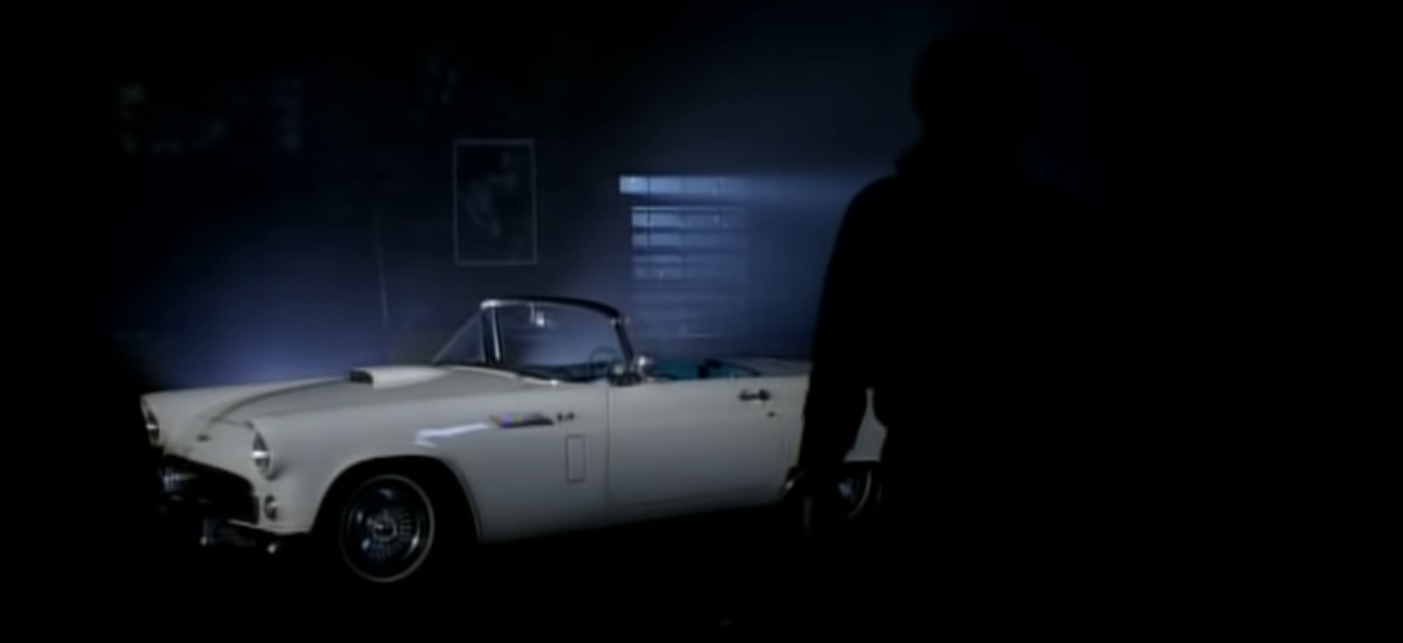
"Her" car is a 1956 Ford Thunderbird. Legend has it this is the same '56 Thunderbird Suzanne Sommers drove in "American Graffiti".
If there was any Thunderbird that remotely comes close to living up to its magnificent name it was these first generation, two-passenger, 1955-1957's.
Ford's answer to Chevrolet's 1953 Corvette, the two-passenger Thunderbirds have a graceful femininity and understated sensuality testosterone drenched Corvettes, even in 1953-1954 six-cylinder guise, did not have. Had the producers of the video cast a '56 Corvette instead of a '56 Thunderbird it would been a distraction to the video's focus about the unrequited desire the man and the woman in the video have for each other.
The Thunderbird in the video a simultaneously blunt yet subtle soaking wet phallic symbol. Seriously, could "she" have driven anything else?
It's a shame Ford had to muddle the original Thunderbird and make it a four-passenger automobile come 1958. Had Ford continued to go tire to tire with the Corvette I'd like to believe both companies would have two-passenger sports cars today. Or at least we'd have had a longer period of time when they both had sports cars.
Back in the 1950's The Ford Motor Company was in a different place financially than GM was and despite the two-passenger Thunderbird out selling Corvette by a hundred to one, it wasn't profitable; Ford felt could ill afford a model that was little more than an "image-car". The 1958 four-passenger or "Square Bird" made great business sense selling more than four times better than the previous model did, but it ruined any serendipitous romanticism the two-passenger cars had. It was just a car.
If there's any knock on the video, it's when Springsteen's character decides to not ring the woman's doorbell. As far as the plot goes it was without a doubt for the best but it's still a tough putt to believe than any single man in his mid-thirties wouldn't jump at the opportunity to spend "quality time" with a woman of means who makes a pass at them. I hypothesize that the character's chaste was more in line with what Springsteen and his management team wanted his fans to believe of his moral fiber other than anything based in reality. At the end of the day, as entertaining as some music videos can be, they are first and foremost marketing platforms for artists and their music. Image being everything and Springsteen's image as carefully crafted and protected as it was, and still is, at the height of stardom, portraying an adulterer in a video for one of his songs might not have been best for single and album sales. Hard to argue with the formula seeing how well "Born in the USA" sold.
Springsteen has recorded twelve studio albums since "Born in the USA" with none of them achieving anywhere near the commercial success of "Born in the USA". Many of them better balanced and for more nuanced works of art than the calculated "radio-friendly" hit driven "Born in the USA" was.
Same is true of the Ford Thunderbird. Ford may have had better selling Thunderbird's than the two-passenger models but none of them came close to matching what they, sublimely, were.
For years leading up to the debut of the '94 Ram, Dodge was a perennial distant third to Ford and GM. A large part of that was because Chrysler had far fewer vehicle options than the Big Two had what with their perpetual limiting of different bed lengths, drive trains and cab sizes. Things had gotten so out-of-hand that by 1993, while Ford and GM garnered combined sales of nearly one million pickups, Chrysler sold approximately eighty-thousand Ram's. I found this '88 Ram recently sitting in the broken down storage shed on the property of where I work. Please. I know.
I've given up explaining the inexplicable and deplorable condition of this storage facility of sorts. I'm at this job just over a year now and I almost don't even "see" it anymore. Almost. I only really notice it when someone who hasn't seen it before is like, "the hell is this"? I reason that it doesn't do anyone any harm so what's the big deal. If anything it adds unfiltered charm to these early morning photographs of this Ram that might be in worse shape than the shed. I got the story was to why it's here and it's a jumbled, boring mess. Why it's here is doesn't matter. For the purposes of my blog the only thing that matters is that it is here.
Our '88 here is part of the 1981 class of Dodge trucks that traces it's design roots back to the Dodge's 1972 D-Series. While all pickup trucks of this vintage were slabby, the Dodge's were the slabbiest of the slabby. There is a simplicity to the styling that's endearing - to a point. There's something about a truck, as they say, right?
The big engineering breakthrough for '81 was Chrysler offering Borg-Warner automatic locking hubs on four-wheel drive models they called "Power Rams". Prior to '88 owners manually locked hubs at the wheels themselves. Seems as brutally crude as crank starting engines but that's what folks did for years back then. Buyers seemingly just happy to have access to four-wheel drive and put up with the inconvenience.
Pickup trucks didn't so much evolve years ago as much as they went through revolutionary change once every eight to ten years or so. Their buyers are fiercely brand loyal and don't like seismic change - even if it would somehow make their lives easier. Trucks are also expensive to engineer so as long as sales are good and margins are fat why mess with a good thing.
Christened "RAM" in the earliest days of the Iaccoca administration using an axiom Chrysler hadn't used on their trucks since the '50's, like I said what with Chrysler all but abandoning the market over the years by 1988 these came with only one cab size and two bed lengths. This is a bone stripped "Ram" with two-wheel drive, no AC, a four-speed (with over-drive) and, much to the delight of engine geek me, Chrysler's "three-nine" V-6 engine.
Chrysler developed this engine for their new-for-1987 Dakota series of small or mid size trucks and they used it in their full size Ram's as the base engine starting 1988 replacing the "Slant-Six". A "318" V-8 with two cylinders lobbed off, it has split crank pins to quell some of the vibration inherent in ninety-degree V-6 engines. It was never the smoothest of operators even with the split pins; with a manual it was even worse since there was no torque converter to help dampen the shakes. Chrysler never used it in cars.
Holley throttle body fuel injection helped it make one-hundred eighty horsepower and some two-hundred forty pounds of torque. Not bad for something Chrysler put together quickly and as inexpensively as possible. They built these for thirteen model years and while certainly not the near forty-year run of the "Slant-Six" it replaced it was still somewhat admirable given the circumstances it was originally baked up in.
Somewhat ironically much in the same way I guess 1970-1974 Plymouth Barracuda's and Dodge Challengers are the end all and be all of the classic car world, a Dodge Ram of this vintage in good condition is worth a heck of a lot more than a '94 Ram in similar shape. Safe to say even this basket case is worth more than a rusted out '94 Ram would be.
I'm not sure why that is either but I "get it" like I "get" how a 1970 Challenger is so much more valuable than a 1978 Challenger is; even if the '78 Challenger is a far superior automobile. There's a 1989 Dodge Dakota sitting to the right of this Ram, it's greenish blue and you can make it out if you look closely enough. It's been there for the entire time I've been at this job and it's never once occurred to me to blog about it. And I'm not going to either. Why? Because it is what it is.
1973-1977 Chevrolet Monte Carlo's - the go to first car of better off cool kids in my graduating class of 1982 at Oceanside High School back on Long Island. These were de rigueur back in the day with scores of them with their exaggerated, swoopy "suitcase fender" styling filling up the parking lot of OHS. Our subject here is from the class of 1977.
I may be in the minority here with my affection for these big brutes what with many an auto pundit finding the 1970-1972 Monte Carlo's more aesthetically pleasing. Thing is, I don't recall seeing anyone in high school having one of those. These, again, were seemingly aplenty and outlier me with his squeaky Comet sedan wanted one very badly.
I'm not sure I really liked these cars back then as much as I wanted one just to fit in. Honestly, much like lava lamps, disco music and bell bottom jeans they weren't for everyone but it seemed like everyone either had one, wanted one or at least knew someone who had one. I look at them now and I don't see a beautiful, desirable car as much as I see a mental appliance of sorts for nostalgia trips. Can you learn to love or at least like something? Apparently, yes.
In comparison to the do everything well cross-overs that fill up high school parking lots today, these cars are a joke. They're a Chevrolet Chevelle four door sedan with two less doors and all of the extra length compared to a Chevelle coupe all up in front of the firewall accented with the largest hood Chevrolet ever made. It may have made for a unique sculpture but all the extra real estate out there pushed the limits on an automobile that were already stretching the limits on how large a car could be and still be manageable.
My time behind the wheel of one of these, like all large cars of yore, was fun but at the same time fairly terrifying. They rode and handled decently enough but never gave the driver the sense of confidence you get today in even the cheapest Kia.
1977 was literally and figuratively a big year for the Monte Carlo with Chevrolet pushing out over four-hundred thousand of them. Perhaps that was because word got out these would be dramatically (and disappointingly) downsized come 1978; the masses wanting to get in on the party before it ended.
All I know for certain is that there's no way the modern crossovers that kids drive today will ever be the time machine one of these is.
There's nothing more I can say about Cadillac Coupe deVille's of this vintage other than to reiterate that I simply love the look of them. It may not be very "Cadillac" to say that since it doesn't matter to me whether this was a Chevrolet, Dodge, Ford or the antithesis of it, a Honda or a Subaru but it does speak volumes for my appreciation of the design of the car. To really know me is to know that I'm aberrant to status symbols and labels. Love what you do for what it is - don't do it because you love what it portends to say about you.
This 1973 Coupe deVille is part of GM's 1971 class of full sized designs. The '71's evolving from the "longer, lower, wider" GM design ethos made famous by their 1950's designs. Thanks to a government mandate, with a five mile per hour "safety bumpers" lashed to the front end, the 1973's were the longest passenger cars GM had ever made to that point. Similar bumpers were added to the rear for 1974 making them designs longer still.
Due to those front end bumpers which led to what could be construed as a hasty restyle of the lovely 1971 and 1972 front ends, these '73's are my least favorite 1971-1973 Cadillac. I much prefer the front end of the 1972. Not sure if that's sentimentally driven or not given that my father had a '72 but I've always been fond of it. I wouldn't kick any 1968, 1969, '70 or '71 CDV out of my Jay Leno Fantasy Garage either.
Again, at least the '73's had the same rear bumper design as the 1971 and 1972 models. That of course going in the design dumpster come 1974.
Another saving grace is the '73's were still hardtops with rear windows that rolled all the way down. They were frameless and piggybacked on the back of the front windows to make a seal. Pretty neat - when they worked correctly. The slightest misalignment in the regulators and the windows rolled up on top of each other. And if the weather stripping had the smallest of tears in them it wasn't so much wind noise as wind whistling. The pillared '74's may not have suffered from such maladies but they lacked the elan of the wonton styling frivolity only a hardtop affords buyers.
The massive canvas for 1971 allowed GM designers to pen a Cadillac design that was simultaneously faithful to "traditional" Cadillac design cues while also being contemporary. It's one of those things that you either love, like I do, or you want to distance yourself from as much as possible. Note how far forward of the front of the door the hinge is. That's insane. Safe to say they don't make 'em like this anymore.
If there's on thing about these cars I can't look past it's their interiors. Cadillac starting chintzing out them in 1965 substituting plastics for real metal and wood and using less expensive leather. The '68's were even worse but nothing was as bad as these 1971-1973 insides. '74 saw an all new dash design that I'm as ambivalent towards as I am all 1974-1976 Cadillac's. The only thing that saves this particular car plastic bowels is the red color scheme that works so wonderfully with the white exterior. Elvis would love this. Funny how the inverse of this color scheme, that Cadillac did offer, is laughably hideous.
For the better part of twenty-five years leading up to 1973 GM had stopped plowing engineering resources into Cadillac trickling down much of what had made a Cadillac a Cadillac to lower price brands. Cadillac's cache was still alive and kicking quite strongly in the early 1970's helping the division to record sales; even if you could get essentially the same car, if not a better driving car at that, "down" at Chevrolet. That said, it still wasn't nearly as good looking as this. Even if this is a 1973.
BTW, Elvis did have several 1973 Cadillac's including an Eldorado and Fleetwood.