Friday, February 19, 2021

Plymouth Barracuda - Dig This

My recent critically acclaimed and award-winning soliloquy (no one fact checks anymore, right?) about the 1971 film "Vanishing Point" and the 1970 Dodge Challenger R/T featured in it reminded me I'm way over due in blogging about the '70 Challenger's stablemate, the also new for 1970 Plymouth Barracuda. Grab your tie-dye and bell bottoms and let's get at it. 

Of course, I can't leave well enough alone - I have to include a history (below) of the Barracuda's that came before the mighty 1970 rendition. Let's also back off the aquarium tank and acknowledge the Plymouth pony car's namesake which is a predatory, salt-water fish. Adorable, no? Might as well have named the car the Plymouth Piranha; the alliteration sounds catchier too. 

A "barracuda" is also a less than flattering slang for a sexually aggressive woman or someone behaving underhandedly. The mighty Wilson sisters 1977 rock anthem paying homage to such people and behavior and not the fish or Chrysler built automobiles. Thank goodness the Plymouth Barracuda was long gone by the time this song came out; who knows what cheesy commercials would have been made using the song as an underscore. Gosh, those first couple of Heart albums where fabulous where they not? 

Born into the murky waters of a market segment that had yet to be defined, the Plymouth Barracuda faced more problems than just a questionable namesake. The original debuted on, of all days, April Fool's Day, 1964 which was, notably, a good two-weeks plus ahead of Ford's debut of the Mustang. It was all downhill or upstream from there.  

The original Barracuda, based on Chrysler's capable compact "A-body" chassis, was actually branded as a Plymouth Valiant Barracuda and perhaps done-so by the product-planning and marketing team that branded the 1960 Valiant as a "Valiant by Chrysler" and not as a Plymouth Valiant. That transgression quickly rectified come model year 1961. Chrysler dropped the Valiant pre-fix for 1965 and they, wisely, never brought it back. 

The only tangible difference between a Valiant and a Valiant Barracuda was this gigantic rear windshield, or "back-light". Chrysler partnered with Pittsburgh Plate Glass to fabricate this thing that was and remains the largest piece of automotive glass ever produced. Nothing if not distinctive, it added approximately one-hundred pounds to the curb weight of a Valiant and was heavily tinted so as not to turn the insides of the air-conditioning free Valiant, err, Barracuda, into a greenhouse or sauna. Aside from that, the '64 Valiant Barracuda was all Valiant. Well, save for the availability of a high-performance version of Plymouth's 273 cubic-inch V-8 engine on Formula S models. For 1965 and beyond, Barracuda was a separate model from the Valiant even if it stayed looking like a Valiant with a huge rear window. You wouldn't be alone in thinking the design somewhat attractive if not cool while also being cluttered and awkward. 

Unlike what Ford was able to do with their Falcon based Mustang, purportedly, what with millions spent and lost on the abortive 1961 downsizing of Plymouth and Dodge models,  Chrysler did not have the financial resources to fully develop the Barracuda into a uniquely styled automobile. The fact that the Barracuda was a lightly disguised Valiant along with Plymouth calling it a Valiant Barracuda for 1964 being the auspices that have been decided as being the circumstances that did in Barracuda; the thinking goes buyers were unable to decipher the car from the economy car based Valiant. 


To make matters worse, Plymouth marketed the utility of the Barracuda what with its fold-down rear seat and generous cargo area afforded by the massive back-light. Can you mix business with pleasure? On paper, maybe, but rarely could you do so back then. Today's do-everything-well cross-over utilities are a different story but back then a practical sporty car was akin to taking mom along on a hot date. Although that hot date had a habit of balancing picnic baskets on her head. 

Plymouth slogged on through 1966 with the Barracuda making minor styling updates to the Valiant based two-door as designers headed back to the drawing board. Less than one-hundred thousand 1964-1966 Barracuda's found buyers meanwhile Ford literally and figuratively ran all the way to the Mustang bank to the tune of more than a million sold during the same time. 

It's easy to say that Plymouth should have come out with this car in 1964 and not what they came with instead. 

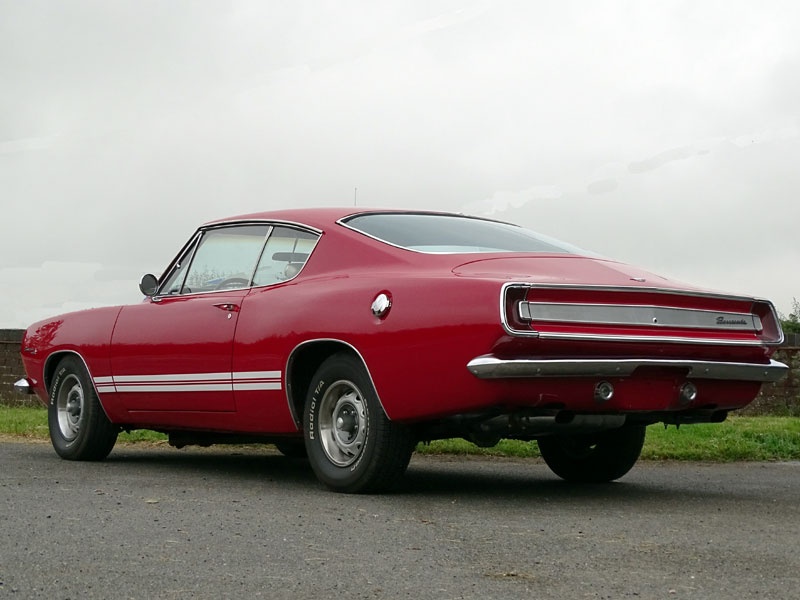
Available in notch-back, convertible and fast-back with a smaller more conventional looking back-light like this, the 1967-1969 Barracuda was still A-body based underneath but featured all-new, unique sheet metal up top that was construed as a stylistic success. From some angles I'd concur; from others not so much. 

However, sales were still disappointing with this generation of the Barracuda best sales year, 1967, below the best years of the 1964-1966 models. A large part of that was most likely due to a market segment that now included a redesigned Mustang and a version of it from sister division Mercury. Don't discount GM's world beating twin-ponies, the Chevrolet Camaro and Pontiac Firebird. The market for these types of cars may have increased and expanded but it could only so by so much. Choice, after all,  is great for customers but terrible for business. 
Seeing that by the late 1960's what had become known as "pony-cars" had became a lucrative market segment commanding thirteen percent of all vehicle sales, somewhat remarkably, Chrysler executives tried for a third time to make inroads with an all-new Barracuda for 1970. Have to hand it to Chrysler in those days, they were nothing if not diligent. 

Which brings us to today's main attraction. Ladies and gentlemen, may I present the greatest looking muscle or pony car of all time, the 1970 Plymouth Barracuda. 

If I thought that Chrysler should have come with the 1967 Barracuda in 1964, then Chrysler should have come with this car in 1967. I hate the word, "should" but sometimes no other word is appropriate, 
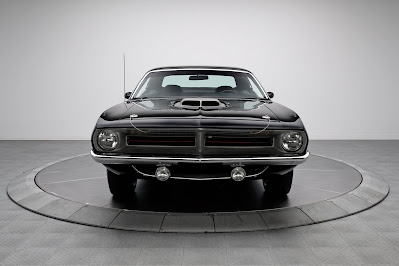
Bigger in every way from 1964-1969 Barracuda's except in actual length, the 1970 Plymouth Barracuda and it's stable mate Dodge Challenger began their development. Chrysler starting with their intermediate "B-body" chassis that also underpinned the Plymouth Satellite and Dodge Coronet. 
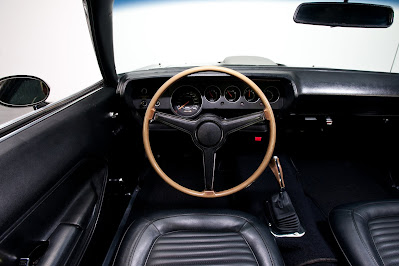
Essentially a mid-size car with a shortened wheelbase, the 1970 Barracuda was available in notch-back and convertible only; the fast-back design gone from the line up but lived on, somewhat, in a new "A-body" based design at Plymouth known as the Duster. 

Subjective as it may be, my blog, my rules, pardner, what Chrysler came with in 1970 with the Barracuda was and remains, to me at least, one of the greatest looking automobiles of all-time. Note I said "looking". 

Curiously, the story goes that Chrysler did little suspension work on these believing that as fast as the cars where, if they could handle well it would have been even more dangerous. Makes no sense now, of course, as a high-performing car is actually a safer car. Well, usually. If you've ever had a car that was  fast as hell but handled poorly, you know how quickly that gets old. As they say, it's much more fun to drive a slow car fast than drive a fast car fast. 
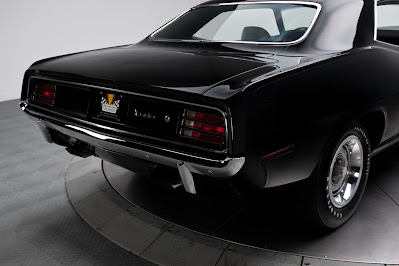
That was too bad given how spectacular the design was and how well they could go in a straight line. The 1970 and 1971 models with Chrysler's mighty 440 cubic-inch V-8 in particular. The "Hemi" models as well but I'm of the opinion that the 440 engine was a better day-in, day-out street engine than the street-legal race engine that was the Hemi. "Legendary" doesn't always mean "good". I'd also opt for a 'cuda with the 340 "Six-Pack" but that's just me. Again, power is over-rated; it's control you want. Well, power and control. 

Wouldn't you know it, though? Sales of these-generation Barracuda's, while better in 1970 compared to 1969 models, were extremely disappointing. Approximately fifty-five thousand found buyers in 1970; Dodge sold more than seventy-six thousand Challenger buyers but it's been said those sales came out of the bumpers of Charger sales and not Barracuda's. I know, weird but that's what they (der experts) say. . Barracuda sales dropped to around an abysmal eighteen-thousand for 1971, 1972 and 1973 sales hovered around a twenty-two thousand. In 1974, the model year most affected by the 1973 OPEC embargo, less than twelve-thousand Barracuda's left dealer lots. 


So, how could such a handsome car as this fail so badly at the box-office? Blame a confluence of circumstances the most significant of which being rote bad timing. 


Chrysler coming with this gorgeous albeit overinflated, ill-handling gas-guzzler just as the performance car market was beginning to wane. That due in large part to insurance company surcharges on any vehicle construed as a performance car. Couple that with less than stellar reviews because of it's ponderous handling capabilities, or lack there-of, not to mention a market by 1970 literally clogged with options for buyers and it's fairly easy to see what happened to the Plymouth Barracuda. 

Also, to use a vernacular of the times, "dig-this"; if you were of the age and of the means to buy a sporty compact in 1970, what with the gaggle of makes of models available to you, which one, all things being equal and you wanting the best car for your money, would you buy? Keep in mind GM's Camaro and Firebird were freshly updated and were gorgeous and performed better overall and the 1970 Mustang and Cougar were updated as well. You also had a Plymouth Duster that handled better and went like stink when optioned with the right go-fast engines. Choices. Choices. Too many choices, actually. Remember what I said about choices.  

An all-new Barracuda was planned for 1975 but Chrysler didn't move forward with it seeing the automobile market was changing so quickly. 1974 was the last model-year for Plymouth's fish-car with approximately just one-hundred fifteen thousand "third-generation" models sold. 

Ironically, 1970-1974 Plymouth Barracuda's, especially the 1970 and 1971 models, more than likely due to their scarcity and the fickle nature of the collector car market, have become some of the most sought after and valuable cars of this era. 

Monday, February 15, 2021

Vince Lombardi's Pontiac's - More Than Just X's and O's


When I was a kid and came of football appreciating age in the mid '70's, I was transfixed by the Green Bay Packers of the 1960's and their coach Vince Lombardi. I'm not a Packers fan, mind you; just an admirer of that team and their coach. NFL Film's series, "A Football Life", documents the lives of select NFL players, teams, owners and coaches and the expansive, ninety-minute episode they did several years ago on Lombardi is one of their finest. Recently, I watched it again for the first time and found myself more perplexed than ever by the enigmatic man; again, a man I unquestionably worshiped when I was growing up. The film, and this is a testament to how well it's done, much like the man  doesn't leave much room for indifference.  


Of course, this is a blog (primarily) about cars, and what inspired today's soliloquy were the two scenes in the documentary that featured Lombardi either driving or walking around Pontiac's. It surprised me too much in the same way I used to be occaisionally intrigued by what my school teachers drove. This scene in "A Football Life", originally, from a highlight film shot by NFL Films just before the historic 1967 NFL championship game between Lombardi's Packers and the Dallas Cowboys shows Lombardi behind the wheel of a brand-new 1968 Bonneville. 


In this shot from another documentary on the game we see that Bonneville he's driving is a four-door model but not, from best I can tell, a top-of-the-line Brougham.  

The tell-all it's a '68 is the chrome trim around the front end. 1965 models had stacked headlights, '66's had body-colored trim where the '68's have chrome. Also, obviously, seeing this footage was shot on December 31, 1967, it couldn't have been any newer than a 1968 model. 


Seeing what a conservative man he was in outward physicality, dress, offensive play calling and his devotion to God, a Pontiac seems somewhat overt for him. Not quite sure what I'd expected him to be driving; there are other films about those great 1960's Packers teams and I swear they show Lombardi driving a 1963 Chrysler New Yorker that I find more fitting of him what with its more stantoiran, autoritarian aire. Then again, one of many remarkable things about Lombardi was that he could also be  equally progressive and in many more ways than one. Famously color-blind with regards to race and a "Kennedy Democrat", the Bonneville perhaps were his way of showing the world there was more to him than just X's and O's. 


If I was surprised by the Bonneville, imagine my delight later in the film seeing him next to this all-new for 1969 Pontiac Grand Prix. Based on the wheel-covers and vinyl top this is probably an "LJ" model as opposed to the somewhat sportier "SJ". Was Lombardi actually a passingly casual automobile enthusiast who, much like his ability to evaluate raw football-talent, knew of a trend-setting automobile when he saw one? After all, the 1969 Pontiac Grand Prix helped spur a market segment that would go onto to define much of 1970's domestic automobilia. 


We are what we drive, right? So, who was Vince Lombardi based on the cars he porportedly drove? For the purpose of today's blog I'll look past any chance of his vehicle choices being happenstanial; after all, we are talking about Vince Lombardi who left nothing to chance. That aside, like most things, who he was and what fifty-plus years after his death of legend making have made him out to be now, the answer to that question lies somewhere in the middle. 

Friday, February 5, 2021

1992 Buick Regal GS - Shoulding All Over Myself


My first brand new car was a 1990 Chevrolet Lumina Euro coupe I bought late in 1989. Solid and reliable in ways the 1982 Buick Riviera it replaced could never have been, in December 1993 I made the mistake of not only getting rid of a car that was paid off, had low mileage and was in very good condition, I replaced it with another Lumina. Ah, but not just any Lumina, a 1994 Lumina Z34. The "Z" was hardly the worst car I've ever owned and although it was comfortable, looked great, in my opinion, and handled quite well, it may have been the most disappointing car I've ever had. That's saying a lot considering the rolling losers I've had over the years. The problem was it's 3.4-liter, double-overhead cam, twenty-four valve V-6 (LQ1) that I thought would be the answer to the only real problem I had with the Euro - a lack of power. While the Z was altogether faster, I found the engine sluggish and unresponsive at low rpm's, noisy, thirsty and ultimately came to believe the added expense of the darn thing over the Euro's seemingly plebeian, one-hundred thirty-five horsepower 3.1-liter engine was not worth it; buyer's remorse is a terrible thing. In hindsight, what I should have done, aside from not getting rid of the Euro and driving it into the ground, was have gone up a rung or three and gotten a Buick Regal GS like this '92 here. 


A "Buick" may have seemed like an odd choice for a guy who wasn't even thirty-years old at the time,  after all Buick, despite their best efforts, has always skewed older, but a Regal GS back then was all-in-all a better automobile than the Lumina Z34. While somewhat softly sprung compared to the Z, it's heart, its engine, was far better and you could a leather lined interior like our '92 here has. By the way, here's one of several reasons why critics lambasted General Motor's early GM10 or "W-Bodies", this ergonomic joke of a center dash layout. I count thirty-seven buttons on. Thirty-seven. I'm amazed they found room plaster BUICK on it. 


The engine under the hood of early '90's Regal GS' was the then latest incarnation of the Buick 3.8-liter V-6. Improved incrementally over the years from its humble origins as a Buick V-8 with two cylinders lobbed off back in 1962, what became known as the "3800" in 1988 had become a pretty stout and responsive performer by the early 1990's; everything being relative. Making all of one-hundred seventy horsepower and two-hundred twenty pounds of twist by the early '90's, it was actually significantly less powerful than my Z34's wonky "Dual Twin Cam" V-6 that purportedly made two-hundred fifteen horsepower. The big difference between the 3800 and the DOHC V-6 in my Z was that the 3800 blasted you with peak torque at a V-8 like 2,000 rpm's whereas the fancy twin-cam V-6 made you wait all the way to 4,000.  Couple that high rpm torque peak with an automatic and I hope you begin to put two and two together that acceleration off the line in my Z was almost an afterthought. 


What's become known as the 3800 "Series-1" in our '92 here benefited from a number of improvements and refinements over the years. One of the most significant being that for 1977 GM split the crank shaft pins to smooth vibrations from its uneven firing order given it was literally a ninety-degree V-8 with two missing cylinders. I'm no physics expert but apparently ninety-degree V-8 engines are inherently balanced whereas ninety-degree V-6 engines are not and they shake like a Home Depot paint-shaker. A balance shaft added in 1988 really quelled the shakes down to the point that when running, it was all but indecipherable from a V-8. Port fuel injection first appeared on the 1984 turbocharged version of the 3.8 and added greatly to the engine's performance capability. It's not uncommon for some to refer to the engine in our GS here as being the "Grand National engine without the turbo"; that's a bit of a stretch but it's not that far out of the realm of reason. 


What I thought was a  head scratcher at the time was why General Motors went through the exercise of creating the funky DOHC V-6 when they had a more than capable power-plant for performance upgrades with their 3800. It's not like they gave it their best try either seeing they started with their oh-so-humble, sixty-degree (inherently balanced), 2.8-liter V-6 and strapped twelve-valve heads on them with belt driven overhead cams. That might sound like an oversimplification of what they did but really, it's not. Along they way, the snappiness of the 2.8, later enlarged to 3.1, 3.4, 3.5 and even 3.9-liters lost in translation. What they came out with was, again, a sluggish, clickity-clackity engine that felt unresponsive especially off the line. Any gusto the engine had came only from flogging  it relentlessly. That can be fun but comes at a cost at the gas pump. I much prefer the instant torque, off the line responsiveness of a large-ish V-8 or a V-6 that thinks its a V-8 like the old Series-1 3800. 


When I later learned that the Z34's engine was simply done so that GM could brag it had a double-overhead cam V-6 like their arch-nemesis Ford had, I felt somewhat betrayed and played as a fool. Especially considering that the engine all but sucked. Nothing quite like getting caught in a senseless cross-fire. That Ford DOHC V-6 was actually built by Yamaha and powered the Taurus SHO from 1989-1995 and was a vastly superior motor to the GM mill. 


I was so disgusted with the LQ1 in the Z34 that when I got rid of the Z in 1996 and went with, in retrospect somewhat inexplicably but I'm a GM die-hard, a 1997 Monte Carlo, I eschewed the optional DOHC 3.4 for the base 3.1-liter, one-hundred sixty horsepower V-6 that felt every bit as powerful and more importantly, felt stronger taking off from standing still. It was great on gas too. 


Wouldn't you know it, though, GM dropped the LQ1 after 1997 and started putting the 3800 into applications where they had been using the LQ1 prior including the Monte Carlo Z34. Son-of-a-gun. I don't know if I would have waited another year for a Monte Carlo Z34 with a 3800, the lease was up in the Z anyway, but a couple of test drives of Monte Z' and Lumina LTZ' powered by what had turned into the 3800 "Series II" convinced me that maybe I should have. What's life if you don't have regrets, right? 


I got my chance with a 3800 Series II when I wore out the '97 Monte Carlo and went with a 2001 Monte Carlo SS that had one. Mighty fine motor in my humble opinion. I'm such a fan of the 3800 that I've had four cars with 3800 Series II's over the last twenty-years and they've all been the best part of the cars. My 2002 Dale Earnhardt Monte Carlo is still pulling like a freight-train even with 220K on its ticker. The rest of the damn thing is rusting away and is plauged with but that Series II is as smooth as it was when brand new. 


As far as what I did back in late 1993 in going with a Z34 instead of a Buick Regal GS, hindsight is 20-20; would of, could have, should have. But you know what they say when you say, "should have"; you're "shoulding" all over yourself. 

Monday, February 1, 2021

2004 Honda CRV - Dr. Jeckyll and Mr. Hyde


Clearing out my desktop this morning on an old laptop and I came across these few photos I took of what I thought was my most responsible automobile purchase of my life. It's a 2004 Honda CR-V and it turned out very quickly to be the worst automobile purchase I ever made. Thankfully, the story has a fairly benign albeit somewhat interesting ending. It was brief too. 

Introduced for sale in the United States in 1997, Honda had been making and selling them since 1996 but strangely a Honda dealer group consortium balked at selling them prior because they thought it would impact Pilot sales, the CR-V was one of the first car-based SUV's. Buyers inhaled them like unsupervised children pounding down pizza, cake and ice cream at a Chuck-E-Cheese too; pre-Covid of course. Folks gobbled them up despite some oddities like a curbside hinged tailgate and a somewhat funky interior layout including oddly positioned power window buttons. Such was the state of Honda years ago that no matter what, "it was a Honda" so it had to be good. Oh, and it was. These things were sweet little trucklettes.  

My 2004 here is a first-gen CR-V, which allegedly stands for "crossover recreational vehicle" but it has a 2.4-liter, 166 horsepower engine instead of the dawgish 2.0-liter, 126 horsepower til that plagued the earlier models. This thing hauled like a kid packed with too much pizza and ice cream running to the bathroom. Very surprising. It handles much like the Civic it's based on too with tons of room inside and the proud stance of practicality that I haven't felt since driving a friend's Volvo years ago. No more Chevy Camaro, Pontiac Trans Am or Ford Mustang for me, sir. This boy is sold lock, stock and barrel on a Honda. 

Well, I actually bought it for my younger son, the one who could care less about what he drives, and it was to replace the woe-be-gone 1996 Camaro that was demolished when a woman had an epileptic seizure while driving her Lexus GX470 and she plowed into it. She's fine but she totaled four cars including his Camaro. Her insurance company settled with me for over six-thousand dollars. I'm still pinching myself. To make matters better, I spent it wisely, so I thought, on this cute-as-a-button little CR-V. 

Whoever said don't judge a book by its cover knew what they were talking about. Just like what I did with my Ford Mustang that I bought, the first thing I did was take it to a mechanic for a looksee under the auspice that anything found wrong would be covered by the dealership. Within reason of course.  However, unlike the Mustang that passed with such flying colors that the mechanic who did the inspection wanted to buy it from me, the CR-V flunked. Flunked big time. The culprit was rust. Heavy-duty rust. 

I kick myself for not peering underneath that damn thing before I bought it but when I got to the shop where it was being inspected, I could not believe that amount of corrosion it had. You'd never know it either seeing how spic and span the body is. The interior was showroom immaculate too. Rust was everywhere and it seemed literally everything underneath needed an overhaul. Brakes, brakes lines, emergency brake cables, fuel lines, AC lines, even the radiator was leaking because it was rusting out. Tires had dry rot too.  The mechanic said it looked like the thing had sat submerged for years; it looked like the sunken Titanic underneath. All fixable stuff, yes, but all in for this thing was going to run me over eight-grand; I bought it for about $4,300. Yeah, I could have done a bulk of the work myself but still, why should I have had to? 

Now, to be perfectly candid, I have a pretty bad temper and I'm embarrassed to death by it. Bless my family for putting up with me and on top of that, apparently I have a fairly wicked looking resting disposition that intimidates people. I work on both constantly and most people who get to know me think I'm pretty swell and swell. Again, when they get to know me. I'm usually as laid back and affable as Dr. Jekyll but in situations like feeling like I got taken to the tune of over four-thousand dollars, my "Mr. Hyde" comes out. 

I don't remember exactly what I said to the owner of the used car lot I bought the CR-V from but fueled with the erroneous knowledge my wife gave me that all automobile purchases can be returned to the point of purchase within three days, I laid into the guy who sold me this piece of junk good. Real good. And he, thankfully, acquiesced and agreed to give me the check back I bought it with; he hadn't even cashed it yet. That's how short the time period was that I had the vehicle. I also, proudly, did not utter a single swear word as I was getting increasingly livid with him as I read off the laundry list of problems with what he sold me. See? I'm trying. I really am. 

I promptly returned it within twenty-four hours of the original purchase and redeposited my money. I later spent a good chunk of it on a 2003 Chevrolet Malibu that my younger son still drives to this day and is quite happy with it. While it hasn't been the sturdiest or most reliable of rides, he's happy w ith it and it's all good in the end. 

What's the shortest amount of time that you've owned a vehicle? Comment below. I'm curious. Prior to this I had a car for four months, another couple I had for like nine. Oh, and by the way, there's no law that automobile purchases can be returned in three days in any state. There should be. CarMax and other used car dealership networks advertise that you can return a car within five to seven days but for those run-of-the-mill corner used car lots, no such law, rule or stipulation applies. Buyer beware.  

Thursday, January 28, 2021

1970 Dodge Challenger R/T - Vanishing Point

Gosh, movie theaters. Remember them?

I first saw Vanishing Point when it hit theaters in 1971. My mother took me, and I couldn't have been more than six years old. Suffice it to say, between the drug use, gratuitous nudity, anti-authoritarian attitude, romanticized CB radio culture, and that thunderous 1970 Dodge Challenger R/T, it's no surprise the movie left a permanent impression on both my conscious and subconscious.

My mother didn't do much for me growing up, but I'll always give her credit for dragging me along to see Vanishing Point. Thanks, Mom. 

A vanishing point is the point at which parallel lines, viewed in perspective, appear to converge. Why the movie is called Vanishing Point is open to interpretation, but the film itself is straightforward enough.

Released in 1971, it follows a car delivery driver named Kowalski—who I'm almost certain is called "Mitch" in one scene—whose job is to transport a brand-new Dodge Challenger R/T from Denver to San Francisco.

Why the customer couldn't simply buy a Challenger in San Francisco is never explained. There are vague references to the car being "supercharged," so maybe we're meant to assume the owner wanted work done by a favorite Denver speed shop.

Bueller? 

Kowalski has an entire weekend to make the roughly 1,300-mile trip, but instead decides to do it in just fifteen hours. Why? Because he bets his drug dealer that if he makes it on time, the handful of bennies he swallows before leaving will be free. Otherwise, he pays triple.

Now that's incentive.

His troubles begin almost immediately when a motorcycle cop signals him to pull over for speeding. Instead of stopping, Kowalski floors it, setting off one of cinema's longest police chases. Before long, law enforcement from four states—possibly five if he passed through Wyoming—is after him.

Along the way he encounters an unforgettable collection of oddballs: a Jaguar E-Type driver he drag races nearly to death, a pair of would-be hitchhiking robbers, a naked woman riding a motorcycle who practically throws herself at him, and a snake charmer he meets after blowing out one of his Goodyear Polyglas tires.

Whether it's the amphetamines or simply artistic license, Kowalski is also plagued by flashbacks to earlier chapters of his life: racing motorcycles and stock cars, serving as a police officer, fighting in Vietnam, and mourning a woman who apparently died in a surfing accident.

Oddly enough, despite being in a desperate hurry, Kowalski always stops to make sure anyone he nearly killed is still breathing. He may be strung out, but he's also a genuinely decent guy.

He's a Vietnam veteran, somehow finds time to check in with blind radio DJ Super Soul throughout the chase, and still manages to cover 1,300 miles in fifteen hours.

Brother gets a lot done in one day.

I'm no film critic, but after watching Vanishing Point again recently—for the first time in roughly fifty years—I can confidently say it's pure, unadulterated, exploitative nonsense.

Fortunately, it's glorious exploitative nonsense.

More than anything else, the movie is a shameless ninety-minute commercial for Dodge's brand-new Challenger R/T.

And honestly, that's enough for me.

Although Chrysler technically beat Ford to market with the pony car by introducing the Plymouth Barracuda two weeks before the Mustang debuted in 1964, Dodge didn't enter the segment until 1970.

When Dodge finally arrived, though, it didn't exactly show up empty-handed.

It rolled into the party carrying fresh kegs, a case of Jack Daniel's, a pound of marijuana, several strippers, and enough pizza to feed the neighborhood.

Unfortunately, the police showed up before the night was over.

People are still talking about that party.

Between 1964 and 1969, pony cars accounted for an astonishing thirteen percent of all new vehicles sold in America.

The original Barracuda never seriously challenged the Mustang or Chevrolet Camaro, and by 1970 Chrysler decided to start over. Dodge wanted its own version, so the Challenger was born.

Mechanically, the Challenger and Barracuda were very similar, with the Dodge riding on a slightly longer wheelbase. Their styling differences are subtle enough that many enthusiasts still confuse one for the other.

How did the Challenger drive?

I've never had the pleasure, but Car and Driver wasn't exactly impressed when it tested a 426 Hemi Challenger R/T in late 1969.

The magazine criticized the car's weight, pronounced understeer and oversteer, and even complained that the mighty Hemi idled poorly and felt sluggish at low RPM.

Well...it was basically a street-legal race engine. What were they expecting?

Ironically, Car and Driver found the smaller-engine Challengers to be better balanced, but those cars lacked the horsepower to keep up with lighter rivals from Ford and General Motors.

At least everyone agreed the styling was gorgeous.

Watching Vanishing Point today, you can actually see the Challenger struggling through corners.

Four cars were reportedly used during production, and in many scenes they're bouncing, leaning, and fighting for grip. Barry Newman spends much of the movie sawing away at the enormous non-adjustable steering wheel just to keep the car pointed in roughly the right direction.

Sporty?

Not exactly.

Chrysler supplied the filmmakers with four Challengers. Three were 440 Magnum R/Ts equipped with four-speed manual transmissions and Sure Grip differentials. The fourth carried a 383 V8 backed by an automatic.

Rumors persist that as many as eight cars—including a few Hemis—were ultimately used during filming, but little evidence supports those claims.

Barry Newman himself reportedly said the 440 was almost too much engine for the chassis.

The producers chose white because it photographed best against the Southwestern desert. One of the cars allegedly arrived green before being repainted for filming.

Sadly, none of the movie cars survived.

Every Challenger used in production was heavily damaged, and Chrysler reportedly scrapped them afterward rather than repair them for promotional use. Company executives allegedly weren't thrilled about having their newest muscle car associated with amphetamines and anti-establishment behavior.

You have to wonder...

Didn't anybody read the script first?

For all its flaws, Vanishing Point does a respectable job maintaining continuity. Dents generally stay dented, and damage accumulates naturally throughout the chase.

Then comes the ending.

When Kowalski's Challenger slams into the bulldozers, the exploding car is very obviously not a Challenger.

It's a 1967 Chevrolet Camaro.

Seriously.

I understand budgets and production schedules, but couldn't someone at least have swapped the steering wheel before blowing it up? That stunt car is pure General Motors.

Kowalski deserved better.

Contemporary reviews of both Vanishing Point and the Challenger itself were mixed.

Personally, the movie still feels like a collection of disconnected ideas stitched together with one question guiding the writers:

"What happens next?"

Yet somewhere along the way it became an art-house cult classic. I've never quite understood why. The entire premise rests on a highly intelligent, fundamentally decent man deciding that fleeing police across half the western United States is somehow the logical response to a speeding ticket.

Then again...

Drugs.

Perhaps appreciating Vanishing Point requires the same mindset as appreciating a 1970 Challenger R/T.

If someone doesn't understand why these cars stir the soul, no amount of explanation will convince them. They'll simply see an old car with soft suspension and plenty of body roll. The rest of us see one of the greatest-looking muscle cars ever built.

If you've never seen Vanishing Point, track down the original.

Even if the story doesn't make much sense, it's a fascinating time capsule of early-1970s America—fast cars, hippies, drugs, CB radios, anti-establishment attitudes, and wide-open highways.

Some things change.

Some never do.

There was also a 1997 remake starring Viggo Mortensen. Despite featuring a genuine Hemi-powered Challenger R/T, it's almost entirely forgettable.

Spend your time on the original instead.


Monday, January 25, 2021

1979 Chevrolet Camaro Z28 - A Lot of Green


As they say, it ain't easy being green. Despite my being 99.99% Irish and a fan of the New York Jets I'm not a fan of it. Especially on cars. This lovely and somewhat over restored 1979 Chevrolet Camaro Z28 can't even sway my feelings towards green either. That's saying a lot as these cars were favorites of my woebegone, misbegotten youth. They still are. 


I take it I must be fairly alone feeling that way since this has an asking price of $25,000. That's a lot of green for a lot of, ahem, green. 


With the third-generation Camaro delayed somewhat, Chevrolet did a great job gussying up the outgoing model. Some deride the added pointless doo-dads, baubles and bits on 1979-1981 Z28's but the boy racer in me likes it all. Color be damned. 


We first find "Z28" on Chevrolet's Trans-Am race series cars in 1969. Those Camaro's, regular-production code (RPO) "Z28", had a unique, high revving 302 cubic-inch V-8, Hurst four-speed manual transmission, power front disc brakes, quick ratio steering and a "special suspension. Without knowing for sure it would seem someone in marketing thought "Z28" catchy and Chevrolet has held onto the moniker off an on for over fifty-years. The current Camaro does not have a Z28 model. Never say never about what they may have up their exhaust pipes for the future. 


Contrary to what some may think, it was the height of the insurance surcharge crazy 1970's that felled the Z28 in 1975 and 1976. Chevrolet brought it back halfway through the 1977 model year and it stayed with these second generation models through the end of its production run in 1981. 


For 1979, checking the Z28 box on the order form got you a one-hundred seventy-five horsepower 350 V-8, this one painted a period incorrect Chevrolet orange as the block should be blue, dual resonator tailpipes that looked like dual exhausts but they really weren't, special springs, shocks and rear stabilizer, white letter tires and a god's green-earth 3.73 axle with the available four-speed manual transmission. Our automatic equipped green-machine here was born with a 3.08 axle. Interestingly, the highest rear end ratio on 1979 Corvette's was a 3.55. 


One-hundred seventy-five horsepower may not sound like a lot these days but back in "my day", when all I had was a ninety-six horsepower in-line six, more than twice the power seemed decadent. My brief time behind the wheel of one of these years ago the type of earth-moving automotive experience you simply don't forget. 


Who knows how much oomph this thing has. Hopefully more than what it came with originally seeing the engine is most likely not original to the car. Note this car has a catalytic converter. Some states, like California for instance, require that if a car was originally offered with one, it has to still have it. 


You buy an old car out of state that doesn't have one and that will run you quite a bit of green to put one back in. Sorry. Couldn't resist.