Saturday, February 29, 2020

1980 Toyota Tercel - New Think


This...is a 1980 Toyota Tercel. How I disdained it when it was new. I was hooked on bigger-is-better, over-styled, rumbling V-8 powered, two-ton plus gas guzzlers. Eight, nine, ten miles per gallon? This is America, kid, and that's the way we do things here. Well, honestly, that sentiment was fine until I started driving and realized how difficult the big domestics were to handle and how expensive filling up a twenty plus gallon gas tank was on a car that couldn't go much more than two hundred miles on a fill up. I also had no idea how utterly frustrating constant break downs could be. I had so much to learn. Oh, so much.


Hard to believe but prior to 1980 Toyota did not sell a front-wheel-drive automobile in the United States. Honda, Subaru and even Datsun (Nissan) did but Toyota? No. And when they finally did come out with a front driver in 1980, they did it differently than anyone else. Well, different than the other Japanese makes.


While having an interior just as space efficient as the others, Toyota eschewed the growing conventional sentiment of driving the front wheels via a transverse mounted engine and unequal length "half-shafts". It may have looked like a rear wheel driver from inside the engine room but our Tercel has a power train with more in common with a then current Cadillac Eldorado and it's "unitized power package" than a Honda Accord or Datsun 310.


Unless we're able to pin down a Toyota engineer who helped design this power train, we'll never know for sure why they went longitudinal with the mounting of Tercel's engine. One could surmise it was a safer engineering bet than going "all-in" with an all new trans-mounted design. Toyota was then as they are now, a very conservative company and slow to adapt "new-think". Thing is, while they've always been slow to move, they're always moving forward. And a benefit to this engine mounting was in for 1983, when they rolled out an all wheel drive model, all they had to do was throw on a drive shaft out the back of the transmission. As if it things like that were ever that simple.


Toyota was also so concerned that the buying public would be incredulous towards a new model that they festooned "Corolla" on 1980 and 1981 Tercel's so it would appear it was a sub-brand of Corolla. A model that by 1980 had achieved near iconic status in a gas starved America.


Would one of these ever appear in my "Jay Leno" fantasy garage? Oh, hell no. However, if I was to be the curator of an automobile museum, one of these along with an early Civic, Datsun F-10 and Subaru GL most certainly would be as they represent the apex of automotive engineering in the late 1970's and early 1980's.  

Monday, February 24, 2020

1967 Chrysler Newport - More Than Meets The Eye

Funny how as we age, we see an old car and we see a lot more than just an old car.


In my high school days in the early 1980's, half of the crew that I ran with had their own cars while the other half drove their parents cars. There was certainly no shame in the latter since all of the guy's parents cars were way cooler than the horrific piece of junk I was unlucky enough to call my own. Without a doubt the coolest of the "parents cars" was the 1967 Chrysler Newport that belonged to my buddy Rob's mom. This well preserved example looks just like it save for a darker shade of green. Or whatever fifty-three years of mid west weather has worn it down to.


My take-a-ways on that big Newport was its awesome styling inside and out, cavernous interior and magnificent engine. The only real downside was it got single digit gas mileage even when driven responsibly; that seriously got into our modest "fun money" since we all chipped in for gas whenever we'd go out in it. It had horrible brakes too and its steering made the rudder on the Titanic seem responsive but oh, that engine. Granted it seemed even more powerful compared to the emissions clogged, six cylinder golf cart I was driving but any time I drove it I felt as though I was king of the world. Which, for reasons that seem preposterous to me now, I found myself doing quite often because "the gang" considered me to be a "responsible and safe" driver. Truth be known, aside from being intoxicated by the right-now! thrust of the car's "383" engine, the sheer mass and bulk of the thing terrified me. My apprehension driving it more than likely came across as maturity.


So, what was, a Newport? Well, as is often the case with automobiles, there's more to what we're looking at than meets the eye. Named after a Chrysler concept car from the 1930's, the 1960's Chrysler Newport evolved from Chrysler's discontinuation of their DeSoto line in mid model year 1961. What had been a "DeSoto" suddenly became a lower priced Chrysler model. It was rather brilliant when you think about it and begs the questions as to why they didn't do something like that sooner. The answer to that probably has more to do with pride and hubris than anything else.


In the years before and after World War II, Chrysler attempted to go bumper-to-bumper with General Motors in having a line of automobiles that would fit a wide variety of income levels. At the bottom of their pricing ladder was Plymouth followed by Dodge, DeSoto, Chrysler and finally Imperial. While there was always a resemblance to all makes and models on GM's family tree, for the most part, Chrysler did little more than rebadge each of their makes and models making little distinction overall between, say, a Plymouth and an Imperial. The two brands that took the brunt of Chrysler's lack of distinctiveness were Imperial, which could never really go bumper-to-bumper with Cadillac not to mention Lincoln, and DeSoto which attempted to be Chrysler's Oldsmobile. Throw into the batter the fact that Ford attempted to the same pricing ladder thing in the late '50's and poor little DeSoto didn't stand a chance.


As all auto manufacturers did back then, Chrysler sliced, diced, kneaded and chopped their wares seemingly every year so that each model year their wares were different from the previous year prior. In my humble opinion, of all the different iterations of the Newport throughout the sixties, they really got it right with the '67 two door models. Although, that flying buttress of "C" pillar holding up the back of the roof, cool as hell as it was, did young me or anyone driving these cars any favors when changing lanes. Holy blind spot, Batman.


Sadly, I lost contact with Rob about half way through college. I'm not really sure what happened but in the politics of the group I called my friends, really we were just a really obnoxious clique, he fell out of favor with what could best be described as the leaders of the bunch. To remain in good standing with the group, I was more or less forced to part ways with Rob which was really sad since I was friends with him first and he introduced me to everyone. Of everyone in the group, I felt a special bond to him since he was the only one else like me who came from a wildly dysfunctional family.


As for his mother's Newport, although his parents were divorced, his father still ruled the roost when it came to finances for her. It being the early '80's and gas being as expensive as it was, he thought it best to trade it in for something more economical. That more economical thing turned out to be a Fiat Strada of all things. A horrible little car that actually made even less sense than the Newport did. Talk about dysfunctional.


Friday, February 21, 2020

1995 Chevrolet Corsica - Haha. A Corisca.


The other day I was gassing up my wife's beloved 1995 Lexus SC400 at Costco when an employee working the gas station asked me what year my car was. When I told him it was a '95, he laughed and said, "I've got a '95 too!" Taken back by the absurd coincidence that someone else could have the same make, model and year Lexus SC that my wife and I have, they're not exactly common place, I nervously blurted out, "it's a great car, isn't it?". Only thing was, he wasn't referring to a 1995 Lexus that he had but his 1995 Chevrolet Corsica; the only thing in common between our cars was the model year. I told my son the story later that night and he laughed out loud, "haha, a Corsica!" His was red just like this and in similar condition to this '95 I found somewhere on line. 


Haha. A Corsica. Indeed. Somewhat indignant that someone would ask what year our Lexus was, we don't look at it and see a twenty-five year old car but rather one that is a timeless beauty, I must admit the guy's Corsica appeared to be in great shape too. Someone was pulling in behind me and needed my pump so I couldn't continue the conversation. I waved at the guy giving him a thumbs up and a smile as I was suddenly catapulted back to 1988-1996 and all of the memories I have of Corsica's came rushing back. I can't say any of them are bad but much like the car itself, they just are very memorable.


Named after the beautiful French governed Mediterranean island of Corsica, Chevrolet's Corsica was their compact sedan offering that replaced their infamous Citation. To give you an idea of the lineage, Citation replaced the Nova for 1980 and the Malibu in 1997 replaced the Corsica. While the Corsica carried over the Citation's 60 degree V-6 as an option and Chevrolet's on again, off again tendency for alliteration, it was all but a clean sheet design when GM rolled it out early in 1987 as an '88. While it's sister coupe, the Berretta, was a memorable design and stood out at the auto show, the Corsica didn't wow anyone with its "modern" but still dowdy sheet metal. If the Church Lady drove a 1988 domestic, she probably drove a Corsica. Things got even worse inside.


Injection molded plastic automobile interiors were a cost saving rage in the late 1960's and they really took off in the 1970's. While there's still a lot of that even today, they've come a long way in terms of fit, finish and texture but in the late '80's, the Corsica's joyless insides epitomized GM '80's craptacularness. I can't imagine how any one purchasing an automobile back then to a price point would buy a Corsica when for not much more money they could have had a Honda Civic. Or any compact Japanese sedan for the matter. Yeah, "buy American" was a powerful sentiment even back then but still. Folks gave up a lot of refinement and reliability for the Red, White and Blue.


My time spent in a Corsica boiled down to a ten day period in summer of 1988 when I rented one while my shitty 1982 Buick Riviera's transmission was being replaced. It was competent enough but amazingly unremarkable. Nothing like the zippy Toyota Corolla FX that I had rented not six months prior when I was between my Cordoba and the Riviera. My buying the Riv and not buying something like the FX one of a handful of seriously bad automobile buying decisions I've made in my life. Don't hold your breath, I don't plan on making any better ones in the near future.


While the specialness of our 1995 Lexus has been somewhat eroded by a mass of other cars that have seemingly come up to reach it's awesomeness if not somehow surpassed it, the contrast between the two '95's is really startling. Where our Lexus is refined in every single way imaginable, the Corsica is crude, cheap and primitive. It's also ugly. Granted it's not fair to compare a Japanese luxury car that stickered originally for more than $53,000 to a Chevrolet economy sedan that cost under $20,000 back then, but today, you really don't sacrifice that much in overall road going vehicle dynamics if you drive a modern Malibu versus the spiritual successor of our SC, the Lexus LC.


Amazingly, luxury car makers today have resorted to wild styling and gadgetry to lure buyers as opposed to actually offering cars that perform better than less costly makes and models. Much like athletes, the sky's only so high. Our 1995 Lexus SC400 illustrates just how much higher GM needed to jump back then to stay competitive. While a mid '90's Cadillac could go tire-to-tire with Lexus to some degree, you have to give GM credit these days for making a Malibu as smooth and competent as it is. Please note, I didn't say it was good looking.


Back to that guy's Corsica, the most interesting thing is why and how such an ordinary if mundane automobile has survived as long as it has. I doubt I'll ever see that guy again seeing how Costco cycles through employees faster than they do "48 packs" of toilet paper but I would like to ask him more about it. Just as well as is most often the case, any story I could come up with would probably be a lot more interesting than the truth. That said, if I do see him again, I'll be sure to ask him so stay tuned.

Monday, February 17, 2020

1958 Oldsmobile Super 88 - The Outer Limits


I don't know whether it's a subconscious thing or not but I have a problem getting my arms around "fifties-cars". I just don't "get-them" like I do most anything made just a few years later. When I see pristinely restored ones like this 1958 Oldsmobile Super 88, I don't see a car I'd like to own as much as I think it belongs in a museum. Who would want such a thing as this? Especially one that comes with an asking price of more than one hundred thousand dollars? I'd be terrified to drive it for fear that a pebble could kick up, nick the finish and knock ten grand off its value.


My disconnect with cars from the 1950's has probably more to do with the fact that by the time I became fully aware of cars, that being probably around eight or nine which would have been 1972-1973, most cars from the fifties had either rusted away or were junked because of mechanical problems.


And the "old cars" I did see weren't parade floats like this thing either. They were more like the Pontiac Chieftan the family that lived across the street from my family that had the same last name as ours did. I've deduced over the years that "Mr. Connolly's" Pontiac was a 1952 and I thought it was not only the ugliest car on earth, but even just twenty or so years old at the time, the oldest car on earth as well. 


If I'm drawn to any fifties cars it's most often General Motors makes and models. Sure, I like a '55 Chrysler 300 as much as anyone and who doesn't appreciate a two passenger Thunderbird but if I was alive and of car buying means in the 1950's, I'd be driving something, "GM". 


Although, I can't imagine I'd give this chrome drenched rolling bomb a looksee. Isn't it horrible? Seriously, up against  similar designs from Chevrolet, Pontiac and even Cadillac, does this thing even hold a candle to it? To me it most certainly doesn't. The '58 Buick's were weird too. My favorite 1958 GM model being the Chevrolet Bel Air "Impala" Sports Coupe. And, to be honest, I like that car because I think it's a beautiful design in lieu of the fact that it came from the fifties. I like '49 Cadillac's for the same reason.


In many ways the design excess of this car helped lead to many of the extraordinarily restrained and tasteful GM designs of the 1960's. How else do we know how far not to go unless we've crossed over the limit at some time? The '58 Oldsmobile's were over the limit. The "Outer Limits" if you ask me.

For more information on this car, click here


Saturday, February 15, 2020

2005 Ford Mustang GT - Check Please


I sold my 2005 Ford Mustang GT a couple of weeks ago. Why? Because, my wife told me to. Haha. Seriously, I got rid of it because less than a week after I bought it last year I lost my job and in an instant, what was to be my "summer car" was suddenly frivolous, utterly unnecessary and a brutal reminder of when I had a job that afforded me the luxury of yet another car. When I finally did sell it, through Facebook Marketplace, which, by the way is awesome and makes Craigslist look like the  shit show it is, my wife and I were like a couple of giddy bank robbers counting their take after a heist. The wife happy to have it gone because of the expense of it and I was happy to see it go because, and please, don't tell her this, I really didn't like it.


I know. I know. What's wrong with me? Me, dyed in the wool car guy who first dated his wife because she drove a cool car and who's been fortunate to own a host of spectacularly craptasitc cars in his lifetime. Well, all I can tell you is that given that plebeian transportation today is so good, I quickly lost the want and acceptance to make the sacrifices this car required of me. Look at my very short ownership of this car being not unlike dating someone who's gorgeous but is dumb as a bag of rocks and you find really annoying. Hot as hell but so difficult to be with that the physical attraction quickly wanes.


What was not to like to about my Mustang? I mean, wow. Look at this thing. Sexy as hell but where shall I start? Quirky dash layout, uncomfortable seats, lack of modern amenities like a compass and an outside temperature gauge not to mention at least an aux hookup for my phone or whatever. Oh, but I could change the color of the back lighting behind the dash. Seriously, what the eff, Ford? It had heavy, clumsy steering, a stiff, kidney rattling ride and while it had good power, its twitchy throttle made for all or nothing acceleration. While on that subject, I felt the car was a freakin' rocket. However, even as a sporting conveyance, it wasn't that interesting to drive and used as a daily driver was maddening.


Why did I buy it in the first place? Honestly, because I thought it was cool and that was about it. Did I realize what a pain in the ass it was when I bought it? Umm, I guess so. Maybe I thought I could learn to live with all its charming quirks and foibles. Well, I was wrong. Just like the 2002 Chevrolet Camaro Z28 I had years ago, which was an even tougher son-of-a-bitch to live with, used as a daily driver, cars that are nothing but powerful and good looking get old. Fast. In fairness, using the Mustang as sparingly as I did, whenever I did drive it I found it to be very entertaining. A really fun, weekend car.


Here's the kicker. As much as I loathed this car and that Camaro Z28 I had, I can't honestly tell you that sometime in the future I won't get another one. Or two. Why? Because I still find them alluring and taken in small doses they're actually quite fun. Used as a daily driven appliance? Check please.


Saturday, February 8, 2020

1979 Ford LTD Coupe - Little Big Ford


My fervor for coupes stems from my "Wonder Years" occurring during the heights of the personal luxury car boom of the 1970's. Personal luxury cars evolving from the primordial ooze of the muscle car craze of the '60's; most of those being coupes as well. I gravitated towards two door versions of four door sedans because, in general and somewhat magically so, they were much cooler than four door cars. However, my love for all things coupe began to fade come the great downsizing epoch that GM started in 1977. While the cars were absolutely much improved transportation conveyances, from an aesthetics standpoint, none of them were an improvement over what they replaced. These "big little" Fords that followed GM's suit in 1979 were even worse. This here is a 1979 Ford LTD. 

Unlike GM that used the bones of their 1973 intermediates as a starting point for their downsizing, Ford developed an all new chassis known internally as "Panther". Lighter and smaller than the still very large chassis GM was using, with a blank slate, Ford had a chance to finally do something right  and...like the Cleveland Browns and New York Knicks, they blew it. This the cake topper of a decade that also brought us the Ford Pinto\Mercury Bobcat, Ford Maverick\Mercury Comet four door (the pre 1974 coupes were cool), and the Mustang II.


In retrospect, the downside to downsizing was it ushered in the age of automobile function over form. For decades designers were unencumbered by safety and emissions regulations not to mention CAFE or "corporate average fuel economy" standards. Their, at times fabulously whimsical or ridiculous designs led to some spectacularly dangerous and awful cars. Oh, but weren't they great?


I get that cars had to get smaller, safer, more efficient and pollute less but they didn't have to get so damn boring looking. We could spend all day discussing why cars are not considered true "classics" if they were made after downsizing began but there's more to it than the fact the cars were smaller. Quite simply it's because they just weren't as good looking as the cars they replaced.


Despite its inauspicious beginning, though, and somewhat ironically too, the Ford Panther platform, which also underpinned the Mercury Marquis\Grand Marquis and the Lincoln Town Car, became the longest produced automobile platform in North American automotive history. The last Panther rolling off the assembly line in 2011 after thirty-three model years. Quite the run for a boring old, big little Ford.


Wednesday, January 29, 2020

2000 Chrysler Concorde - You've Been Warned


Found this gem of a 2000 Chrysler Concorde on Cars.com last weekend. Sure is nice, isn't it? I must say that  back in the day, whomever penned this, or whatever team did it, they had it going on and I have to rattle my memory banks to remember why my wife and I bought a Ford Taurus back then and not one of these beauties. Well, probably because for what we dropped on that fully loaded Taurus we couldn't touch a lofty Chrysler Concorde.  Especially one equipped the way I would want one. That and the fact that back then Chrysler's didn't have the best reputation. 


After the seemingly endless K-Car derivatives that stabbed us in our eyes repeatedly throughout the 1980's, Chrysler had some great looking sedans in the 1990's based off their "LH" platform that debuted in 1993. That platform, incidentally, had DNA in it going back to, are you ready? AMC. AMC originally developed the platform in the 1980's with Renault. Chrysler bought AMC in 1987 and along with Jeep, they bought the chassis and running gear that underpinned the Renault 21 and 25. Just like that, in addition to a small truck division, Chrysler had the replacement for the blasted K-Car. They sold those boxy and fairly odd looking cars as the Eagle Premier and Medallion and Dodge Monaco before the ugly ducklings became the LH's. 


Chrysler updated the entire LH lineup for 1998 and of course, as is seemingly typical in the auto industry, the cars got bigger. The Concorde, which was, in my worthless opinion, the least attractive of the LH's, was stretched out nearly seven inches to a whopping 210 inches plus. While that's not '75 Chrysler Newport big, that's still ginormous. Like just shy of '65 Chevy Impala huge. However, the new bigger cars were somewhat lighter than their predecessors and the bump in length also came along with a longer wheel base which made for one cavernous rear seat area. The bigger canvas also allowed stylists and engineers to design a roof that despite a coupe like rake, had more than ample head room for rear seat passengers. 


Such a pretty silhouette...and if you use your imagination a little, you can see that it may have inspired some later GM designs like the 2006-2011 Buick Lucerne. Wouldn't have been the first time a Chrysler design was cribbed by GM scribes. You just don't see cars like this today then again, you don't see many new cars these days because fewer and fewer of them are being made. These cars may have been the best looking front wheel drive, "three box" sedans ever made. Subjective? Oh, you betcha. Seriously, compare these side by side to a Taurus or Impala of the same vintage and it's not even close. Problem was, again, reliability. They just didn't stay bolted, screwed or glued together very well and Chrysler cheaped out on the details too. They did have a great warranty back then - then again, they needed one to help sell the cars. 

I wish I could take full credit for that snarky warranty remark but a rep for GM once said that to me with regards to Hyundai's crazy ten year warranty. 


When I was working briefly for CarMax back in Dallas years ago, a customer bought one of these with the full, additional power train warranty that they offered years ago. It was an unusually comprehensive warranty that while expensive, dealerships make a ton off extended warranties, did cover anything that could go wrong with a car's engine or transmission. Sure enough, on that particular Concorde, which had Chrysler's at the time top of the line, two hundred fifty three horsepower, single over head cam, 3.5 liter V-6, another derivative of the AMC/Renault alliance from the '80's, the engine failed and CarMax' warranty picked up the entire tab to the tune of more than seven grand. There are some price points that warranty companies wince at and that was one of them. 


I'm a sucker for a pretty face and a sexy bod just as much as anyone, especially one that wraps what is a relatively strong performing automobile as well. As long as the vehicle is running. These cars, and this one is in exceptional shape for being as old as it is, are best appreciated for being state-of-the-art 1990's automobile architecture and nothing more. This car has just over 34,000 miles on it and has an asking price of $4,900 and I love how Cars.com says it's a great deal. Well, it is on paper but there's no way you're going to get paper on it that's an extended warranty. Here's the listing. You've been warned. 


Sunday, January 26, 2020

1989 Mercury Grand Marquis - As Much As Things Change


This commercial for Mercury's Grand Marquis was a not so gentle reminder that things were going to change for the big "Panther" come 1992. These cars and it's fraternal twin Ford Crown Victoria getting the "aero" treatment for '92 similar to what Ford breathed on the Lincoln Town Car in 1990. The new cars used the same chassis, what Ford called "Panther", were rear wheel drive, body on frame and had a V-8 engine although it was Ford's relatively space age, at least for the time, overhead cam "modular" V-8 rather than a god's green earth, overhead valve, "pushrod" engine. What is it they say about as much as things change they remain the same? 


I thought they were a tad odd since, to me at least, the "new" cars retained most if not all of the attributes that the old cars had and after twelve years, even someone like myself, who's somewhat abhorrent to change, welcomed something different. Maybe they felt much of their targeted clientele might have left the old "boxy" Panthers behind once they got a load of the new models. Who knows. Anyway, I found our 1989 "Grand Mark" here this morning as I was doing one of my "cheap car" searches on cars.com and it brought back a ton of memories. Make that two tons. Sorry, couldn't resist.


Things sure have changed, haven't they? I mean, not only is Mercury gone nearly a decade but Ford not only doesn't build any rear wheel drive, V-8 sedans any more, for all intents and purposes, these days - they don't even build cars. So, forgive me if I wax a little nostalgic here today for the way that things used to be.


It seemed like way back in the olden days there were two distinct groups of car buyers - young, or young at heart and old. Or old at heart, like I used to be. At late and usually not so great Mercury, their Sable was for the young buyers while the big ole Grand Marquis was for the oldsters or those resistant to change. Same went for Ford with the Crown Victoria and the Taurus. Those who drove one of these because they were either in the service industry or given one as part of their employment, of course, are exempt from either gross generalizations. Drive a Sable and a Grand Marquis back to back and I'd be hard pressed to believe anyone would say that the Grand Marquis was the better driver. As far as the physical appearance goes, well, I can understand how someone could have construed the Sable as being too "out there" at the time and have gone running to the safe confines of what they were familiar with.


In many ways, these cars were never really new. While they were certainly "all-new" in 1979 when Ford finally downsized their full size wares going so far as to introduce an all new chassis they called "Panther", Lincoln followed suit in 1980, much like GM's ballyhooed 1977 downsizing, the new big Ford's didn't really advance the state of the art of automotive engineering much. Mechanically, they were a rehash of the same old, same old that had been around since well before World War II. Body on frame, engine up front, drive shaft to a live, leaf spring sprung rear axle, recirculating ball steering. Rack and pinion steering? Independent rear suspension? Struts? Nope. 


As far as having efficient interior design, that was a different story. Remarkably, the new "big" Fords had more genuinely usable space inside despite losing more than a foot of length and just over two inches of width. They also lost some six hundred pounds. While the shrinkage was done primarily at the behest of fuel economy, in addition to the commodious new interiors, their trunks were larger too, there were also benefits to maneuverability and handling. To those ends, progress was made. Ford freshened the package in 1987 eschewing some of the boxiness of the design. Sadly, two door versions didn't survive the tasteful albeit slight reboot. 


You have to wonder, though, what America would have thought of the Sable and Taurus had Ford introduced them back in 1979. In hindsight it's easy to say that they would have been accepting of the jelly bean shaped little cars that rocked the world in 1985 as 1986 models, but keep in mind that in 1979, imports were just beginning to get a real foothold in this country. American's still liked their beef and white bread although they were leery of how large they had become. Something had to be done regardless of whether or not there were gas crunches or not. Introducing new think like the Sable and Taurus in '79 may have been too much to handle. We'll never know. 


Some people say that change is good. Well, it's only good if in fact it is good. Change, if anything, is stressful and the older we get and the more experience we have the more we can evaluate the prospect of change and appreciate everything that it entails. In the mid 1980's, both Ford and GM had plans to discontinue producing body on frame, rear wheel drive sedans when they introduced their new front wheel drive designs. Some bright executive had the foresight to give the big old timers a stay of execution. As much as things change they remain the same? That might be true only to a certain degree. GM kept building them through 1996 while Ford, no doubt due to the fact they had a market onto themselves, kept pushing out them out until 2011. 


Saturday, January 18, 2020

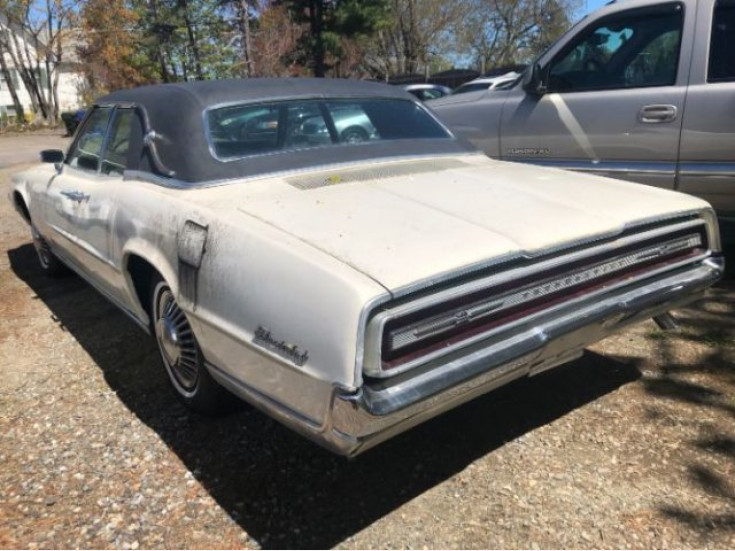
1967 Ford Thunderbird - Nothing Less and Nothing More


From a fairly half witted answer to Chevrolet's Corvette to a seminal personal luxury car to, well, I'm not quite sure what, Ford certainly messed around with whatever they wanted their "Thunderbird" to be, didn't they? And, not unlike a song or movie that's not very good but does have a memorable name or beat, in my humble opinion, none of Ford's thirteen generations of Thunderbird ever quite lived up to it's vaunted native American inspired name. Thunderbird. What a great name for anything but from an automotive perspective, what does or did it mean?


Of all the various iterations, the most fantastically bizarre and all over the road of them were these  four door "fifth generation" T-Bird's Ford rolled out between 1967 and 1969.  Our subject here hails from 1967. Actually, this generation of Thunderbird went all the way to 1971 but I don't count the "Bunkie Beak" '70 and '71 models. They were called that for Pontiac honcho Bunkie Knudsen who jumped to Ford in the late sixties and insisted a huge beak be added to the front of these cars. 


Funny how your first impression of anything sticks with you. When I was a kid, I thought these cars were weird as hell. And I still do. I thought the suicide door Continentals strange as well but these things were even more out there - more out there in a Munster's meet the Adam's Family kind of way. That doesn't mean they weren't strangely cool. Listen, I don't understand what people see in horror movies but I respect their opinion and I press my face against the glass doing my best to see what they see. 


These big birds may look similar to the 1961-1969 suicide door Continentals but they're actually quite different. Yes, they may share some running gear and who knows what else but the Continentals where unibody, meaning the frame and body were one unit, whereas these cars were "body on frame". Body on frame automobiles tend to have a quieter, more cushy ride compared to unibody models and that played well to Ford's ever more luxurious aspirations for the Thunderbird theme. 


Tart the thing up with wonky and inefficient doo-dads like windshield wipers that face each other and clumsy and complicated head light doors all you want, if it wasn't for the crazy rear hinged rear doors, this car would be nothing more than an LTD. Buyers loved them, at least at first, because they were so different from anything else on the road at the time and they were willing to pay extra for all the schmaltz and glitz. Even if they were, if anything, fairly ordinary if atypical (for the time period) automobiles.  


The times, though, they were a changin'. The market for "personal luxury cars", got crowded come 1968 when sister division Mercury rolled out their inexplicably cool, Mustang based "Couger" and then GM one-two punched the whole segment with their 1969 Pontiac Grand Prix and 1970 Chevrolet Monte Carlo. Along with the flashy Buick Riviera, Oldsmobile Toronado and Cadillac Eldorado, these over-styled land yachts quickly became as outdated as saddle shoes and bobby sox. 


That, in a nutshell, summed up what these cars were all about - they were fashion statements. Nothing less and, sadly, nothing more. The problem with keeping up with fashion is that whatever you have right now quickly becomes obsolete. Ford ditched the suicide door Continental come 1970 and these Thunderbirds, there was a debate-ably more tasteful coupe version of these, went the way of the leisure suit come 1972