Friday, November 25, 2016

1968 Ford Ranch Wagon Revisited - Window To His Soul


It's said that your eyes are the window to your soul. Perhaps. I believe the car you drive a subliminal glimpse to your soul and one that reveals outwardly, whether we intend to or not, who we really are - even if at first glance it's obvious we're attempting to be something that we clearly are not. What kind of car or truck are you? 


I've already hashed and rehashed the 1968 Ford Ranch Wagon that was the vehicle of my childhood a couple of times already, but that car, which was originally a light sky blue that my parents had Earl Sheib dump a gallon of dark blue paint all over like our our subject car here, remains a source of fascination for me. That car as close to a window to the soul of  my father as I will ever have seeing how emotionally distant and awkward he was.  


On the surface, his bone-stripped Ranch Wagon he bought from a Hertz was uncannily just like him. Unremarkable, ordinary and middle aged. He was in his late forties when he bought it in the early spring of 1970. Station wagons were middle age at that time too if we determine the widespread use of "station wagons" first came about with Ford's seminal 1952 five door Crestliner "Country Squire" and ended unceremoniously with the death of the Buick Roadmaster Estate Wagon in 1996. 


Station wagons used as a family vehicle having rose dramatically through the 1950's; from less than 1% of the market in 1950 to more than 17% by 1960. The term stems from the type of utility vehicles that hotels used to carry guests to and from train station depots. Seeing the explosion in popularity in crossovers the last ten years its easy to see that America's appreciation for practicality is nothing new. 


Like most base models of automobiles back then, and just like my father, our Ranch Wagon was  capable yet lacking in ostentation, ornamentation and pretense. The only "luxury" items our car had was the new for 1968 302 V-8 and power steering. No air. No power brakes. That 302 must have been like a Saturn rocket compared to the flat head six under the hood of the Rambler the Ranch Wagon replaced. My father, again, never one to want to stand out, loved to peg the gas and have the Cruise-o-Matic downshift for a rush of speed on a half mile or so stretch of road near our home that he knew cops rarely patrolled. He did it for my benefit, I believe, bless his heart, and he would gush endlessly over the car's immense power. We're talking two-hundred ten gross horses moving a car on the dark side of two-tons. Easy now, big fella.   


Unlike the lavish 1968 County Squire that the folks across the street from us had, like all Ranch Wagons, our car did not have a third row jump seat that increased passenger capacity to eight or even nine. Ours had this flat steel floor with obnoxious exposed hinges allowing the floor to open to a gigantic trunk underneath that stretched from the bumper to the rear of the back seat. The back seat folded forward as well making for an expansive rear cargo area to rival any modern Tahoe or Suburban. Downside was any time spent traveling back here was akin to kiddie-torture. If the hinges didn't bruise your ass then you risked breaking your neck when the car would pogo-stick you up into the roof because you were sitting on the axle. 


The most remarkable piece of engineering on these cars is this "Magic Tailgate"; it could open outwards or open flat. It was a marvelous hidden talent, like my father's ability to draw, that many people didn't know about. You opened it to lie flat via a handle on the inside top of the tail gate. The rear window could also roll down into the door via a handle and crank that folded out of the chrome cast bezel above the F O R D lettering on the outside. I always thought it an extravagance given how spartan the rest of the car was but all Ford wagons had Magic Tailgates going back to 1966. 


For all the Ranch Wagon had to offer as a utilitarian vehicle and what little luxury it provided at the same time, for the life of me I still can't figure out why my father bought that car. He wasn't exactly a "family first" doting father type and while he was certainly a capable "handy man" with a fairly sound mechanical intuition, being a white collar managerial executive type, this yeoman's car was out of sync with the man most people thought he was. An LTD sedan would have been more fitting of the man most people thought my father was but knowing his blue collar heart and soul, the Ranch Wagon was who he really was.  


My father struggled as a manager and much like his middle son he was seemingly most content toiling alone on some project in the garage or basement. I've always felt he would have had a more satisfying life had he been tradesman like his father was. Sadly, I always felt he had little time not ability to be the father I wanted and needed him to be what with his rocky, loveless marriage and challenging career. It is a nice memory to think about those Saturday mornings long ago when he would speed in his Ranch Wagon. 


Life boils down to at most a handful of huge decisions. Get them right and life can be beautiful. Get them wrong and you could be, like my father was, miserable. His 1968 Ford Ranch Wagon was a work vehicle, a wagon for a tradesman with few if any real creature comforts. It's starkness and simplicity, which I was abhorrent to at the time, was everything he really was. 


Friday, November 18, 2016

2017 Mercedes Benz C300 Coupe - Nice Honda Accord You Got There


What's the point of spending the equivalent of a mortgage payment on a small house in the Midwest every month if people have no idea that you've spent that much? Take this 2017 Mercedes C300 4Matic coupe; does it not look resemble a Honda Accord coupe that costs maybe half as much if not more? Hope the owner really loves the car for what it is and not because of what he or she thinks it says about them. Peronally, I think it says they've wasted their money.


That's the thing with spending a lot of money on a car these days. What are you really getting that you can't get for far less money? Cocktail party bragging rights? Really? Does the owner of this car live in such a tony neighborhood that they don't think something like a Honda Accord would suffice? Point is mute - this car belongs to someone who lives in the residences at an outdoor mall on Cleveland's west side. So much for impressing the Jones' with their fat ride stuck in a parking garage. But I digress.


Years ago, yes, you did get a lot more car for your money when bought large but these days the lines between austere frugality and luxury are blurred. After all, the Honda Accord coupe (above) is a most excellent automobile. Ugly as hell from the edge of the doors back, just like the C300 coupe, but excellent nonetheless. Why is it that both the Mercedes Benz C class and the Accord four door are much better looking than their coupe variants? Same goes for the old Sigma II based Cadillac CTS and just about every sedan based coupe these days. If sedans are dying then coupes are dead.


Save for the American muscle car triumvirate, Mustang/Camaro/Challenger, coupes today suffer from weird styling details that make me look away. You give up a lot with coupes and in doing so, the syling's got to be dead on otherwise, what's the point? This saying a lot coming from card carrying, coupe lover me. I'll never buy a sedan but I can see why cross over utility vehicles are so dang popular these days; they offer styling mojo that coupes once offered. When time comes to replace our family Tahoe I know for certain that my wife is going to insist on a cross over. Gee whiz, I can hardly wait. By the way, if you're wondering, these days I'm all about the Ford Mustang GT.


Back to Mr. or Ms. Gotrocks here and this $60,000+, C300. Damn that's a lot of money. Anyway. one thing that is nicer on this car, compared to an Accord, is the interior. Absolutely stunning. However, much like the Accord and almost all coupes today, cars in general when I think about it, is that visibility all around and particularly out the back is atrocious. Blame hump back whale baby butt for that. Not a fan.


I'd love to run into the owner of this car one day, it could happen, and gush over his gorgeous car and make it seem as though I'm living vicariously thorugh him wishing that I had the means to blow a grand or so a month on one car. If I sound jealous, so be it. One thing for certain, I'd never have the the gumption to tell them snidely, if not snarkely that I love their new Honda Accord. It is fun to think about it. 

Thursday, November 17, 2016

1982 Chevrolet Camaro Z28 - Ridden Hard and Put Away Wet


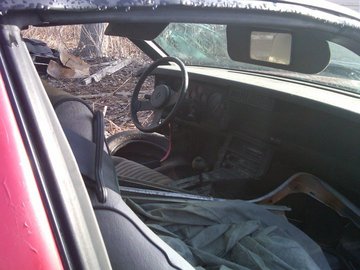
Like old songs, cars are a great way to have a high school flash back. I was flashing back when I stumbled across this junker 1982 Chevrolet Camaro Z28 that was all new the year I graduated high school. Today, let's dust off our metaphorical high school year book, leaf through the now sepia toned pictures and see what ever happened to old what's-her-name. 


Although I was disappointed that I would not graduate with the "Big Body" 1970 era Camaro as part of the backdrop of the year I graduated high school, why that mattered to me is now beyond me, I was quite fond of the "new girl". She and her stable mate, the very similar Pontiac Firebird, just may have been the the prettiest girls in the Class of '82. Forced to choose between the two, the Chevy would have been my prom date. 


Thanks to an all new suspension featuring MacPherson struts up front and a new coil spring and shock rear set up, the new Camaro was a markedly better handler than her leaf spring and shock equipped predecessor. Rack and pinion steering replaced the old recirculating ball system too. On the Z28, rear disc brakes were available and all in, on average, these cars were some three hundred pounds lighter than the car it replaced. Gee-whiz, was this a Chevrolet or a Porsche? 


No. She was no Porsche. Not even close. Despite by the comely exterior and decent track numbers, the 1982 Camaro was panned for a rattling interior, sloppy build quality, harsh ride and for being under powered. Ouch. But what did I know? Being in love with these cars I would hear none of that talk. Who cares if the car is a piece of crap and is a bitch and a half to drive. She looks cool. 


Anyway, with regards to our subject here rotting away behind an auto body shop near my house west of Cleveland, Ohio, after all these years it is somewhat disheartening to see something that was once so molten hot now appear, as they say, "was ridden hard and put away wet". This thing open like it is it stank of mold, mildew and animal droppings too. No doubt Mother Nature has had her way with her much like Father Time has had his way with that once super hot new girl back in high school. 


Seems our Camaro Z28 left the factory with Chevrolet's infamous "Cross Fire Injection" fuel injection system. Cross-Fire, which sounded so cool back then, was two throttle body fuel injection systems from Pontiac's 2.5 liter "Iron Duke" in line 4 working in tandem to help the little 305 develop 165 net horsepower. That sure sounded like a lot back in the height of the Malaise Era but it couldn't get a Camaro to 60 in under ten seconds. "Cross-Fire Injection" was, needlessly complex, fussy and  difficult to work on. I don't believe this car had been in a major accident from what I could tell so perhaps it's last owner got sick and tired of attempting to get the Cross-Fire Injection to work right. 


Within three years, Chevrolet did have port fuel injection on tap for these cars but by then the market was beginning to shift away from sporty, impractical coupes like this. The market got so bad for these cars that GM even pulled the plug on them altogether in 2002. Chevrolet reintroduced Camaro in 2010 on the GM Zeta platform that it shares with cars like the late, great Pontiac G8 and others of the same vintage. 


None of us are getting any younger and seeing cars from our wonder years destroyed like this makes us all aware of what eventually awaits all of us. Some of the gang from back in the day looks better than others but it's the rare person who looks arguably better with the wear and tear of thirty five years of life on their personal odometers. Sure hope those who were "ridden hard and put away wet" enjoyed the ride. 

The term "ridden hard and put away wet" refers to horses. Like humans, horses sweat heavily during exertion. Afterward, the hoses needs to be curried (groomed) to remove sweat from it's coat. to prevent a number of health and hygiene problems. A horse who was rode hard and put away wet would feel, look and smell awful. 

Thursday, November 10, 2016

1990 Chevrolet Beretta GT Indy - Bad Then, Worse Now

 
I remember these from the time my younger brother bought a '90 Beretta brand new out of a long since closed Chevrolet dealership back in Baldwin, New York. I went with him on the test drive of the car he would eventually get and his sales person joked to us that he could get him into one of these for less than what he was going to pay for the all but bone stripper he was getting. He wasn't kidding either. 


It's funny - things like this simply don't age well. And if you think this looks ridiculous now, it looked ridiculous back then too. Chevrolet only built 1,500 of these Indy Car replica's, yes, a Beretta was the pace car of the 1990 Indianapolis 500 albeit it was a convertible. All of these day-glo Beretta's were coupes. 


Produced between 1987 and 1996, Beretta's, which replaced the Citation in Chevrolet's mid-to-late 1980's stable, were powered by a wide variety of GM engines and transmissions; all "Indy's" were powered by GM's all but ubiquitous 3.1 liter, 60 degree V-6. Making all of 135 horsepower, it felt like it had decent enough poke since its torque curve was low and flat at low rpm's. The more it revved the quicker it ran out of steam. The fact these weighted just 2,700 pounds soaking wet helped them feel as though they were faster or "snappier" than they actually were. 


I forgot just how sparse and cheap the interior of these cars were and the snazzy neon seat inserts go a long way towards dressing this up. That steering wheel looks like an air bag equipped wheel but it's not. Hard to imagine a car built in the 1990's not having at least one air bag but we are talking the early '90's which was really an extension of the late '80's. These didn't come with ABS brakes either. Late '80's/early '90's GM cheapness rearing its ugly head once again. These Beretta's shared their "N platform" with the Chevrolet Corsica, Buick Skylark, Oldsmobile Ciera and Pontiac Grand Am.


These weren't the worst looking Chevrolet of the era, it's sibling the Corsica was, but Chevrolet didn't replace them; technically speaking anyway. When the Malibu rolled out for 1997 it took the place of the Corsica and the Beretta and there was no two-door coupe. Another chink in the armor for us coupe lovers. 

Tuesday, November 8, 2016

1961 Cadillac - What Goes Up Must Come Down


For Cadillac's all new post war models, Harley Earl commissioned designer Frank Hershey to create an automobile based on the profile of a Lockheed P-38 Lightning. That aeronautic theme, as it were, was highlighted by "tail fins" on the upper rear quarter panels that became such a popular design element throughout the auto industry in 1950's, that Cadillac raised the height and length of them at least every three years to keep their fins larger or more ostentatious than those offered by any other manufacturer. 


Cadillac tail fins, which morphed into something that could best be described as "rocket tips" by 1957,  literally peaked in 1959. Starting in 1960, Cadillac's fins began a most merciful and graceful decline in "elevation". By 1965, on Cadillacs, for all intents and purposes, tail fins where gone.  


That subtle year to year decline in the size and angle of fins resulting, if not gloriously then serendipitously, in the 1961 Cadillac; in my humble opinion one of the most gorgeous automobiles ever created. Especially in two door guise like our blue mist subject. Personally, I think tail fins are ridiculous but a 1961 Cadillac would just a big Buick or an Oldsmobile, without them. 


When Harley Earl retired in 1958, one of the first things his replacement, Bill Mitchell did was tone down Cadillac's fins. However, rather than eliminate them in one fell swoop, Mitchell changed them subtlety, their "decent" evolutionary versus the sudden erection that was the design leap from 1956 to 1957 or the priapism that resulted in the goofy 1959 fins. The fins on the '60 were still comically high but for 1961 Cadillac models, something suddenly went right. If for only one year. The '61's tail fins still retained some of the fluidity of the 1959's while not being as horizontally bolt straight as the '62's. It works beautifully to compliment the overall look of the car; even if the aviation/aerospace theme is all but a foot note. If it's a cliche to say they don't build 'em like this anymore so be it. All I know is there's nothing on the road today as gratuitous of design as a 1961 Cadillac.


I'm not sure, honestly, if that's a good thing or not as I'm personally enamored with so few designs today despite the fact that modern automobiles are generally fantastic, bullet proof reliable, transportation devices. One thing that I am sure of is that you can't confuse this 1961 Cadillac with some plebeian, soul less although very dependable appliance; if for no other reason that the car is just so damn good looking.


It's been said that today, the sedan is dead or dying. One of the reasons for that is that people want more from their vehicles than said reliability; cars today, despite being rock solid, are, with some very few exceptions, boring. That's why buyers looking for more than just an appliance are flocking to cross overs because in addition to their dependability and practicality, "CUV's" offer something style wise that they can't find in a sedan. CUV's, for better or worse, have a soul. If the sedan has any chance of a future, and that's a big if, designers would best be suited to look to the incredible GM designs of the early 1960's for inspiration. Not so much to copy the designs or pay homage to them but to be inspired to add much needed chutzpah to whatever it is they're working on. Judging by what I've seen of upcoming 2017 models, they could learn a thing or two from the designs of the past.


Located along the south side of I-40 just west of the Amarillo city line, "Cadillac Ranch" is a roadside homage to the evolution of Cadillac tail fin design from 1949-1964. You're encouarged to deface them with spray paint. Spray cans in hand, my family and I stopped by during our south west driving trip in 2010 just prior to our move to Cleveland, Ohio. 

Tuesday, November 1, 2016

1968 Meyers Manx Dune Buggy - Assembly Required


"The Hillbillies", as my parents referred to the family that lived in the duplex across the street from us on Long Island, not only changed automobiles with fascinating regularity but they also built some of their own cars as well. Well, not exactly built, more like assembled - they built "Dune Buggy's", just like our 1969 Meyers Manx, from kits. 


The elder "Hillbilly", a mechanic by trade, bought fiberglass bodies from a Meyers Manx distributor and would bolt them to the running gear of junked Volkswagen Beetles. He and his sons, the youngest a good five years older than me, would dismantle the junked VW, cut out a section of the chassis to shorten the wheelbase and would bolt the whole thing together. All in their backyard over the course of several weeks. Amazing. He'd sell the finished Buggys soon after but not before us neighborhood kids would get rides in them. My first ride in one with the windshield laid down flat as thrilling as the first time I rode a motorcycle. While my myriad traipses to watch and sometimes even help with a project mortified my mother, the wonderland of car parts, tools, sweat, grease, blow torches and the sound of an exhaust free air cooled VW engine was far more interesting than anything I could ever find in a book.


I don't know if it was my mother's inexplicable disdain for those people or contempt for people who made a living working with their hands in general that irked her as much as it did. Any interest that I had in anything that wasn't of some sort of intellectual pursuit irritated her to no end and my time spent "across the street" would be the first of many points of consternation between the two of us. My brothers never stepped out of line and they've done quite well for themselves; my older brother a real estate tax attorney, my younger a CPA. Me? Well...My mother either did me the greatest service or disservice by ultimately dissuading me away from a life she sarcastically referred to as a life in "the pits". Jury's out on that one. She may have dissuaded me but she couldn't douse what has become my life long interest. I sure would like to try and assemble one of these myself. That would be fun.


While VW Beetle chassis are as hard to find in junkyards today as would be finding a Model T in one, a modern subsidiary of Meyers Manx sells almost complete. air cooled, rear engine Dune Buggy kits starting at $13,995. Almost complete meaning you still have to find your own engine and trans axle. A fully loaded Manx can be had for $18,995 plus shipping. Remember, assembly required. I'll take a "Kick Out" in sparkly blue, please.


Sunday, October 30, 2016

1988 Lincoln Continental Mark VII - Hot Rod Lincoln


In 1978 Ford started their downsizing by introducing an all new compact platform or chassis that was internally code named, "Fox". What would become known as the Fox body platform, in varying wheelbase lengths, would come to underpin a wide variety of vehicles for the Ford Motor Company including the 1978-83 Ford Fairmont and Mercury Zephyr, 1979-94 Ford Mustang, 1979-86 Mercury Capri, 1980-82 Ford Granada, 1980-88 Mercury Cougar, 1980-88 Ford Thunderbird, 1982-87 Lincoln Continental, 1983-86 Ford LTD, 1983-86 Mercury Marquis and the subject of our blog today, the 1984-1992 Lincoln Mark VII. Our feature car is a 1988 Bill Blass edition. 


Compared to the boxy Mark VI that came before it, the Mark VII was as radically different looking as the suicide door 1961 Continental was compared to a 1960 Continental. Thanks to MacPherson struts up front, the Fox platform also gave the Mark VII handling capabilities like no other Lincoln before it. Including the "Panther" body based VI that in and of itself was a radical departure from the levianthesque Mark V it replaced.  


Performance aside, though, the Mark VII had a difficult and very tight line to drive. Luxury car buyers are a notoriously fickle and are abhorrent to change. The styling of the VII couldn't stray too far from Lincolns of yore yet could not being as staid and true to older models like the knife edged, boxy VI if they had any shot at younger buyers. The polarizing trunk hump as much a nod to Lincoln's past as it was a styling differentiation from the similar Ford Thunderbird and Mercury Cougar that it shared the Fox platform with. While the VII has aged quite well, buyers, particularly older Lincoln clientelle, were indifferent towards it at first. That indifference stemming in large part from the car's much tidier dimensions compared to the VI; the Greatest Generation were sold on the  the size of a car being reflective of ones stature. The Mark VII, and its four door version the 1982 Continental, much like the 1975 Cadillac Seville and German makes and models like the Mercedes Benz  280 S, went a long way towards changing that age old bigger is better paradigm.  


Lincoln did have challenges within the Ford Motor Company to charge the premium they did for the VII since it did share as much as it did with Thunderbird and Cougar; VII's sticker priced in the mid to high $20,000's while Thunderbirds and Courgers cost maybe half that much. Styling and "premium" nameplate aside, to make the Mark VII as exclusive as possible, the "High Output" 5.0 liter V-8 from the Mustang GT was made available on the VII and was never made available on either Thunderbird or Cougar. That engine, incidentally, helped give the VII it's tongue in cheek moniker, "Hot Rod Lincoln". 


Save for some luxury accoutrements found on even the most plebeian of vehicles today, the interior of the Mark VII was virtually indistinguishable from that of a Thunderbird or Cougar of the same vintage. Have to imagine there had to have been more than just a handful of people who cross shopped these cars and wondered why the Lincoln version of the Thunderbird was priced so much higher. 


The idea of a four passenger, two door sedan seems almost as foreign today as trying to imagine a world without wifi. As good as the Mark VII was and as much of a value as it was compared to similar vehicles from Germany, even by the mid 1980's, consumer tastes were moving away from doggedly impractical, expensive vehicles like this. If luxury buyers bought domestically, and that was a big if even back then, they began buying stylish and infinitely more practical sport utility vehicles. Lincoln replaced the VII with the the flamboyant Mark VIII for 1994 but by then SUV's had really taken hold in this country leaving not only the market for the Mark VIII tiny, but the market for two door sedans in general tiny as well. Lincoln hasn't made a two Mark, or anything with two doors, since 1999. Although the Fox platform underwent a near complete redesign for the 1994 Mustang, it technically remained in production under the Mustang through 2004 making it, along with Panther chassis and Model T, one of the longest running and successful platforms in Ford history. 


"Hot Rod Lincoln" is a song by singer songwriter Charlie Ryan and a recording of it by Johnny Bond was first released in 1955. The song is about a hot rodded Ford Model A powered by a Lincoln V-12 engine and not a song, literally, about a Lincoln automobile. The most famous version of the song was recorded by Commander Cody and released in 1971. 

Saturday, October 15, 2016

1977 Ford LTD - Darkest Before Dawn


This 1977 Ford LTD sat for sale for well over eighteen months at a used car lot not far from my home here in Cleveland. Sitting as long as it did, it became a landmark of sorts and the longer it remained unsold the more assured I was in my drive by assessment of it that no one would ever buy it.


Well, never say never. It disappeared shortly before the lot closed. I wonder if someone actually bought it or if it went to auction and was sold to another of these little lots that dot the landscape here in northeast Ohio and northwest Pennsylvania. They do say there's an ass for ever seat but Big Red here was a tough putt - like a super needy, sickly but sweet old dog in a need of a forever home, the odds were stacked against it despite it being in great shape and with a reasonable asking price of around four thousand dollars. There's an enthusiast market for two door sedans and station wagons but four door sedans? Nada.


Man, these cars were big and standing next to it the anxiety came back to me that I felt as a young, inexperienced driver behind the wheel of a big car. While the John Wayne in me would never let on how scared I was, trust me, I was freaked the hell out. Back in the 1970's, it wasn't as if people didn't know that cars were too big either. Going back to the '40's, American cars were derided for their sheer mass but Detroit kept making them incrementally bigger and bigger. Things really got out of hand, though, in the 1970's. Iron like Big Red were not only bigger than ever, on the cusp of the great downsizing epoch that was spear headed by GM starting in 1977. they were biggest they'd ever be. What is it they say about it being darkest before dawn?


It wasn't so much the length of these cars I found so intimidating - it was their width. At give or take eighty inches wide, that's nearly eight feet, having handling that could best be described as nautical and seats as spongy as a broken sofa with no side bolstering to speak of save for leaning against a door or the poor, hump sitting middle passenger, they felt wider than a school bus. Being maybe five foot ten at my tallest, in a big car like this without a power seat to push me up to where my scalp was skimming the headliner, I always felt like as though I was looking up and over the steering wheel as opposed to sitting squarely behind it and being able to see the mass expanse of hood in front of the firewall. How I never side swiped a parked car is beyond me. Maybe I did and I didn't realize it.


For decades, Detroit marketed "bigger was better" and many buyers, like my father for instance, thought big cars like this handled like dream boats. Compared to the crude contraptions they grew up with, these softly sprung cars with automatic transmissions, over boosted steering and air conditioning where modicums of modernity. And, bless my father's heart,  I don't recall ever hearing him complain that whatever barge he had was "too big". Although, there were plenty of times he scraped the side of the of the garage or backed it into parked cars, trees or sign posts. He also had an embarrassing habit of rubbing the right front tire on the curb in front of our pre-war home on a oh-so-narrow south Nassau County, New York street to make sure he was parked properly.


Thing is, despite all that size, cars like this didn't have interiors that were much more spacious than smaller cars like a Granada. The size was all for show - the interiors were horribly inefficient. Sure, they were wider giving the hump sitting middle passenger more room side to side but aside from that, interior room on big cars back then was atrocious.

Let's not over the lovely color combination of our subject too. No doubt the litany of interior color options led to a customization that doesn't exist today off showroom floors but it also led to variances in assembly that compromised quality. I steel feel bad, though, for whomever had to sit on the damn hump in the back or the front. Kids today have no idea how good they've got it. By the way, how safe was it having a person sitting right up against the driver anyway?


American automobile manufacturers began to make larger cars with the advent of all steel bodies in the 1930's. However, it was after engineering innovation hit a plateau in the mid to late 1950's that things started to get really out of hand. What with most if not all of the accouterments once construed as luxury items having trickled down to even entry level makes and models and further innovation being cost prohibitive, Detroit resorted to gimmicky styling to appeal to buyers. For certain, while a 1960 Ford sedan may look nothing like Big Red here, there's really not much of a difference between the two of them "under the hood". That kind of long term engineering stagnation is seemingly unfathomable today.


As far as sheer bulk, for most of the 1960's, Ford's full size sedans were around two hundred and ten inches long and seventy six inches wide. Large, yes, but relatively maneuverable compared to the brutes that they came out with in the 1970's. That massive up sizing started with their 1969 models that while more than six inches longer than 1968 models, at least came with a bump in wheel base that had the benefit of giving rear passengers a scoshe more leg room. 1973 saw another up-sizing that, along with federally mandated "safety bumpers", helped to make Ford sedans like Big Red stretch the tape measure out to more than two hundred and twenty four inches long. That's comically huge.


Ford only made them this big between 1973 and 1978 and their timing couldn't have been worse. The OPEC embargo in October 1973 knocked the snot out of sales of big, thirsty cars and they never recovered. Couple that with the imports finally beginning to get a real toe hold at the time and its easy to see how and why road dinosaurs like Big Red became extinct.


So, what happened to Big Red? Hard to imagine someone bought this as a daily driver but you never know. Certainly would make for an interesting ride but it would be so expensive to gas up given this thing might get eleven or twelve miles per gallon. Hey, maybe some movie company scooped it up for use in a period piece they're making? That would be cool. Suffice to say, regardless of what happened to it, whatever we come up with is probably more interesting.