Thursday, May 11, 2023

1977 Pontiac Firebird Esprit - The Truth Lies Somewhere In the Middle


Either the world has indeed finally gone completely mad or the owner and\or poster of the ad for this car has been taking swigs of grandpa's cough syrup. This 1977 Pontiac Firebird Esprit is for sale somewhere up here in northeast, Ohio with an asking price of $34,000. Say it slowly and it sounds even more absurd; thirty-four, thousand-dollars. Grab your bell bottoms, Charlie's Angels t-shirt and your Bee Gees 8-track, kids. This is going to be an interesting ride. 


While I believe this car has an asking price that's too high, it's actually not out of the realm of reason. NADA peg this car in Concours condition, essentially showroom or museum quality, at $37,000. Excellent shape at $24,000, good at around $14,000. "Fair" (whatever that means) at some $7,500. 


Seeing the shape this is in, which is actually very, very good, I surmise it should have an asking price somewhere around $25,000. Not that I'd pay that for a Firebird that didn't have a "screaming chicken" on the hood but that's just me. 


Gosh, you'd think then that if these cars are worth so much, my 1977 Corvette could go for somewhere near that, right? Granted, my Corvette is not in the shape this original and unrestored oldie is, but my '77 ain't worth half of what the asking price of this is. Shoot, I'd be hard pressed to get $12,000 for it. Why? Because of the market. And the market, while kinder to most third-generation Corvette's or "C3's" like mine than most C4's, is driving the white or blue-hot values on these cars. Camaro's of this generation as well. 


What's really a kick in the tailpipe is these cars retailed for almost half of what a Corvette went for in 1977. And the Corvette, everything being relative, with it's independent rear suspension, was a better all-around riding, handling and performing car. Better looking too if you ask me. Take a drive in one of these and I'd hard pressed to believe you wouldn't think it rides like a truck with square, wooden wheels. My '77 Corvette, which I've painfully restored to original 1977 suspension spec, dare I say rides like a Cadillac in comparison. With it's mildly hot-rodded 350-cubic inch Chevy small block would suck the doors off this thing too. 


But, again, it's the market that's driving the proverbial bus here. These cars are nostalgia trips for Generation X and older Millenials as they were everywhere when they were young; I was born in '64 and therefore technically a "Boomer" but I identify as Gen X. Corvette's of this vintage were actually rare sites back then. Very rare. Not unlike seeing a late model Corvette today. And then, as now, there was a quiet, somewhat unspoken disdain for anyone driving a Corvette. Trust me, whenever I take my creaky '77 out, I see and feel the sneers and hear them saying under their breath, "what a douche bag". If they only knew. 


For 1977, long gone Pontiac built four different types of Firebirds. There was the bone stripper base model with a Buick V-6 and a 3-speed, floor mounted manual. Our luxury-tinged or themed Esprit here  was next on the model totem pole followed by the "Formula" and the apple of everyone's eye, now as then, the Trans Am. Especially black T/A's with the gold trim that Burt Reynold's Bo "Bandit" Darville drove to fame in the greatest bad movie of all time, the original "Smokey and the Bandit". Fun fact, all four of the T/A's in the original "Bandit" where 1976 models with 1977 front-ends. 


The big news at Pontiac for 1977 was a revised engine lineup that included our Esprit's 301-cubic inch V-8 that was not only Pontiac's first new V-8 since the introduction of the 455 in 1970, it was the first Pontiac engine sold to the public that was not based on the venerable 287 "Strato Streak" Pontiac engine dating back to 1955. 


Based in part on the 303-cubic inch V-8 Pontiac developed for Trans Am racing in 1970, an engine never sold publicly, our Esprit's 301makes all of 135-horsepower in base guise, an optional four-barrel carburetor goosed horsepower to 150. With 235 pounds of torque just off idle, it provided reasonable scoot for the time period. "Reasonable" being relative, of course. 


Despite the shape it's in and the honeycomb rims, its $34K asking price is making be ill. Perhaps it's the sickly blue exterior color (I don't mind the interior) or that I'm not the biggest fan of most Firebirds made after 1974 that have the larger, more wrap-around rear windshield. Or, if I'm being perfectly honest, and what do I have to lose by not being so, I'm just jealous that I couldn't get half the asking price for my Corvette. 


As with most things in life, the truth probably lies somewhere in the middle. 


Wednesday, May 10, 2023

1981 Ford Fairmont - Oh So '70's Vibe (And Not in a Good Way)


Although my birth year coincided with the debut of the Pontiac GTO and I was born within a month of the launch of the Ford Mustang and the Plymouth Barracuda, by the time I approached driving age, thanks to two gas crisis and EPA emissions and safety regulations, the cool car party was long over. Due to increasingly stringent safety, emissions and gas mileage regulations, staid looking economy cars were king and anything with a V-8 engine, not to mention any modicum of performance, real or imagined, was verboten. 

However, what came about at the Ford Motor Company as result of circumstances and government scrutiny, was actually quite good. Although, I had little use for the game changing 1978 Ford Fairmont and its corporate kissin' cousin, the Mercury Zephyr. Even in two-door guise like this '81 Fairmont.  


To be honest, though, as good as these cars are based on what became known as the "Fox-body", or platform were, they have not aged well. At least in comparison to their far more famous sibling, the Ford Mustang. And to a lesser degree the 1979-1986 Mercury Capri. The Ford Motor Company used the Fox-body on a wide variety of automobiles across all three of their divisions including Lincoln. The origin of the name, by the way, the subject of much conjecture but the common notion is Ford named it after the Audi Fox which was supposedly the benchmark they aspired to when they first started drawing it up in 1973. 


The "Fox-body" was a radical departure from most anything the Ford Motor Company or any domestic manufacturer had come with before it. The relatively lightweight, unit-bodied Foxes featured a then "space-age" Macpherson strut front suspension and rack-and-pinion steering that afforded drivers a near European level of ride and handling. Well, for at the time anyway. 


Ah, but where it counted to pre-pubescent me, its simple styling was a decided turnoff; not that there were any Ford's of the era that I cared for save for any Fox-body Mustang or Capri with a "5.0" glued to its front fenders. Simple by design and straightforward in ways what they replaced (the Ford Maverick and Mercury Comet) certainly weren't, the Fairmont and Zephyr were the Ford Motor Company's literal and figurative interpretation of a Volvo 240. Ha, as if? Well, auto pundits raved about these cars in ways they didn't gush about General Motors downsized full and mid-sized models that were really, if we're being honest, nothing more than shrunken versions of what they had been pushing out for the past thirty years or so. Your opinion may vary, see dealer for details. 


Funny how some of us have to learn life's lessons the hard way. While my first car, coincidentally or not, was a 1974 Mercury Comet, what I refer to as my "second first car", was exactly what I wanted in the first place - a big, spatially inefficient, V-8 powered "personal luxury car" that was a wallowing monster to handle. But I thought it cool as all hell even though I was smitten by the handling prowess of a friends tiny, early '80's Toyota Corolla. That little car along with a number of other smaller, sharp handling cars subliming stoking the coals of my inner race car driver; I didn't realize at the time that not only was I a budding automobile enthusiast, I actually really enjoyed driving. 


Back to our '81 Fairmont here in the '23. I found this on Facebook Marketplace not long ago for sale near my home here on the west side of Cleveland, Ohio. Asking price was a fair $4,500 for a rust-free, forty-year-old, 50,000-mile anything although I chafe at the thought of dropping that on this. Attempting to look at it through the goggles of my 26-year-old, semi-car conscious older son, I still can't see past it's, as he would put it, "not in a good way, oh-so-'70's-vibe". He adores my 1977 Corvette so he does know a thing or two. I might me somewhat alone in my contempt for this car as I went back to Marketplace to find it and it seems to be gone. 


Wednesday, April 19, 2023

1968 Oldsmobile Delta 88 Holiday Coupe - Dare To Be Different


The poster of the ad for this 1968 Oldsmobile Delta 88 on Facebook Marketplace dares a buyer to be different stating, "you'll never see another one at a car show". That may very well be true, but I'll turn down that challenge. And not just because the $16,500 asking price has me crying out in pain. An asking price that is, amazingly too, somewhat under market. 


This one family owned '68 hails from bucolic Rittman, Ohio, a good 45 minutes southwest of Akron and a solid hour and half drive for me here on the west side of Cleveland. Given the tin worm's proclivity to devour old iron and steel, it's refreshing to see something this old in such great shape up here - especially considering it's original and unrestored. However, like many a 1965-1970 General Motors full-sizer, I'm not a fan of its styling despite how good these cars stay bolted, screwed, welded and glued together. They also ride and handle better than anything made before them and much better than the shuddering messes that replaced them in 1971. There are some exceptions but in general, there's just something about their lines I can't warm to. In particular these fastback coupes that all GM divisions came with back then save for Cadillac. 


If you had to have an Oldsmobile coupe for MY 1968 but didn't care for the fastback, Oldsmobile referred to their hard tops back then as "Holiday", you could opt for an 88 convertible. Or spring for a 98 two-door that was spared the ignominy of the swoopy tail treatment. Bonus, the 98 rode on the larger GM C-body that afforded rear passengers a scooch more leg room; our 88 here along with Buick's LeSabre and all Pontiac and Chevrolet big boys rode on the shorter wheelbase GM B-body. Downside was, if you thought the 88 was an "old man's car", the 98 was metaphorically even "older". Incidentally, Chevrolet was the only GM division that offered a formal or notchback roof line on their B-body two-door. 


Another problem with the fastback design was the rear blind spots it created. Couple that with no factory passenger door mirror and when changing lanes, I'd break out my Rosemary beads. Left or right. And on a windy day, the fastback would act like a sail making an already tailspin happy car even more so. Imagine the fun.  

Oldsmobile had two '88's for 1968, the entry level "Delmont" and the "Delta"; I'm sure there's an origin story for Oldsmobile's use of the Delmont and Delta prefixes. Delmont replaced "Dynamic" in the Oldsmobile portfolio for 1967; from 1969, through 1988, Olds buyers could only buy a Delta 88. There was also a range-topping Delta 88 Royale from 1971-1988. Through the 1950's and 1960's there were also Super 88's, Celebrity 88's, Fiesta's and Jetstars. If you're keeping score, bless your heart if you are, after 1988, Oldsmobile marketed 88's as "Eighty-Eight's".  

Suffice to say, whether it be an "88" or an "Eighty-Eight", it was a very profitable thus important model designation for GM's long gone middle division. 


The "88" nomenclature hearkened back to the days when Oldsmobile identified their models numerically with the first digit denoting chassis or body, the second the number of cylinders it had. Although, from the start, the "88" muddied the nomenclature since there never was a 6-cylinder, "86". 1949 and 1950 "88's" shared their bodies with the existing, entry level, 6-cylinder, 76 models and featured Oldsmobile's "Rocket" V-8 engine. With the use of the Rocket V-8 in the smaller, lighter 76, some claim the Olds 88 was the first "muscle car". 


Speaking of der Rocket, my only experience directly with one of these cars was during a brief, albeit memorable spin in a 425-cubic inch, Rocket V-8 powered 1966 Delmont 88 "Town Sedan". Although, much like our '66 here, I found its styling off putting if not out and out bizarre, I had much love for the mighty Rocket. Everything is relative, but compared to the wimpy sixer in my '74 Mercury Comet I had at the time, I felt that big old Olds had enough power to fly me to the moon. The power-boosted brakes on that car were almost as bad as the unboosted drums on my Comet. 


I can only imagine the cheap thrills to be had with this car's Rocket 455; the poster of the ad didn't specify which of the three 455's it may have had. Yes, three. Oldsmobile made a five 455 engines in different states of tune for 1968. '68 was also the first year for the biggest of all Rockets and they built it through 1976. You'd find it under the hood of just about any Oldsmobile during that time save for the Chevrolet Nova based Omega, and Chevrolet Monza\Vega based Starfire. 


Dare to be different? I usually accept that challenge but on our '68 here, I'll let someone else who's got $16,500 burning a hole in their bank account rise to the occasion. Although, I wouldn't mind taking this out on a lonesome, mid-Ohio country backroad to see if it's Rocket engine has as much power as I remember it might have had. 

Wednesday, April 12, 2023

1976 Ford Mustang - It's Not Bad at All, Really


Most Ford Mustang cognoscenti want nothing to do with 1974-1978 Mustang's, the Pinto-based "II's" that the "II" haters claim either "wasn't a real Mustang" or all but eradicated a decade of seminal pony car pioneering up to that time. This is a 1976 "II" for sale up in, appropriately, Dearborn, Michigan with a $3,700 asking price. No vinyl top, notchback, alloys and a "Cologne" 2.8-liter V-6 - aside from a rather high asking price for any mid-'70's car that needs a fair amount of work, is this really such a bad car? 


In a vacuum, I don't think so especially compared to other Ford designs of the 1970's. This car may be festooned with Mustang badging, but squint or blur your eyes for a second or two to see a strong, familial resemblance to the Ford Gran Torino\Mercury Cougar or dare I say Thunderbird of the vintage. Then again, depending on your point opinion, that might not be such a good thing either although I do find at least some dash and elan to the fish-mouthed 1972 Torino's. 


Squint again and you may come to some to see what this car really is - a luxurious, longer-wheelbase version of the Ford Pinto. The Pinto association, as much as anything else, may explain the vitriol  Mustang fans have for the II's that were replaced by the Fox-body Mustang in 1979. Shoot, this ain't even a Maverick in disguise. 

It is somewhat amazing if not miraculous that Ford introduced this car as the Mustang II in 1974 given where the Mustang had been in the few short years since it's most successful launch in 1964. Based on the compact 1960 Falcon, Ford had sold more than a million Mustangs in an elongated first MY run between April of 1964 and the end of 1965. Tack on another 400,000 or so before a rebooted 1967 Mustang and you have one of the most successful vehicle launches in automobile history. Problem was, as was or is almost always the case, subsequent updates of the Mustang where all longer, wider and heavier and the fatter the Mustang got, the more sales declined. 


Coincidentally or not, the market had changed by 1967 and Ford needed to update the Mustang to keep pace with General Motors; competition something Ford didn't have to contend with until 1967. Technically, Chrysler had a competitor with their Plymouth Barracuda that was even introduced some two weeks prior to Ford's rolling out the Mustang in '64, but due either to it either being a lightly disguised Valiant, half-arsed marketing campaign or combination of both, it sold poorly. 

Much of the credit for the "II" goes to, all of all people, that big car loving Ford honcho, Lee Iacocca. Iacocca agreed whole-heartedly with critics of the 1971 Mustang that Ford's foal had gotten too big and ordered a smaller Mustang dimensionally akin to the '64 to be introduced for MY 1974. And rather than use the compact Maverick chassis, he insisted the Pinto's underpinnings be used; that in-and-of-itself not a bad thing given the Pinto's rack-and-pinion steering and light weight. However, Lido insisted what would become the Mustang II not have an available V-8 engine. That changed come 1975 but the dye was cast with Mustang Nation - the Mustang II was first and foremost an economy car.  


Timing being everything, just as Ford pulled the sheet off the Mustang II, the first gas crisis hit in the fall of 1973 and buyers flocked to the 20-MPG "little" Mustang. Ford sold more than 400,000 "II's" that first model year, best since 1967. Soon as the earth cooled and gas prizes stabilized, though, Mustang sales came tumbling down never reaching half of what they were during the dark days of the gas crisis. Meanwhile, sales of General Motors Camaro and Firebird recovered nicely although their replacements were sold along side them in Chevrolet and Pontiac showrooms. "Replacements" based on the Pinto's GM competitor, the Chevrolet Vega. Apparently, cooler heads or more passionate fans of the Camaro and Firebird were able to convince GM suits that gluing "Camaro" and "Firebird" on gussied up Vegas was not a good idea. 


Again, much like what Linus said of the Christmas tree Charlie Brown bought, "it's not bad at all, really". Perspective, then, is everything. Some see a car that almost killed off what has become an American automobile institution while others may see it for what it is - either a large Pinto or, dare I say, a smaller Thunderbird. Either way, it was one of the few bright spots for Ford in the 1970's and a Mustang that may have saved the, ahem, breed. 


Monday, April 10, 2023

1985 Cadillac Coupe deVille - Happy Easter


It was a lovely, sun splashed spring afternoon around easter time day on Long Island in 1984 when I first saw one of Cadillac's all-new-for 1985, front-wheel-drive deVille's. I don't remember if it was a coupe like this '85 decorated like the easter bunny but I do recall a sick feeling in the pit of my stomach realizing that my beloved General Motors had made another hideous mistake. 


Was there another time in the annals of automobile history when a manufacturer immolated themselves to the degree that Cadillac did in the early-to-mid-1980's? GM in general but what happened to Cadillac was particularly harrowing. Whether it was the hump-back 1980 Seville, V-8-6-4, HT4100 (engine) or the creme-de-la-creme, the Chevrolet Cavalier based Cimarron,  you didn't have to be an automobile connoisseur to appreciate that GM's luxury brand had run aground. And the hits just kept on coming. 


These cars were actually the second wave of shrinking to GM's full size line, the first of course occurring in 1977 when they began their great downsizing epoch. The front-wheel-drive deVille's were actually supposed to launch in 1982, but development issues tapped the brakes on their debut into 1984. In the old way of GM doing things, they launched them in early '84 and called them 1985's. No harm, no foul. Well, at least in terms of when they introduced them. Can't say that about the cars themselves. 

Irony of ironies, the one thing that was ready to go by 1982 was their engines. Well, supposedly ready to go. The 249-cubic inch, aluminum block, iron head V-8 developed exclusively for these front-wheel-drivers was dropped into Cadillac's existing models after the V8-6-4 debacle of 1981. That it made all of 135-horsepower and (good grief) 190-foot pounds of torque and was tasked with moving some cars weighing north of two-tons wasn't the biggest issue facing the "HT4100", catastrophic engine failure was. 


The HT or "High Tech" had such maladies as head gaskets blowing, cam bearings going kaput, oil pumps giving up the ghost and on and on. For a company that had such a stellar reputation up to that point with V-8 engine development, it was particularly vexing. They'd fix most if not all of the issues with the HT by the end of the decade but Cadillac took a serious kick in the giblets to their reputation at a time when failure was not an option. 

The styling, or lack thereof, is what depressed me the most. I could have cared less if these were front-wheel-drive with transverse mounted V-8's or not and handled better than any Cadillac before them. This college sophomore thought there were ugly. Apparently, I was fairly alone in that sentiment as these flew out of dealerships. At first. Not unlike the first MY for Chevrolet Citations and their various spinoffs. 


This pink-on-white CDV is for sale on Facebook Marketplace with an asking price of $990. A scant 67,000-miles on it's analog ticker. Why so cheap? Blown engine. Won't even crank. Sounds to me like its aluminum oil pump croaked and the engine is totally locked up. Sort of a shame but not really. I mean, seriously. And this came from the factory looking like this. 


General Motors famed design honcho Bill Mitchell retired in 1977 and the last designs he was directly responsible for where GM's class-of-'77 full-sized models and what would become the 1979 downsized E-body Cadillac Eldorado, Oldsmobile Toronado and Buick Riviera. You can see a familial resemblance in those designs harkening back to his glory days of the 1960's. He had nothing to do with the 1978 shrink-rayed intermediates and anything else that came after. Including, of course, these cars. 


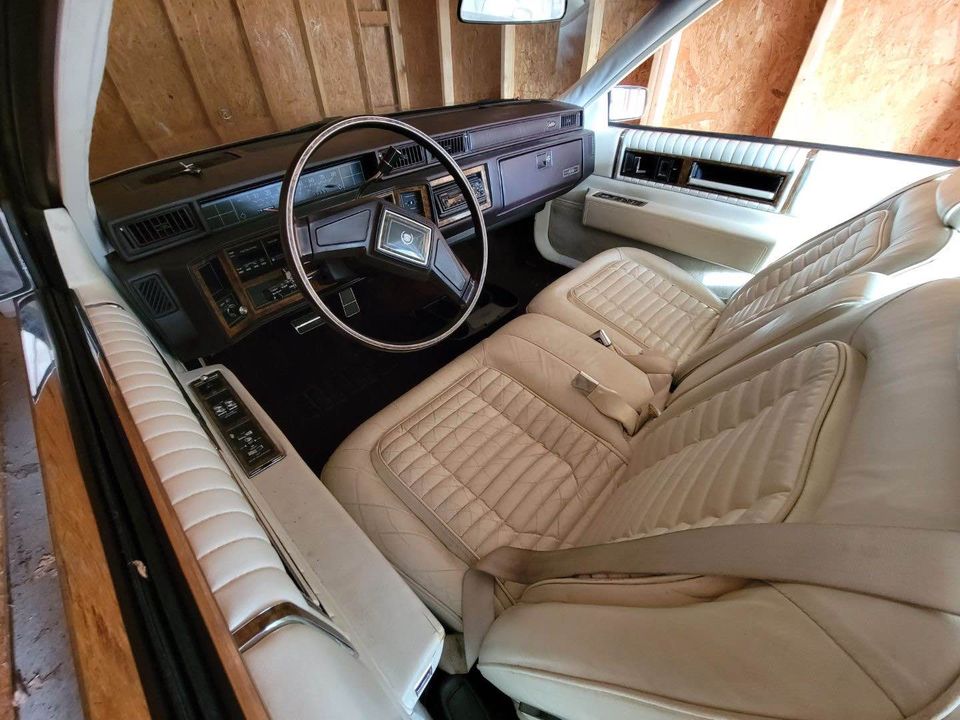
The "heather-firemist" hue and padded landau top do the blocky, bolt-upright styling no favors. At least the interior is handsome and is as cavernous as the insides of the deVille these replaced. Perhaps more so given the lack of a driveshaft hump. To that degree, these were engineering watersheds. 

Even if this car was a different color and it didn't have the silly padded top, I can't do the mental gymnastics to make the more than fair asking price seem worthwhile. As far as the engine goes, there's no shortage of zesty options available but something tells me someone will scoop this up and gut the insides and throw out the rest. 


Not unlike what we do to easter eggs. 

Saturday, April 8, 2023

1972 Cadillac Coupe deVille - The Wizard of Oz


1972 Cadillac Coupe deVilles aren't my favorite Cadillacs but they were, in my opinion, the last Cadillacs to uphold or attempt to uphold all of what a Cadillac was supposed to be before, much like Richard Nixon after 1972, things really went down hill. 

And what, exactly, was this Cadillac attempting to uphold? Frankly, nothing more than the mantle of what was once referred to as the "Standard of the World". Sounds like a big responsibility but that mantle had little more going for it than a Chevrolet Caprice that could be had at some 25- to 30-percent less. With nothing more going for it than image, this car might as well be the Wizard of Oz. And Toto was about to pull the sheet off the old man. 


Sure, you could get some niceties on a Cadillac you couldn't get on a Chevy like these rock hard leather trimmed seats, a scooch more rear passenger room due to a longer wheelbase, an insanely thirsty proprietary engine and a funky trunk closer, but not much else. Buyers did get to say they had a Cadillac and that notion still meant something in 1972 to a lot of people; my mother included. Times were about to change, though. Big time. 

1972 was the last year before the safety-bumpers came in 1973 and 1974 that along with the center post on the coupes, ruined the flow of the design. The OPEC oil embargo of 1973 made fuel-swilling Cadillac's even more pariah like and those who really "had it", were opting not for Cadillacs but rather Mercedes-Benz'. The hits just kept on coming for decades as Cadillac attempted meekly to stand down the luxury imports. 


So, what exactly made a "Cadillac" a "Cadillac" in the first place? Well, it wasn't vestigial tail-fins, sheer bulk, or a premium sticker price - it was engineering innovation. That combined with lavish styling and masterful marketing. All that and in reality, no real competition. 


Named after Antoine de le Mothe Cadillac, the founder of Detroit, an independent auto maker until bought by General Motors in 1909, Cadillac was the first manufacturer to offer interchangeable parts, electric engine starters, fully enclosed passenger cabins, "Synchromesh" transmissions, mass-produced V-8 engines, shatterproof safety glass, power steering and more. 


General Motors drive to keep profit margins at the incredible levels they were in the decade or so after World War II led to compromises in design and engineering. With Cadillac comfortably perched at the top of General Motors vaunted pricing ladder, starting around 1950, GM put Cadillac development on cruise control as many of the luxury trinkets Cadillac pioneered trickled down to lesser makes and models. 

That's fine but Cadillac all but stopped innovating. Beg to differ, but perhaps aside from sentimental lighting introduced in 1964, and that was hardly as seminal as the electric starter, name a single engineering innovation Cadillac came out with between 1950 and 1972 that changed the automotive industry for good. 


Didn't matter much to Cadillac buyers in 1972 as it was a record sales year and a Cadillac was still construed as something special although it was all smoke and mirrors. The average worker's buying power was at an all time high in the early '70's as well making a Cadillac quite affordable to the work-a-day bourgeois. 


Somewhat inexplicably, in the summer of 1977, out-of-the-blue, my mother insisted my father trade in his 1968 Ford Ranch Wagon and replace it with a Cadillac. Granted, I was delighted that she finally saw the light that we should shed ourselves of that rental-grade appliance, but I was not enthralled with her insistence my father get a Cadillac. 

I knew how silly it would look in our blue collar, working class neighborhood to go from a humble station wagon to, of all things, a Cadillac. "Look at us, we're rich now!" No, we weren't. We owned a trapping of the wealthy; we was still the same poor bunch of slobs we always was. 


I recall my mother ultimately being less than enthralled with the 1972 Sedan deVille they ended up with although I was never quite sure what she was expecting in the first place. To be showered with adulation like British royalty parading outside Buckingham Palace? To explode in orgasmic bliss each and every time she rode in it (she never learned to drive). The thrill of telling people she had a Cadillac got old real quick too. But, she got her Cadillac. 


Sunday, April 2, 2023

1974 Chevrolet Nova Hatchback - What Was Not to Love?


I've always had a soft spot for 1968-1974, two-door Chevrolet Nova's with a "350" badge on the front fenders denoting a 350-cubic inch Chevrolet V-8 under the hood and the hatchback option. These cars even looked pretty good with the battering-ram, five-mile-per-hour, government-mandated safety bumpers. Ah, such the stuff of "first-car-dreams" that went unfulfilled. 


Alas, on this $2,500 Facebook Marketplace find, the 350, which was available in three-states of tune up to a 185-horsepower barnburner, and it's partner-in-crime, it's "Turbo 350" transmission, are long gone. Judging by the rust on the frame and suspension here, looks like gone a very long time. Most of these 350 Nova's came with 145-horsepower, "350-two-barrel's", a 160-horse, four-barrel available for '74 as well. Please hold your laughter regarding the asking price for our subject until the presentation is completed. Thank you. 


Somewhat curiously, General Motors came out with a hatchback option on these cars in 1973 which was only two-model years before a fairly substantial reboot of the line for 1975. Any Nova, or any of their "clones", are tough finds these days. Hatch's rarer still. 


America's ambivalence towards hatches has always vexed me since they were oh-so-practical and, in my opinion, added a sportiness to the rear styling. Fold down the rear seat and you've 27.6-cubic feet of storage space too. More than enough room for a 19-century wicker picnic basket and lacrosse equipment. Yes lacrosse. What was not to love about a hatchback? Granny-mobile Nova four-door's? Never. Nova hatchback? Yes. Yes, please.  


The practice of platform-sharing was all but as old as GM by the time the 1970's rolled around but doing little more than festooning different names to the same cars got a jump start in 1971 when Pontiac started selling a Nova they dubbed, "Ventura". The Buick Apollo and Oldsmobile Omega came in 1973 - put 'em all together and their first letters spell-out, "N-O-V-A". 


"Nova" is derived from the Latin term, "novus", which means "new". Speaking of new, just in time for the 1973 OPEC embargo, all the Nova's all got new 21-gallon, rear-suspension compressing gas tanks. That "350" may have been cool but it was thirsty and the monster sized tank helped extend range a good 40-60 miles. Your mileage may vary, see dealer for details. 


Sales brochures for these cars lauded their manageable size as much as anything even though they were, at least by today's standards, hardly small. Classified as compacts, big-bumpered Nova's were some 196-inches long and 72-inches wide, all but the same as a 2023 Honda Accord that no one would consider a "compact car". The real upside was they were perhaps the best handling cars made in the U.S. at the time. 


General Motors replaced these neat little-big-cars for model-year 1980 with their infamous Chevrolet Citation's; Pontiac and their Phoenix, Oldsmobile their Omega, Buick their Skylark. Together their first letters spell, C-P-O-S; that mean Chevrolet Pieces of Shit? All of the CPOS', save for the Buick, came with hatchbacks.