Friday, July 28, 2023

1976 Buick Riviera - Careful What You Wish For


Ah, 1971-1973 "boat tail" Buick Riviera's - you either love them or hate them. I'm so fond of them I've reserved at spots for a 1971 or 1972 model (forget the big front bumper '73's) in my "Jay Leno Fantasy Garage". One original and unrestored the other LS-swapped up the ying-yang that still looks stock. Sigh. 


Legend has it these cars were polarizing inside GM as well as with dealerships who claimed the design too aggressive and off-putting to Buick's generally conservative clientele. Buyers apparently felt that way too as sales of the "boat tails" dropped off by roughly half of what they were prior. What to do? 


Just get rid of the "boat tail" and make the rear end more mainstream, right? That wasn't as simple as you'd think as doing just that would make the Riviera all but a LeSabre; which it essentially was albeit one with the interior of an Electra. In lieu of that, this is what they did for 1974. Careful what you wish for. 


Our subject here is a 1976 that popped up on Facebook Marketplace recently. Asking price is $8,000 which is quite the deal if this really is in the great shape it appears to be in. Personally, I much prefer a LeSabre of this vintage but that's just little ole me. Taste and armpits as they say. 


Actually, the design was inspired the tail end of an experimental Cadillac deVille and the grafting of the rear end of this car onto the Riviera was Bill Mitchell's idea. Hey, we're all human. Back in the day, GM designers mixed and matched disparate design cues and elements that may have been intended originally for one make and model but ended up on another. Google "Pontiac Banshee" and you'll see just how much of that car, that never made it to production, there is in the third-generation Corvette. 


Buick designers weren't too proud of their efforts with the updated Riviera; they claimed they did what they were told to do. 


Honestly, in a vacuum these aren't such bad looking cars - had Buick called them "Wildcat" or "Centurion" they would have been just another emissions clogged, gas-swilling, phlegmy, mid-'70's Buick. However, once Buick glued or riveted "Riviera" on them, these cars were forced to write checks their egos couldn't cash. 


Sales sputtered along at around 20,000-units sold per year between 1974 and 1976, about the same number sold as boat tails sold. Blame the OPEC gas crunch for some of that as anything with a V-8 engine suddenly became a pariah. That and the premium sticker price didn't do sales any favors either. Sales of 1974 Chevrolet Monte Carlos, a design debatably as outlandish as the Riviera boat tails, were comparatively off compared to 1973, but once gas prices stabilized, sales soared. 


Buick's designers were further hampered updating the Riviera for 1974 by limited resources. This mid-production cycle reboot had to be done as economically prudent as possible since GM was spooling up for their "Great Downsizing Epoch" they'd begin for model year 1977. There was little money to be spent on an all-new design that was going to be discontinued as soon as possible. 


My question is - why didn't Buick disguise an Oldsmobile Toronodo and call it a Riviera? That could have been a nice "stop-gap" model until the Riviera ultimately came to share platforms with the Toronado and Cadillac Eldorado in 1979. I find it hard to believe they didn't think of that. Perhaps it was simpler or more cost effective to do this instead? 


As for our '76 here, as they say in the business, "there's an arse for every seat". This will no doubt sell and to someone who may purchase it for reasons that I would never think of. 

Thursday, July 13, 2023

1985 Buick Electra (Coupe) - Trash or Treasure


The poster of the ad for this 1985 Buick Electra claims this a classic - ouch. That's like hearing a song you remember from your high school days being played on the oldies radio station. And just like not all songs from high school should be heard again, through my chipped windshield, this falls short of being a classic. Way short. 


Although, with an asking price of $6,500 and just 84,000-miles on its 38-year-old analog ticker you could do worse for the money. You could do better too; all depends on what you're looking for. First car for your teenage son or daughter you'll be ok with them beating the tar out of? Snaps to you if dropping $6,500 is akin to pocket change but if it checks out mechanically this might be something a tad more interesting for them than a ten- or twelve-year-old crossover. I'd clear that with them before you show up one day with this for them - you could be scaring them for life. As far as buying it to mothball in hopes of it appreciating one day? Well, this ain't no Buick Grand National.  

That's not to say this biggish old Buick doesn't have anything to offer or isn't historically significant. To the latter, it most certainly is with it being Buick's first full-size front-wheel driver and features rack-and-pinion steering, a port-fuel injected, transverse mounted V-6, four-speed automatic and independent rear suspension. Heady stuff in its day but only us car wonks care about such things. 


It is a big, comfortable cruiser that appears to be in very solid condition. Get it closer to five-grand and I think it bought even better. All said and done, though, to me this is just an old car and one that hasn't stood the test of time either. Aesthetically anyway. That's saying a lot too since I am a fool for coupes. 

Awkward looking now as it did back in the day when it was shinier and new, two-door cars that are less attractive than their four-door counterparts are few and far between. Subjective? I guess...but sales for these were so slow that Buick pulled the plug on them after 1987 with less than 15,000 sold. The LeSabre coupe, introduced in 1986, stuck around through 1991 accounting for less than 10-percent of LeSabre sales. No surprise then that when Buick rebooted the LeSabre for 1992, a two-door wasn't part of the lineup. 


What makes this so clumsy looking is that unlike the front-wheel-drive LeSabre coupe, this thing suffers from a dowdy, formal roof line and one accentuated with a god-forsaken vinyl top. What's more, it's windshield lacks the LeSabre coupe's degree of rake. Mind you, it's not like the LeSabre coupe, even in T-Type guise, was the second coming of the Buick GSX. 

Makes me wonder why Buick bothered in the first place if this is really nothing more than a four-door sedan with two less doors. Was it because Buick always built a two-door Electra and they felt compelled to continue the tradition? Even the Electra coupe it replaced had an elan this car sorely lacks. 


What makes a car a classic in the first place anyway? That's actually hard to define and in fairness, taste being like armpits, it's really up to the individual. Afterall, one person's trash could be another's treasure. 

Wednesday, July 5, 2023

1967 Plymouth Fury III Wagon - Are We There Yet?


Some of my earliest childhood memories involve me and my family "going on vacation" to resorts in the Pocono Mountains the last week of August coming home on Labor Day. Living a stone's throw from Kennedy Airport and traffic being what it was and still is there, we didn't go far, hence, the nearby Poconos. Seriously, the task of just getting off the Island and getting through The City could take two-and-a-half to three-hours. The traffic and being shoehorned into my father's 1961 Rambler Classic, the 125- or so mile traipses to some resort in the Pocono Mountains in northwest Pennsylvania felt as though we had driven to Europe. 


One year we stayed in our home state and traveling roughly the same distance, we stayed in a motel and partook of the amenities of several of the Catskills' staple resorts that were straight out of "Dirty Dancing"; again, we didn't stay at those resorts we just visited them. Nice to see how the "other half lived" and all. The highlight of the trip, for me at least, was a dark blue Plymouth station wagon my father rented for the trip that was just like this dark red 1967 Fury III wagon I found on Facebook Marketplace recently. Asking price is $4,500. Are we there yet? 


I couldn't have been more than five, maybe six at the time so my memories of the big Plymouth are mostly random flashes. I do recall being all alone out back waving to folks in traffic and being delighted when they'd wave back. Some did not. Perhaps they were like, "who the hell let's their kid bounce around in the back of a station wagon with a rear facing jump seat?" And with no seat belt on to boot. 


Through what I construe are adult lenses, I find it somewhat humbling to realize that the staple of familial hauling as we came to know it was not even twenty-years old when this big Plymouth rolled off the assembly line; you grow up with something you think it's always existed. Like how my twenty-something sons view the internet. "Station wagon" had been around for years before The War but they didn't really gain traction in this country until after it. 


The Big Three quickly tapped into the market potential for car-based utility\family haulers and Chrysler had a large part in pioneering them with their series of wagons across their Chrysler, Dodge, Desoto and Plymouth divisions. Their 1955-1975 Imperial division never got one. Wagons become so popular that for 1967, Plymouth had three succinct lines of them - there were these full-size Fury's in I, II and III trim levels, the somewhat smaller "Belvedere" line, can't call them truly mid-size, and the compact "Valliant". 


I can put two and two together now and surmise that big Plymouth was the impetus for my father purchasing the 1968 Ford Ranch Wagon from Hertz that would be the familial chariot of my woebegone wonder years not long after. Difference was, the rental Plymouth was equipped decadently whereas the Ranch Wagon was as bare bones as a Conestoga Wagon. Rear jump seat? Nope. Just a flat, steel floor back there. Roof rack and air conditioning? Please. 


I blame my parents both being children during the great depression for the reason why they were unscrupulous penny-pinchers. The last night of that Catskills trip they took us to an all-you-can-eat "smorgasbord". Arriving late, the place was closing but my mother was able to coerce the staff to let us eat, we were the only ones in the place. The food had the unmistakable texture and taste of stuff that had been under heat lamps for hours and in the middle of the night and by the next morning, we were all violently ill. I don't recall waving to any one in traffic on the way home the next day. That trip even longer than the trip up there due to frequent, ahem, rest stops. 


Friday, June 30, 2023

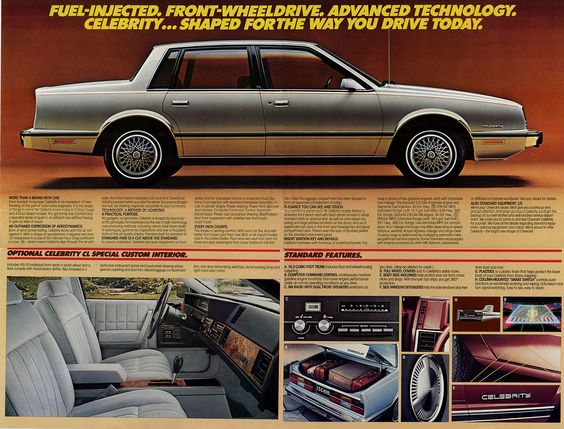
1988 Chevrolet Celebrity Eurosport Two-Door - Old Man Smell


GM fan girl I am, I did my darndest to see any positives when I first saw a magazine ad for Chevrolet's all-new-for-1982 Celebrity. It was similar to the one in this informationally dense ad is. Being 1982, more like 1981 when this was photographed, you just know the fella in this ad is "main-splaining" that his old man's new Celebrity was assembled with "robotic precision" and that "gamma rays" assisted in assembly to insure proper fitment of body panels. Gosh, do people who aren't "car wonks" really read all of this copy? And did we think for a moment these two actually own this car? 


The Chevrolet Celebrity and it's Pontiac, Oldsmobile and Buick brethren were a very, very big deal for General Motors back in '82. Set to replace GM's class-of-1978, "A-body" intermediates, the new "A-bodies" were touted at the time as being the first true, six-passenger, front-wheel-drive domestically produced sedans. They weren't GM's first foray at FWD, however. That mantle went to their kissing cousins, the infamous GM "X-body" Chevrolet Citation, Pontiac Phoenix, Oldsmobile Omega and Buick Skylark of which, since they're cousins, they shared a considerable amount of DNA with. Newsflash, that was a not a good thing. 


Acid-penned critics were less than impressed with the lot of them but in the interest of keeping ad dollars flowing through the door, they did their best to tactfully damn them with faint praise. However, come 1983, they heaped many a frothy accolade upon the Pontiac 6000 STE (Special Touring Edition)., which was the sporty version of Pontiac's version of the Celebrity. Pontiac's numeric nomenclature no doubt their attempt to ape whatever cache they believed the haughty German makes and models had in doing so. Only problem was the 6000 STE stickered at nearly $13,500 - nearly 40-percent more than what a base 6000, that few if any ever bought, went out the door for. Still, the tariff for all the STE's baubles and bits that made it a really good car, in terms of performance since it was bolted together as poorly as anything else GM built back then, was quite stiff. 


Not to be outdone, Chevrolet came with their version of the 6000 STE come 1984. Ladies and Germans behold the "Celebrity Eurosport". Thing was, much like Chevrolet SS' of yore, the "Eurosport" could be had generally as an appearance package first and foremost. Chevrolet's F41 suspension and the "HO" (high output) version of the GM 2.8-liter, 60-degree V-6 cost extra. And at the end of the day, a loaded "Eurosport" still didn't get nearly the gee-whiz stuff that made the 6000 STE special. Then again, a loaded Eurosport would run you a good 25-percent less than an STE.  


Back in the day of General Motors divisional autonomy, which even by the early-to-mid-'80's was beginning to wane to a certain degree, for 1984, Pontiac countered with a bargain basement 6000 STE. That made no sense then and even less now; that's why, reminder, kids, those who are in charge probably have no idea what they're doing. However, whereas Pontiac never offered a coupe version of the STE, they did have a two-door 6000, Chevrolet whipped up a Celebrity Eurosport two-door for us coupe aficionados. And what did we think of it? In a word, "meh" (he shrugs his shoulders).  


Well, can't fault 'em for tryin'. But, seriously, this is the best they could do? The Celebrity coupes never sold well (surprise!) and who knows, perhaps if they did add a dollop of coupe panache into the meatloaf mix it may have impacted Monte Carlo sales, which were heading south in the mid-'80's as well. 


As it was, the Celebrity coupe, all front-wheel-driving A-bodies got two-door versions, really was nothing more than a Celebrity four-door with no rear doors and the center-post moved back a scooch. The resultant remaining doors were elongated and heavy - give them five years and the hinge-pin bushings would wear out and they'd sag. Said sagging leading to difficulty closing them. My father's last car was a Cutlass Ciera two-door and you had to lift the door up by it's "casket handle" when slamming it shut. 


Throw in the F41 suspension, which meant thicker front and rear anti-roll bars, stiffer struts, and a quicker steering box and the "High Output" V-6, which by 1988, the year of my Facebook Marketplace find here, had port-fuel injection and a tuned intake runner, you had a pretty decent transportation conveyance. At least in terms of a mid-1980's Chevrolet sedan. Buy it, drive it into the ground and dispose of it. Which makes the fact this '88 is even still around somewhat remarkable. 


Coupe fanatic I am, I never gave these a second glance back in the day because I simply didn't find them attractive. And us "coupers", my term for those us who consider anything with four-doors verboten although we do love station wagons, are nothing if at the end of the day, grossly shallow and superficial. A coupe must look good, if it doesn't, forget it. What's the point? 


1988 was a transition year for Chevrolet and their intermediate coupe offerings as the Monte Carlo was put on hiatus after 1987 and the Celebrity two-door's air-apparent, the Lumina coupe, wouldn't be in showrooms until 1990. Thus, for 1988, if you wanted an intermediate Chevrolet two-door, this was the only thing available to you. 


Our pristine '88 here hails out of bucolic Akron, Ohio and has just 42,500 miles on its 35-year-old, analog ticker. Asking price is a fairly breath-taking $6,995. Poster of the ad claims it's a "classic" which is amusing. Can't fault them for saying that, of course. Knowing better and having lived through the ignominy of these cars, in any guise, two-, four- or even five-doors, all this is to me is an overpriced old car. Bet these seats have that GM, "old man" smell too. 


"Old Man Smell" that curious mixture of Aqua Velva, wet dog and cigarette butts. 

Wednesday, June 28, 2023

1979 Chevrolet 3.3-Liter V-6 - But Wait There's More


Newsflash - people try to sell the craziest things on Facebook Marketplace. Take this 3.3-liter, Chevrolet V-6 for instance. While its $275 asking price is fair, what would someone do with it? Maybe I could swap it onto my 38-inch, Craftsman tractor. I would if I could. Some people do nuttier stuff than that. 


Chevrolet came out with these little engines in 1978 and stuffed them in their newly downsized, intermediate Malibu and El Camino; this came out of a 1979 El Camino. Making just 95-horsepower and 160-foot pounds of torque for 1978, 94 and 154 respectively for 1979, Chevrolet boasted it made more horsepower and torque per cubic inch or liter than the inline six it replaced. How's that for spinmeistering. What's more, they claimed it shared many "design efficiencies" with the seminal Chevrolet small block. 


Based on the seminal Chevrolet "small block" V-8, this 90-degree V-6 shared the SBC's stroke but had a teeny-tiny bore. To that extent it's a unique engine. With regards to "design efficiency", many SBC  parts bolt onto and into it. For 1979, Chevrolet added two-cylinders to the block creating the almost equally unknown or forgotten, Chevrolet 267-cubic inch V-8. 


Right into the teeth of the second gas crunch, Chevrolet pulled the plug on this for 1980; the 267 V-8 slogged on through 1982. They replaced this with a bored out version displacing 229-cubic inches (3.8-liter). Making all of ten more horsepower, its calling card was its significant increase in torque although anything with that mill would hardly be considered "powerful". Then again, my little tractor most certainly would be. 


But wait, there's more. Many believe the late, great Chevrolet 4.3-liter V-6 is a Chevy 350-cubic inch V-8 with less two cylinders. That might be mathematically correct, but in reality, the 4.3 is a larger bore 229 V-6. 

Saturday, June 24, 2023

1997 Honda Prelude - Don't Be Like Me. Drive a Honda.


Back in the day, every time I'd drive a Honda I'd always ask myself, "why don't I own a Honda?". That's not so much the case anymore as the canyon between domestic cars and imports has narrowed significantly; just as the automobile as we know it is on the endangered species list. Back in the fall of 1996 I test drove one of these all-new for 1997 Honda Preludes and was enthralled by it - even if it had "only" a 2.2-liter, inline-four albeit one packing 195-horsepower. I opted instead for a brand new Chevrolet Monte Carlo LS and while that car never let me down and I was quite happy with it, from a visceral, seat-of-the-pants perspective, my pokey Monte Carlo was no match for the little Prelude. 


My reasons for going with the Monte Carlo were sound if not somewhat juvenile and\or misguided. I'm frustratingly brand loyal, I liked the lines of the Monte Carlo better, it had a real back seat that folded down and, probably most importantly, I had a wad of cash sitting on my GM Mastercard I could use as a down payment. And while I now wax somewhat nostalgically over the Monte Carlo, it has more to do with reflecting on a tumultuous and rewarding time in my life more than about the car itself that I found, ultimately, rather bland. That's why during one of my recent new car searches, while I find on occasion Monte Carlo's of that vintage, I pass right over them; nothing to see, been there done that. Meanwhile, I'm stopped dead in my treads over a solid looking Prelude like this 154,000-mile Facebook Marketplace find. Asking price a cool $9,000. A '97 Monte Carlo LS in this shape with this low mileage might go for half that. Maybe $5,500. 


I used to look at Honda's like I'd like look at quiet, working-hard-as-a-beaver over achievers in high school; they don't look like what they are. Meanwhile my Monte Carlo was the beer guzzling, handsome jock who got all the girls but who really wasn't any good at anything. Not particularly awful either but, metaphorically, you know who now has the waterfront, 5,000-square foot home and who doesn't. 


Preludes were hardly Honda's best selling models through five generations made between 1978 and 2001. The best selling of them being the second-gens made between 1982-1987, Honda moving on average maybe 60,000 of them a year back then; hardly Accord numbers on which Preludes were loosely based on. Ford sold more than twice as many Mustang's through that time period too. Granted, the Mustang was substantially less expensive even in "5.0" guise, but you got what you paid for. 


This '97 here was part of the fifth-generation of Preludes and was packed with a ton of gee-whiz, state of the art engineering\technology that if it weren't on a Honda, I'd run screaming from it. Seriously, can you imagine how a GM version of Honda's stability enhancing yaw-control, what they called "Active Torque Transfer System" would age? Newsflash - it wouldn't. 


Don't be like me and have a life full of (automotive) regrets - drive a Honda. 

Friday, June 23, 2023

1987 Pontiac Firebird Trans Am - It Takes Guts to be Different


This 1987 Pontiac Firebird is the funkiest thing I've seen since I stumbled across that oh-so-goth twin-turbo, Ford V-10 powered Cadillac Fleetwood earlier this year. Oh, it may not look it, but this is one special homemade hot rod. 


And that there is why. Someone swapped out the Chevrolet LG4, 5.0-liter V-8 this was born with for a turbocharged, Buick 3.8-liter V-6. This engine most famous for powering 1985-1987 Buick Grand National's and the 1987-only, Buick GNX. Obvious too that this car was originally yellow; looks much better in black in my opine. Yours may vary, see dealer for details. 


If you're like, "why would anyone do that", well, you don't get this. In this day and age of all but ubiquitous "LS-swaps", something like this is quite refreshing. And with a Facebook Marketplace asking price of just $6,000, I may need to be restrained. It's down near Dayton which is a good three hour haul for me from up here in god-forsaken Cleveland, and I do have better things to do with my time than take a six-hour road trip for something I really have no intent on buying. I have close friends in that area I haven't seen in a while; would be nice to see them and kick the turbo on this thing. 

      
Pontiac Firebird and Trans Am cognoscenti know that this swap isn't that far out of the ordinary. Pontiac offered Buick's turbo V-6 on a limited run of 20th-anniversary Trans Am's for 1989. Albeit, one that was modified to be, ahem, "more reliable". John Davis and his Motorweek '89 team clocked it going from zero-to-sixty in 5.4-seconds and "melting the quarter mile" in 14.2. That's rather mundane if not ho-hum today, but back in 1989 that was seriously quick. 


Some Trans Am aficionado's claim the 20th-anniversary T/A with the Buick turbo V-6 could do zero-to-sixty in 4.6- and the quarter mile in 13.4-seconds. Whose ever numbers are correct, either way, the 20th-anniversary turbo T/A was faster in a straight line than a top-of-the-line Firebird GTA (Gran Turismo Americano) with a slightly detuned Chevrolet Corvette L98, 5.7-liter V-8; 6.5-seconds zero-to-sixty and 15-seconds in the quarter mile. It even smoked an L98 Corvette that could only muster 6.6-seconds zero-to-sixty and a 14.9-second quarter mile. 


Other Pontiac pundits will recall the "Turbo Trans Am" of 1980 and 1981 infamy. Pontiac eschewed the Buick V-6 that time around using the same Garret turbocharger Buick used to boost their 4.9-liter V-8. Fastest one of these could do zero-to-sixty was 9.0-seconds, quarter-mile in 17.2. Yikes, I know. Even Smokey and The Bandit II was a forgettable - that was the one with the elephants. Best I can say about "Smokey II" was it wasn't "Smokey III". The bulge on the hood was to clear the turbo.


My concern with this thing is what to do if something goes wrong on it - gosh, who would you take it to? I guess a speed shop might be able to, but the wonky engine might explain the relatively low asking price for this. I mean, it's hard enough these days to find a mechanic who can work on old cars let alone something like this. Still, I applaud the person or persons who dared to be different. That takes guts. 
 

Thursday, June 22, 2023

1968 Chevelle Malibu - Like Father Like Son


My older son treated me to a round of golf this past Fathers' Day Weekend and much to our delight, this lovely 1968 Chevelle Malibu was in the parking lot of the golf course. He parked his 2017 Camaro a couple of spots up from it and we both went a bit weak in the knees the closer we got to it. I guess there is is some truth to the adage, "like father like son". 


Might be cliched to be a fan of these cars but seeing my son's reaction to this one, there is something to them.  Even in retina searing "Butternut Yellow". Although my wife didn't join us, I know she likes them too although I'm not so sure she'd approve a purchase order for anything yellow that wasn't a banana. 


Those of a particular vintage may be familiar with the "Chevelle" moniker but few may know exactly what one was. In short, any intermediate Chevrolet made between 1964 and 1977 was a "Chevelle". The origin of the name the subject of conjecture. Some say it's a mashup of Chevrolet and "gazelle", a gazelle a somewhat smaller impala although most people use the terms gazelle, impala and even antelope interchangeably. Others say that "Chevelle" was meant to invoke a smaller Chevrolet; the "Chevette" nameplate was rumored to be in play at first too. 


Not that there's anything "small" about this car as its certainly "full-size" by today's standards, but everything being relative, it's got nothing on the full-size dreadnaughts of the day. The new-for-'64 Chevelle was dimensionally all but identical to the seminal 1955 Chevrolet and bridged the literal huge gap between the compact Chevy II and the seemingly always getting larger Impala. Our '68 here is roughly three-inches longer, nearly two-inches wider, all but two-inches lower and a whopping 800-pounds heavier than a 1964 Chevelle. 


The near half-ton of extra weight certainly doing our subject's 327-cubic inch, "Turbo-Fire" V-8 any favors. I wasn't about to pop the hood to check which one of the three 327 engines this might have had with 250-, 275- or 325-gross rated horsepower. Safe to say, at least it doesn't have a "307" or the "Turbo-Thrift", inline-six. I don't like taking pictures of interiors but it this has a column shifted automatic (2-speed Powerglide) and bench seat. This is no muscle car. 


Chevelle's came in four different guises or trim levels for 1968 on two different wheelbases. Our Malibu coupe here rides on a tidy 112-inch wheelbase, four-door models and station wagons rode on 116-inch wheelbases. "Above" the Malibu, which was also available as a pillared and hard top four-door, was the SS396 Sport Coupe and convertible, below it the entry-level "300" series. There was also a luxury-themed "Concours" model that was only available as a four-door hard top. Chevelle wagons for 1968 were all called "Nomad". Sigh. So many Chevelle's and only so much space in the garage. 


Chevrolet riveted or glued "Chevelle" to their intermediates for only fourteen model years but I think it deserves a plaque in the Chevrolet Hall-of-Fame right up there Impala, Caprice, Monte Carlo, Corvette and Camaro. Malibu too, I guess. Chevrolet intermediates were dubbed "Malibu" after GM downsized all their mid-sizers for 1978; those stubby little cars survived through 1983. 


Subsequently, Chevrolet affixed "Malibu" to a series of compact and intermediate sedans starting in 1997 and is still doing so currently. The most recent Malibu, while actually a fine, modern  transportation conveyance, not exactly the stuff dreams are made of like our '68 here. Fore!